
Dokly
Stop wrestling with documentation. Start shipping it.
Hey IH 👋
I'm Gautam, solo founder of Dokly — a docs platform I've been building for 6 months. Posting here because I'm at a real decision point and could use the kind of honest input this community is known for.
What I built
Dokly is a docs platform — think Mintlify or GitBook, but for people who don't want to wrestle with Git, YAML, and deploy pipelines. Sign up, write in a Notion-like editor, your docs site is live in 5 minutes with HTTPS on a subdomain. Auto-generated llms.txt so the docs are AI-discoverable out of the box for ChatGPT, Claude, Perplexity, Cursor.
Pricing: free tier, Pro at $19/mo, Team at $49/mo. Competitors are $150-300/mo.
Where I am
Product works, I use it daily
Handful of free signups
Zero paying customers
5 Twitter followers
Blog ranking for nothing yet
No email list, no community, no network in dev tools
Where I'm stuck
Honest version: I have no signal in either direction. No customers means no feedback. I genuinely can't tell if:
The product is good and I just suck at distribution
The product is fine but the market doesn't want another docs tool
I picked the wrong wedge inside a real category (Mintlify raised $25M, GitBook $25M — demand is clearly there, but maybe "cheaper and simpler from a solo founder" isn't the wedge that wins)
What I've tried
SEO — built two free tools (llms.txt generator, README generator), publishing blog posts. Realistically 6-12 months before this pays off.
Build in public on Twitter — got me no followers, no paying customers
Free tier — people sign up but don't convert
What I haven't tried (because I genuinely don't know how)
Cold outreach
Active community participation in dev-tool spaces
Partnerships / integrations
Anything resembling real sales conversations
Where I need help from this community
How do you get product feedback when you have no users? I'd take 10 brutal critiques over 10 signups right now. What's worked for you when you had zero distribution?
For solo founders who've gone up against well-funded competitors — what's the real move? Not the "find your niche" answer everyone gives. The actual thing that worked. Did you win a specific persona? A geography? A use case the incumbents ignored?
The decision question: If you were 6 months in with zero paying customers, what's the signal that would make you keep going vs. shut it down? I want to make this call with something better than vibes.
I'm an engineer. I've shipped code my whole career. I've never marketed anything. I'd rather hear "kill it" from people who've been here than keep guessing alone.
Roast the product, the positioning, the strategy — whatever. I can take it.
Thanks 🙏
— Gautam (@gsharm_ on X)

Small update on Dokly (hosted docs platform, Mintlify alternative).
Just shipped a "Generate with AI" button in the page editor.
You type a short brief — "API reference for /users, cover auth and
rate limits" — and it drafts a full MDX page using the real Dokly
components (Callouts, Steps, Tabs, syntax-highlighted code).
The important bit: it generates into the component library, not
around it. No generic markdown blobs. The output drops into the
editor as editable MDX, so you always own the final version. AI
handles the blank page, you handle the judgment.
The following is an example of AI generated page. It is made up of all Dokly components.
How it's priced: credit-based, tight free tier (15 credits = ~1
full page to try it), then $19/mo (Starter) / $49/mo (Pro) for real
usage. Calibrated so even a heavy Pro user stays at ~85% margin.
What's next:
- GitHub import (generate a docs site from your repo)
- Tightening the system prompt so vague briefs don't produce
confident-but-fabricated sections
- Better credit UI so users see the meter tick down
Give it a spin if you're curious: [dokly.co](https://dokly.co)
Feedback very welcome — especially from anyone who's priced an AI
feature before. Still not sure "credits" is the right mental model.
TLDR: Started a new job. Managing that plus house commitments has slowed progress significantly. Only 1 signup this week. But I've had a key realization: distribution > product. I believe in what I'm building. Showing up every day.
One signup this week. Slow, but still moving.
The Reality: New Job + Side Project is Hard
Let me be real about what's going on.
I recently started a new job. The learning curve has been steep. Between that and house commitments, finding time for Dokly has been genuinely difficult.
I'm not complaining—this is the reality of building something on the side. Most indie hackers aren't full-time founders. We're squeezing in work between jobs, family, and life.
Some weeks you ship features. Some weeks you ship one tweet. This was a one-tweet kind of week.
The Realization : Distribution is King
Here's what I've finally internalized:
Distribution > Product
I spent 6 months building Dokly. Visual MDX editor. BYOK AI writing. Auto-generated llms.txt. Custom domains. All the features Mintlify charges $300/month for, at $49/month.
The product is solid.
The problem? Getting people to try it.
Mintlify raised $20M. They sponsor every conference. They're in every "best docs tools" listicle. GitBook has 10 years of SEO. ReadMe has an enterprise sales team.
I have a laptop and a Twitter account.
No amount of features will fix a distribution problem. I've been playing the wrong game.
What I Shipped This Month
I'm not adding new features right now. Just refining what exists and focusing on distribution.
Feedback Widget
Every dashboard page now has a help widget at the bottom.
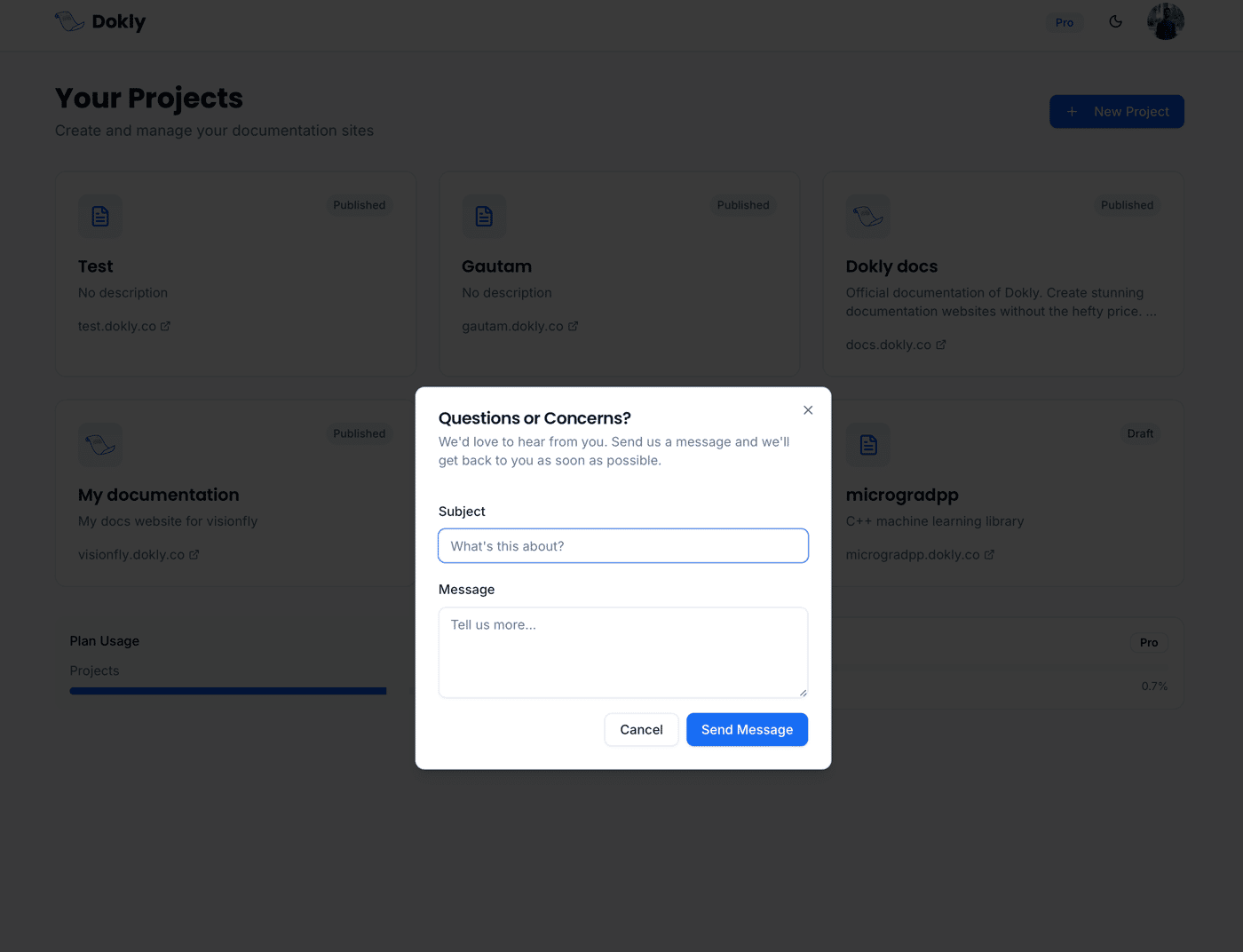
Why it matters:
- Direct signal on which pages need work
- Users can leave comments without leaving the page
- Helps prioritize what to fix
Small feature. Took maybe 3 hours. But it's the kind of thing that compounds—every piece of feedback is a free product roadmap.
BYOK AI Writing (Why I'm Proud of This)
Most documentation platforms charge insane markups for AI features. Mintlify, GitBook, others—they're charging $50-100+/month extra for AI writing that costs them pennies.
Dokly does it differently: Bring Your Own Key (BYOK).
You connect your own OpenAI API key. You pay OpenAI directly (usually $5-20/month for heavy usage). No markup. No "AI tier" upsell.
Why this matters:
Transparent pricing (you see exactly what AI costs)
No vendor lock-in on AI features
Works with GPT-4, GPT-4o, whatever you want
You control your data
I genuinely think BYOK is the right model for AI
4 Blog Posts Ready
Finished these comparison posts:
Knowledge Base Software 2026 (301K monthly searches, KD 15)
Docusaurus vs Mintlify
README vs GitBook Alternatives
Technical Writing Examples
SEO is slow. But it compounds. These posts will keep bringing traffic for years.
Why Not Paid Ads?
I've thought about it. But running paid ads as a solo founder is expensive and risky.
Google Ads for "documentation tools" = $5-15 per click
100 clicks to maybe get 2-3 signups = $500-1500
No guarantee any convert to paid
When you're bootstrapped, burning $500 on an experiment that might not work is a big deal.
For now, I'm betting on content. SEO takes longer but the economics are better—write once, rank forever.
Maybe I'll test ads eventually. But not until I have more data on what converts.
The Competition Reality
Mintlify : $20M raised, YC network, conference presence
GitBook : 10 years of SEO, brand recognition
ReadMe : Enterprise sales team, established
Docusaurus : Free, Facebook backing, huge community
Me: Solo founder. Bootstrapped. Building on the side.
I charge $49/month for what Mintlify charges $300/month. Same features. Better price.
But price doesn't matter if nobody knows you exist.
The Plan : Distribution Mode
I'm not adding new features. The product works. Now it's about getting it in front of people.
What I'm doing:
SEO content - 2 blog posts per week targeting comparison keywords
Twitter daily - Building in public, sharing what I learn
Refining, not building - Polish what exists instead of adding more
Talking to users - That 1 signup this week? I'm going to learn everything about why they signed up
What I'm NOT doing:
- Adding features nobody asked for
- Chasing shiny objects
- Pretending I have more time than I do
I Believe in This
I know this sounds like cope, but I genuinely believe in the product.
Documentation tools are overpriced. $300/month for docs is insane for most teams. There's a real gap in the market for something that's:
- Beautiful (like Mintlify)
- Easy to use (no Git required)
- Affordable ($49/month, not $300)
Dokly is that. The product-market fit is there—users who try it, stay.
The only missing piece is distribution. And that's a solvable problem.
Showing Up Every Day
The plan is simple: show up every day.
Can't outspend Mintlify. Can't out-network YC companies. Can't quit my job to go full-time (yet).
But I can be consistent. Write content. Tweet about what I'm learning. Talk to users. Ship small improvements.
Compounding works if you don't quit.
Follow the Journey
I'm trying to tweet every day about building Dokly, the docs space, and indie hacking in general.
If you want to follow along: [@gsharm_](https://twitter.com/gsharm_)
Not promising wisdom. Just honest updates from someone figuring it out in public.
The product: [dokly.co](https://dokly.co) - Documentation platform with visual MDX editor, BYOK AI writing, $49/month instead of $300/month.
Happy to answer questions about the stack (Next.js, Supabase, Vercel), the docs space, or just chat about building on the side while working full-time.
Hey IH,
Just shipped AI writing features in Dokly (my documentation platform). But instead of charging extra like everyone else, I did something different: BYOK (Bring Your Own Key).
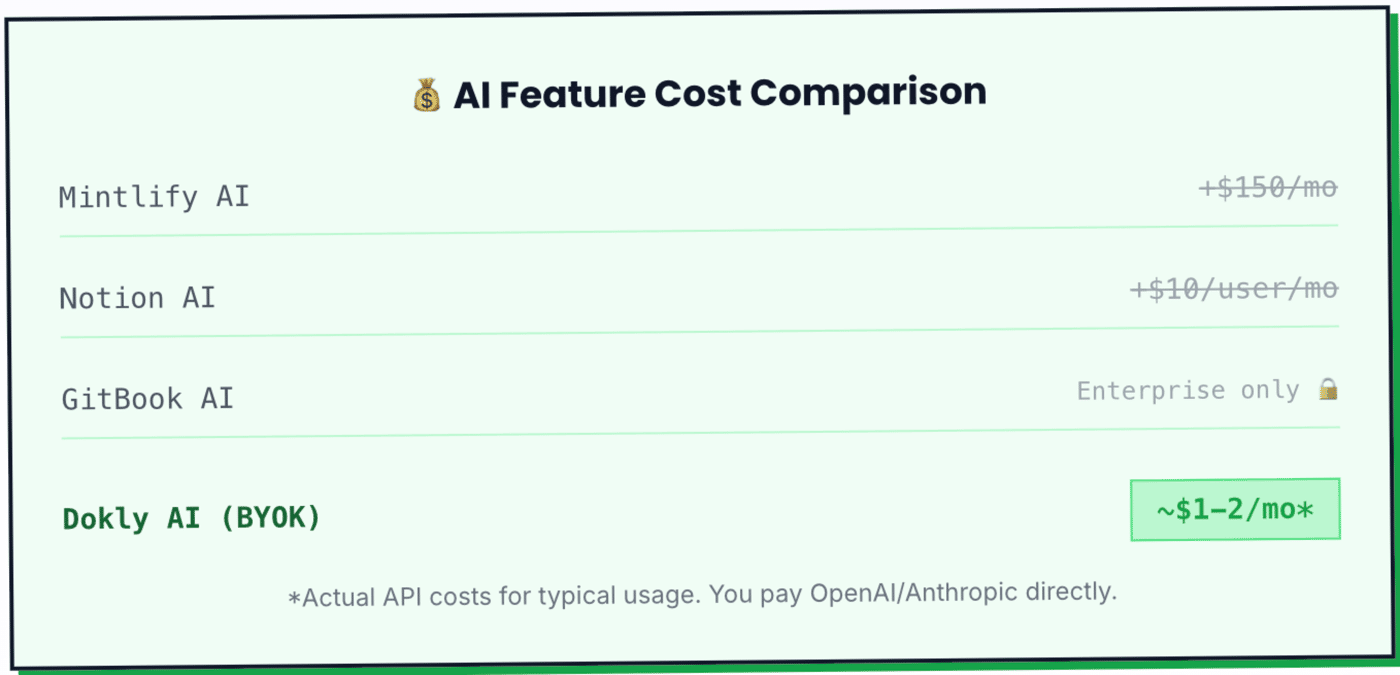
The problem with AI pricing:
Every docs platform is adding AI now. Look at what they charge:
- Mintlify: +$150/month for AI features
- GitBook: Enterprise only
- Notion: +$10/user/month
These companies are reselling OpenAI/Anthropic API calls with a 50x markup.
The math:
Let's say your team makes 500 AI requests/month (improving text, expanding sections, fixing grammar).
With Mintlify: $150/month = $0.30 per request
With BYOK using GPT-4o-mini: ~$1-2/month = $0.003 per request
That's $1,776/year in savings.
How BYOK works:
1. Plug in your OpenAI or Anthropic API key
2. Use AI features in the editor (improve, expand, simplify, fix grammar)
3. Pay OpenAI/Anthropic directly at their rates
4. No middleman markup
Your key stays encrypted. We never see it in plaintext.
Why I built it this way:
I'm bootstrapped. I could've added "AI tier" at $50/month and padded revenue.
But that felt gross. GPT-4 and Claude are already great at technical writing. Why charge $150 for something that costs $2?
BYOK is the honest approach:
- You pay actual cost
- I don't profit from your usage
- Everyone wins
The features:
Select any text in your docs:
- ✨ Improve Writing - makes it clearer, more professional
- 📝 Expand Content - adds examples and detail
- 🎯 Simplify Text - technical → readable
- 🔧 Fix Grammar - instant cleanup
Works with OpenAI (faster, cheaper) or Anthropic (better at nuance).
Try it:
Dokly Pro is free for 14 days. AI features included, just add your API key.
Happy to answer questions about the implementation or the decision.
The launch
Launched Dokly (https://www.producthunt.com/products/dokly) on Product Hunt this week. It flopped.
No viral moment. No surge of signups. Just me refreshing the page hoping for upvotes that didn't come.
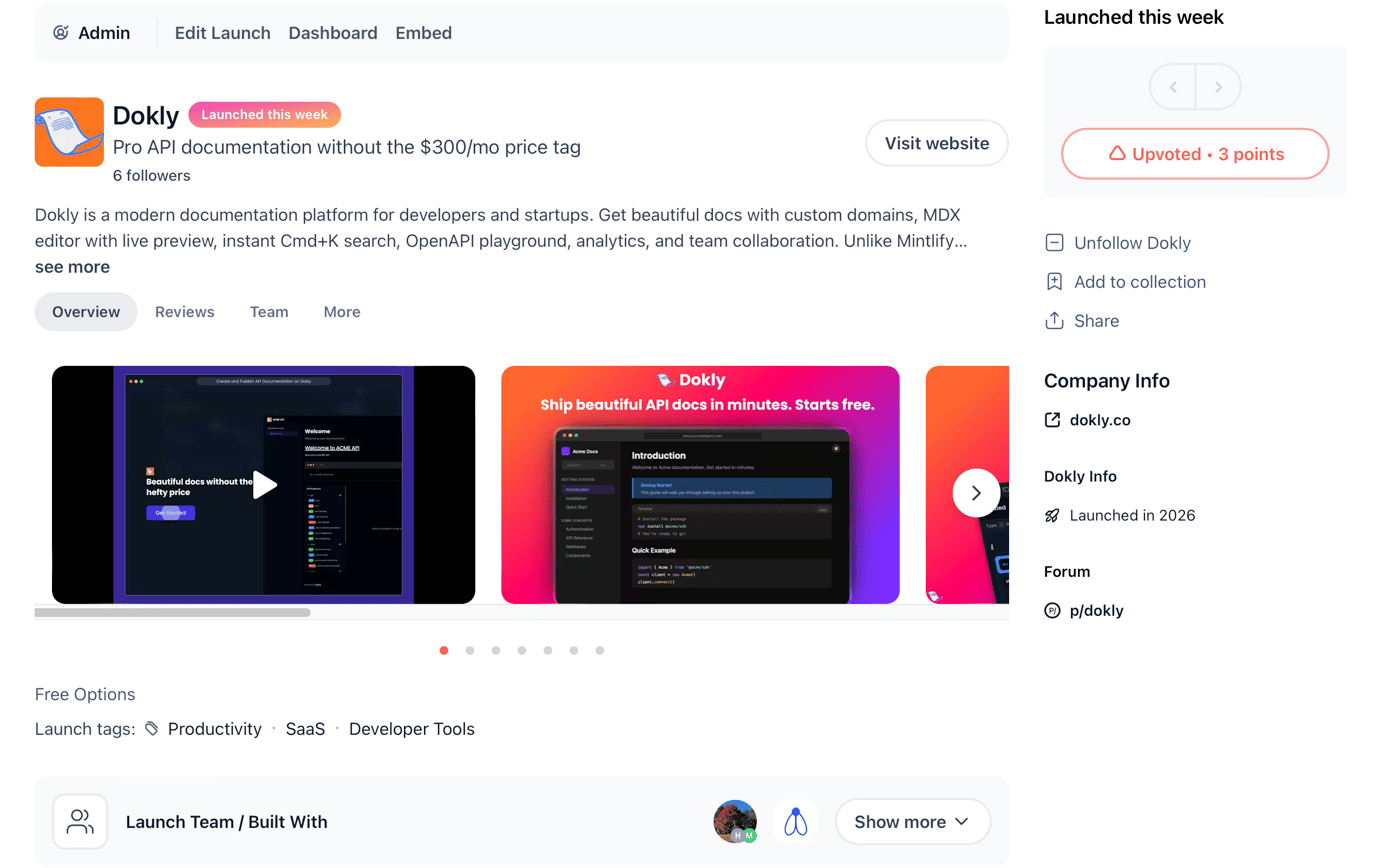
What Dokly is
A documentation platform for SaaS products. Think Mintlify/GitBook alternative. You sign up, get a subdomain (yourproduct.dokly.co), write MDX docs in a browser editor, and get a live doc site instantly.
Why I'm not upset
Honestly? I don't have feature parity with the big players yet. Launching on PH was probably premature. Mintlify has years of polish. I have a few months of nights and weekends.
What's next
Changing strategy. Instead of hoping for viral distribution, I'm going direct.
This week I'm reaching out to indie hackers building API products and dev tools - people who clearly need docs but haven't set them up yet. Offering free Pro access in exchange for feedback.
If you're building something that needs documentation and want to try Dokly for free, please email me at hello@dokly.co.
The hard part
I work a full-time job. This is evenings and weekends only. Plus I am preparing for an exam so right now I am just able to give it few hours on the weekend.
Some weeks I ship features. Some weeks I'm too burnt to open VS Code. Progress is slow but it's still progress. Right now, shipping features is not the priority, getting noticed is.
Not complaining - just being honest about the constraints. If you're in the same boat, you know what I mean.
This week's focus
- Outreach to 10-15 qualified founders
- Get 3-5 people actually using the product
- Collect feedback on what's missing
Shipping features is easy. Getting people to care is the hard part.
Building in public because accountability helps. If you've gone through a failed PH launch and bounced back, I'd love to hear how.
-
1
Congrats on the launch, looks solid. How are you currently thinking about acquiring early users and gathering feedback?

Hey IH! 👋
Quick update - Dokly is live on Product Hunt today: https://www.producthunt.com/products/dokly
But honestly, I wanted to come back here first to say thank you.
After my last post, I got some really solid feedback on the landing page. A few of you pointed out it looked too "AI-polished" and generic. You were right.
So I went back and rewrote the whole thing. New headline ("Ship docs, not invoices"), added my actual photo and story, made the pricing comparison way more prominent, and gave it more of that scrappy indie feel instead of trying to look like a VC-backed startup.
The TL;DR on Dokly: It's a Mintlify/GitBook alternative for API docs. Same features, $49/mo instead of $300/mo. Or free forever if you're just getting started.
If you have a sec to check out the PH launch, I'd really appreciate it: https://www.producthunt.com/posts/dokly
And if you have more feedback on the new landing page (https://dokly.co), I'm all ears. Still iterating.
Thanks for being the most helpful community on the internet. 🙏
– Gautam
-
1
Looks great, I just signed up! I think you have built out a lot of the great features needed, but for me personally I think you have to focus on design a little bit. In my opinion, I want my docs to look super top-notch design wise to give customers that "luxury" feel with software
-
1
Thanks for signing up!
Yeah I hear you. I am trying to improve the design and ultimately want to make everything super customizable for the user. Just want to get the basics right and go from there. I would be super grateful if you can give it a go and give me feedback. I am more than happy to extend you a pro membership for as long as you want :).
-

Alright, quick update for anyone following along.
Launched Dokly publicly yesterday. Ran some ads, posted on Reddit, did the whole thing.
The results:
Decent traffic to the site
0 signups
Yeah.
What I did:
Reddit posts on r/SideProject and a few other subs
Some paid ads to test the waters
Posted in a few communities
People clicked. People looked around. Nobody signed up.
How I'm feeling:
Honestly? Pretty dejected. You spend months building something, finally put it out there, and then... nothing. That silence hits different when you're solo and there's no team to share the disappointment with.
But here's the thing:
I know this is how it goes. First launch almost never works. The product isn't the problem (I think). The messaging might be. The targeting probably is. Maybe the landing page doesn't communicate value fast enough. Maybe I'm reaching the wrong people.
I don't know yet. That's what I need to figure out.
What's next:
Actually talk to people instead of just broadcasting
Figure out where devs who need docs actually hang out
Maybe the free tier is too limited and scares people off?
Keep shipping improvements anyway
I'm not going to pretend this doesn't suck. It does. But I've also read enough IH stories to know that the people who make it are the ones who stick around after days like this.
Long way to go.
If anyone's been through similar first launches and figured out what actually worked, I'm all ears.
-
3
This is the most authentic and universal startup experience there is. That deafening silence after the first public launch is a rite of passage. Congratulations—you've now leveled up from "builder" to "iterative problem-solver."
You're 100% right to suspect messaging and targeting. Traffic without conversion is a classic sign that you're speaking the wrong language to the wrong crowd. Your product likely solves a real problem, but the people who clicked didn't instantly see their pain reflected in your copy or believe you were the solution.
Your "What's next" list is gold. Especially "Actually talk to people instead of just broadcasting." Do that immediately. Find 5 developers who should need docs and interview them about their current process. Don't mention your tool at first. Just listen.
A few tactical thoughts based on your post:
"Free tier too limited?" Possibly. Could it feel more like a trial than a free plan? Consider a temporary "Unlock all features for 30 days" launch offer to remove friction and get critical early users in the door.
Landing Page Autopsy: Does your headline state the user's biggest frustration with documentation, or does it just describe your product? People buy aspirin, not vitamins.
Targeting:
r/SideProjectis full of builders launching their thing, not necessarily looking for new tools. Where do developers go to complain about writing docs? Find those threads, listen, then engage helpfully.
The only failure now would be to stop. You've built in public, now learn in public. Share what you discover from talking to people. That shift from "Here's my thing" to "Here's what I'm learning about your problems" is where the real connection starts.
You're in the trenches. This is where founders are made. Keep going.
-
2
Damn good advice
-
1
Thanks for this awesome comment.
1. Just gave everyone 14 days pro subscription. You are right. People need to see the features before agreeing to pay.
2. Yeah good point. My positioning has always been docs that are cheaper than my competitors. Maybe I need to focus more on what I deliver rather than focusing on affordibility. That's up to my users to decide.
3. Yeah realized that the hard way. But learned a lot from this experience.
Not stopping at all. This just gave me more fuel to double down on my efforts :).
-
1
Love this model
As someone in the painting industry, especially serving clients searching for Painters in San Antonio, keeping costs lean matters. BYOK makes total sense—why pay inflated AI markups when you can use it at real API cost?
Transparent pricing builds trust, just like in painting. Respect for choosing the honest route.
-
1
I am getting close to this point. And it does terrify me a bit. But hopefully things go well.
-
2
You got this!
-
-
1
Been there. First launches rarely convert.
What channel brought the most qualified traffic, not just volume? That’s often the clue. I am curious which platform you advertised on. -
1
Oof I really feel this. That “people clicked but nobody signed up” silence is uniquely brutal, especially when you’ve been carrying the whole thing solo for months. You’re handling it with a lot of clarity and honesty, though, which already puts you ahead of where most people are after Day 1.
One thing that jumped out at me is your instinct that it’s probably not the product, but the messaging. That’s very often the case. You might find the StoryBrand framework helpful here. It forces you to make the user the hero, clearly name the problem they feel, and show how your product helps them win quickly, without asking them to work too hard just to understand the value. A lot of dev tools fail not because they’re weak, but because the landing page answers what it isinstead of why the visitor should care right now.
When someone lands on your homepage, can they immediately see what painful problem in their day gets easier in the next 5 minutes if they try Dokly — or do they have to think like a builder to get it?
You’re absolutely right that talking to people next is the move. This post alone shows you’re doing the hard part: staying in the game after the first punch. Rooting for you! Day 1 is rarely the story people tell at the end.
-
1
Been there! That first silent launch hurts more than people admit.
One thing worth sanity-checking early: 0 signups with traffic usually isn’t a “marketing” failure yet, it’s a clarity or friction issue.
When someone lands, they’re subconsciously trying to answer three things very fast:
– what is this actually for?
– is it meant for someone like me?
– what do I get before committing?If any of those feel fuzzy, people don’t reject the product, they just don’t act.
Before changing channels, I’d try watching a few people react to the page cold (even friends). If they can’t explain the value in one sentence after 5 seconds, that’s usually the first lever.
Respect for shipping publicly though, most people never even get this far.
-
1
This resonates deeply. I'm a solo dev from Japan with 24 iOS apps, and the silence after launch is something I know too well.
Your point about "broadcasting vs actually talking to people" is the key insight here. I spent months localizing my apps into 35 languages thinking that would drive downloads. It didn't. What I should have done was exactly what you're planning - genuine conversations, not just announcements.
One thing that helped me reframe: Day 1 data tells you nothing except that you shipped. The real signal comes from the conversations you have in the next 2-3 weeks.
Keep building in public. This kind of transparency is exactly what makes IH valuable.
-
1
Thanks for sharing this transparently.
It’s striking how often traffic exists, but no decision happens on the other side.
-
1
I also encountered the same situation. The product I just released, Qibanhub (https://www.qibanhub.com), has very few users and is scattered. I post too many external posts and worry about being blocked or deleted by the platform. Cold start is always difficult, but you have to be shameless to find users for your own products and your own children. No matter how hard it is, we still have to maintain it well so that it can survive this period and slowly grow naturally.
-
1
I know how frustrating that can be but I think you are targeting the wrong subreddit. My opinion about reddit could be really biased since I am resenting them for banning by 12 years old account with lots of karma but I have noticed their audience convert poorly with ads. They are hardliners . There's the bots issues too.
I don't know how you validated the idea but I think you are up to some real deal, it's a nice product. You just have to build your distribution now and perhaps try to find a better positioning, a small group of people that'd live on your product all day.
You can solve positioning issues by making ad variations with so much variation like, virtually different positioning. Doesn't have to be an ad, could be free posts on Quora, indiehackers, medium, YouTube, or just go for meta ads, track the source whose audience stayed longer, did more clicks or signed up. That's the audience you should be talking to.
I have also found that products like yours do much better on viral platforms like tiktok, especially when you find a way to bundle 'AI' term into the marketing/promotional texts.
Goodluck!
-
1
I decided to add this as a reply to my own comment. I checked out the product. You need to niche down. Make it docly for one particular set of people. It will appeal better.💯
-
1
I tried Google Ads and got a bunch of people visiting the site but not many signups. I am thinking of reaching devs on indiehacker and reddit and offering them free subscriptions to try out my product.
I am curious about niching down? Any industries that come to your mind?
-
-
-
1
I feel your pain. Hang in there.
-
1
The 0 signups sting is real - been there more times than I'd like to admit. What yamamoto said about broadcasting vs genuine engagement is spot on.
One thing I'd add: your timing might actually be fine, the targeting probably isn't. Reddit posts in generic startup subs reach people who are *curious about startups* - not people who are actively wrestling with documentation pain right now.
The developers who'd pay for this are mid-project, probably googling things like "how to deploy docs site" or "docusaurus vs gitbook" right now. They're not browsing r/SideProject. Might be worth lurking in language-specific discords and subreddits where people ask documentation questions, then just... answering them. When someone asks "how do I host my API docs?" the answer isn't "use my product" - it's genuinely help them, and they'll click your profile.
Also worth considering: the free tier might be testing the product but not testing the *workflow*. If someone can't actually go through the full "write docs, publish, share with team" loop in the free tier, they haven't really evaluated it. They've just looked at the editor.
Day 1 data is basically noise anyway. Keep shipping.
-
1
Hey Jack,
Thanks so much for your feedback. I really can't put it in words how much I appreciate your support.
I agree with your point on broadcasting vs genuine engagement. That's what I have planned for next two weeks.
And you are spot on regarding my target audience. I was in their shoes googling the same thing so I am surprised I missed that in the midst of building the product.
I also 100% agree on the free plan being too constrictive. Working on making all plans available for 14 days - FREE.
Will keep you posted on how things go!
-
-
1
Day 1 with 0 signups is brutal, but it's also information. A few things I'd dig into:
Traffic source mismatch: Reddit and broad ads often bring curious browsers, not buyers. Developer docs buyers typically discover tools when they're actively building something. Have you tried reaching out to recently launched projects on IH or PH that might need docs?
Free tier friction: The 1 project / 5 pages limit might actually work against you. It's not enough to properly evaluate the product, but it's also not generous enough to feel like a gift. Consider either removing limits for 14 days or making the free tier more useful.
The "who's using it" concern: I'd address the previous comment's point directly. If those logos are aspirational, better to remove them. Trust is everything early on.
One thing that worked for me: Instead of "broadcasting" on Reddit, I started commenting genuinely on posts where people discussed the problem my product solves. Much slower, but converts way better.
The product looks solid. The gap is in the distribution, not the build.
-
1
Thank you so much for taking out the time to give great feedback. I really appreciate it!!
1. I agree, posting on reddit and broad ads might be too generic. Your suggestion of reaching out to people on PH and IH is awesome. Didn't think about that. Added to my plans.
2. Yeah since it was my first product, my pricing could be little off. I think you are right, having a 14 day trial with full features will give users a better idea of what the product can do.
3. Definitley aspirational. Will remove it today.
4. Yeah that's also on my list. Have kept this week only for that. No more building features. I need more of reaching out to people I think.-
1
Solid plan. The "no more building, just reaching out" mindset for the next two weeks is exactly the right call.
One small tip for the IH/PH outreach: look for founders who just launched something that needs documentation — they're in the middle of the pain, not just aware of it.
Looking forward to hearing how the experiments go. Keep us posted.
-
-
-
1
Hey, I checked the site out. Honestly, simplify it by 10x. I say this to be constructive, not mean, but it just looks like annother fancy js heavy LLM bloat site. Show the value on the landing page straight away. There are also some dishonest claims on the site about who is using it, which isn't a great vibe.
-
1
Thanks for taking out the time to review it.
Yeah, agreed, it might look little bit bloated. Having spent time looking at all my competitors (all very big companies), I think I got influenced to design my site like theirs. Let me think how can I simplify stuff. Any specific pointers?-
1
Its just my preference, so i can't speak to how universal it is, but as soon as i go on a website that has things moving around all over the place and gradient colours I hate it. It screems "im trying to sell to you". Which I personally hate. But that's just a hot take, not evidence based.
-
1
Yes agreed!. Remade it yesterday and now it has a more indie feel :)
-
-
-


Hey IH! 👋
I'm Gautam, and I just launched Dokly – a hosted documentation platform for developers and startups.
The Problem
Documentation tools are absurdly expensive. Mintlify charges $300/month. GitBook and ReadMe aren't much better. For indie hackers and early-stage startups, that's a huge chunk of runway just to have decent docs.
But here's the thing: great documentation shouldn't require an enterprise budget.
What I Built
Dokly lets you create beautiful, professionally-branded documentation sites in minutes:
MDX editor with live preview – write docs with Markdown + React components
Instant publishing – static sites that load fast worldwide
Custom domains – docs.yourcompany.com with automatic SSL
Full-text search – Cmd+K instant search across all your docs
API playground – import OpenAPI specs, let users test endpoints live
Built-in analytics – see what pages get read, what users search for
Dark mode – because it's 2026
All for $49/month (Pro) instead of $300+.
Why Now?
In the AI era, your docs need to be fast and static. AI agents are crawling documentation to understand APIs. Slow, JavaScript-heavy docs get skipped. Dokly generates pure static HTML that loads in under 100ms – perfect for both humans and AI crawlers.
Current Status
Launched on Product Hunt (1,058 upvotes)
Free tier available (1 project, 5 pages)
Building in public
Tech Stack
Next.js 15, Supabase, Stripe, Vercel. One Next.js app handles marketing site, dashboard, and all customer doc sites via middleware routing.
What's Next
GitHub sync (edit docs in your repo)
Versioning for API docs
Collaborative editing
The Ask
Would love feedback from fellow indie hackers:
Does the pricing make sense?
What features would make you switch from your current docs solution?
Anyone interested in being an early adopter?
Check it out: dokly.co
Happy to answer any questions about the build, the tech, or the business model.
– Gautam
-
1
Website looks great! Keep it up!
-
1
Thank you :)
-
-
1
I am curious, how did you come up with this idea and how did you validate it?
-
1
I was working on an API related SaaS some time ago and wanted a way to document it to my users. I had no users but still I wanted to create a beautiful website. Unfortunately, everything out there was expensive and had too many features for me. So I thought maybe it's a good idea to simplify the product and make it more accessible.
-


18 Comments
he real problem isn't the product — it's communication.
When you're competing with established players, users need fast feedback. If they ask a question and get a response in 24+ hours, they'll try Mintlify or GitBook instead.
Build a system where you respond to every inquiry in minutes, not hours. That's what converts free users to paying customers.
Hey David, that is a solid advice.
Already on top of that. I think currently I have very few users who do not use the product frequently so d have 0 feedback.
Just need to keep grinding and get more users.
Honestly, I don’t think zero paying customers at 6 months automatically means the product is bad — especially in dev tools.
One thing I’ve learned building my own platform is that distribution and trust take way longer than most engineers expect. You can build something genuinely useful and still struggle because nobody knows you exist yet.
What stood out to me is this line:
That’s probably the bigger challenge right now than the product itself.
I also don’t think “cheaper Mintlify” is the strongest positioning. Simpler/no Git/YAML is more interesting because there are a lot of people who want docs without feeling like they need DevOps knowledge just to publish a page.
If it were me, I wouldn’t shut it down yet. I’d spend the next phase talking directly to users instead of mainly building SEO and features. Even 10 real conversations with developers/startups could reveal more than months of coding in isolation.
The fact that you shipped, use it daily, and are self-aware enough to ask these questions already puts you ahead of most people who never launch at all.
That is an awesome strategy.
Yeah I think I need to move away from the "cheap" version of X to something that is unique like no git workflows.
Currently, no user has really shown interest to talk to me. I just need more eye balls. What's the best strategy for that?
Honestly, I think the biggest thing early on is consistency + distribution instead of trying to perfect the product too early.
A lot of founders wait for people to magically discover them, but usually you have to repeatedly put the product in front of the right audience until patterns start forming.
One thing that helped me was creating posts around problems, psychology, and real observations instead of only “here’s my product.” People engage more with ideas than ads.
Also, don’t underestimate small niche communities. Sometimes 100 targeted people are worth more than 10,000 random impressions.
The fact that you’re already thinking about differentiation instead of being a cheaper copy is a very good sign though.
Honestly, I don’t think 6 months with zero paying customers is automatically a “kill it” signal in your case.
The bigger issue is probably that you built in a category where trust and workflow inertia are extremely strong. Documentation tools become part of a company’s infrastructure very quickly, so people move slowly even when the product is objectively better or cheaper.
What stood out to me is that you still don’t have enough real conversations with your target users. Right now you’re trying to interpret silence, but silence is ambiguous:
bad product
wrong positioning
weak distribution
or simply not enough exposure yet
Those are completely different problems.
I’d probably spend the next 1-2 months doing things that don’t scale before deciding to shut it down:
direct outreach
onboarding calls
watching people use the product live
understanding why free users don’t convert
Because if people use it and genuinely like the experience, that’s usually a stronger signal than early revenue alone.
Yeah that is a solid advice. I stopped shipping features and will just be concentrating to have the word out for peple to see the product. Need to have eyeballs to my website right now.
fellow solo maker in a similar phase here. shipped an iOS app a few weeks ago, small user base, app store just rejected 1.4. taking your three questions seriously.
on feedback with no users. the most useful signal i got wasnt from signups. it was from posting on hacker news and getting torn apart in the comments. roast threads on reddit/IH work the same way. people who comment "this is bad because X" are giving you free product research. you dont need users for that.
on the wedge. the llms.txt auto-generation is your real angle. mintlify will add it eventually but their docs werent built around it from day one. when AI agents are buying api access, docs that are llm-native by default win. dont bury this under "AI writing" features.
on keep-going vs kill. you've shipped 6 months of polish and written a clear-headed post explaining your three buckets of uncertainty. thats not a kill signal. thats a "havent started marketing yet" signal. give distribution mode 6 more months, then re-evaluate.
good luck.
Wow that is such a great advice. Thank you so much.
Yeah, you are right, I need to lean fully towards the AI angle. Other competitors docs was not built around that and I have advantage having no customers. I can make drastic changes to my code base.
I like your AI ideas. Will keep you posted on this!
yeah 0 customers sounds bad but actually good situation right now. you can change everything without breaking old users.
one thing about AI angle - demo is everything. let people upload their existing docs and watch ai rewrite in few seconds. that moment is what they pay for i think.
good luck. share the link when you launch.
I'll start by prefacing this with the fact that I know very little about your business compared to you. That being said, I think before you make the decision of whether or not to keep going, you need to ask yourself a few questions.
- Of the 6 months spent building so far, how much of that have you spent marketing and talking to potential customers? If the answer is less than 30%, then you need to get on that real quick and forget everything else. 30-40% may mean you need to experiment a whole lot more to find better strategies that work. Anything above that and maybe you need to rethink your approach or offerings
- Who exactly is your target market? I feel like "people who want affordable alternatives to ..." is not specific enough. Eg. from their websites, I know mintlify are targeting enterprise teams and with gitbook it seems to be product builders. If you are having trouble identifying this, then you may want to re-evaluate
- Of the free signups, how many of them have you had direct, honest conversations with? If the answer is not all, why? Only they can really give you an accurate insight on the viability of what you are trying to build
I will say this, I'm impressed and motivated by how far you have gotten in your journey.
I'm 2 months ahead of you on a parallel arc. Different product, same structural problem. Competing in a category with well-funded incumbents, "AI wrapper" critiques, 0 to a handful of paying users in the first month after launch. Some of what you're asking I can actually answer from this week, not from theory.
On the feedback-with-no-users question: I went to r/SideProject with my product and posted a "rate this, be brutal" style post. Got 2K views, 19 comments, and one Top 1% commenter ran my product through itself and gave me a written tar-pit critique. That single comment was worth more than 50 signups would have been. The framing that worked: don't ask the sub to try your thing, ask them to roast it. People who would never sign up will happily critique. You convert critique into rubric calibration. r/SideProject specifically is the right sub for this. r/Entrepreneur is not.
On the "find your niche" question, here's the honest version. You don't find a niche. You find a wedge of distribution that the incumbents structurally can't cover. Mintlify can't show up in r/SideProject as a person, they're a company. They can't write a vulnerable post about a 6-month grind. You can. The wedge isn't a feature, it's a channel where the incumbent's size is the disadvantage. For me that's been Reddit and IH. For docs tools specifically, it might be writing in places where dev tool founders are already losing time to bad docs (Hacker News comments on docs-related posts, replies to people complaining about Mintlify pricing on X, comments on Build in Public threads about technical writing). Wherever the actual buyers of docs tools are being honest about their pain in public, be the person showing up there as a human, not a brand.
On the decision question, I won't tell you to keep going or stop, but I'll tell you what I'm using as my own signal because it might be useful: the thing I track isn't signups or revenue at this stage, it's whether the conversations I'm having about the product are getting sharper. Six months ago could you have written this post? Probably not. The fact that you can articulate the three buckets of uncertainty this cleanly is itself a signal. Killing it because revenue is flat at month 6 is rational; killing it while your understanding of the market is still compounding is not. Watch the second derivative, not the first.
One last thing on the BYOK angle from your March update: that's the strongest piece of strategic thinking in your whole feed. Don't bury it. That's the thing that makes you not-Mintlify in a way that's actually defensible, and it should be at the top of your landing page, not a feature buried under "AI writing."
Good luck. You're not as far behind as it feels.
Hey Zack,
First of all I would like to say I am so humbled to get such a feedback. Thank you for taking out the time to write this out. I appreciate it deeply.
I really like your reddit streategy. Will start working on it.
Honestly, I think I have spent all time building and not enough distributing.
I have stopped building new features and now my goal is to:
Put the word out, get more eye balls to the product. People need to know that this product exists. I need to be where my users are.
Secondly, I need to identify my ICP. The first point will help in this. And then I think I should just rinse and repeat.
I will keep you updated Zach!
First of all, so sorry for the delay. I'm relatively new to IH and forgot to check notifications. My apologies.
Secondly, glad my comment helped. One small reframe on your two-step plan: the "identify my ICP" step actually happens THROUGH the distribution work, not as a separate phase before it. When you post in three different places and one of them gets a real conversation going, that's your ICP telling you where they live. Don't try to figure them out from your desk. Go where you think they might be, write something honest, and watch which rooms answer back.
Keep me posted, genuinely curious how the Reddit attempt goes. The thing I'd watch for is not signups but who shows up in the comments. That tells you more than the upvote count does.
Hey Gautam! Don't kill it just yet. As an engineer who spent years shipping code before diving deep into B2B automation and lead generation, I can tell you 100% your product isn't the problem, your distribution model is.
You are trying to use passive inbound marketing (SEO, building in public) against companies with $25M in funding who dominate the ad space and search results. That's a losing battle for a solo founder.
Here is the brutal, actionable advice you need right now:
Your Wedge is Wrong: "Simpler and cheaper" won't make a CTO switch from GitBook. But your "Auto-generated llms.txt out of the box" feature? That is a goldmine in 2026. Every AI-first SaaS and API startup desperately needs their docs to be easily scrapable by Cursor, ChatGPT, and Claude. Double down on that AI-ready angle.
Stop Waiting for SEO, Go Outbound: Since you have zero budget, you need to launch a hyper-targeted B2B Cold Outreach campaign. > Instead of guessing, you should crawl Product Hunt, Y-Combinator directories, or LinkedIn for newly launched early-stage tech startups. Filter for those that have messy README files or no structured developer docs, scrape their founders' emails, and shoot them a personalized, automated 3-step cold email sequence. Offer them to migrate their messy text into Dokly for free to make their product "AI-discoverable" in 5 minutes.
You've built a solid engine, you just need to hook it up to an outbound pipeline to get those first 10 paying customers.
Drop me a DM here or on X, I'd love to jump on a quick chat and help you brainstorm/structure an automated scraping & outbound sequence to get Dokly in front of the right founders. You've got this!
Actually what's your @X?
Hey thanks a lot for the encouragement and the useful advice. Sending you a DM here!
Hey! Just saw your message here. My X (Twitter) is actually a bit clear of business stuff right now, so let's just keep the momentum going right here in the DMs much cleaner!
I took a look at Dokly, and you've built a really solid engine. The missing link is just setting up that automated outbound data pipeline to consistently hit the right founders without you doing manual copy-paste all day.
Tell me a bit about your current tech stack and how you're tracking potential leads right now. Let's map out a quick sequence to get those first 10 paying users.