
EmailEngine
EmailEngine is an email client but for apps, not people.

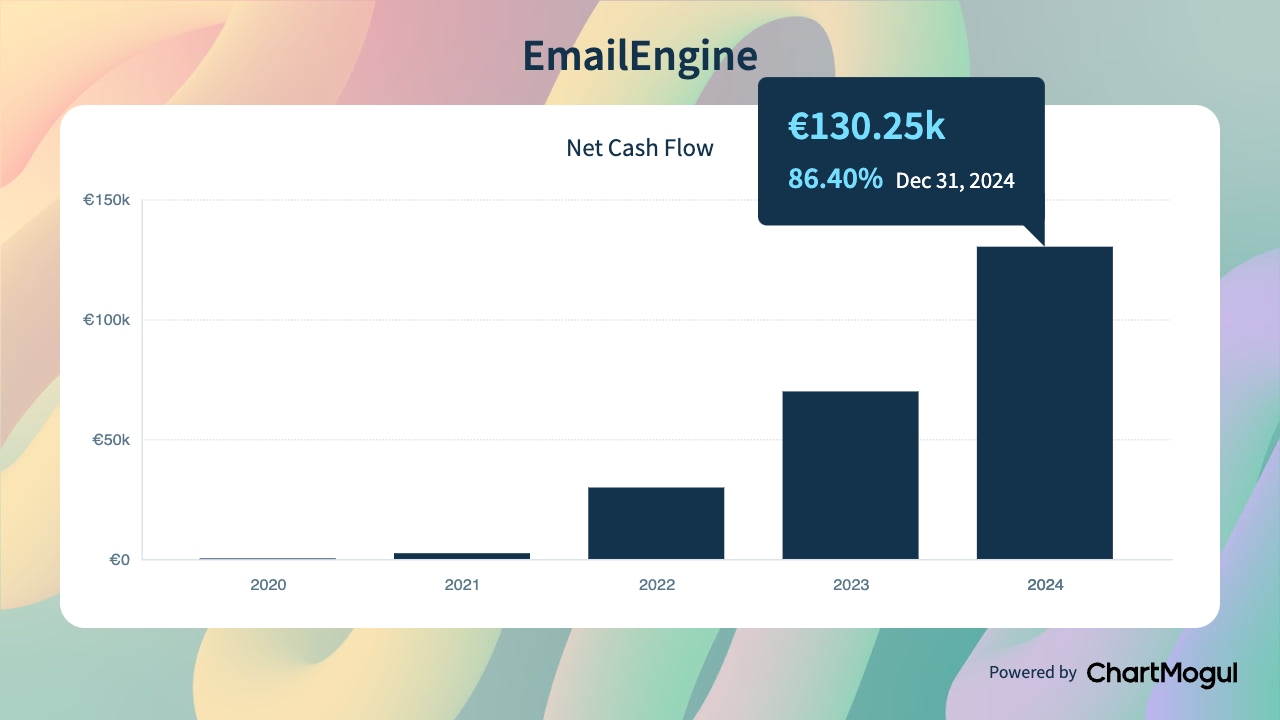
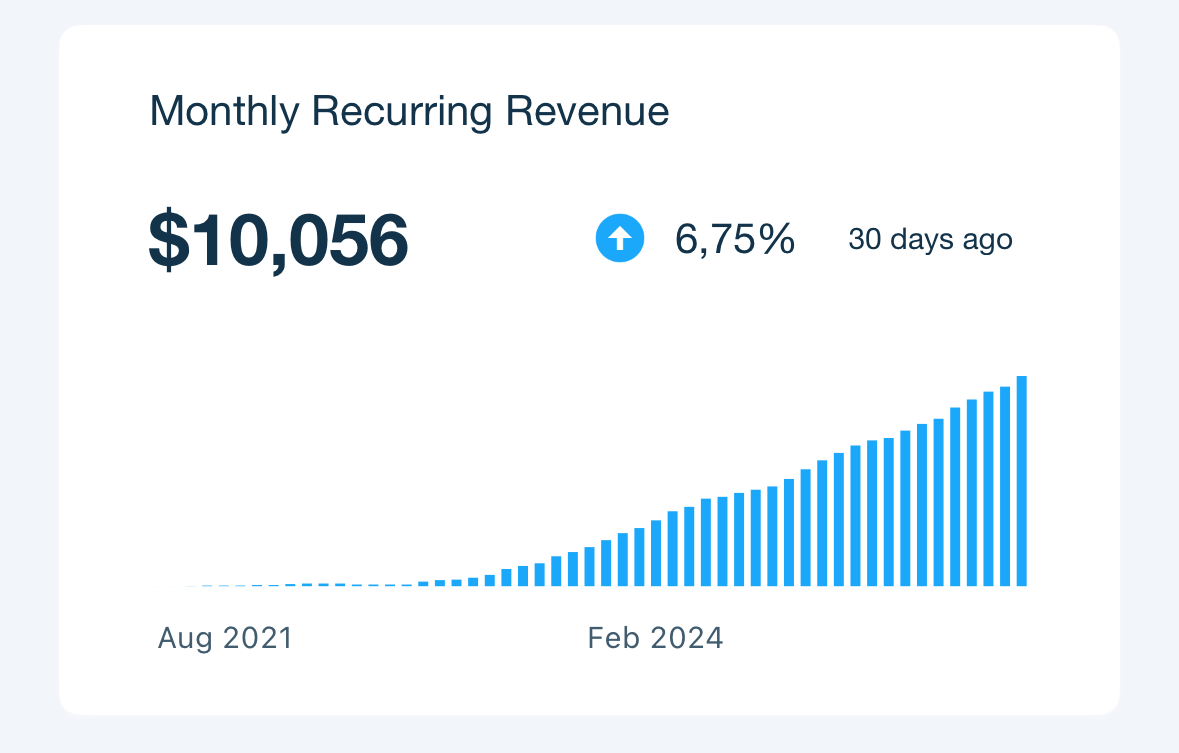
2024 was a great year for EmailEngine. I had two main targets: to reach $100k in ARR and $10k in MRR, and somehow, I managed to hit both.
Since EmailEngine is a solo venture, I do everything except accounting. To be honest, these goals were more like hopes than actual strategies because I wasn’t sure how to reach them. I just saw a graph trending upward, extrapolated it to the end of the year, and concluded the numbers were attainable. In that sense, these weren’t good goals because I didn’t have a plan to achieve them—they happened despite my efforts, not necessarily because of them.
So, I feel I’ve hit a bit of a ceiling. The numbers keep rising, yet I’m unsure why. I don’t really know where the users are coming from or what’s attracting them. It remains a mystery, and it’s clear that transitioning from a developer to an entrepreneur is anything but simple.


I knew this day would come eventually, but it still feels surreal. EmailEngine has officially crossed $10k MRR! When I started, this number felt like a distant holy grail. Now that I'm here, it’s both exciting and humbling.

I had to cave in and started accepting payments for EmailEngine in USD in addition to EUR. Previously, EUR was the only option. While EUR remains the default, new customers can now select USD when subscribing. I found out the hard way that not everyone in the world has automatic conversion to euros on their credit cards, and there were too many instances where customers faced errors during the subscription process due to insufficient funds — simply because their balance did not include euros 💵💵💵
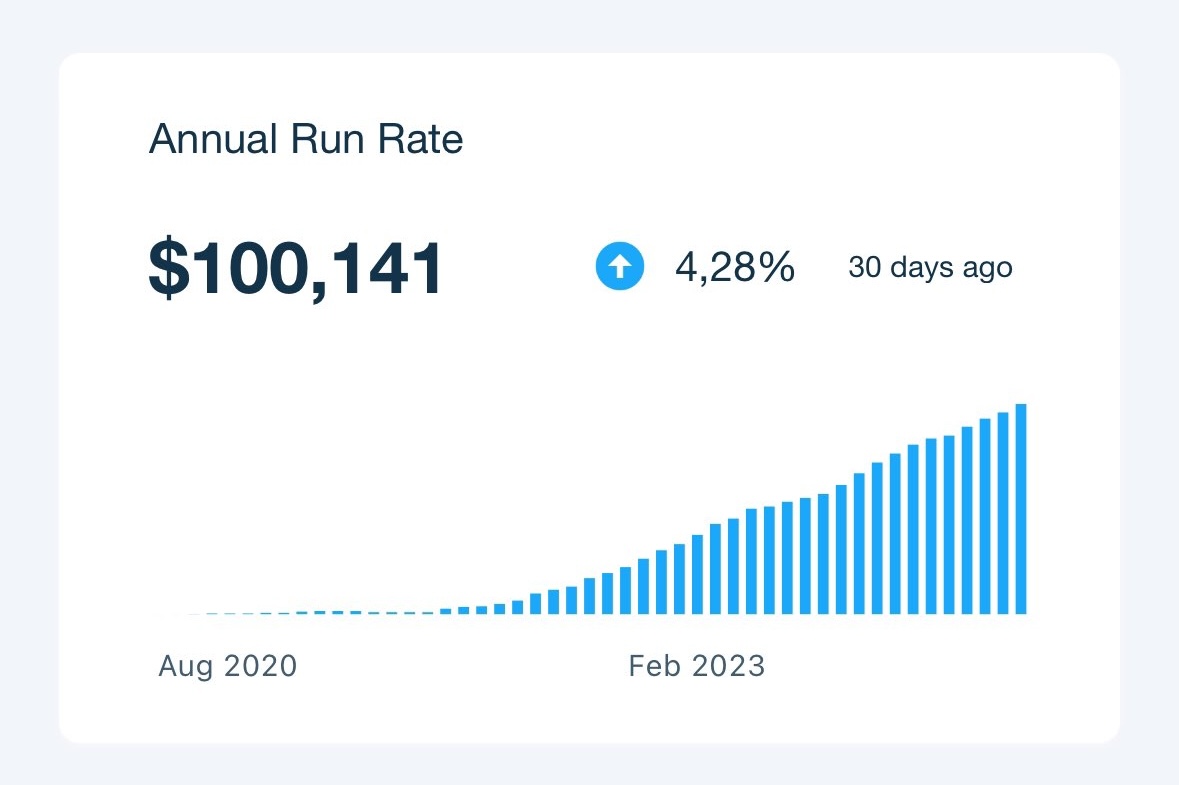
After years of grinding, I’m excited to share that my bootstrapped, one-person business has hit $100k ARR! With minimal expenses (my biggest cost is a co-working desk), it's incredible to see how far this has come. Onward!
-
1
This is absolutely amazing.
How many time it takes to you? I've been working on my projects for a couple of years and for now i'm feeling stucked because my revenue is: $0I'm trying to grow through people testimonials like this one.
Congrats!
-
2
Thanks. As you can see from the ARR chart, it took me about 1.5-2 years to get any traction. Until then, my MRR was close to 0. It was only a side project (I was working full time), one of many. Only once the MRR started growing, and I saw that there really is a market for my product, I went full in. Dropped all other side projects and even quit my job (had some savings to live on).
-
1
Thanks for the insightful perspective. Especially the part where you ensured you had savings first haha, not many people reveal that. Appreciate it!
-
-


The latest Startups For the Rest of Us podcast shortly covered my blog post about turning an open-source project into a business, and their conclusion was that I should raise prices 10x for EmailEngine 🤔 https://www.startupsfortherestofus.com/episodes/episode-707-once-com-open-source-to-ft-income-and-more-hot-take-tuesday
EmailEngine, the business I run solo, is profitable enough that it pays my salary. As a developer turned founder, I've been asked a lot about how I got here and how I found the customers. Being primarily a developer, I really don't know how to do "business", and that shows – for the first year and a half, EmailEngine made no money. There were a few sales, but these were not actual customers but people who wanted to support my effort. It was only after I re-imagined who my target customer actually was and adjusted the sales process that I managed to get things going.
My first attempt was quite simple. I published EmailEngine as an open-source project under a very strict copyleft license. There was an option to pay to get a commercial license instead. My assumption was that businesses do not like copyleft licenses, and if they find EmailEngine useful, they will opt for the commercial license. In hindsight, many things were wrong with this approach.
It turns out that only enterprise companies care about licensing; smaller ones usually do not. Larger companies were not using EmailEngine because it was a self-serve open-source application with a strange license. Smaller ones did use it and did not care about the license at all, so there was no incentive to convert. Complete mismatch of interests.
I took some time to re-think who the customer I wanted to target was. Basically, I tried to define my ICP. And, to my surprise, the best customer seemed to be someone I already knew about – myself. Or a representation of myself over my experiences in multiple companies and roles.
I was working in Pipedrive more than 10 years ago when Pipedrive was still starting out. I think there were less than 2000 customers, and I worked on similar email integration issues that EmailEngine does. So, it seemed natural to target CRM and SaaS companies at a similar stage because I knew they needed such software, and they do not have the capability to build in-house due to being too small.
My other experience was in Outfunnel, where I was the technical co-founder and built the entire initial software stack. I had a credit card to cover technical spending, and if the amounts weren't high, I did not need to get any permissions. So, I figured that I should try to target the CTOs and engineering leads of small SaaS companies. They would definitely understand how hard it is to build email integrations, and if they can easily swipe their card for any sub-$1k amount, that's my customer. Such a person also wants to move fast, and they or their team is able to figure things out, which also decreases the need for me to provide support. They get predictable and cheap pricing for a feature they can't afford to build themselves. I get a low-effort customer who is able to get stuff done without much guidance.
Obviously, among the current 100+ customers of EmailEngine, there are different kinds of companies, but the core is the one I described.
-
1
This project has given me great inspiration. Something complex yet useful, when studied and offered in a more user-friendly manner, holds significant value.
I appreciate your analysis and sharing regarding customer positioning. Some technical products are indeed not utilized by large companies, and small users tend to prefer free options. However, there are certainly small and medium-sized enterprise customers willing to pay for such services.
Could you please continue sharing some methods and experiences for acquiring these customers?
I have a small tool for preventing decompilation of JAR files in Java/Scala projects. It's very convenient and highly effective, surpassing any methods based on code obfuscation and customized classloaders. However, I'm unsure how to find potential paying customers.
Do you have any suggestions on how I should proceed?
-
1
While the value is clearly there, I do not have a clue on how to sell a security product. With EmailEngine, it is easy - I can provide cost and time savings to potential customers. The customer does not have to build the solution as they otherwise would (all customers have development teams/capabilities), and instead, they can immediately start developing their actual value-added features instead of wasting time on implementing email protocols. There is no need to wait (time savings) and no need to pay for developers (EmailEngine's subscription fee is magnitudes lower than any developer's salary). My suggestion would be to figure out the why (in EmailEngine's case, time and cost savings), and the who (choosing the ICP profile as described in the post) and then move from there.
-
1
This comment was deleted a year ago
-
-
-
1
Hi, great product to tell us. One thing I would like to know is that, is your licensing system also open source, I mean if it's coded in open source code then it's easy for your user to crack your licensing system without paying you money.
-
1
EmailEngine is source available. It means that anyone can download and inspect the source code but is not allowed to use it. No way for me to detect if anyone is doing so for personal projects (don't care either), but EmailEngine's customers are businesses that usually do not want to run pirated software. There would be no support; each upgrade might change license key validation rules, so upgrades must be patched manually; additional checks added to the code might unexpectedly break the software even while it's running etc.
-
1
Yeah, that makes sense, supports are important for B2B bussiness. Thank you for your reply, that helps me understand how open source projects handle license keys.
-
-


Even when operating a company with just a single person like I run EmailEngine, it is still important to cover all the different roles that running a company entails. I can't just develop software and ignore everything else, as such a company would surely fail.
I might not have a good answer for every specific role, but I still need to acknowledge that these roles exist, and if I'm not able to fully cover them, then what must I do to compensate?
These are the roles I have defined for my company:
Software Development
There is a 1-person development team, that's me. I don't outsource any development tasks. So, I either build stuff myself or use ready-made open-source components.
IT Operations
EmailEngine is a downloadable software, so there are no services to operate. A simple web app for managing payments and license keys is hosted on a VPS.
Sales
The main sales process is self-serve. Customers discover EmailEngine, sign up and start paying. There are also inbound sales where potential customers approach me before buying.
I advise non-technical persons and persons with special feature requests to consider an alternative instead of going with EmailEngine. This is for me to avoid support burden later on.
While getting more customers is essential, minimizing current and future efforts to serve the customer is also important. Adding additional overhead with each customer does not scale with a one-person team!
Marketing
I have no marketing budget, so I can't use paid ads or any other channel that includes costs. The primary marketing channel for EmailEngine is Engineering as Marketing. I develop and release free, open-source projects and link to EmailEngine from the documentation sites of said free products.
The secondary marketing channel is SEO. This mainly includes releasing relevant blog posts that describe how to use EmailEngine features to tackle specific issues.
Product management
I get some input for my Trello board from customers, but product planning is mostly derived from my initial vision. EmailEngine should not have a gazillion features, one for each customer. Instead, it should only tackle a few hard-to-solve issues.
Customer support
The primary channel is email-based ticketing software. I try to answer urgent issues as fast as possible and deal with anything else once a day. The secondary channel is a public Discord chat channel where I go through pending messages daily.
Customer success
I haven't defined an "official" customer success role for myself. It's more of a continuation of general customer support. If a customer wants to use EmailEngine to handle a specific task that has yet to be covered, I help figure out how to do this and write it up into a documentation page for other customers.
Organizational services
Anything office-related is handled by the co-working office in which I reside. I also have an accountant. I used to do all the accounting myself, but it got too complex for me to handle.
It finally happened. The net revenue from sales of EmailEngine reached 100k€. If I had used dollars instead of euros, this would have happened already earlier 🫠
Without considering the first year and a half, where EmailEngine virtually made no revenue at all, it took me slightly over two years to reach this number.
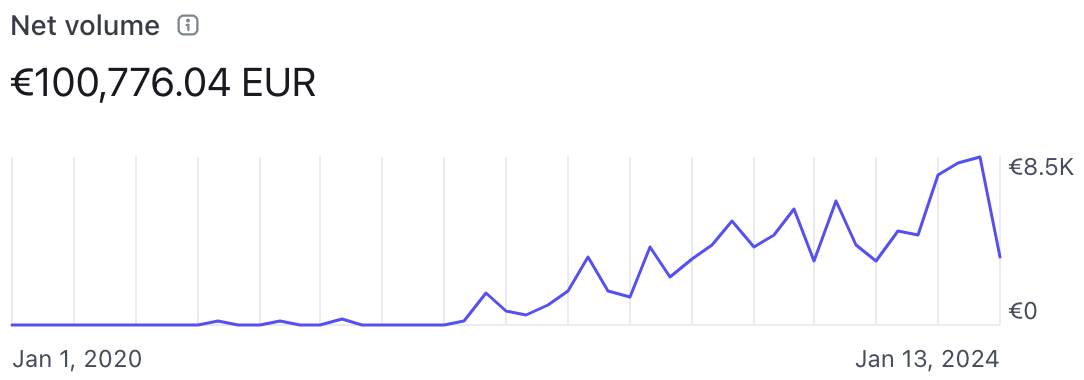


I crunched the numbers, and it seems my one-person indie-hacking business sold EmailEngine software subscriptions for 73k€ ($80k) in 2023. In 2022 the same number was 36k€ ($40k). Is there really a chance to hit 100k€ this year? 😳 #buildinginpublic

It's that time of the year again. It is time to start preparing for the year-end holidays. To look back, how did EmailEngine do in 2023?
All numeric expectations were met. MRR, ARR and net cash flow grew more than 100% compared to 2022. The customer churn rate was 20% for the entire year, which is on par with 2022. The subscriber count grew by 70%. My current ARR is 65k€, and my expectation is to reach 100k€ by the end of 2024. It is a tiny number for mankind, a giant leap for a single-person business.
Key learnings
There is little point in working with enterprise clients as a solopreneur. I was in talks with 3 different (inbound) enterprise prospects, and during on-and-off negotiations lasting six months or more, not a single customer got closed. The best I was able to achieve was to get added to the vendor's database for one prospect, and that's about it. It's a total waste of time. I like my existing customers way more. Hands-on, no-fluff problem-solving people.
No real reason to give discounts. I value long-term customers and all customers who have asked for a discount churned by the next yearly renewal. So, if they are going to churn anyway, maybe try to get the full payment out of them.
Do not overpromise. It is better not to promise anything and only sell the existing feature set as it is. I told one potential customer that I was working on a larger feature they needed. They subscribed and became a paying customer. 4 months later, I've had no time to work on this feature and really don't see how I could do it in the next quarter. Being a solopreneur means I need to take care of all sides of the business, and there is often just not enough time for building larger features.
As EmailEngine grew from micro-business to small-business as defined in the local accounting act, I've been busy getting all the business sides in order, including taxing, etc. For example, I moved from a homebrew tax collecting system to Stripe Tax. Shouldn't have done that. Stripe Tax shows me exactly in which regions I have met the sales tax threshold. Didn't want to learn this information 🫣
3 Comments
Congratulations on achieving your targets. I would love to know a bit about your marketing approach.
My main marketing channels are my open source project homepages. People use open source libraries for free, understand that they need more features and the documentaion pages of these open source libraries link to my commercial project. So CAC is in effective $0
Oh okay nice marketing approach and clearly has worked well for you