
Feetpik
Buy & Sell Feet Pics. Safely. Anonymously. Securely.
Half the platforms in this niche changed their pricing in the last eighteen months. Almost none of the guides noticed.
---
In 2021, FunWithFeet's entire pitch was "no commission on sales." You paid a small subscription and kept every dollar. It was the friendly alternative to the market leader, and thousands of sellers signed up on that promise.
That model no longer exists. FunWithFeet now charges roughly $14.99 for six months plus a 15% cut of everything you sell.
I'm opening with that because it's the cleanest illustration of the problem with researching this niche. Search "best sites to sell feet pics" today and you'll find dozens of articles still describing the 2021 model as current. They're not lying on purpose — they were written from other articles, which were written from other articles, in a chain going back to a source that was accurate three fee changes ago.
Meanwhile the actual market moved. Tiered commission structures arrived. A subscription-free challenger got competitive. The legal environment for adult-adjacent platforms changed more between mid-2025 and mid-2026 than in the previous decade combined.
So this guide does something different. Every platform gets its current fee structure, its real weakness, and a specific answer to "who is this actually for." Then the second half covers the operational stuff — pricing, fraud, identity, tax — that determines whether you make $80 a month or $800.
The 60-second version
If you don't want the full thing:
Best overall for buyer volume: FeetFinder. Biggest verified buyer base by a wide margin.
Best odds of being seen as a beginner: Feetpik. Far less saturated on the seller side, and the only platform running in nine languages.
Best fee structure at high volume: Footly. Down to 5% on the top tier.
Best if you already have followers: Fansly, then OnlyFans.
Best for video: ManyVids.
Most underrated: commercial stock photography. Zero stigma, passive income, nobody does it.
Realistic earnings: under $100 in month one, $300–$900/month once consistent, $1,000–$3,000 for the top decile.
Biggest mistake: assuming the marketplace will market you. It won't.
The rest of this article is the reasoning.
Four questions to answer before you pick anything
Most people choose a platform by reading a ranked list and signing up for number one. That works, sort of. But the right answer depends on four variables that no listicle can know about you.
1. Do you already have an audience?
This is the single biggest fork in the road.
If you have followers on X, Reddit, TikTok or anywhere else — even a few thousand — subscription platforms become viable immediately. OnlyFans and Fansly are conversion machines with almost no internal discovery. They monetize traffic; they don't generate it.
If you don't, you need a marketplace where buyers are already browsing. Dedicated feet marketplaces exist precisely for this. You pay a commission for the privilege of being findable, and it's worth it.
Getting this backwards is the most common expensive mistake in the niche: someone with zero followers signs up for OnlyFans, posts for six weeks into total silence, and concludes the whole thing is a scam.
2. What's your expected monthly volume?
Fee structures cross over. A platform that's cheapest at $150/month is expensive at $1,500/month, and vice versa. There's a table further down; the short version is that fixed subscriptions punish low-volume sellers and percentage cuts punish high-volume ones.
3. Where do you bank?
Genuinely underrated. A platform advertising "fast weekly payouts" often means fast weekly payouts to a US bank account. If you're in Poland, Portugal or Brazil, what matters is whether they support Paxum, MassPay, crypto, PayPal or SEPA — and what the minimum threshold is before they'll release anything.
Check this before you upload a single photo. Money you technically earned but can't withdraw is not income.
4. How much anonymity do you need?
Everyone says "completely anonymous." Then they ship a physical item with a return address, or use a username they've had since 2014, or post a photo with a window in the background.
Decide your actual threshold. If you need genuine separation from your legal identity, that rules out physical goods entirely and changes how you shoot. If you're relaxed about it, more revenue streams open up. Neither answer is wrong; drifting between them is.
What changed legally, and why it affects your income
This section isn't in most guides, and it should be.
June 2025: the US Supreme Court decided Free Speech Coalition v. Paxton 6–3, upholding Texas's age-verification statute under intermediate scrutiny. Strict scrutiny had been the standard blocking these laws for years. That barrier came down.
The result: in January 2023, one US state had an active age-verification requirement. By early 2026 there were 25; West Virginia's took effect in June 2026, making 26. Fines commonly reach $10,000 per day, and several states allow parents to sue platforms directly. Three states — Ohio, South Dakota and Wyoming — apply their rules to any platform with adult content at all, with no threshold.
In parallel: the UK's Online Safety Act hit its compliance deadline on 25 July 2025, demanding "highly effective" age assurance from any service serving pornographic content to UK users regardless of where it's hosted. Ofcom has issued penalties. The EU is pushing the same direction under Article 28 of the DSA, with Commission guidance stating plainly that a self-declaration checkbox doesn't count. Australia phased its own regime in through March 2026. Germany went further in December 2025, giving authorities power to require banks and payment processors to stop serving non-compliant adult platforms.
Three practical consequences for you:
Your verification burden went up. Government ID plus a liveness check is now standard onboarding on any serious platform. This isn't intrusiveness — under 18 U.S.C. § 2257, US-facing sites carry record-keeping obligations for everyone appearing in content they host. A platform that doesn't verify you is a platform with a compliance problem, which is a platform that may not exist in a year.
Geo-blocking is a real income risk. Some adult platforms have withdrawn from entire countries rather than build verification infrastructure. If yours exits a market where your buyers live, your revenue drops through no fault of your own. Platforms that have already built compliant verification are the safer bet, boring as that sounds.
Informal channels got worse, not better. As legitimate money concentrates on compliant platforms, the DM economy is left with a higher proportion of people who couldn't or wouldn't pass verification. "Just deal directly and skip the fees" was always risky. It's more so now.
The 15 platforms, grouped by what they're for
I've kept the ranking, but grouped it — because comparing a stock photography site to a fetish marketplace on the same scale is how these lists become useless.
Group A: Start here
1. FeetFinder
The market leader, and not just by inertia. Reported buyer spending exceeds $110 million, with a verified user base above 10 million. It has been consolidating aggressively — both Instafeet and FootoGraphy are now owned by it, and Instafeet's domain routes traffic straight into FeetFinder's marketplace.
What it costs: a seller platform fee of about $4.99/month (Basic) or $14.99/month (Premium), with annual and lifetime options available, on top of a service fee the current Seller Agreement puts in the 10–15% range depending on plan. Net: you keep 85% on Basic, 90% on Premium, minus the fixed monthly cost. The annual Basic plan brings the effective monthly platform fee down to roughly $1.25, which is the cheapest fixed cost of any subscription platform here.
Payouts: weekly, US sellers through integrated processing, international sellers via Paxum or MassPay. Thresholds apply.
The real product you're buying: the subscription revenue funds marketing that brings buyers in. That's it. That's the value proposition, and it's a good one, because buyer acquisition is the hardest problem in this business and they've solved it.
Where it disappoints: you're competing against an enormous number of other profiles, so a new listing can sit unseen for weeks. The fixed fee charges in months where you sell nothing. The interface predates the 2025–2026 design wave and feels it. Payout-delay complaints appear in creator communities often enough that I won't pretend they don't.
Who it's for: almost everyone starting out. If you're picking exactly one platform, pick this one.
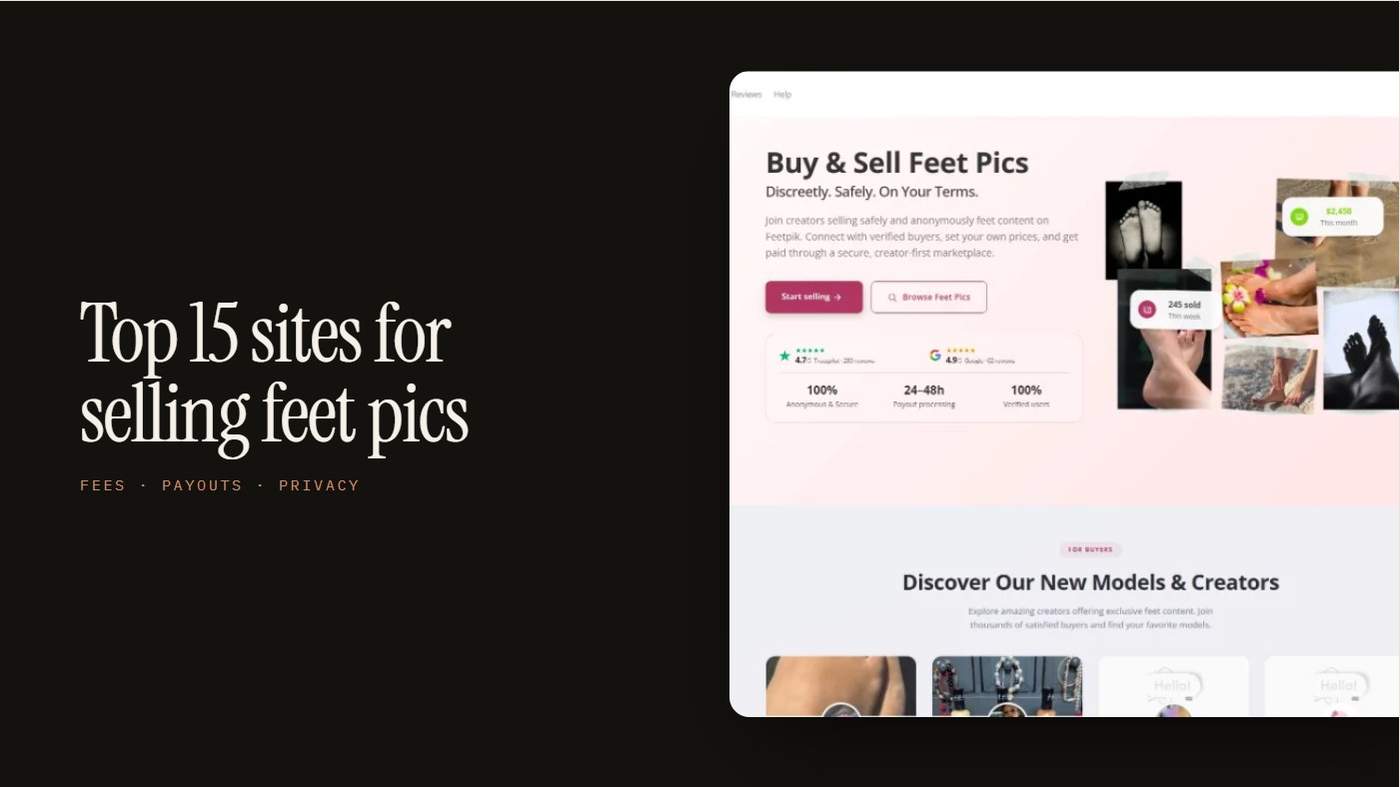
2. Feetpik
The most interesting position in the market right now — and the one I have to introduce by telling you where it loses.
What it costs: a $4.99/month seller subscription plus 20% commission. You keep 80%.
Put that next to FeetFinder Basic — $4.99/month plus a 15% service fee — and the comparison is unambiguous. Identical fixed cost, five percentage points worse on commission. At $500/month in sales, FeetFinder Basic returns about $420 and Feetpik about $395. On price alone, it loses. Any guide that positions it as the budget option is one that didn't open a calculator.
So why is it in Group A at all?
Because for a brand-new seller, the fee percentage is close to irrelevant next to a much harder problem: nobody can find you. FeetFinder's ten million users are a genuine asset, but they arrive at a marketplace carrying a seller pool so dense that a fresh profile with no sales history and no reviews can go a month without a single view. Feetpik has fewer buyers — considerably fewer — but the seller side is thinner by a much wider margin, so the traffic that does arrive is spread across far fewer profiles. A new listing surfaces in days rather than weeks. Twenty percent of steady sales comfortably beats fifteen percent of nothing, and that five-point gap only turns into meaningful money once you're already established.
Its second differentiator: the platform runs in nine languages — English, Czech, German, Slovak, French, Spanish, Italian, Portuguese and Polish. That reads like a footnote until you register how relentlessly American this industry is. Every other marketplace here assumes you'll onboard, price, negotiate and dispute in English. If you're a creator in Madrid, Lisbon, Warsaw or Prague, that assumption is a tax on your time and a reliable source of expensive misunderstandings. It also means the buyer pool skews more European than the incumbents — genuinely additional demand rather than the same American buyers sliced differently.
Payouts: requested above a minimum threshold, approved payouts typically processed within 24–48 hours rather than on a weekly batch cycle. Rails include Paxum, USDT crypto, PayPal and bank transfer depending on region — which for a non-US seller matters far more than any headline speed claim.
The rest of it: anonymous selling with no face or legal name required, mandatory 18+ verification, a published § 2257 statement plus a DMCA and content-removal policy with a formal appeals process, mobile-first uploading, an analytics dashboard, content scheduling, and four revenue streams in one account — individual posts, video, subscriptions and custom requests. Public review scores run around 4.7/5 on Trustpilot across roughly 280 reviews.
Where it disappoints: the fees, and I've already been blunt about them. 20% is worse than FeetFinder Basic's 15%, twice FeetFinder Premium's 10%, and four times Footly's Icon tier. At $2,000/month in sales that's $400 gone against $200 on FeetFinder Premium, and at that point you should be moving your volume. The buyer base is also, straightforwardly, much smaller than the market leader's.
Who it's for: new sellers who need visibility more than they need a lower percentage, and any creator who doesn't work primarily in English — for whom it's arguably the only sensible primary platform on this list. Run it alongside FeetFinder rather than instead of it; two entry subscriptions come to under $10/month, and no marketplace in this market demands exclusivity. Re-run the fee table once you pass roughly $500/month and move the bulk of your catalogue to whichever platform your own numbers favour.
3. Footly
Launched 23 December 2025 and went straight at the incumbents on price. Tiered: Rising at $3.99/month with a 15% fee (keep 85%), Spotlight at $6.99 with 10% (keep 90%), Icon at $9.99 with 5% (keep 95%). The rate applies uniformly across subscriptions, tips, pay-per-view, message unlocks and custom requests, with none of the carve-outs competitors bury in their terms.
95% is the best creator share available anywhere in this category.
Where it disappoints: it's young. The Icon tier's economics only justify its higher subscription if you're doing volume, and doing volume requires buyers, and buyers take time to accumulate. The product is legitimately good — quick, a well-tuned discovery feed, bundled subscriptions, a properly designed custom-request pipeline — but no amount of UX polish creates demand.
Who it's for: test it cheaply on the $3.99 tier now, and if its buyer growth holds through 2026, migrate your volume there on fee arbitrage alone.
Group B: Subscription platforms (bring your own audience)
4. Fansly
I'm ranking it above OnlyFans for feet-specific creators, which is unusual, and here's why: Fansly's tagging and categorisation system actually surfaces niche content. Fetish creators consistently report being findable there in a way OnlyFans doesn't allow. The tiered subscription setup is more flexible too.
Smaller total audience than OnlyFans. Same fundamental requirement that you supply traffic, though slightly less absolute.
Who it's for: any creator whose content is specifically feet rather than general adult, once they have somewhere to promote from. Verify the current revenue share on their terms page — it moves.
5. OnlyFans
Flat 20%, no subscription, no small print. The simplicity is genuinely underrated in a market full of stacked fees.
The mistake is thinking it's a marketplace. It isn't. Internal discovery is effectively nonexistent — nobody browses OnlyFans and finds you by accident. Every subscriber arrives from somewhere else you sent them.
What it's excellent at: recurring subscription revenue at $4.99–$49.99/month tiers, pay-per-view messaging, tips, live streaming, and a payment infrastructure that has survived more processor and regulatory pressure than any competitor's. If you have an audience, nothing converts it better.
Where it disappoints: without traffic, it produces nothing. 20% looks expensive now that tiered rivals exist. And feet-only content competes for subscriber attention against fully explicit content at the same price point, which shapes expectations in ways that aren't always in your favour.
Who it's for: month three or four, after you've got a promotion channel that works.
6. LoyalFans
The best creator tooling in this group. Subscriptions, pay-per-view, tips, individual clip sales, paid phone and video calls, and a store function, all from one dashboard. Moderation is more permissive than mainstream platforms while staying compliant.
Where it disappoints: the audience is meaningfully smaller than OnlyFans or Fansly, and there's less network effect helping you. Everything depends on subscriber count, which depends on you.
Who it's for: a third or fourth platform for someone already running a diversified stack and wanting monetization options the others don't offer.
Group C: Dedicated feet marketplaces (smaller, cheaper, thinner)
7. Feetify
Feetify's pricing is the one set of numbers in this article I couldn't pin down. Sources variously describe a roughly $49/year premium plan that waives commission entirely, and separately a $4.99/month plan carrying a 20% cut. Those are very different propositions, and I'm not going to pretend otherwise — open the live pricing page before you pay, and discount any specific figure you read elsewhere, mine included.
If the annual zero-commission plan is genuinely available to you, the economics are excellent: about $4/month with no cut on sales beats every structure in this article at volume.
There are community-style extras too: tips, virtual gifts, paid video calls, and reportedly periodic cash awards for consistent posting.
Where it disappoints: limited buyer traffic next to the top three, basic discovery with no algorithmic feed, slower verification, and a lot of dormant profiles cluttering the marketplace. Once the fixed fee is accounted for, effective costs reportedly land somewhere in the 24–40% range depending on volume — worse than any headline number suggests.
Who it's for: creators who already have an audience to point at it. It struggles to build one for you, which is the opposite of what a beginner needs.
8. FunWithFeet
Launched 2021 as the cheap, beginner-friendly alternative. Current pricing is roughly $14.99 per six months plus 15% commission. If you find a guide claiming FunWithFeet takes no commission, that guide is at least two years stale, and you should discount everything else in it.
The complaint pattern is worth understanding, because it isn't about fraud. It's about silence. Sellers build profiles, upload decent content, and then wait for buyers who arrive slowly or never. That's structural — a marketplace with thin demand cannot generate sales for you regardless of how good your photography is. Sellers often read this as personal failure. It isn't.
Who it's for: a secondary listing, if you have spare time to maintain one. At current pricing it's competing head-on with FeetFinder Basic and losing on the only metric that matters.
9. OnlyFeet
Dedicated feet marketplace, 20% commission plus a monthly platform fee. The commission matches several competitors; the differences are the fixed cost, the buyer base and the security model.
The honest comparison is unkind: FeetFinder's annual Basic plan lands around $1.25/month effective, with a buyer base an order of magnitude larger.
Who it's for: worth testing if your particular content style underperforms elsewhere — but test it, don't assume it.
10. FeetLoversOnly
Part of the All Things Worn family, which also covers worn clothing. Sales run heavily through direct messaging with a small, loyal buyer base. Non-established sellers typically price around $10 per photo or clip, and you can list worn shoes, hosiery and accessories alongside digital content.
Low competition means easier visibility and fewer total buyers. Which side of that trade wins depends entirely on how good you are at converting a conversation into a sale.
Who it's for: a low-effort second storefront. Cross-post to it, don't build your income on it.
Group D: Different content, different money
11. ManyVids
A clip-sale platform first. If your strongest content is video rather than stills — movement, close-up work, longer scenarios — this is where video buyers actually shop. Functioning internal discovery, contests that drive visibility, and per-clip price points that photos will never reach.
Revenue share varies by seller status and content type; check current terms before committing.
Where it disappoints: photo-only sellers get little from it. There's a real learning curve. Top-ranked video slots are fiercely contested.
Who it's for: anyone whose output is more than a third video.
12. Snifffr
Not a feet-pics site as such — a marketplace for worn socks, shoes, underwear and other scent-related items, running since 2019. 20% commission, no subscription, escrow protecting both sides.
It's on this list because worn-item buyers are repeat buyers. Someone who liked your socks comes back next month. A photo buyer often doesn't. Add-on pricing stacks well: roughly +$5–20 per additional day worn, +$10–30 for specific activities, +$10–50 to bundle photo or video content with the item. Sellers pairing digital and physical consistently report the physical side producing steadier recurring income.
The serious caveat: shipping means a return address exists. PO box or anonymous forwarding service, every single time, no exceptions. The platform is legitimate and pays reliably — the risk is inherent to the model, not the operator. This is the one entry here where I'd tell you to read the safety protocol twice before signing up.
Who it's for: sellers comfortable with physical fulfilment who will follow anonymous shipping discipline without ever cutting a corner.
13. DollarFeet
Structurally unlike everything else here: DollarFeet buys video content outright at a fixed rate per accepted clip. No profile, no audience, no recurring revenue. You shoot to their brief, submit, and if it passes review you're paid immediately.
Where it disappoints: there's no upside. A clip that becomes wildly popular still pays the flat rate, and you've transferred the content. The rate is modest.
Who it's for: quick cash between marketplace sales, or anyone who wants income without maintaining a public presence. Read exactly what rights you're assigning before you submit.
Group E: Outside the fetish economy entirely
14. Commercial stock — Adobe Stock, Dreamstime, Foap
The entry nobody expects, and the one I'd push hardest for a specific kind of creator.
Commercial buyers need foot imagery constantly: podiatry practices, footwear brands, nail salons, skincare and wellness companies, travel publishers, physiotherapy clinics. That content is entirely safe for work — feet in sandals on a beach, mid-pedicure, walking on grass, in running shoes — and it sells through channels that have nothing to do with the fetish market.
How it works: register as a contributor (Adobe Stock reviews roughly ten sample images before accepting you), upload with careful keywording, earn a royalty each time someone licenses. Foap adds brand-sponsored "Missions" with paid briefs.
Why it's genuinely worth your time: zero stigma, zero age-verification complexity, no fetish-adjacent risk, and passive long-tail income — an image licensed in 2026 can still be earning in 2031. It's also the only lane here that goes on a portfolio.
Where it disappoints: per-licence royalties are small, technical standards are real (sharp focus, clean composition, correct exposure — phone snapshots get rejected), and income only compounds once your portfolio is large. Commercial licensing terms are more complex than a marketplace sale, and model releases apply even when the model is you.
Who it's for: anyone with a decent camera and a working understanding of light. Run it in parallel with everything else. Almost nobody does, which is exactly why there's room.
15. Your own storefront — Gumroad, Payhip, Ko-fi
The eventual destination, not the starting point.
A direct storefront takes 5–10% between payment processing and platform fee, hands you the customer email list, and means no marketplace can end your income with a policy change. Gumroad and Payhip both handle digital delivery and EU VAT. Ko-fi supports low-fee memberships.
Where it disappoints, badly, at first: you supply 100% of the traffic. There is no discovery whatsoever. And payment processors have firm opinions about adult-adjacent content — read the acceptable-use policy before you build anything on one. That's the failure mode that actually catches people, not the technology.
Who it's for: your top 20% of repeat buyers, once you have them. Marketplaces are customer acquisition; your storefront is customer retention. Migrating regulars there is how a $900/month seller becomes a $1,400/month seller without gaining a single new customer.
The three costs nobody adds up
Sellers compare commission percentages and stop there. There are three costs, and the third is invisible.
Cost one: the percentage
Obvious, scales with revenue, hurts most when you're doing well.
Cost two: the fixed subscription
Charged whether you sell or not. Hurts most when you're doing badly — which, for a new seller, is most of the first quarter.
Read across the $100 row: the 20%/$4.99 structure and the 10%/$14.99 structure return exactly the same amount, because the better percentage is entirely consumed by the bigger subscription. Read across the $3,000 row: the gap between best and worst is $445 a month.
Below roughly $150/month, fixed cost decides. Above it, the percentage decides, and it decides hard. Almost nobody recalculates after signup, which means a large number of sellers are permanently on the wrong plan for their current stage.
One caveat that outranks the whole table: all of this assumes identical sales across platforms, which is never true. A five-point fee advantage is worth $25/month at $500 in sales. A marketplace where your profile actually surfaces, or one reaching buyers nobody else is serving, is regularly worth more than that. Fix discovery first. Optimise fees second.
Cost three: trapped money
Minimum payout thresholds. If a platform holds funds until you reach $50 and you're earning $12/month, your money is locked for four months. Nobody calls that a fee. It functions as one — worse, actually, because it also stops you reinvesting.
Check the threshold and the available payout methods for your country before you commit. A platform that pays weekly by US bank transfer is functionally a savings account with no interest if you bank in Lisbon.
The operating manual
Platform choice is maybe 30% of your outcome. This is the other 70%.
Pricing without undercharging
Beginners price low out of nerves, then feel exploited. A saner starting framework:
ProductRangeNotesSingle photo$8–$20Under $5 signals low quality and attracts your worst customersBundle (5–10)$25–$60Price at 60–70% of the individual sum; converts better than singlesCustom request$40–$150Where the real money is — you're selling time and specificityVideo3–5× photo rate per minuteDisproportionately more work, and buyers know itSubscription$10–$25/monthOnly works with reliable delivery cadence
Two rules that outrank the numbers themselves:
Never negotiate down on a first purchase. Someone who talks you from $20 to $8 will do it every time afterwards, and will tell others you're negotiable. Hold the price, or counter with a bundle — same money to you, more value delivered, no precedent set.
Raise prices as reviews accumulate. Social proof is a pricing input. Twenty positive reviews support a 30–50% increase, and most buyers who valued you at the old price will stay at the new one.
Content production that doesn't burn you out
The sellers who quit are almost always the ones producing one photo at a time.
Batch. One two-hour session with good light should produce four to six weeks of posts. Change the setting, the angle, the nail colour, the footwear between sets and you have distinct-looking content from one afternoon.
Light matters more than gear. A window at mid-morning outperforms an expensive camera under a ceiling bulb. If you shoot indoors at night, one cheap softbox transforms your output more than any lens will.
Keep a shot list. Soles, arches, toes, top-down, in heels, in socks mid-removal, crossed ankles, against contrasting fabric, outdoors, wet. Working from a list stops the paralysis of setting up with no plan.
Schedule, don't improvise. Every serious platform supports scheduling. A profile that posts three times a week consistently outperforms one that posts eleven times in a burst then goes quiet for a month — both for the algorithm and for subscriber retention.
The scams, ordered by how often they work
The off-platform redirect. "The site's cut is ridiculous — pay me on PayPal and I'll add extra." This is the most common fraud in the niche by a distance, and the generous framing is exactly what makes it effective. It removes escrow, removes dispute records, and enables a chargeback weeks later after they've kept the files. The commission you're paying is this protection. Keep everything on-platform.
The overpayment. They "accidentally" send $300 for a $30 item and ask you to return the difference. The original payment reverses; your refund doesn't. Never refund an overpayment — void the whole transaction and have them resend correctly.
The free-sample ladder. A "verification" photo, then one more, then one more, with a large order always just ahead. Real buyers purchase from your existing catalogue. Offer a cheap entry product instead of free samples.
The forged payment screenshot. Edited confirmations sent before delivery. Deliver only when funds appear in your account balance — not in your inbox, not in your messages.
The agency fee. "Management" promising promotion for an upfront payment, or an "exclusive contract" with a joining fee. Legitimate management takes a percentage of earnings. It never charges to start.
The custom-request ghost. Long discussion, detailed requirements, silence at payment. Take 50% upfront on any custom over $50, or use platform escrow. Someone unwilling to deposit was never buying.
The blackmail attempt. A claim to have identified you, with demands for free content. This is a crime almost everywhere. Don't pay, don't engage, screenshot everything, report to the platform and to police. Paying escalates; it never resolves. It's also the strongest argument for the identity discipline below — the threat only functions if there's something findable.
Identity protection: do this before your first upload
Strip metadata. Photos carry EXIF data that can include GPS coordinates depending on your settings. Disable location for your camera app, and run files through a metadata stripper anyway. Some platforms strip server-side. Don't rely on it.
Audit the background of every frame. This is how people are actually identified — not by hacking. Real cases have turned on: mail on a counter, a prescription label, a laptop screen, a recognisable view through a window, a pet's name tag, a reflection in glass, a distinctive tattoo, a branded calendar. Shoot against plain surfaces until the instinct develops.
Compartmentalise completely. A dedicated email sharing no username, recovery number or password with anything personal. A seller alias with no connection to any handle you've ever used elsewhere — username reuse is the single easiest way to be linked across sites, and it's how most deanonymisation happens. Two-factor authentication on that email above everything else.
Watermark previews, not deliverables. Preview watermarks belong across the subject, not in a croppable corner. Paid files shouldn't be watermarked — that's what the buyer purchased. Embedding a subtle per-buyer identifier in delivered files makes leaks traceable to whoever leaked them.
Never confirm personal details. Not your city, job, exact age, or relationship status. Deflect pleasantly and redirect. Buyers who keep pushing on personal details are collecting information, not flirting.
PO box or forwarding service for anything physical. Every time.
When your content is stolen
It will happen. Here's the process that works.
Monitor. Reverse image search your most popular images every month or two — Google Lens, TinEye. Set a search alert on your seller alias.
Document. Screenshot the infringing page with the URL and date visible. You need this if it escalates.
Send a DMCA notice. More effective than people expect, because hosts and search engines have strong legal incentives to comply quickly. A valid notice contains: your contact details; identification of the original work; identification of the infringing material and its URL; a good-faith statement that the use isn't authorised; a statement under penalty of perjury that your information is accurate; and your signature, electronic being fine.
Send it to the host, not just the site. A WHOIS lookup usually surfaces the host's abuse contact, and hosts act far faster than infringers do. You can also file with Google to remove the URL from search results, which eliminates most of the traffic even when the page survives.
Use your platform's process. Any serious operator publishes a content-removal and appeals policy — FeetFinder and Feetpik both do. Use it, because a platform's legal team sends notices that carry more weight than yours.
Triage ruthlessly. Chasing every instance is not realistic. Prioritise anything ranking in search, anything being monetised, anything attached to your alias. Let the rest go, or you'll spend more hours on takedowns than on earning.
Tax, briefly but seriously
This is self-employment income essentially everywhere. It's taxable. Platforms increasingly report payouts and processors do too.
Record from day one: gross sales per platform, fees deducted, net received, dates. A spreadsheet suffices. Reconstructing a year backwards is genuinely awful.
Track deductions, which in most jurisdictions include platform subscriptions and commissions, camera and lighting equipment, apportioned phone costs, props (footwear, hosiery, nail products), pedicures used for content, editing software, and a home-office share if you qualify.
Reserve 25–35% of net as you earn it. The rate varies by country; the failure mode — spending everything and facing a bill you can't cover — does not.
VAT and sales tax. In the EU, digital services to consumers are generally taxed where the buyer is located. Most marketplaces handle this as the deemed supplier. Your own storefront generally doesn't, which is a substantive reason to build on Gumroad or Payhip (both handle EU VAT) rather than rolling your own checkout.
I'm not an accountant and this isn't advice for your situation. An hour with a local professional in your first profitable year costs less than the mistakes it prevents.
A 90-day plan that actually works
Days 1–7: setup. Create your alias, dedicated email and 2FA. Register on one high-liquidity platform (FeetFinder Basic, cheapest on the annual plan) and one less saturated platform where a new profile can actually surface (Feetpik, or Footly's $3.99 tier). Total fixed cost: under $10/month — roughly one photo sale. Complete verification on both — it takes time, so start it immediately.
Days 8–21: build a catalogue. Two batch shoots. Target 40–60 usable images across varied settings and styling. Write listing descriptions with searchable terms rather than one-word titles. Upload to both platforms — there's no exclusivity requirement anywhere in this market, and duplicating your catalogue costs nothing.
Days 22–45: build one promotion channel. This is the step people skip, and it's the one that separates $80/month from $800/month. Pick Reddit or X, read the rules properly, and post consistently for three weeks. Funnel everything to your marketplace profiles. Do not transact in DMs. The point of the social channel is traffic, not sales.
Days 46–70: optimise on data. Which platform actually produced sales? Which listing style converted? Which price point stalled? Raise prices on anything selling reliably. Cut anything that isn't. Start responding to custom requests — that's where the margin lives.
Days 71–90: add a second revenue type. Subscriptions if you've got returning buyers. Video if you enjoy shooting it. A subscription platform if your promotion channel produced followers. Only add one thing; three half-maintained platforms earn less than two well-run ones.
Then, every quarter: re-run the fee table against your actual volume. Ten minutes, four times a year, and it's frequently worth a few hundred dollars annually.
And one piece of advice that isn't technical at all: the business is repeat buyers. Selling again to someone who already bought takes roughly a tenth of the effort of finding someone new. Remember what they ordered. Deliver when you said you would. Be consistent and pleasant and professional about it. The people earning real money here aren't the ones with the best photographs — they're the ones with forty regulars who buy every month.
FAQ
Which platform is genuinely cheapest? Nearly every dedicated marketplace now charges a seller subscription between $4 and $15/month plus a commission between 5% and 20%. Below about $150/month in sales, the lowest fixed cost wins — FeetFinder's annual Basic plan works out near $1.25/month. Above that, the commission percentage decides, and Footly's Icon tier at 5% is the lowest available. Check the table above against your own numbers, then read the caveat underneath it.
Can I use several platforms at once? Yes, and you should. No mainstream feet marketplace requires exclusivity. Running two or three simultaneously is standard and it's the biggest driver of income growth after promotion.
How long before the first sale? Typically one to three weeks after verification, assuming a complete profile with 15+ images and some external promotion. Profiles with four photos and no promotion can sit unsold indefinitely.
Do I need to show my face? No. The overwhelming majority of sellers don't. Anonymous selling is standard on every dedicated marketplace here — alias only, no real name publicly, nothing above the ankle if you prefer.
How do payouts work if I'm not in the US? Check before you register. Look for Paxum, MassPay, crypto (USDT), PayPal or SEPA. Feetpik supports several, which is a large part of why it works better for European sellers than most competitors. Note the minimum threshold too.
What content sells best? Sharp, well-lit, high-resolution images with clean composition. Soles, arches and toes are perennial. Variety in setting and styling beats a hundred near-identical frames. Custom requests carry the highest value per unit by some distance.
Is a seller subscription ever worth it? Only when it comes attached to buyer traffic. You're buying access to a marketing operation that brings customers in. If a platform charges monthly and can't show you a buyer base, you're funding their runway, not your income.
Is any of this legal? In most countries yes, provided you're over 18, everyone in the content is a consenting adult, and you follow platform terms and local law. Requirements vary by jurisdiction and by how explicit the content is — which is exactly why every legitimate platform now requires age verification.
What's the single most common mistake? Expecting the marketplace to do the marketing. It won't. It puts your storefront where buyers already are, which is worth paying for — but every seller earning well is also driving their own traffic on top of that.
Closing
This niche has grown up. There's functioning payment infrastructure, real escrow, verified buyers, and compliance requirements that have pushed out a lot of the people who made it unpleasant three years ago.
It's also more competitive than it has ever been. Which means the gap between people who treat it as a business — with pricing discipline, a promotion channel, a content calendar and a spreadsheet — and people who upload twenty photos and wait, has never been wider.
Start on two platforms. Keep your fixed costs near zero until you know it works. Build one traffic source. Protect your identity before you need to. Recalculate your fees every quarter.
The rest is just showing up consistently, which is, as usual, the hard part.
All fee structures reflect publicly available terms as of July 2026. Pricing in this market changes frequently and often without announcement — verify against the live seller agreement before committing money to any plan.
Disclosure: I have a commercial connection to Feetpik, which appears at number two here. I've been explicit about where it loses to competitors as well as where it wins, and you should weigh that entry accordingly.

We've officially launched the Feetpik Affiliate Program.
If you run a blog, website, social media page, Reddit community, or simply know people interested in foot content, you can now earn commissions by referring new users to Feetpik.
✅ Free to join
✅ Unique tracking links
✅ Recurring commissions
✅ Fast signup process
Learn more here:
👉 https://feetpik.com/affiliate
Questions? Feel free to ask below.
Comment