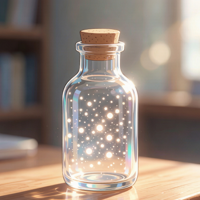
FocusBottle
Particles Dance as You Focus-focus, plan, and task.
Because time always slips away without us noticing
The reason we built FocusBottle is personal.
Every day we face the same thing: we sit at our desks for hours, yet when we look back, we can't recall where the time went. It's not that we did nothing — it's that our attention keeps getting sliced into smaller and smaller pieces. One notification, one popup, one "I'll just check quickly" impulse, and focus leaks away like sand through our fingers, faster the harder we clutch.
There are plenty of timer tools out there, but most of them only track time — they don't help you get into a focused state. What we wanted was something that makes focus visible, steady, and lasting.
So we built it like a bottle
The name FocusBottle is itself a metaphor: gather the scattered attention, like water, and pour it into one bottle.
It's not just another Pomodoro timer. It's a small system rebuilt around the idea of "focus":
Focus timer — the basic starting point. But unlike others, we use particle animation to externalize your focus state: the more immersed you are, the calmer and more gathered the particles on screen become. Focus stops being an abstract number and turns into something real and alive in front of you.
Focus calendar — drop every focus session onto a date. You no longer just see "what I did today," but "what I gave my time to this week, this month." Focus gains a trail, and only with a trail does it compound.
Task management — focus needs direction. Break tasks down, slot them into the calendar, and the timer finally has a purpose instead of staring at a blank screen.
White noise — often we get distracted because the environment is too loud or too quiet. White noise helps the brain "switch off" background noise and slide into deep work faster.
Time collection — this is the soul of FocusBottle. We call it Time Collector: what you're saving isn't just hours, but every stretch of life you treated with care.
What it's for
If we had to say it in one line: FocusBottle isn't solving an "efficiency" problem, but a relationship problem — your relationship with time.
Our generation isn't short on tools; what we're short on is a sense of control over our own time and a feeling of calm while focusing. The meaning of FocusBottle is to turn "staying focused" from something you white-knuckle through willpower alone into an experience that can be designed, seen, and collected.
The particles will dance, the calendar will accumulate, the white noise will hold you — and all you need to do is begin.

5 Comments
The distinction between tracking focus and actually changing how focus feels is interesting.
With the people who've used FocusBottle so far, what are they coming back for most: the visible/collectible sense of focused time, or the more practical timer, task, and calendar functions?
Thanks, you've hit on exactly the thing we keep turning over ourselves. "Tracking attention" and "actually changing how attention feels" really are two different things. Most tools stop at the first step — quantifying time. What we want FocusBottle to do is reach the second: let you feel yourself focusing in the moment. The particles gather as you lean in, the white noise settles you down, and every session gets collected into Time Collector — all of it exists to turn "focus" from a number into a felt experience.
As for your question — what do users value most — we're still watching the data, and we don't have a hard conclusion yet, but the early signal is interesting. Most people are first drawn in by the practical stuff: the timer, tasks, calendar. That's the easy-to-grasp hook. But the people who stay, and who tell their friends, tend to talk most about the visibility and collectability — "I can finally see what my focus looks like," "it feels good that my time is saved."
That’s helpful context. The difference between what initially attracts users and what makes them stay is an interesting distinction.
I’d like to continue the conversation outside the thread. What’s the best email to reach you on?
Hi
Thanks for your attention. I haven’t granted permission for my email yet