
FounderForesight
Find what to build next — before your competitors do

Every time I wanted to validate a product idea, I'd spend hours manually scrolling Reddit, GitHub issues, and Hacker News looking for pain signals. Half the time I'd convince myself the idea was good just because I was too tired to keep researching.So I built something to do it automatically.
What it does
FounderForesight monitors discussions across GitHub Issues, Hacker News, Play Store reviews, and RSS feeds — then runs an 11-stage AI pipeline to surface real product opportunities:
- Scrapes and normalizes discussions across sources
- Extracts pain points, categories, and sentiment using LLMs
- Clusters them semantically into scored opportunities
- Detects buying intent signals and competitor weaknesses
- Scores each opportunity across severity, monetization potential,
cross-source confidence, and velocity
The result is a ranked feed of opportunities like "AI Ethics & Validation" (+840% velocity), "Personal Finance Management" (+225%), "Cold Email Follow-up" (+200%) — each with a full problem summary, target user, ICP segments, current workarounds, and suggested product direction.


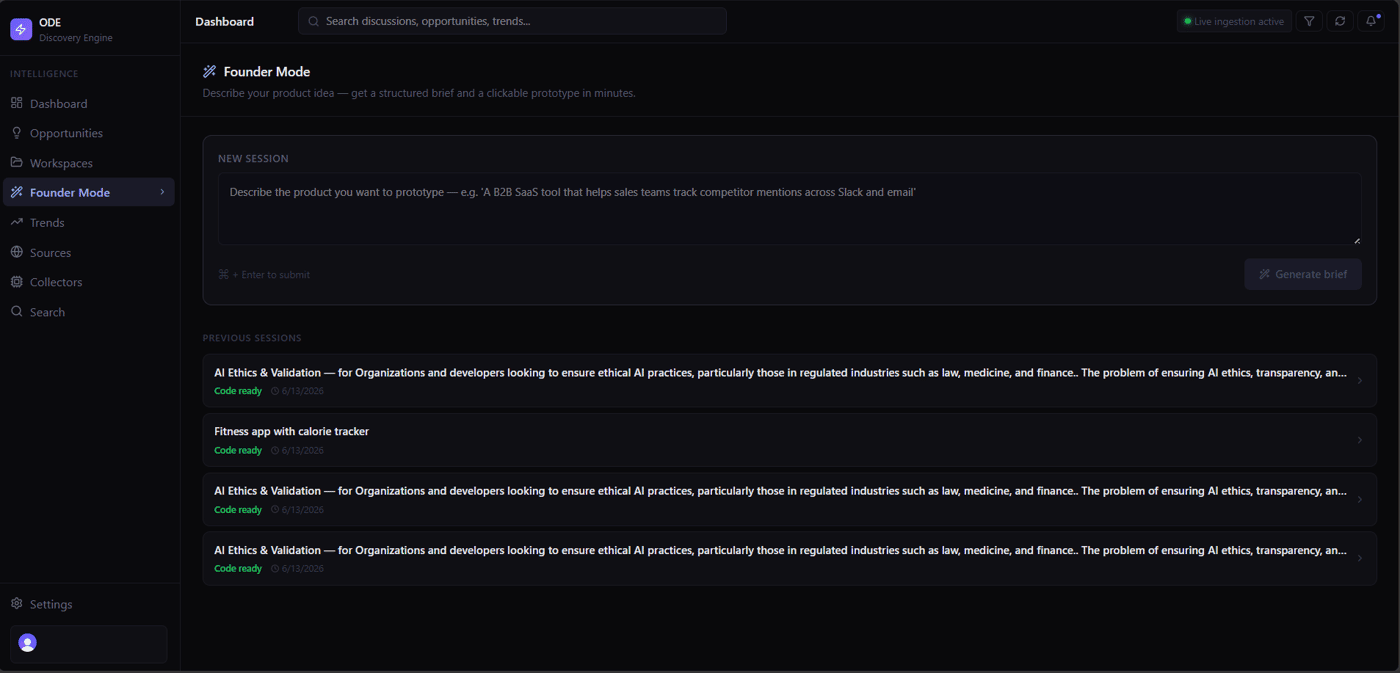
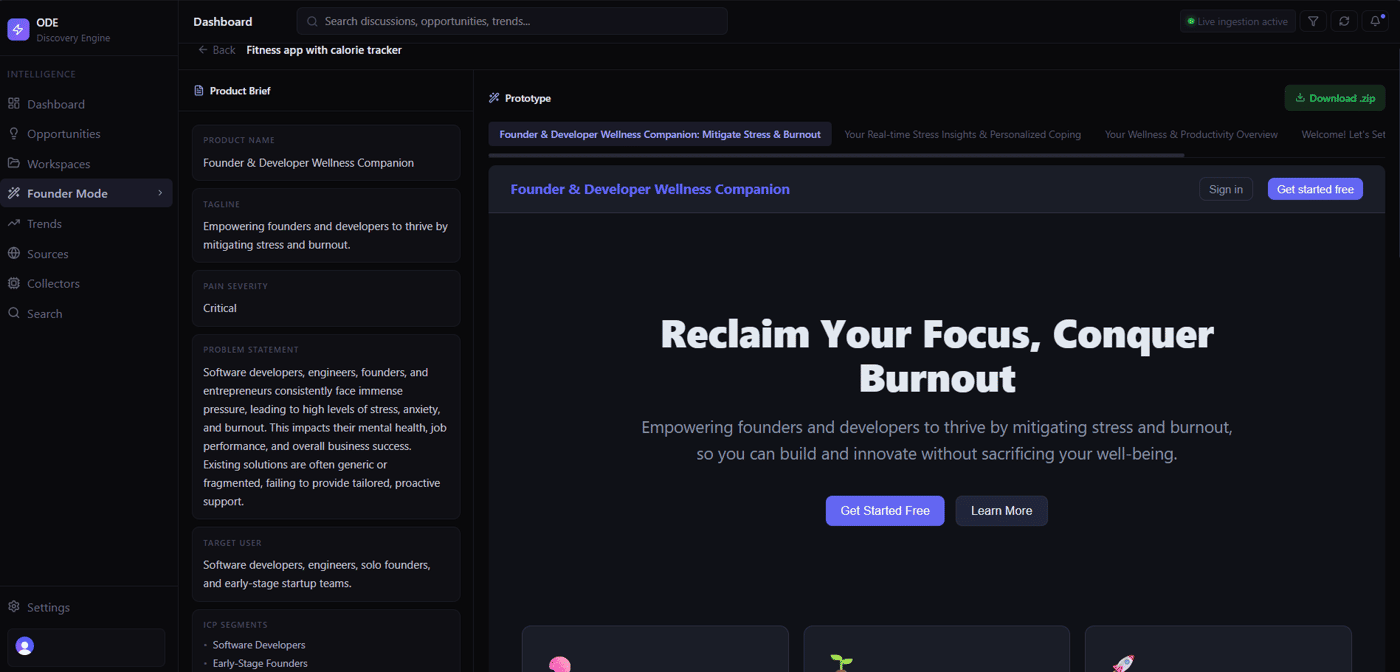
The part I'm most proud of — Founder Mode
You describe a product idea. The platform:
1. Retrieves the most relevant opportunities from its database
2. Synthesizes them into a structured product brief (problem, features, competitors, monetization model)
3. Generates a clickable 5-screen HTML prototype
4. Exports working Next.js + Tailwind UI code as a downloadable zip
All grounded in real market signal — not just LLM hallucination.
What I built it with
- FastAPI + PostgreSQL + Next.js on Cloud Run + Vercel
- Groq (Llama 3.3 70b) for background pipelines — free tier
- Gemini 2.5 Pro on Vertex AI for Founder Mode
- Clerk for auth
- Weekly data refresh cycle — total infrastructure cost ~$20/month
What I learned the hard way
Data quality matters more than pipeline sophistication.
I spent weeks building an 11-stage AI pipeline only to realize 84% of my data was Play Store reviews from Candy Crush and fitness apps.
The pipeline was processing noise at scale. Fixing the source configuration had 10x more impact than any model improvement.
Separate your LLM providers by use case.
Groq's free tier is great for background jobs but has daily token caps. Mixing interactive features with scheduled pipelines on the same quota caused silent failures I didn't catch for days.
The hybrid approach beats full HTML generation.
Instead of asking the LLM to write HTML directly, I have it output a JSON component manifest — which components to show, in what order, with what content. Python renders every HTML tag from that schema. Even weak local models produce structurally correct output this way.
Where it is now
- Live at founderforesight.com
- 210 opportunity clusters from 5,361 discussions
- Sources: GitHub (39%), RSS (46%), Play Store (12%), HN (2%)
- Founder Mode generating briefs + prototypes + code exports
- Workspaces for tracking opportunities (Saved → Investigating →
Building → Rejected)
What I'm trying to figure out
I'm not sure yet whether this becomes a B2B SaaS product, a portfolio showcase for AI automation work, or something else. Right now I just want to talk to founders and PMs who do market research manually and understand whether this would actually change their workflow.
If that's you — I'd genuinely love to hear how you currently find and validate startup ideas, and what's most painful about it.
Try it: https://founderforesight.com
What's your current process for finding startup ideas or
validating market demand? What's the most painful part of it?

5 Comments
What stood out to me wasn't the pipeline or even the opportunity clusters.
It's that the same set of signals could justify several very different businesses.
That's what makes the next decision difficult.
Not because the data is weak.
Because multiple interpretations can look equally reasonable while pointing toward completely different futures.
I'd spend more time on that question than on expanding the pipeline right now.
Hi Aryan, first of all thanks a lot for the feedback it really means a lot to me since this is my first time building in public 😊.
Thats really an insightful information. Hopefully we are in the same page, the opportunity cluster tells which pain has the most opportunity to be build as a Saas, but has no particular systems, workflow, and target audience for that opportunity right?
The data tells you on what is the painpoint of most AI users but doesn't tell you a specific solution
Therefore, what the next improvement should be to be more specific with those factors. For instance in "AI Ethics and Validation" cluster opportunity, the opportunities should include what kind of service to provide whether it is a compliance tool or developer library from that signal.
Let me know if this makes sense.
Possibly.
The reason I'd still be careful is that I don't think the difficult part is moving from pain to solution.
I think it's deciding which interpretation of the signal deserves confidence in the first place.
That's one of those decisions that can quietly determine what gets built, who it's built for, and which opportunities end up looking validated later on.
I wouldn't try to unpack that properly in a thread.
If you're curious, drop your email and I'll send over the tighter version.
Hi Aryan really appreciate you taking time for this. This is the pushback I need now. I agree with this that it is easy to move from pain point to solution, but deciding which signal deserves confidence is the crucial part.
I'll be glad to continue the discussion properly
Please email me at iponoelfilemon@gmail
P.S. I cannot include the dot com after gmail. It seems not allowed in the thread haha
Appreciate it, Noel.
I sent you a note by email.
The thing I'd be most careful with is not whether the data is useful, but whether it's quietly pushing you toward an interpretation that feels validated before it's actually understood.