
Gojek Clone App
Multi Service App
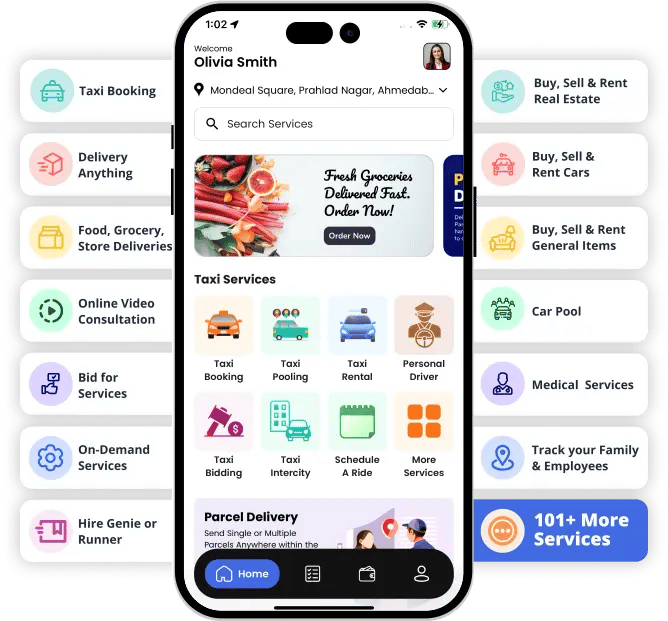
The demand for multi-service apps is growing rapidly as customers prefer using one platform for multiple everyday needs. From ride-hailing and food delivery to grocery shopping, home services, pharmacy delivery, and beauty bookings, a multi-service app can bring several services together under one digital platform.
For startups and entrepreneurs, partnering with the right multi-service app development company can simplify the process of building, launching, and scaling such a platform.
What Is a Multi-Service App?
A multi-service app is a digital platform that allows users to access different services from a single application. Instead of downloading separate apps for transportation, food, groceries, and home services, customers can use one app for multiple requirements.
A typical multi-service platform can include:
Taxi and ride booking
Food delivery
Grocery delivery
Pharmacy delivery
Parcel delivery
Home cleaning
Plumber and electrician services
Beauty and salon booking
Laundry services
Car wash
Courier services
Handyman services
This model creates opportunities for businesses to serve multiple customer needs while generating revenue from different service categories.
Why Start a Multi-Service App Business?
Launching a multi-service app can offer several advantages for entrepreneurs.
1. Multiple Revenue Streams
A platform can earn from commissions, delivery fees, booking charges, subscriptions, advertising, surge pricing, and other monetization methods.
2. Larger Customer Base
Offering multiple services gives customers more reasons to install and regularly use the application.
3. Better Customer Retention
When users can access several services through the same platform, they are more likely to continue using it instead of switching between different apps.
4. Easy Business Expansion
You can launch with a few core services and gradually add new categories according to customer demand and market conditions.
5. Strong Brand Ecosystem
A multi-service platform can establish a recognizable brand across transportation, delivery, home services, and other on-demand industries.
Key Features of a Multi-Service App
A professional multi-service platform generally consists of several applications and an administration system.
Customer App
Important customer features include:
User registration and login
Service selection
Location detection
Service search
Booking and scheduling
Real-time tracking
Multiple payment options
Ratings and reviews
Push notifications
Booking history
Promo codes and discounts
Wallet functionality
In-app chat
Customer support
Service Provider App
Service providers need tools to manage their jobs and earnings.
Key features include:
Provider registration
Profile management
Online/offline status
Service requests
Booking acceptance/rejection
GPS navigation
Earnings dashboard
Job history
Ratings and reviews
Wallet
Notifications
Customer communication
Admin Panel
The admin panel provides centralized control over the entire platform.
Administrators can manage:
Customers
Service providers
Services
Bookings
Payments
Commissions
Promotions
Reviews
Locations
Reports and analytics
Notifications
Content
Disputes
How Does a Multi-Service App Work?
The basic workflow is straightforward:
Step 1: A customer opens the app and selects a service.
Step 2: The customer enters the required details and location.
Step 3: The platform identifies suitable service providers.
Step 4: A provider receives the request and accepts it.
Step 5: The customer can track the service status in real time.
Step 6: The service is completed.
Step 7: Payment is processed and both parties can leave ratings and reviews.
This workflow can be adapted according to the type of service being offered.
How to Choose a Multi-Service App Development Company?
Selecting the right development partner is one of the most important decisions for your startup.
Consider these factors:
Experience
Check whether the company has experience developing on-demand and multi-service applications.
Ready-Made vs Custom Development
Decide whether you need a ready-made multi-service app solution or a completely customized platform.
A ready-made solution can reduce development time, while custom development provides greater flexibility.
Technology Stack
Check the technologies used for mobile apps, backend development, databases, APIs, cloud infrastructure, and security.
Scalability
Your application should be capable of handling increasing users, service providers, bookings, and transactions.
Third-Party Integrations
A strong development company should be able to integrate services such as:
Payment gateways
Google Maps
SMS services
Push notifications
Social login
Analytics
Cloud services
Identity verification
Post-Launch Support
App development does not end after launch. Look for a company that provides maintenance, updates, bug fixes, and technical support.
Multi-Service App Development Process
A typical development process includes:
Business requirement analysis
Market and competitor research
Service selection
UI/UX design
Backend development
Mobile app development
Admin panel development
API and third-party integrations
Testing and quality assurance
Deployment
Maintenance and upgrades
How Much Does Multi-Service App Development Cost?
The cost depends on several factors, including:
Number of services
Number of applications
Customization requirements
UI/UX complexity
Technology stack
Third-party integrations
Location and development team
Security requirements
Admin features
Post-launch support
A basic multi-service platform will generally cost less than a highly customized solution supporting dozens of service categories and advanced AI, analytics, and automation features.
Instead of focusing only on the initial development price, businesses should evaluate the total cost of ownership, scalability, security, support, and future expansion capabilities.
Monetization Models
A multi-service app can use multiple revenue models simultaneously.
Commission
Charge service providers a percentage of every completed transaction.
Delivery or Booking Fees
Add a fee to specific bookings or deliveries.
Subscription Plans
Offer customers or providers premium membership packages.
Advertising
Allow businesses and service providers to promote their services inside the platform.
Surge Pricing
Apply dynamic pricing during periods of high demand where appropriate.
Featured Listings
Charge service providers for higher visibility within search results.
Future of Multi-Service Apps
The multi-service app market is moving toward more intelligent and automated experiences. Businesses can integrate AI-powered recommendations, voice-based booking, predictive analytics, automated customer support, fraud detection, and personalized offers.
For startups, the biggest opportunity is not simply putting many services into one application. The goal is to create a single ecosystem that makes multiple everyday services convenient, reliable, and easy to access.
Final Thoughts
Choosing the right multi-service app development company can help turn your business idea into a scalable digital platform. Whether you want to launch a Gojek-like super app or build a platform around specific local services, selecting the right features, technology, monetization strategy, and development approach is essential.
A well-planned multi-service application can start with a small number of services and expand gradually as your customer base and business operations grow.

Comment