
Indiehackers
Posting
A few months ago, I came across a viral video that was being shared everywhere.
The same clip had completely different explanations in the comments.
Some people said it was recent.
Others claimed it was years old.
A few insisted it was taken out of context.
I wasn’t particularly interested in the debate itself. I just wanted to know one thing:
Where was this video originally posted?
It sounded like a simple question.
It sounded like a simple question. After all, we have reverse image search in which you upload a photo to Google and often find similar versions in seconds. Surely there must be a way to do the same thing with videos.
So I started searching.
A few hours later, I was still looking.
That was the moment I realized something surprising:
Reverse video search doesn’t really exist in the way most people think it does.
The rabbit hole
My first instinct was to use reverse image search.
I extracted a frame from the video and uploaded it to multiple image search engines.
The results were disappointing.
Some searches returned unrelated content. Others found reposted versions of the same clip but provided no clue about the original source.
So I extracted another frame.
Then another.
Then ten more.
Some frames produced slightly better results, but none gave me a reliable answer.
The more I experimented, the more obvious the problem became.
Videos are fundamentally different from images.
An image is a single piece of content.
A video can contain thousands of frames.
Which frame should be searched?
What if the most important frame never appears in the search results?
What if the video has been cropped, edited, compressed, or reposted with a watermark removed?
The problem was much bigger than I expected.
The internet is full of recycled videos
As I dug deeper, I noticed another pattern.
The same video often existed on multiple platforms.
TikTok.
YouTube.
Facebook.
Instagram.
Reddit.
Sometimes dozens of copies existed simultaneously.
In many cases, the original uploader was nowhere to be found.
A clip would get downloaded, reposted, clipped, cropped, stitched, edited, and reuploaded until its origin became almost impossible to trace.
This wasn’t an edge case.
It seemed to be the norm.
And yet there wasn’t a simple tool designed specifically to investigate video origins.
Looking for existing solutions
At this point, I assumed somebody else had already solved this problem.
I spent weeks testing different tools and approaches.
Some relied on extracting individual frames.
Others focused on metadata.
A few offered limited video analysis features.
But every solution seemed to have the same weakness.
They only solved one small part of the puzzle.
Finding the origin of a video isn’t usually a one-step process.
It’s an investigation.
You need to compare evidence from multiple sources, validate findings, and often look at more than one frame before reaching a conclusion.
The process felt fragmented and unnecessarily complicated.
That’s when I started thinking about building something myself.
The idea wasn’t to build reverse video search
Ironically, I didn’t start with the goal of creating a reverse video search engine.
I started with a much simpler question.
What if I could make the investigation process faster?
Instead of treating a video as one searchable object, I began experimenting with breaking it into key moments.
I tested extracting multiple frames rather than relying on a single screenshot.
I explored ways to compare findings across different sources.
I looked at how investigators, journalists, fact-checkers, and researchers verify videos manually.
The more I learned, the more I realized that no single search result should be treated as the final answer.
The real value comes from cross-referencing information.
That insight became the foundation of the project.
Building the first version
The first prototype was terrible.
It was slow.
The results were inconsistent.
And it generated far more noise than useful information.
But it taught me something important.
Even imperfect results were often better than manually jumping between multiple tools and websites.
So I kept improving it.
I refined frame selection.
I reduced duplicate results.
Tried different ways of comparing results across sources.
I improved the workflow.
And gradually, the tool became useful.
Not perfect. But useful.
What I ended up building
Instead of trying to force reverse video search into a single “search bar experience,” I built a tool focused on investigation.
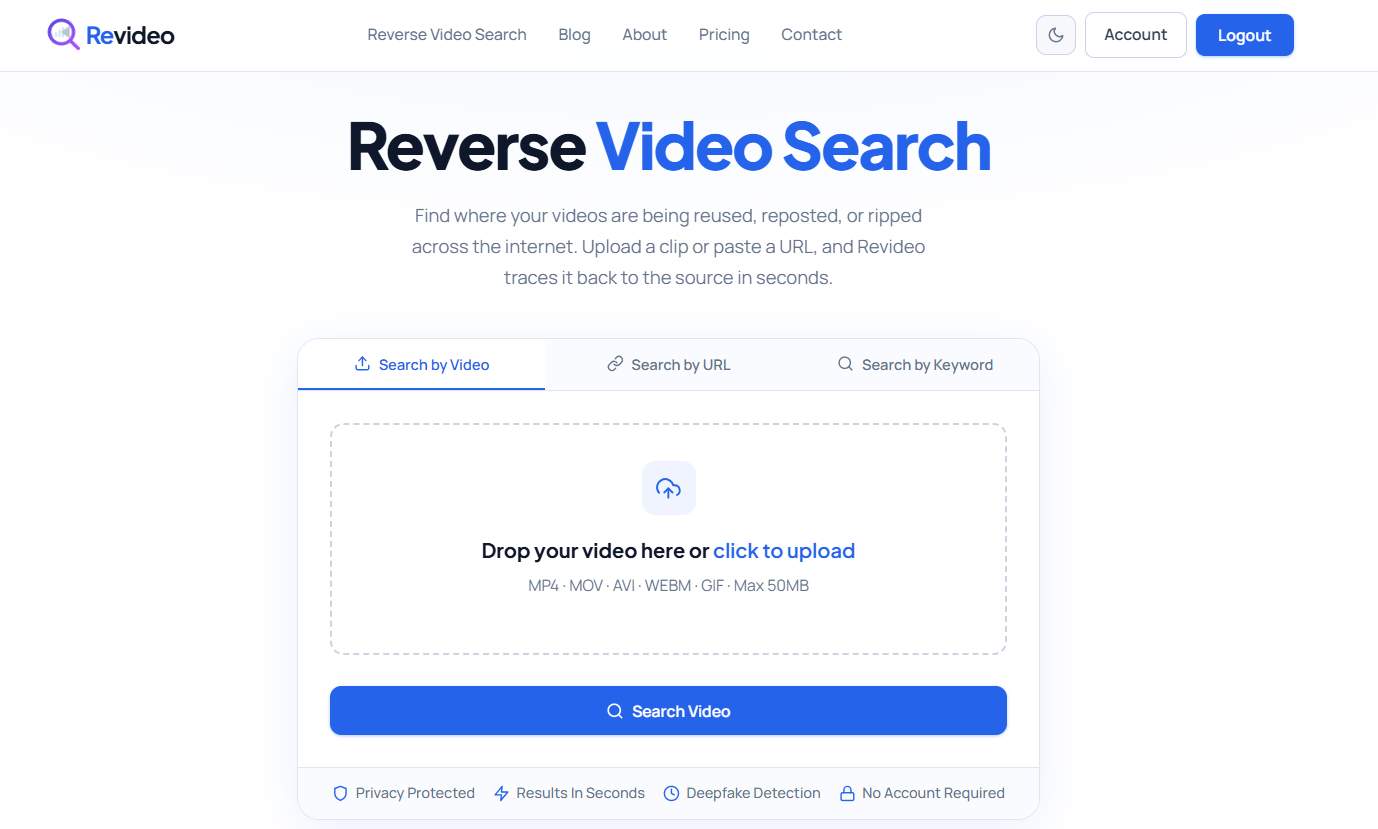
That tool became Revideo.io. It’s a web-based reverse video search engine that analyzes the uploaded video and extracts key frames from it to find similar results online.
The logic behind ReVideo is simple. A single frame may provide wrong results, but with multiple frame extraction, it only discovers the authentic reposts online. Instead of relying on one search result, ReVideo helps you compare results across different frames side by side.
This makes it easier to:
Spot reposted versions of the same video
Identify similar uploads across platforms
Cross-check different visual matches
Narrow down possible original sources
The goal was never to “solve” reverse video search in a perfect way. Instead, it was to make the video verification process easier so that you don’t get tangled between multiple tools to find an exact match of a clip.
Simply put, with Revideo, you do not need Google or any other reverse image search tools to process a video and find its similar versions across the internet.
It’s not a magic button. It’s more like a toolkit for video investigation.
What surprised me most
Building the tool taught me things I wasn’t expecting.
The biggest surprise was how often context gets lost.
Many viral videos become detached from their original source after only a few rounds of reposting.
Another surprise was how unreliable single-frame analysis can be.
Sometimes one frame leads nowhere, while another frame from the same video reveals valuable clues.
I also discovered that finding similar videos is often easier than finding the original video.
Those are two very different problems.
The internet is surprisingly good at preserving content.
It’s much worse at preserving attribution.
Why I kept building it
Even after getting the first working version, I didn’t think the problem was “solved.”
Reverse video search is still messy, and honestly, it probably always will be to some degree.
But what changed for me was realizing that even an imperfect workflow is still incredibly useful when you're dealing with viral or reposted content.
That was enough reason to keep improving it.
Where it stands today
ReVideo is still early, and I’m continuing to refine it based on real usage and feedback.
It’s not meant to replace investigative work or human judgment.
It’s meant to reduce the time it takes to get to a reasonable answer.
If you want to try it
If you’ve ever tried to trace the origin of a viral video or struggled with reposted content, you can check it out here:
I’d genuinely appreciate any feedback or suggestions from people who deal with online videos regularly.
Curious to hear from others
Have you ever tried to find the original source of a video?
What tools or methods actually worked for you?

When formalizing your business, one of the first critical decisions is whether to form a corporation or an LLC. Although both structures have legal protection and legitimacy, they differ in almost every aspect, including tax, management, and funding. Making the right choice at this stage can mean thousands of dollars and years of administrative hardship. This article provides you with everything you need to know to make this decision with confidence.
What Is an LLC?
With a Limited Liability Company (LLC), you get a combination of the liability protection of a corporation with the tax simplicity of a sole proprietorship or partnership. LLCs, by their nature, shield members' personal assets from LLC liabilities and lawsuits.
LLCs have an operating agreement that articulates the company's management, profit distribution, and outlines the procedures to be followed upon the occurrence of certain events, such as a member’s exit. As a result, LLCs are a great choice for freelancers and small business owners.
What Is a Corporation?
A corporation is an entity owned by its shareholders and has a legally separate structure. Because a corporation is a separate legal entity, it has a rigid structure, unlike an LLC, which does not require a board of directors, corporate officers, or shareholder meetings. Corporations must also keep formal records, such as bylaws and meeting minutes.
Small and medium businesses have access to two types of corporations:
C Corporation: The most common corporate structure. Considered a "double taxation" structure, as revenue is taxed at the corporate level and again at the shareholder level when dividends are paid.
S Corporation: This structure enables revenues and losses to be reported at the shareholder level, thus avoiding double taxation. However, S Corporations have strict requirements: all shareholders must be U.S. citizens or residents, and the S-Corp may have no more than 100 shareholders.
Corporation vs LLC: Side-by-Side Comparison
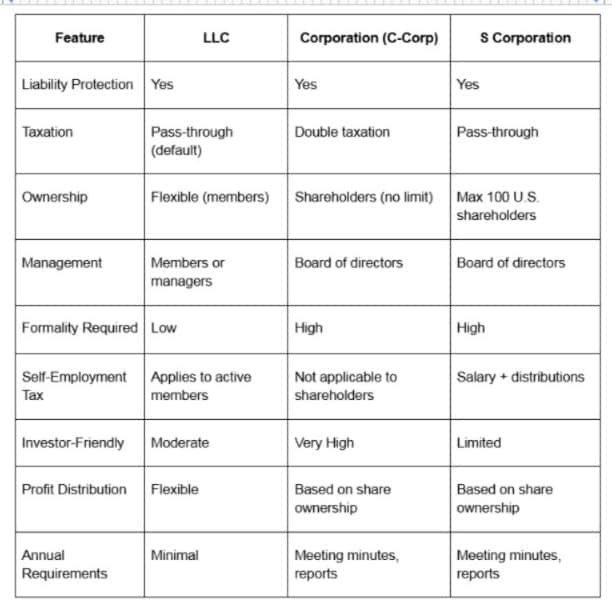
Corporation vs LLC: Tax Differences Explained
The tax structure plays a key role in most businesses' decisions about whether to register as a corporation or an LLC. Understanding the tax structure can significantly impact your business.
LLC Taxation
A single-member LLC is treated as a sole proprietorship tax-wise. A multi-member LLC is treated as a partnership. Thus, all profits and losses are reported on the members' individual tax returns. Members also pay the 15.3% self-employment tax (2024 net earnings ceiling: $160,200) on their income.
Electing S-Corp status is advantageous to LLC members for tax purposes. Members who are also owners can avoid self-employment tax by strategically splitting their income between a salary (subject to payroll tax) and profit distributions, which are self-employment tax-free.
Corporation Taxation
Under the Tax Cuts and Jobs Act, C-Corp profits are taxed at a flat corporate rate of 21%. Dividends are then taxed again at the individual shareholder level. This situation creates a corporation's double taxation structure. C-Corps are tax-advantaged for companies that reinvest upcoming profits rather than distributing them to shareholders.
S-Corps pass income directly to shareholders and avoid double taxation. However, they are subject to many restrictions and are less flexible than LLCs.
Liability Protection: How Each Structure Shields You
Both the LLC and the corporation provide a legal barrier between your personal assets and business liabilities. If your business is sued or goes into debt, creditors generally cannot come after your personal bank accounts, home, or savings, provided you maintain the separation between personal and business finances.
"Corporate veil" is the term for when courts shield the personal assets of the corporation's owners from a judgment against the corporation. However, if a business owner treats the corporation as a personal account, commingles funds, or fails to maintain the required documentation, courts may pierce the corporate veil.
LLCs are easier to maintain than corporations. Corporations require a set of formalities that is much more extensive than those of LLCs. Corporations must convene annual meetings, keep minutes, and issue stock, among other requirements. Failure to adhere to these requirements can diminish the liability protection offered by corporations.
Ownership and Investment Considerations
When your business needs to raise investor funds, its legal structure should be a C-Corp rather than an LLC. Venture capitalists will only invest in C-Corps because:
C-Corps allow the sale of different types of stock.
The sale of stock options is easy and clear.
C-Corps have a clear route to become a public company through a stock market listing.
Investors understand how to trade debt and convert notes within a C-Corp structure.
Investors can invest in LLCs, but there are much higher barriers to funding and investing due to strict membership rules. An LLC structure will operate well if you are building a business from your own funds and taking on a limited number of partners.
Management Structure: Flexibility vs Formality
One of the clearest differences in the corporation vs LLC debate is management structure.
LLC Management
An LLC can be structured in two ways:
Member-managed: All members participate in the day-to-day operation and decision-making.
Manager-managed: Designated managers, who may or may not be members, handle the operations.
With this flexibility, your LLC can evolve to suit your team rather than boxing you into a specific structure.
Corporation Management
There are three clear tiers within corporations. Shareholders elect boards, boards appoint the officers, and the officers manage day-to-day operations. Investors are familiar with this structure as it is definitive; it requires consistent documentation and periodic meetings to remain compliant with rules.
When to Choose an LLC
If you identify with one or more of the examples below, an LLC will most likely be your best option:
You are a sole trader or a simple small business owner.
You want the option to choose how you distribute profits to your members.
You operate in real estate or consulting.
You prefer not to have too many formalities.
You want to avoid seeking institutional venture capital.
When to Choose a Corporation
A corporation is typically the better option when you:
Plan to raise venture capital or seek financing.
Want to provide stock options to your employees.
Are likely to go through the IPO process.
Want your business in an industry where the corporate structure gives you a stamp of approval.
Plan to retain profits in the business to fund growth, benefiting from the 21% corporate tax rate rather than the higher individual tax rate.
State-Specific Considerations
Different states offer different rules and different fees for formation and for continuing obligations. For many years, Delaware has been the preferred state for incorporation, especially for startups and companies that will or plan to raise capital. This is largely due to the Court of Chancery, its well-established corporate laws, and flexible statutes. Low fees and strong privacy laws also make Nevada and Wyoming popular states for incorporation.
However, even if you are incorporated in Delaware and operate your business in California, you will be subject to California law and will incur additional fees for doing business in California. Your best first step is to consult your CPA or business attorney who understands your state's rules.
Final Thoughts
There is no single right answer when deciding how you will operate your business in the corporation vs LLC debate. Some factors to consider include what your business is, where it will be in the future, taxes, and the legal paperwork pertaining to the business. For most small businesses and freelancers, an LLC is the perfect fit, as it offers a combination of protection, flexibility, and simplicity. On the contrary, for founders planning an exit, building a scalable tech company, or seeking venture funding, a C-Corp often makes the most sense.
When creating a business, it is very important to choose the right legal structure at the right time. Seeking professional guidance early in the process can help you avoid costly mistakes and create a strong foundation for a successful business. This can create a strong foundation for a successful business.
Frequently Asked Questions
Q: Do LLCs have the ability to convert to a corporation in the future?
Most states allow you to grow your business and convert the LLC into a corporation. It is a process and could lead to adverse tax effects, so consult a CPA before considering the switch.
Q: Which offers a more credible structure?
Corporations are generally the preferred structure for larger clients and financial institutions, so if your large clients are institutional investors, a corporation is likely the structure they prefer.
Q: Will a corporation save me more on taxes than an LLC?
It really depends on your circumstances. Most small business owners are better off with an LLC, especially an S-Corp, as they benefit from pass-through taxation and lower overall taxes. In contrast, the corporation that retains its earnings and pays the 21% corporate tax may be a better tax choice.
Q: Do I have to hire an attorney to create an LLC or corporation?
Not necessarily, but it is strongly recommended to seek professional guidance. Mistakes in the paperwork of an LLC or corporation can create legal and financial problems in the future.
3 Comments
Have you tested how well it performs with edited videos? Cropping, filters, or text overlays usually make reverse searches much harder. I'd be interested to know how your approach handles those cases.
Excellent Article and very easy to understand. Thanks for sharing such useful information.
This is a clever workaround. I always assumed reverse video search would work the same way as reverse image search, but the technical limitations make sense. Using key frames is probably the most practical solution available right now. Nice build!