Newsletter edition: conversation types and purposes
by Semyon FastHello!
This edition of the Knei newsletter is about conversations: what is conversation, what types there are, and what people can use a conversation for. To answer these questions, we picked what we think is a suitable piece of information and came up with the Knei team’s own classification.
Let’s start with the term. According to the academic definition, “conversation is the primary basis of direct social relations between persons. As a process occurring in real-time, conversation constitutes a reciprocal and rhythmic interchange of verbal emissions. It is a sharing process which develops a common social experience.”[1]
Second, general scope. David Angle [2] argues that conversations can be categorized based on directionality (one-way or two-way) and tone or purpose (cooperative or competitive). See the scheme in the figure below.
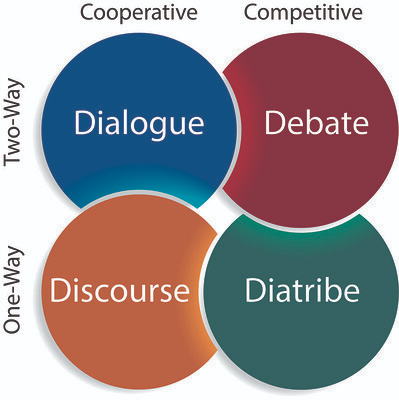
One-way conversations are conversations where an individual is talking towards the other person without having the other person talk back. One of the conversational partners monopolizes information broadcast in bulk, while the other partner is more of a passive receiver.
Two-way conversations, on the other hand, are conversations where there is mutual involvement and interaction. In two-way conversations, people are actively talking, providing nonverbal feedback, and listening.
In this text and at Knei as well, we focus on cooperative two-way conversation since it seems to be the best method to build a relationship with a person.
Third, conversational actions. Knei team prepared a list of aims a person can pursue when engaging in conversations.
Individual reasons to initiate the conversation:
- To receive information.
- To transfer information.
- To perform a transaction (a standard action with an expected result).
- To remind the person about ourselves.
- To ask for action.
- To broadcast the fact of the talk outside (meta-message).
The list is sort of subjective, so we would be happy to know your opinion in our Reddit blog or the comments section.
Thank you, that’s it for this week. You’ve known more about conversation purposes and welcome to utilize talks a bit more thoughtfully for building relationships. Keep in touch!
[1] Allen, D. E., & Guy, R. F. (1974). Conversation analysis: The sociology of talk. Mouton; pg. 11.
[2] Angle, D. W. (2016, December 28). The four types of conversations: Debate, dialogue, discourse, and diatribe. The Opportune Conflict.

