
LeanCompass
Brutally Honest AI Startup Mentor
Getting blinded by your own preconceived ideas. When has that ever happened to anyone, amirite?
I built 🧭 LeanCompass for founders to tinker with their business ideas while getting candid AI feedback. That is, until I reached out to other founders to see how it worked for their startup plans.
The feedback: Not compelling enough. What founder wants to spend their days fiddling with minor details?
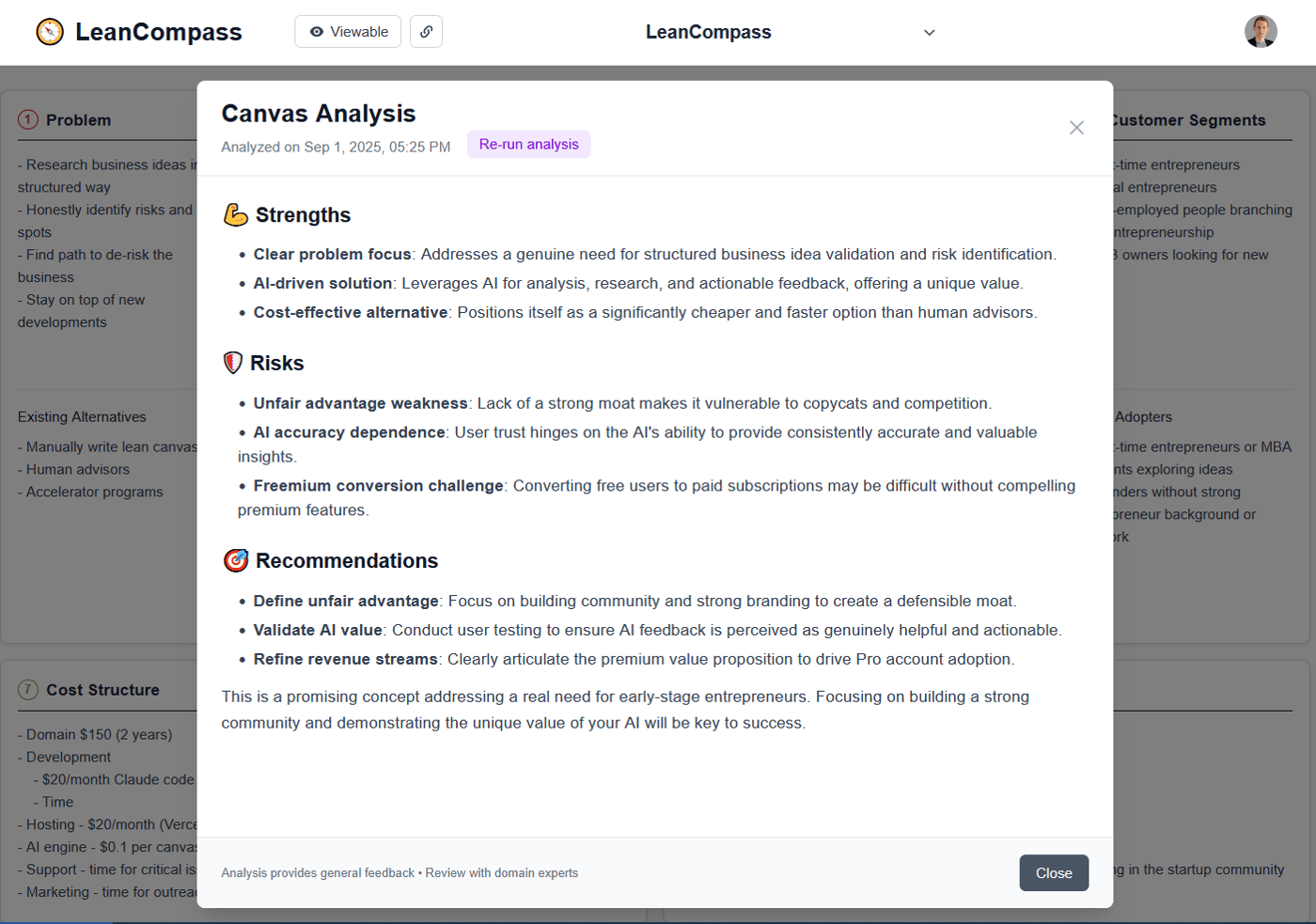
So, a rethink: 🧭 LeanCompass now looks at the bigger picture. You tell it about your startup plans and the AI does the work. It breaks down your idea, analyzes, then comes back with strategic guidance and actionable next steps.
You enter into a dialogue with your AI startup specialist, asking questions, digging deeper, and planning your next move. Like this:
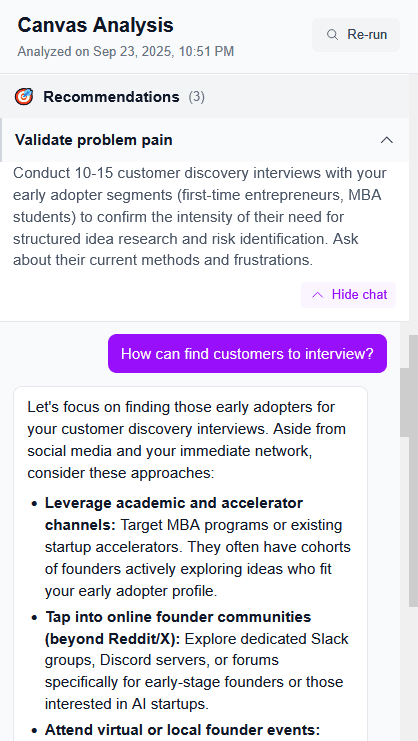
As fellow founders, what's your take on this approach? Put in your startup idea, check out the analysis and start a focused chat with the AI!
Do let me know whether the analysis and the chat brought you impactful advice!

Anyone else get caught in the "I'm sure it's a good idea" trap?
I've been there. I get a cool idea and want to dive straight into building it. Who wants to sit around doing market research when you could be making it happen?
Turns out, that's a shortcut to the startup graveyard.
So, I built a tool to force myself to get honest. 🧭 LeanCompass is an AI-powered sanity check for your startup idea. You tell it what you have in mind, maybe add in a few more details as you go. The AI gives you critical feedback, spots your blind spots, and helps you tighten your plan.
It’s like a candid advisor for those moments when you're just pitching yourself.
That's where I stand now, about 3 weeks in. I have a lot more planned, but no use building before some constructive feedback helping me prioritize where to go.
If you give it a try with your startup idea, do let me know your thoughts!
-
3
love this
-
1
Thank you! Do you have any feedback or advice for me?
Any startup ideas you'd like to get candid feedback on?
-
-
2
I don't think AI can give a truthful answer, to be honest. Validating an idea is not just about artificial intelligence. It involves conducting in-depth interviews, analyzing competitors, TAM SAM SOM, CAGR, and so on.
-
1
Right, AI can't build the business for you (see Anthropic's vending machine experiment). I believe that it can give useful advice, particularly for people with little startup experience.
I'm thinking of it like the sort of mentoring an accelerator provides; you still need to put in the work, but they'll give helpful pointers and candid feedback along the way.
It's true, experienced business development people who know all of those acronyms and have their own playbook won't need it.
-
-
2
The idea and promise had me invest time and made my sign in. But the time and effort invested didn't match my expactations at all - super generic and non-actionable recommendations.
I tried asking in my own GPT account, and told it to be brutally honest about weaknesses with my idea, and it was a far better response.Meta question: How will you monetize - seems like a one-off thing. You could funnel users into other startup tools and earn partnership/affiliate perhaps?
I love the idea - it's really good, but why should I use the service if I can get a better response with "my own AI" seems to be the general question with these AI driven products?-
1
Thank you very much for taking the time and your candid feedback!
In fact I was just working on the prompt yesterday to make it less generic and more actionable. I've made a copy of your canvas and ran the analysis again.
Do you want to take a look? It's in your account, with "(new prompt)" added to the canvas name.
I'm not sure yet where to find the right balance between too kind and too harsh. If it's too kind it's pointless, if it's too harsh people might turn away in frustration. My current thinking is that the recommendations are actually the most valuable thing since they're very actionable (since the update). What's your take? How would you personally want the feedback to be structured and presented?
Thank you very much again for your effort, I really appreciate it!
-
2
You are welcome. I like the tweaked one better for sure.
I was thinking: “Now what?” though.
If you had like: “Click here and I’ll send you 10 easy steps you can throw into ChatGPT” or whatever ☺️
Keep up the good work.
-
1
Exactly, that's what I need to work on! I've gotten a few hundred visitors with pretty minimal promo effort (this post, a handful of Reddit comments & tweets), which I take as validation that there is interest among founders.
Next is creating more incentives to sign up (atm only 3% of visitors do) and then to deliver ongoing value, such as sending emails like the one you were suggesting.
Thanks a lot for your advice, do let me know if you have any other thoughts! 😊
-
-
-
-
2
This is such a good tool and idea, well done!
-
1
Just a heads up since I saw you made an account: I just updated the AI prompt to generate more relevant and actionable advice. I made a copy of the canvas in your account and ran it there.
If you have a moment, would you mind taking a look and letting me know what you think of the change? The canvas is identical, just the analysis is different. You'll find it in your canvas list, with "(new prompt)" in the canvas name.
-
1
Thank you! Are you working on a startup right now or in the past? How did you go about validating your idea?
-
-
2
Anyone else get caught in the "I'm sure it's a good idea" trap?
that is swo relatable I'm sure we have all been there
-
1
Thank you! What idea are you working on at the moment?
If you've had a chance to try out LeanCompass, I'd love to hear your thoughts!
-
-
2
This resonates so much! It’s easy to get swept up in the excitement of a new idea and skip the reality check phase. I love the concept of LeanCompass—having an AI that gives candid feedback could save so many founders from costly missteps.
Curious—how does it handle ideas that are very early-stage or a bit unconventional? Does it give actionable steps, or more of a high-level critique? Either way, it sounds like a smart tool for prioritizing what actually matters before diving in.
Would love to hear how your first few users have responded!
-
1
Right now, it just takes whatever the user gives it. If that has significant gaps, the analysis will mainly point out those gaps and explain why they're important to fill.
I'm thinking of building a "suggestion mode" where it will try to fill in gaps proactively, but not sure yet how to best present that so the user can clearly see what's their own and what's a suggestion.
Right now my priority is on getting some feedback from users. Until now, I've only had feedback from a few friends, who are naturally a bit biased in my favor.
Do you want to give it a try or know someone who should?
-
-
2
This is a fantastic tool that solves a huge and very real problem. The "'I'm sure it's a good idea' trap" is something every founder falls into, and having an AI co-founder for a sanity check is a brilliant concept.
My main strategic question for you is about differentiation. The AI business-planning space is becoming quite crowded. I'm curious, what do you see as LeanCompass's unique "point of view" or "special sauce" that will make it the go-to choice over other tools?
For example, is it the "brutally honest" tone? Or a deep focus on a specific niche (like B2B SaaS, or e-commerce)? Defining that sharp angle seems like it could be a powerful way to guide your next steps.
Really impressive work for just 3 weeks in!
-
1
Thank you for the encouragement!
It's true, there is a lot going on in the space. Right now I think it's about giving candid yet constructive feedback, including questioning the user's assumptions.
From what I can see, many other tools take user assumptions as gospel and help implement them regardless of how realistic or verified they may be.
Will that be enough? Do users want that? I honestly don't know yet. That's my own assumption to verify.
Do you have any advice how to go about that verification?
-
1
That's a fantastic question, and the fact you're asking it is why your project will likely succeed. So many founders skip this crucial validation step.
My go-to playbook for this usually has two parts:
Problem Interviews: I'd find 5-10 of your ideal customers (early-stage founders on Indie Hackers, for example) and ask for a 15-minute chat. But the key is to not pitch LeanCompass. Instead, ask about the last time they had a new startup idea. Dig into their process with questions like: "What was the first thing you did?" "What were you most unsure about?" "Did you ever get feedback that felt too nice or unhelpful?" The goal is to see if they bring up the pain of needing "brutally honest" feedback on their own.
The "Brutal Honesty" Smoke Test: You could also test the specific angle directly. Create a simple landing page with a headline that leans into your unique value prop, like "Your startup idea is probably bad. Let's find out why." Instead of a full product, just have a simple email signup for the waitlist. If a significant number of founders sign up for something that promises painful honesty, you've validated the demand for your specific approach.
Hope this helps! Being the "honest" voice in a sea of supportive ones is a very powerful position to own.
-
-


6 Comments
This is really smart — turning AI feedback into an actual “dialogue” instead of just static analysis feels way more valuable.
I’ve had the same issue: early feedback often feels too shallow, and you end up guessing what to fix next.
Curious:
How deep does the AI go when suggesting next steps (e.g. market fit, pricing, GTM)?
Have you seen it surface unexpected opportunities or only refine what founders already know?
Love the idea of a founder dropping their plan and getting structured guidance right away.
With enough background it goes pretty deep, for example suggesting specific search terms, subreddits, and post content for doing user outreach.
I found this works best in dialogue with the founder so it knows on which topics to dive deep. For example, this is the breakdown and analysis it gave me for Kaelis based on your post a few weeks back: https://leancompass.ai/c/06f26e3d-47cb-434e-bb35-2cf189b7a55e
The analysis on the left gives you a menu of choices to discuss further, such as the channels to reach users and the revenue model.
For example, I've asked it "Are there specific industries that are particularly reliant on messaging, internal or with customers?" in response to its "define channels" recommendation and it gave me this:
Digital Agencies (Marketing, Design, Development): Project-based work, client communication, and internal team coordination are heavily reliant on real-time messaging and shared documentation.
Consulting Firms (Tech, Management): Client engagements involve extensive communication, knowledge sharing, and documentation across distributed teams.
Then you'd decide what to focus on and perhaps ask "What's a good outreach channel for digital agencies" and so on, one step at a time.
Give it a try and let me know how it goes!
Thanks so much Chris 🙌
Really appreciate you sharing LeanCompass and pointing out the digital-agency/consulting angle.
My first ICP stays micro-SaaS teams (3–7 people) to validate the core metrics, but I’ll definitely explore agencies and consulting firms as a natural next step.
Super helpful!
I like how you’re framing this around a compass rather than just another productivity tool -great minds think alike. Systems that give direction often outlast tools that just fill calendars or track tasks. In my own work, I’ve seen how having a compass for clarity and navigation changes the way people approach growth.
Curious — as you developed LeanCompass, how did you test whether people wanted a system to decide differently versus just another tool to do more?
TBH, I don't know yet.
I work with a lot of startups in my fractional CTO role and find myself frequently explaining similar things to different founders. My take with LeanCompass is to build a platform that acts as a mentor and guide at the strategic level, not a tool for executing specific tasks.
What are you working on these days? If you're exploring a startup idea or know anyone who is, I'd love to hear your feedback on LeanCompass, particularly the analysis and chat!
Hey Chris, I've been "in the trenches". Developing, refining, crying cold tears on the pillow. Ya know, a founder's life lmao. In all honesty, I was grazing, trying to figure it out, when I came across some documents inspired by Cal Newport's Deep Work, where the other piece of my puzzle was lying. I TOTALLY forgot about them, but within hours, Kindred Compass Academy was forged.