
Magic Lasso Adblock
Fast and efficient ad blocker for the iPhone, iPad and Mac

There’s a lot of ways to block ads on your iPhone.
However for effective ad blocking – without creating more problems than it solves – requires you to understand how each ad blocking method works, where it may block ads, and the trade-offs to consider.
So, to help choose the right ad blocking solution for various needs, I’ve written up a comprehensive guide on “How to block iPhone Ads”.
This guide explains how:
Content blockers
Web extensions
DNS filtering, and
VPNs
work to block ads on your iPhone – along with the pros and cons of each.
There are many benefits to blocking iPhone ads, including:
Increased Privacy – By stopping ads, you reduce the amount of personal data that advertisers can collect, making it harder for companies to build detailed profiles of you.
Improved Speed – Removing ads reduces the number of resources used to load a web page, which results in a faster, smoother experience.
Less Annoyances – Stopping ads eliminates intrusive pop-ups and un-skippable video ad distractions, allowing you to enjoy your content without constant interruptions.
Better Battery Life – When you block ads, you also extend your device’s battery life, removing battery draining ad network resources and trackers.
Reduced Energy Use – Blocking ads reduces data and server resources, that use significant energy, contributing to a more sustainable online experience.
I’ve also included a recommended approach at the end, to easily block and remove the most ads possible:
https://www.magiclasso.co/insights/how-to-block-iphone-ads/
What do you think?
Do you block ads on your iPhone?
Have you had issues with ad blockers in the past, creating problems or breakages in websites and apps?
Are there other effective approaches or technologies you’ve used to block ads?


What Makes a Great Safari Extension?
To answer that question, I hand-picked seven of the very best Safari add-ons for:
✋ Privacy
🛒 Shopping & Deals
📖 Reading & Social
🖌️ Productivity
🧩 Customization
🔍 Search
🔐 Passwords
What I found is that not all extensions are created equal.
Before installing any extension, it’s worth considering a few key factors beyond its features:
Privacy – Does it respect your privacy and avoid collecting unnecessary browsing data?
Compatibility – Does it integrate seamlessly with Safari and work across iPhone, iPad and Mac?
Ethics – Is it transparent about how it works, without hijacking links or monetising your browsing?
Support – Is it actively maintained, regularly updated and backed by a developer committed to keeping pace with the evolving web?
Every extension I selected meets these standards, delivering an experience that feels right at home on Apple’s platforms and within Safari.
You can read the full post, with details of which are the best Safari extensions and add-ons available in 2026:
https://www.magiclasso.co/insights/best-safari-extensions/
What do you think?
Should other factors be considered before installing any browser extension or add-on?
Agree or disagree with the selected extensions?
What other browser extensions do you find indispensable in your setup?

Here's a pattern I can't un-see:
🤖 AI threatens my profession → "This is unethical."
🤖 AI helps my profession → "This is innovation."
Journalists
AI companies
Hollywood
Universities
They all seem to make exceptions when AI benefits them.
I call it AI Exceptionalism.
It’s the belief that AI should follow different rules depending on who is using it.
To be clear, this isn’t an argument that all uses of AI are equally good. Nor is it an argument that copyright doesn’t matter, or that artists, writers, actors and educators don’t have legitimate concerns.
They absolutely do.
But if we’re going to have an honest conversation about AI, shouldn’t we try applying the same principles consistently?
Agree? Or am I completely wrong?
See four examples where AI consistency disappears remarkably quickly in the full post:
-
2
I think consistency is the key point here. People often judge AI less by the underlying principle and more by whether it threatens or strengthens their own position. That makes debates about AI adoption as much about incentives as ethics.
-
1
Exactly, and it makes a lot of the online discourse written about AI, especially from tech journalists, who praise AI for coding but dismiss AI for writing, especially frustrating.
-
2
One thing I'd keep watching is whether people's views on AI change when the technology changes or when their own incentives change.
Those can look like the same debate on the surface, but they often produce very different conversations.
-
-


It’s always scary comparing your own app against the competition – especially in such a crowded and competitive field such as ad blockers!
Despite the hesitation, I’ve once again looked at the competition and been as objective as possible to crown the 👑 “Best Safari Ad Blocker” in July 2026:
https://www.magiclasso.co/insights/best-safari-ad-blockers/
The comprehensive guide (now updated to also include uBlock Origin) evaluates Safari ad blockers against several key factors:
🔐 privacy
🏎️ speed
🧩 compatibility
😀 ease of use
✋ effectiveness
You can read the full guide to see which options stand out in 2026.
Updating this ad blocker comparison guide ensures that I keep on top of what needs to be improved in my app, and also how well the competition’s been doing over the last couple of years.
What do you think for your own startup or app…
Do you like to keep on top of the competition?
Is it best to focus on your customers and your own product instead of the competition?
Have you ever made a detailed competitor comparison like this one?
-
2
What stood out to me is that you're treating competitor comparisons as a product research tool rather than a marketing exercise.
The interesting part isn't deciding who's "best." It's identifying where competitors have reset user expectations, versus where there's still room to differentiate. That feels much more valuable than simply keeping score.
-
1
Agree – it has been a valuable exercise creating this comparison as it is great for internal research purposes.
As a solo founder, it can also be hard to keep going and a bit of competitive pressure (looking at where my product can be improved and what others have done) has been a good motivator.
-
1
Interesting.
Your reply made me think less about competitor comparisons themselves and more about what changes once they're used to shape product strategy instead of just measuring feature gaps.
I don't think I can explain that line of reasoning properly in a thread without oversimplifying it.
If you're interested, what's the best email to reach you on?
-
-

It’s easy (and fair) to complain about subscription fatigue. But here’s the take that might rub people the wrong way:
Subscriptions aren’t the problem — they might actually be the fix.
Because the thing we’re nostalgic for: “pay once, own forever”, had a flaw we don’t talk about enough: products stopped improving the moment you bought them. The incentives were misaligned from day one.
Subscriptions flip that. If users don’t keep getting value, they leave. Simple as that.
I just wrote a deeper breakdown here:
https://www.magiclasso.co/insights/why-everythings-a-subscription/
As builders, this changes how you think
We run a small subscription app (Magic Lasso Adblock), and moving to this model forced a much sharper question:
“Is this worth paying for every single month?”
Not how to push upgrades. Not what to lock behind a paywall. Just whether the product keeps delivering.
That shift removes a lot of the games around pricing and funnels. You either build something people stick with, or you don’t.
The controversial bit
I’ll push it further: If your product can’t justify a subscription… maybe it shouldn’t exist as a business.
That’s intentionally a bit provocative. But subscriptions expose weak products fast. You can’t rely on one-off purchases or clever packaging; users can just cancel.
At the same time, not everything deserves to be a subscription, and that’s where a lot of today’s frustration comes from. The model is powerful, but also easy to abuse.
Curious where people here land on this?
Are subscriptions actually better, or just better for builders?
What’s one product you happily pay for every month?
What’s one you cancelled instantly?
Do “pay once” products still have a real future?
If you’re building or thinking about monetisation, I go deeper into the trade-offs in the full article:
https://www.magiclasso.co/insights/why-everythings-a-subscription/
Interested to hear where people agree, and where this take falls apart?

Am excited to have just released a new version of Magic Lasso Adblock that blocks ads and trackers in streaming apps on the Apple TV – a feature I’ve long wanted for myself!
The new Apple TV release of Magic Lasso builds upon the existing iPhone, iPad and Mac ad blocking apps, to now also work seamlessly on Apple TV devices, extending protection to:
streaming video apps,
games, and
news apps.
All ad blocking is done directly on-device, using a fast, efficient Swift-based architecture that follows a strict zero data collection policy.
Best thing is, Magic Lasso Adblock, with Apple TV ad blocking, is available now for all Magic Lasso subscribers, at no additional cost.
Read the full blog post to see how easy it is to get started blocking ads on your Apple TV, and some background on the key goals of the new tvOS release:

Web browsers remain one of the most important pieces of software on a device — and the differences between them still matter.
We objectively tested Safari, Chrome, Firefox, and Edge to determine which offers the best:
⏱️ Speed
🧩 Standards Compliance
🖌️ Graphics performance
⚡️ Energy efficiency
🔐 Privacy
In 2026, the browser landscape has continued to evolve.
Key highlights in 2026, covering the most meaningful changes and trends include:
Chrome now equals Safari in web browsing speed tests, though Safari still delivers the best graphics performance
Edge and Chrome have significantly improved their energy efficiency. They now lead all other browsers in low energy use and battery consumption
Firefox continues to lag behind in performance, trailing all other browsers, while regressing in graphics performance during 2025. Firefox has also lost bragging rights to being the most energy efficient browser
Due to the their ‘free’ business models, lack of inbuilt privacy controls continues to be most browser’s achilles heel. Only Safari and Firefox meet the privacy protection standards expected by most users, yet they too could do so much better
Year on year, there’s been no changes in standards compliance rankings with Chrome continuing to lead, followed by Edge and then Safari. Firefox remains a distant fourth.
Browser competition is more intense than ever, with only a 2 point total score gap between the top three placings. In 2025, that spread was 6 points – demonstrating the impact that focused year-on-year improvements can make to a browser’s rankings
See the full tests, rankings and know which browser was crowned "The Best Overall Web Browser in 2026" in the article:

Last week I shipped the 164th version of my app, Magic Lasso Adblock. That’s over 150 releases and 4 million app updates delivered to users — averaging more than one release every month for eight years.
You might ask: why keep shipping so fast, for so long?
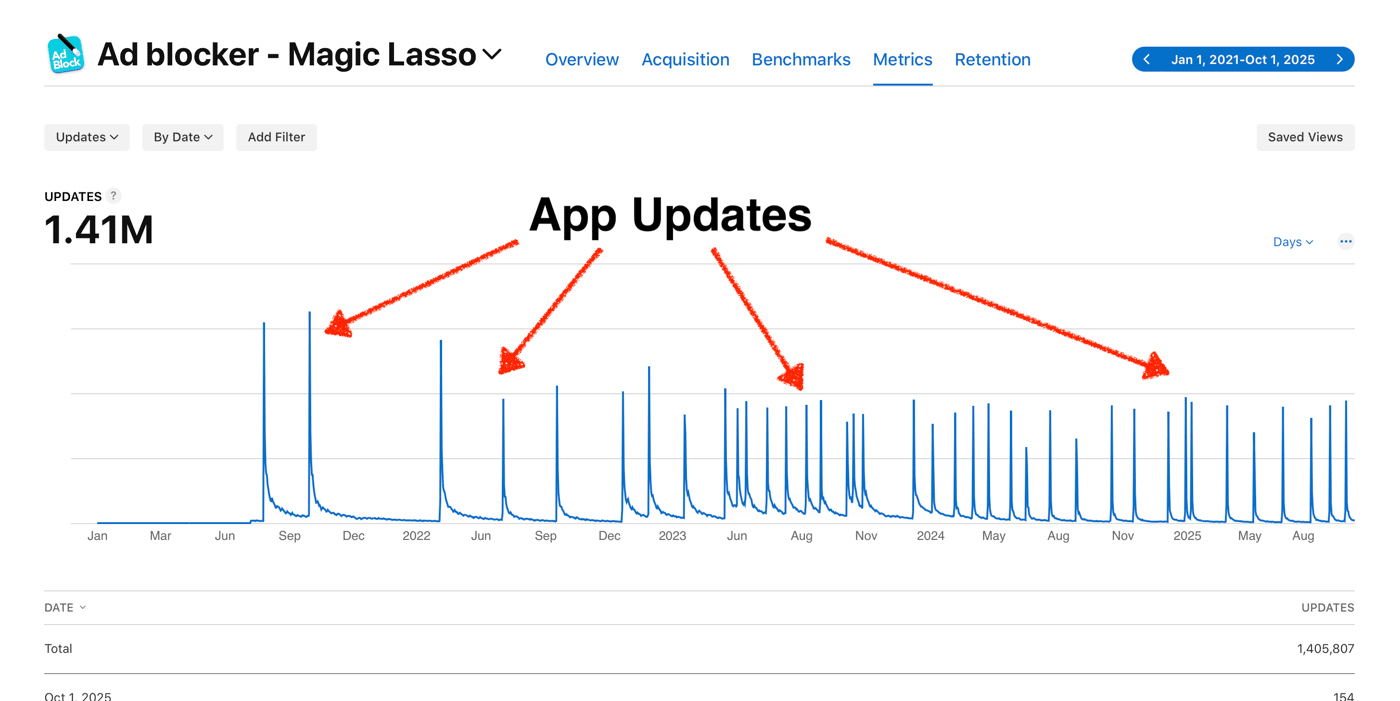
Here’s what I’ve learned 👇
1️⃣ Consistency gets rewarded
Both Apple and users notice regularly updated apps. Frequent releases improve App Store visibility and keep users coming back — which drives engagement and subscriptions.
2️⃣ Stay in sync with users
Each update focuses on the biggest issues or requests coming from real users. That constant feedback loop ensures the app evolves toward towards what people actually want.
3️⃣ Momentum beats perfection
Shipping small, meaningful updates keeps me honest and focused. It prevents “big rewrite” rabbit holes and forces me to deliver real value every couple of weeks.
This approach has helped Magic Lasso Adblock catch up to — and even surpass — larger, better-funded competitors.
So I’m curious:
👉 What stops bigger tech teams from shipping user value this fast?
Is it just the mythical man-month problem — or something deeper about process, incentives, or culture?
Would love to hear your thoughts.
If you’re curious about the app, check it out here:

Last week, Apple released macOS 26 — and the ripple effects have been incredible.
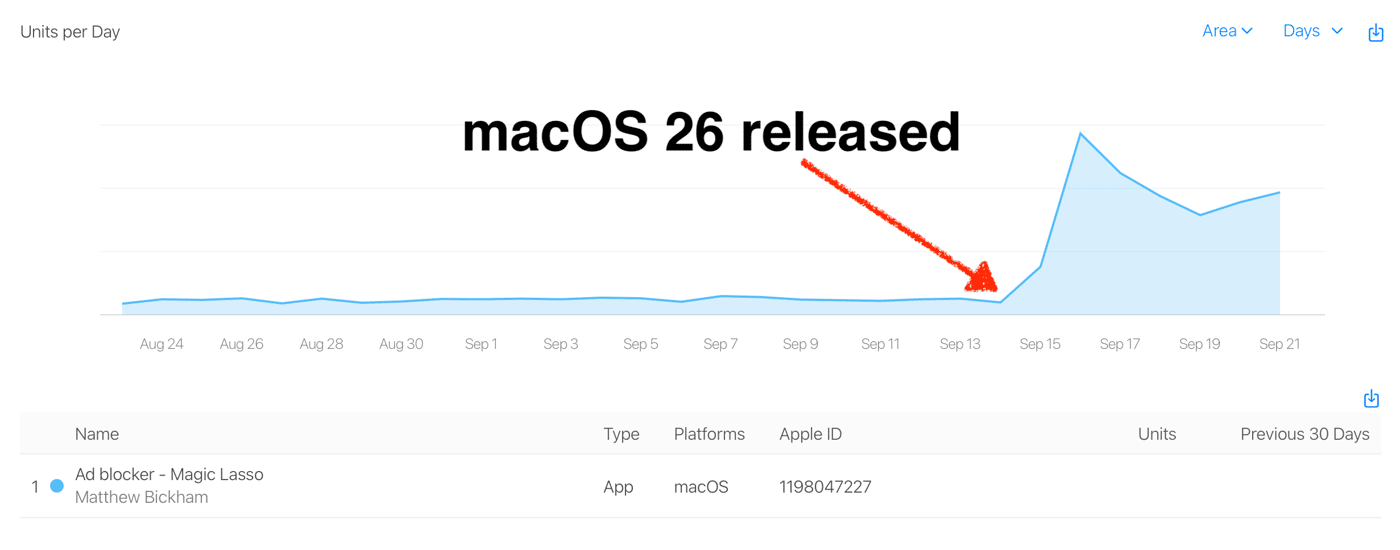
My app, Magic Lasso Adblock, has seen an explosion in downloads, with growth spiking by over 1,000% in just 24 hours.
Here’s why I think this happened:
Safari now prompts users to install extensions on first run — opening a huge new discovery channel for indie developers like me.
OS upgrades are often when people refresh their software stack. With macOS 26 + iOS 26 launching, many past users returned to give Magic Lasso another try — and discovered the new features we’ve been building.
Timing matters: just days after Apple’s release, I shipped Magic Lasso v5.0.3 with full support for macOS 26, iOS 26, and iPadOS 26, including the new Liquid Glass UI — designed to feel right at home in the latest OS.
I’ve been critical of Apple’s App Store policies in the past, but it’s only fair to highlight when they get things right. This change has created a big win for users and developers.
Now the big question:
👉 Will this uplift become a long-term trend, or is it just a launch spike?
Either way, it’s exciting to see indie apps like Magic Lasso benefiting from Apple’s ecosystem decisions.
Curious about my app?
You can check it out here: https://www.magiclasso.co/

Most apps don’t make money from subscriptions. They make money from you.
Your data — browsing history, app usage, personal behaviour — is worth cold, hard cash.
We ran the numbers for our app, Magic Lasso Adblock, and here’s what we found:
Current Subscription revenue per user: $25.50/year
Potential Data broker revenue per user: $30+/year
Meaning: we could more than double our profit margins overnight by selling user data.
And it gets worse: Apple’s 15-30% App Store tax only applies to subscriptions — not data deals. So the platform that markets itself as privacy-first is actively incentivising the opposite.
Still, we said no. No tracking, no selling, no compromises.
But it raises the question: are privacy-first business models sustainable?
Full breakdown here:
https://www.magiclasso.co/insights/cost-of-privacy/
Why I’m sharing this:
Transparency. Most apps won’t admit what user data is actually worth, let alone publish the numbers. We wanted to show the real opportunity cost of building with privacy at the core.
If you’re building a consumer product, you’ll face this trade-off sooner or later:
Take the easy data money 💰
Or build a slower, subscription-driven business with trust at the centre 🛡️
We’ve chosen the second path. But would you?
Question: If you were in our position, would you leave 115% profit growth on the table to protect user privacy?


Comment