
MakePostAI
Make Viral Social Media Posts in Seconds with AI
You're posting. Nobody's responding. And the worst part? You can't figure out why.
It's not that your content is bad. It's that you're making the same five mistakes that kill reach before the algorithm ever gives your post a chance. Each one is fixable — today, not after some 90-day strategy overhaul. Let's go through them honestly.
Mistake 1: Your Hook Is Doing Nothing
The first line of your caption and the first frame of your video are the only things that matter initially. Everything else is secondary.
Here's what most people miss: the hook isn't just about being interesting. It's about pattern interruption. Your audience is mid-scroll, half-conscious, moving fast. Your opening has to stop that momentum cold. "5 tips for better content" doesn't stop anyone. "I lost 4,000 followers doing this one thing" stops everyone.
Strong hooks make a specific promise, create a knowledge gap, or state something provocative. Weak hooks are vague, generic, or start with "I" talking about yourself before you've earned attention. Look at your last five posts. How many open with something that would stop you mid-scroll?
Mistake 2: You're Posting at the Wrong Stage of Awareness
This one's subtle and it kills accounts that are otherwise doing everything right.
Every piece of content targets a reader at a specific awareness level. Some content works for people who've never heard of your topic. Other content only resonates with people already deep in it. When you mismatch the two — writing advanced content for a cold audience, or basic content for a warm one — you get silence.
The fix is intentional. Buffer's content strategy research shows that accounts with the highest engagement rates consistently mix content across awareness levels: 60% broad appeal, 30% mid-level, 10% deep-niche. If you're only posting for people who already know your world inside out, you're writing for a room that's mostly empty.
Mistake 3: The Algorithm Isn't Your Enemy — Your First 30 Minutes Are
Every major platform — Instagram, TikTok, LinkedIn, Facebook — uses early engagement as the primary signal for wider distribution. The first 30 minutes after posting is when the algorithm decides if your content gets pushed to a broader audience or buried.
That means your engagement rate in that window determines your reach for the entire post lifecycle. Not the caption. Not the hashtags. Not the design. The engagement velocity right after posting.
This is why posting at peak times matters so much. It's also why buying fake followers is one of the dumbest moves you can make — a large audience of non-engagers tanks your rate, which tanks your reach, which is a death spiral. HubSpot's 2025 social media report confirms that accounts with smaller but genuinely engaged audiences consistently outperform larger ones with passive followers.
Smaller engaged audience beats bigger passive one. Every time.
Mistake 4: Your CTA Is Either Missing or Wrong
You've delivered value. Someone read the whole post. And then… nothing happens. They scroll on.
That's on you, not them.
Every post needs to direct the reader somewhere — a comment, a save, a share, a click. But here's what most people get wrong: generic CTAs ("follow for more", "like if you agree") perform terribly compared to specific, low-friction ones. "Which of these did you not know? Drop the number below" gets comments because it's easy to answer. "Tag someone who needs to hear this" gets shares because it gives people a reason to act.
The CTA should feel like the natural conclusion of the post, not a tacked-on plea. Write the post, then ask: what's the single most natural thing for someone to do after reading this? That's your CTA.
Mistake 5: You're Consistent in Volume, Not in Quality
Posting every day sounds like discipline. Sometimes it's just noise.
The truth is that frequency without quality trains your audience to ignore you. If someone sees your content three times and it doesn't deliver, they start scrolling past you without even registering it — even when you eventually post something great. Their brain has already categorized you as low-signal.
Sprout Social's engagement benchmarks show that accounts posting four to five times per week with high-quality, consistent content outperform accounts posting daily with mixed quality. The number isn't magic — the quality floor is. Set a minimum standard for yourself, and don't post below it, even if that means skipping a day.
What's your current quality floor? Be honest.
The Structural Problem Under All Five Mistakes
Here's the thing: all five of these mistakes share a root cause. You're posting without knowing how the post will perform before it goes live.
Experienced creators develop an instinct for this over years. They can look at a hook and know it's weak. They can read a caption and feel the CTA is off. But that instinct takes a long time to build — and most people quit before they get there.
The faster path is pre-publish scoring. MakePostAI's viral prediction feature analyzes your content before you post it, flagging weak hooks, mismatched awareness levels, and missing CTAs before they cost you reach. It's not replacing your judgment — it's accelerating the feedback loop that usually takes months of trial and error to complete.
You stop guessing. You fix before publishing. Your engagement rate climbs because you're catching the mistakes at the source.
The Fix in Practice: A Simple Pre-Post Checklist
Before every post, run through these five questions:
1. Does my first line stop a mid-scroll reader cold? If you wouldn't stop for it, nobody else will.
2. Am I writing for the right awareness level? Warm audience or cold? Make sure the content matches.
3. Am I posting when my audience is actually online? Check your analytics. Peak engagement windows vary by niche and platform.
4. Is my CTA specific and low-friction? "Drop a 🔥 if this hit" beats "like and follow" every single time.
5. Does this post meet my personal quality floor? If the honest answer is no, sit on it. Fix it tomorrow. Post it when it's ready.
Five questions. Two minutes. It won't guarantee a viral post — nothing does — but it will stop you from posting the mediocre ones that erode your audience's trust over time.
One More Thing Nobody Wants to Hear
Your niche might just be undersized on the platforms you're using.
If you're talking to ultra-niche B2B buyers on Instagram, you're fishing in the wrong pond. If your audience is 55+ and you're posting only on TikTok, same problem. Platform-audience fit is real and it affects engagement no matter how good your content is.
Before you overhaul your content strategy, make sure the platform itself is right for who you're trying to reach. Sometimes low engagement is the platform telling you to go somewhere else — not that your content is broken.
Fix the platform fit first. Then fix the content. In that order.
MakePostAI handles ideation, creation, pre-publish scoring, and scheduling across all platforms — try it free for 7 daysand run your next five posts through it before they go live.

Timing doesn't make bad content good. But it absolutely makes good content invisible.
You can write the perfect caption, nail the hook, spend an hour on design — and then post at 2pm on a Tuesday in the wrong niche and watch it flatline. The algorithm isn't broken. Your window was just wrong.
Here's what the 2026 data actually says, broken down by platform and niche.
Instagram: When Your Audience Is Actually Scrolling
The Sprout Social 2025 global data puts peak Instagram engagement at Tuesday through Friday, 9am–11am in your audience's local time. Wednesday at 10am is consistently the single highest-performing slot across most account types.
But here's what most guides won't tell you: your niche shifts this significantly.
Fitness & wellness — early morning wins. 5:30am–7:30am Monday, Wednesday, Friday. People check their phone before the gym or right after. Post when the motivation is highest.
Food & restaurants — post before hunger hits. 11am and 5pm are your windows. You're planting the craving before lunch and dinner decisions get made.
Business & B2B — Tuesday through Thursday, 8am–10am. Decision-makers scroll before meetings, not after. Friday afternoon is a dead zone.
Fashion & lifestyle — evenings do well here. 7pm–9pm Thursday and Friday, when people are mentally clocking out and browsing aspirationally.
Parenting & family — 8pm–10pm every night. Kids are asleep. Parents finally have their phone back.
The one universal rule: never post between 1pm–3pm on any platform. That's the productivity slump window where people are at their desks pretending to work, not on their phones.
TikTok: The Algorithm That Doesn't Care (As Much) About Time
TikTok is different. Its For You Page can surface content days or weeks after posting — so timing matters less than on Instagram. That said, it still matters.
Hootsuite's 2025 TikTok analysis points to Tuesday 2pm–6pm, Thursday 7pm–9pm, and Friday 5am–9am as the highest engagement windows globally.
The 5am Friday slot is counterintuitive but real. Early risers, gym-goers, and international audiences overlap in that window. It's a low-competition time with decent eyeballs.
By niche on TikTok:
Entertainment & humor — late evenings, 8pm–11pm. People decompress with TikTok after work. This is appointment viewing.
Education & "learn something" content — mornings, 7am–9am. People want to feel productive. Give them something useful before their day starts.
Beauty & skincare — Sunday evenings. It's routine-setting time. People are planning their week and thinking about self-care.
Finance & investing — weekday mornings, 6am–8am. The audience that cares about money wakes up early and checks markets before breakfast.
Facebook: Not Dead, Just Different
Facebook's median age skews older now and that changes everything about optimal timing.
Best slots in 2026: Monday through Wednesday, 8am–12pm. Facebook users are more habitual — they check at the same times daily, usually morning with coffee. Weekend posting underperforms compared to Instagram and TikTok because the feed algorithm deprioritizes non-paid content on low-engagement days.
Local businesses do well posting Thursday and Friday, 1pm–4pm. That's when people are making weekend plans and local intent is highest.
Community and group-focused content peaks on Wednesday evenings, 6pm–9pm. People engage with community content when they have mental bandwidth — not during the workday.
The Mistake That Kills Your Reach
Posting at the right time with the wrong content is still a loss. And posting great content at the wrong time is a waste.
Most creators pick one or the other to optimize. The ones who grow fast do both.
What's actually happening when you post at peak time is that your content gets its best shot at early engagement — and early engagement in the first 30–60 minutes is what tells every algorithm to push it further. Miss that window and you're fighting uphill.
This is exactly why scheduling matters as much as timing. You shouldn't be manually posting at 5:30am. Tools like MakePostAI let you create, schedule, and publish to all platforms from one place — so the right content hits at the right time without you setting an alarm.
One Rule That Overrides All of This
Your own analytics beat every general guide.
Once you have 90 days of posting history, your account's insights will show you exactly when your audience is online. That data is more valuable than any industry benchmark because it's specific to your actual followers, not some global average.
Use global timing data to start. Switch to your own data as soon as you have enough of it. That's the only posting schedule worth following long-term.
Post consistently for three months. Then let your analytics tell you when to post forever after.
You sit down to create content. You open Instagram, scroll for "inspiration," and then realize you've been scrolling for 20 minutes without a single idea. Sound familiar? You're not alone and you're definitely not broken.
The blank page problem is real. And honestly, it's gotten worse. In 2026, you're not just competing with other creators. You're competing with AI-generated content, trend cycles that last three days, and an audience that's seen everything. Coming up with something fresh every single day is genuinely hard.
Most people treat it as a motivation problem. It isn't.
Here's what's actually happening: your brain doesn't have a content idea shortage. It has a retrieval problem. Ideas exist but you just don't have a system to surface them on demand. When you sit down with a blank screen and no structure, your brain freezes. It's not creative block. It's decision fatigue hitting before you even start.
Think about your niche. You know things about it. You have opinions. You've made mistakes, learned things, tried stuff that didn't work. That's content. But none of it comes out when you're staring at a cursor blinking at you.
"Your brain doesn't have a content idea shortage. It has a retrieval problem."
The creators who seem to never run dry? They're not more creative than you. They have a pipeline. Some of them batch 30 ideas in one sitting and spend the rest of the week executing. Others use frameworks like "problem + solution + story" so they're never starting from zero. The format does the thinking for them.
What does running out of ideas actually cost you? More than you'd think. You post less, your reach drops, the algorithm buries you and then you feel like the account isn't working, so you post even less. It's a loop. Inconsistency kills more accounts than bad content does. A mediocre post that goes out beats a brilliant post you never published.
That's the truth most people skip.
So what's the fix? A few things actually work. First, stop trying to invent ideas cold. Instead, react. Something happened in your industry this week. A customer asked you a weird question. You tried something that failed. React to real things rather than manufacturing novelty from nothing. It's faster and it reads as more human.
Second, steal structure, not content. Look at posts that performed well in your niche, not to copy them, but to understand the underlying format. "Unpopular opinion about X" is a format. "Three things I wish I knew before Y" is a format. Once you collect formats, you're never starting from zero again.
Third, and this is where things get genuinely useful, use AI as a brainstorm partner and not a ghostwriter. Feed it your niche, your audience, and what's trending, and let it generate 50 angles. You'll reject 40 of them. But 10 will spark something real. That's a week of content from a 5-minute session.
What about the quality concern? Fair question. The difference between AI-assisted content that feels hollow and content that actually resonates is your voice layered on top. Use the idea. Rewrite it in how you actually talk. Add the story only you have. Tools like MakePostAI generate the starting point, the niche ideas, the angles, the hooks, but you're still the one who makes it real.
The goal isn't to outsource creativity. It's to stop wasting creative energy on the wrong problem.
Finding what to say is the wrong problem. You already know what to say. The right problem is having a reliable system to pull it out when you need it, at 8am on a Tuesday when you haven't had coffee yet and you've got 20 minutes before your day starts.
Build the system. Collect formats. Use tools. Protect the creative energy for the part that actually matters: putting your perspective on it.
The creators winning right now aren't working harder. They're working with better infrastructure.
Likes are vanity. Saves are currency.
Instagram's algorithm treats a save as a signal that your content is worth showing to more people. Likes? They're a reflex. Someone scrolling at 2am double-taps without thinking. But when someone hits save, they're telling Instagram: I want to come back to this. That distinction matters more than most creators realize.
So if you're only tracking likes, you're optimizing for the wrong metric.
Why Carousel Posts Beat Single Images Every Time
The data isn't subtle. Later's analysis of over 22 million Instagram posts found that carousels consistently outperform single-image posts and Reels in saves and shares. Not by a little — by a significant margin.
Here's why: carousels keep people on your post longer. Every swipe is a micro-engagement. The longer someone interacts with your content, the more Instagram interprets it as high-quality. You're not gaming the system — you're giving the algorithm exactly what it's designed to reward.
The second reason is practical. Carousels let you teach something. And when people learn from your content, they save it to reference later. A beautiful single photo gets admired. A useful carousel gets bookmarked.
What Most People Get Wrong on Slide 1
Slide 1 is everything. It's your headline, your hook, your entire first impression.
Most creators waste it. They put a pretty graphic, a vague quote, or a cluttered title that doesn't communicate what the carousel is actually about. Then they wonder why people don't swipe.
Here's the truth: if slide 1 doesn't make someone curious or promise them something useful, they scroll past. You never get to slide 2. The entire carousel is dead.
Strong slide 1s follow a simple formula — specific promise + implied transformation. "7 poses that make you look 10 pounds lighter in photos" beats "Photography tips 📸" every single time. One tells you exactly what you're getting. The other tells you nothing.
What's your slide 1 promising right now?
The Slide Structure That Gets Saves
There's a structure that works. It's not complicated, but most people don't use it consistently.
Slide 1 — The hook. Specific, direct, promise-driven. Make someone need to swipe.
Slides 2–8 — The value. One idea per slide. Don't cram. White space isn't wasted space — it's breathing room. Keep text minimal: a headline and 1-2 sentences max per slide. If you need more room, that's a new slide.
Slide 9 — The summary. One-sentence recap. "Save this for later" as a natural close, not a desperate plea.
Slide 10 — The CTA. Ask for something specific. "Tag someone who needs this" beats "Follow for more" because it's actionable and spreads your reach organically.
The saves happen because slides 2–8 actually deliver on what slide 1 promised. That's it. That's the whole game.
Design Rules That Stop the Scroll
You don't need to be a designer. But you do need consistency.
Pick two fonts and stick to them across all your carousels. Pick a color palette — three colors max. Use the same slide dimensions every time (1080x1080 for square, 1080x1350 for portrait — portrait gets more feed real estate, which means more impressions).
Readable beats beautiful. A lot of creators obsess over aesthetics and forget that their text is unreadable at thumbnail size. Test your slide on your phone screen before you post. If you squint, your audience squints — then scrolls.
One thing most people overlook: visual consistency between slides keeps people swiping. If every slide looks dramatically different, the experience feels jarring. Cohesion signals professionalism. And professionalism builds trust.
The Caption Strategy Nobody Talks About
The carousel does the work. The caption closes the deal.
A long caption on a carousel post tells Instagram your content is substantive. It's also where you pack your Instagram SEO keywords — yes, Instagram has search, and yes, it reads your captions. Don't keyword-stuff. Just write naturally about what the carousel covers, using the actual phrases people search.
Lead with a hook in line one. Instagram cuts captions after two lines. That first line either earns the "more" tap or it doesn't. Treat it like a subject line.
End with a question. "Which of these are you trying first?" generates comments. Comments extend reach. It's a simple loop that most people skip because they feel awkward asking.
How to Know If Your Carousel Will Actually Perform
Honestly, most creators post and pray. They have no idea if something will land until the analytics roll in 48 hours later. By then it's too late to fix anything.
The smarter move is pre-publish scoring. MakePostAI's viral prediction tool analyzes your content before it goes live — it tells you which posts have the highest probability of performing well based on patterns from millions of successful posts. You can catch a weak hook on slide 1 before it costs you reach.
It's not magic. It's just applying the pattern recognition that experienced creators develop over years, instantly.
The Posting Frequency Trap
More carousels doesn't mean more saves. This is a trap.
Posting three mediocre carousels a week will flatline your account. Posting one genuinely useful carousel will build a reputation. Your audience starts to associate your profile with quality. They save your posts before they even finish reading them because they trust you.
Build that reputation first. Volume comes later.
Three to four carousels a week is a ceiling for most accounts, not a floor. If you're producing that many and they're all strong, great. If you're churning to hit a number, you're burning goodwill.
Tools That Actually Speed Up Carousel Creation
You don't need a full design stack. Here's what works:
Canva — templates, fast, handles the basics. Fine for getting started.
Adobe Express — slightly more control, still accessible, better for brand consistency.
MakePostAI — generates carousel ideas, captions, and content formats in seconds. Particularly useful when you're stuck on ideation or need a full social media content calendar populated fast. It also handles caption writing with the SEO angle baked in, which saves a surprising amount of time.
The honest take: the tool matters less than the process. If your hook is weak and your value delivery is vague, no design tool fixes that. Get the structure right first, then worry about aesthetics.
What to Track After You Post
Watch these three metrics, in this order:
Saves first. This is your primary signal. If saves are low, your content isn't useful enough to reference later.
Reach second. Are non-followers seeing this? If saves are high but reach is low, you might have a hashtag or SEO problem.
Follows third. Saves from non-followers who then follow you is the best possible outcome. That's the carousel doing exactly what it's supposed to do.
Likes are last. Don't build your strategy around them.
A Realistic Timeline
Week 1–2: Structure your carousels properly. Nail slide 1. Get the hook right.
Week 3–4: Test caption formats. Long vs. short. Question ending vs. CTA ending.
Month 2: Watch your save rate stabilize. Start seeing which topics drive more saves than others.
Month 3: Double down on what works. Cut what doesn't. Your audience is self-selecting — they're telling you what they want to save.
It's not complicated. It's just slower than most people want it to be. That's actually good news — it means most people quit before the compound effect kicks in, and you won't.
If you want to skip the guesswork on content ideation and pre-publish scoring, MakePostAI handles both. The free trial is 7 days — enough time to run your next three carousels through it and see the difference.
We’ve been building MakePostAI for one goal: Fight the consistency issue of brands/creators. Get unlimited social content that’s always on-brand.
At some point we realized the obvious: Your brand voice is already written on your website. Why not let AI learn it automatically?
We built a system that does exactly that: → Scan your website → Learn your brand’s style, patterns → Generate unlimited content which stays on-brand every time
Once the brand engine worked, the workflow became simple. You get on-brand ideas instantly.
You can change anything through AI chat - tone, length, angle, style - and it stays consistent.
The entire creation flow collapsed into: idea → tweak → publish.
→ Want it shorter? Done.
→ More playful? Done.
→ Rewrite in your brand tone? Done.
→ Turn one idea into multiple formats? Also done.
This is the foundation of on-brand social media automation.
And we think it’s the next step for creators and brands who want speed and consistency.
If you're a brand owner, we'd love you to give it a free try.
(link: MakePostAI.com)
-
3
Hello,
The concept is very interesting, and I’m going to test it with my web app.
If I may offer a small suggestion regarding the video: on my side, it appears blurry, as if the resolution were low. As a result, it’s very difficult to read the text. It’s also quite hard to understand what’s happening since everything goes very fast. If I were you, I would try to rework it by producing it in higher quality, with a voice-over.See you soon!
-
1
Thank you Valentin for constructive feedback. Yeah the tweet embed blurs the video quality here :(
-
-
1
Love the insight that the brand voice is already written — using the website as the source of truth is smart. Turning the whole workflow into “idea → tweak → publish” solves the real consistency problem. Curious to see how it handles different platforms and formats. Keep building!
-
1
This is a strong step forward for creators. Automating brand-consistent content is something many tools claim but very few actually deliver. Love the idea of collapsing the entire flow into idea → tweak → publish. Excited to try it out.
-
0
RECOVER YOUR LOST BITCOIN // WITH THE HELP OF GEO COORDINATES RECOVERY HACKER
I’m Thermos Lucas. I'm here to tell my testimony about how. GEO COORDINATES RECOVERY HACKER enabled me to recover my stolen BTC. A few months ago I lost $673,000 worth of BTC to a fake investment company. I don’t know how they got my email but I received an email from Investment Bank with a good proposal on how I could make millions out of my investment with them. I was convinced when they showed me profits from other clients that had invested in their platform, I began investing with them. When it was time to withdraw my profits, their website was shut down and I tried contacting them but they wanted me to pay a huge amount of fee to be able to withdraw my funds which I did until they cut me off and stopped all communication with me. I was shocked and devastated, I realized there was nothing I could do to recover my funds, I had gone to the authorities but they couldn’t assist me. I did some research online and I came across a post about GEO COORDINATES RECOVERY HACKER Their professional team was super and it took them less than 48 hours to get my funds back from these scammers. Geo Coordinates Hacker is here to provide that service for you. I highly recommend their services to everyone. If you suspect your Credit card, email & password, Facebook, Instagram, twitter Accounts have been hacked, you need to recover stolen money from scammers, report the incident to GEO COORDINATES RECOVERY HACKER, they can help you recover your BTC. in addition, GEO COORDINATES RECOVERY HACKER, can provide you with educational materials for staying safe online. They can also identify potential security breaches or vulnerabilities that may have led to the loss of your information. Please contact the following email address:
Website: https://geovcoordinateshac.wixsite.com/geo-coordinates-hack
Telegram: @Geocoordinateshacker
The truth always put the wrong people in the right place, and we all need help getting the truth


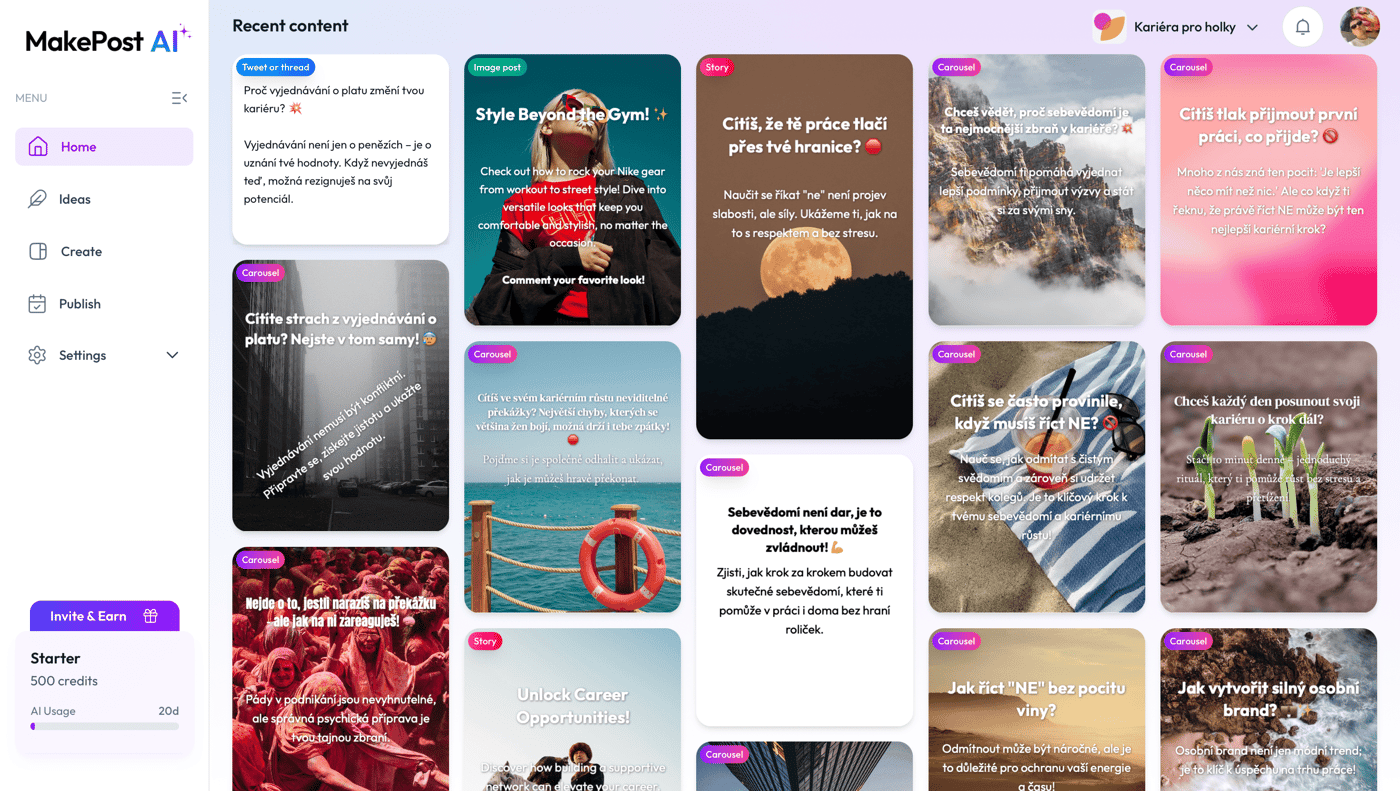
Why I really started
AI started moving at a crazy pace and I felt like I had two choices: jump in or watch it all pass by. So I quit my job, kept one tiny product that paid my bills, and decided I’d build a bunch of MVPs as fast as I could (precisely “one a week”) until something felt right. MakePostAI wasn’t even supposed to be the main project. It just came from a really stupidly simple problem: I had no time to create content for any of my businesses. I was constantly behind, constantly annoyed at myself, and I finally thought, “ok, I’m going to build something that fixes this for me.”
The editor almost broke me
I honestly thought, “yeah, I’ll just build a simple little editor.” That was delusional. Building anything even remotely Canva-like is quite hard. Canvas nodes behaving randomly, exports not rendering, layers jumping around…But I knew that if the editor sucked, the whole product would feel cheap, so I kept going.
UX was the real lesson
I kept assuming people would just “get it,” and they didn’t. At all. The idea → create → edit → publish flow went through so many redesigns I lost count. Every time I simplified something, the product suddenly felt smoother. I had to learn the hard way that creators don’t want 20 buttons...they want one path that’s obvious. It took me forever to learn that.
Scheduling was way harder than expected
I thought scheduling would be a weekend job. Nope. Timezones, cron jobs, tokens expiring, rate limits, random API errors… it was like fighting a boss battle I didn’t prepare for. But once it finally worked, it felt like the first “wow, this actually feels like a real product” moment. Seeing a post go out automatically is weirdly satisfying.
That’s pretty much where MakePostAI is now...still growing, still changing, still teaching me things I didn’t expect to learn. It wasn’t meant to become “the main thing,” but it somehow turned into the project I care about the most.
If you’re building something too, hopefully some of this feels familiar.
If interested, you can see it at MakePostAI.com
-
2
Scheduling logic is basically a boss battle, you nailed that description. The fact that you pushed through the 'editor hell' speaks volumes about your drive. I’m rooting for this one!
-
1
Thank you Hafizur
-
-
2
Nice tool
-
1
Impressive journey with MakePostAI! Building an AI social content automation tool highlights valuable lessons in innovation, user experience, and efficiency. It’s inspiring to see how technology can simplify content creation and help businesses engage audiences effectively.
-
1
The UX lesson resonates hard — I’ve been through the same thing.
You think users will “figure it out”, but they won’t. Every time I simplified something in my product, engagement went up.Also, scheduling/automation is deceptively complex — timezones alone are a nightmare.
Congrats on pushing through the editor pain — that’s where most people quit.
-
1
What I Learned Building an AI Social Content Automation Tool
Building MakePostAI, an AI-powered social content automation tool, taught me far more than just coding and prompt engineering. I learned that the real challenge isn’t generating content — it’s designing a system that understands context, consistency, and human intent. Automation only works when it feels personal.
I discovered how important it is to balance creativity with structure: templates make content predictable, while AI makes it flexible and dynamic. I also learned that users don’t just want posts; they want workflows — scheduling, branding, tone control, and platform-optimized formats.
Most importantly, building MakePostAI showed me that great AI tools are not about replacing creators but empowering them to work faster, stay inspired, and maintain quality across every platform. The biggest lesson? Automation should feel invisible — the creator stays in control, and the AI simply removes the friction.
-
1
Building MakePostAI taught valuable lessons in AI-driven automation, content strategy, and streamlining social media workflows.
-
1
Building MakePostAI revealed key insights into automating social content and enhancing efficiency with AI tools.
-
1
Really love what you’ve built here, solving the “no time for content” problem is huge. As someone who helps founders grow through Reddit marketing, I can say tools like yours perform insanely well when paired with the right subreddit strategy. If you ever want help turning Reddit into a real acquisition channel, I’m happy to share what’s working and how you can get consistent traction.
-
1
The biggest shift in my thinking this year has been moving away from focusing on "cool AI features" and doubling down on utility.
I realized that users don't necessarily need the flashiest new model; they need annoying problems solved simply and reliably. Things like clearing up storage space or getting quick, private OCR from a document.
If I can build a tool that solves one mundane, frustrating problem perfectly, and guarantee it works offline, that’s a better foundation than chasing novelty. It’s hard to stay disciplined, but utility always wins over cleverness.
-
1
This felt very real. Especially the part about users not “getting it” until you simplify. Happens to all of us. Nice work pushing through it.
-
1
this is solid breakdown
-
1
This is a solid breakdown and what you shared actually connects with something I see a lot on Reddit with creators and founders
Many have great products or tools like yours, but their main struggle is getting the right conversations started on Reddit
They post in the wrong subs, at the wrong time, or with the wrong tone… and the product never gets the attention it deservesI help builders fix that by:
• finding subreddits where their users already hang out
• structuring posts that spark real engagement
• avoiding language that triggers removals/bans
• turning Reddit threads into early feedback and user interestIf you (or anyone building a tool like this) want help using Reddit to get more eyes, early testers, or honest feedback without stressing about rules, I’m happy to walk you through what works
DM open anytime


We just launched a new Ideation feature in MakePostAI - it’s like chatting with a creative partner.
You tell it what you want to post about, and it gives you unlimited ideas instantly.
Pick one, and in seconds you can turn it into a full post - carousel, image, caption, whatever you need.
You can simply chat with the post, It updates instantly:
“Make it punchier.”
“Turn this into a carousel.”
“Rewrite the hook.”
Would love feedback from community.
-
2
Totally loved this!
-
1
Thank you Mofrum!
-
-
2
"Love this! It’s amazing how AI can transform a simple idea into a viral post so quickly. Shows the power of smart tools in content creation and audience engagement. Excited to see how this changes the way we brainstorm and share ideas online!"
-
2
Wanted to try your solution, but don't want to sign up since there's a high chance your AI will generate same thing another AI agent will with a good prompt.
If your solution is great at virality, maybe rethink your business model. Get some affiliate income from posts you generate, or create your own monetizeable AI influencers.
-
1
Hey Buddy. Thank you for this feedback, it's also helpful. I think we need to communicate the value added more clearly and maybe also offer more competitive pricing.
We're currently trying to make whole creator pipeline, not just idea...so you should get ideas/inspiration, create whole post, and be able to also publish or schedule.
Hope it gets traction so we can increment on user's feedback.
-
-
2
I like that it supports carousel, images, captions, and hook rewrites—all in one place.
One thing to consider: offering tone/style adjustments or platform-specific suggestions (Instagram vs LinkedIn vs TikTok) could make it even more versatile.
-
1
Thank you for feedback Alex. Yes, I also think some tone/style adjustments or post archetypes will be useful.
I'm looking forward to listening to more feedback to make MakePostAI better for users, and also myself included (as a user)
-
-
2
Good job! I think this really needed when it comes to ideation
-
1
Thank you Sakamoto. I’m looking forward to listening to user’s feedback and building more on the platform
-
-
1
"From No Idea → Viral Post in Seconds with AI" is a practical guide to leveraging AI for content creation and social media engagement. It demonstrates how to generate compelling, shareable posts quickly, offering actionable tips and real-world examples. The book is both inspiring and instructional, ideal for marketers, creators, and anyone looking to boost online visibility efficiently.
-
-1
Seems like AI reply 👎
-
-
1
Turning an idea into a viral post with AI is impressive! It shows how technology can accelerate content creation, optimize engagement, and analyze audience trends. While creativity remains key, AI tools make it easier to experiment, iterate, and reach wider audiences quickly, blending innovation with strategic content planning.
-
1
This is fascinating! Using AI to turn a simple idea into a viral post in seconds shows the power of automation in content creation. It’s a game-changer for marketers and creators, enabling faster engagement and reach while saving time. Exciting to see AI shaping the future of social media.
-
1
This is fascinating! Turning a vague idea into a viral post in seconds with AI shows how powerful content automation has become. It’s a game-changer for marketers, creators, and social media managers, saving time while boosting engagement. The future of content creation is clearly here.
-
1
This looks slick — the “chat with your post” interaction is exactly the kind of UX that makes AI feel like a creative partner instead of a generator. The instant iteration (“make it punchier,” “turn it into a carousel”) is a killer workflow upgrade. Curious to see how it handles niche topics or more complex storytelling.
-
1
This is fascinating! Turning a vague idea into a viral post in seconds with AI shows how powerful content automation has become. It’s a game-changer for marketers, creators, and social media managers looking to save time while boosting engagement and reach. The future of content creation is here.
-
0
This is fascinating! Using AI to turn a simple idea into a viral post in seconds highlights how technology is transforming content creation. It not only saves time but also helps craft engaging, shareable content with precision. Excited to see how AI can assist creators in brainstorming, testing, and optimizing posts for maximum reach.
-
1
Seems like AI reply 👎
-
-
0
This comment was deleted 9 months ago


We just launched an MVP for MakePostAI — a tool that helps people generate high-performing content for Instagram, TikTok, LinkedIn, and Twitter using AI.
It’s built for creators, marketers, and small teams who want to publish consistently but don’t have time (or energy) to write and design from scratch. You pick a goal (engagement, awareness, lead gen), and MakePostAI generates posts — images, videos, and captions — optimized for that intent. You can preview unlimited variations, and only export the final content when you’re ready.
Right now we’re testing if this idea has legs — and we’re mostly focused on the landing page, positioning, and early feedback. If people show interest, we’ll add scheduling, auto-posting, and performance tracking.
We’d love honest feedback. Does this solve a real problem? Would you use this in your workflow? What’s missing?
Built by a small team bootstrapping from Europe. No VC, no nonsense. Just shipping and testing.
Happy to answer anything.
-
3
Interesting!
-
2
This is super interesting — definitely feels like you're tackling a very real pain point. Most creators and small teams want to publish consistently, but the idea–draft–design cycle burns so much time that they either give up or post inconsistently. The “goal-based generation” angle (engagement, awareness, lead gen) is also a smart differentiator — most AI tools just spit out generic posts without strategy behind them.
A few thoughts as someone who works with content daily:
Solves a real problem? Yes. The biggest bottleneck in content isn’t ideas — it’s turning ideas into polished, platform-specific assets. If MakePostAI can turn a concept into ready-to-publish content (image/video + caption), that’s a huge value add.
Would I use it? Potentially, yes — especially if it can keep the visual quality high and allow fast iteration. “Preview unlimited variations” is a strong hook.
What might be missing:
A way to keep brand consistency (colors, fonts, templates).
Reusable post frameworks.
A simple asset library (logos, brand elements).
Maybe analytics later, but not necessary for MVP.
Overall, this feels like something people would pay for if the outputs are strong. Happy to follow along — looks like you’re building in a very grounded way. Good luck to the team!
-
2
Not really a social media poster myself, but this looks very good. Maybe you could add the possibility to make an example post without registering your email.
-
2
sounds like a game-changer for creators drowning in content calendars...
-
2
This is interesting.
-
1
How do you balance it with authenticity? Does it matter?
-
1
is it free trial or paid from beginning only
-
1
Like anything, it's a competitive space, but differentiating is key.
-
1
🚀 Looking for a Serious Teen Business Buddy / Co-Founder for AI + Digital Marketing Agency 🚀
Hey everyone!
I’m a 16-year-old passionate student, seriously working on building a digital marketing agency powered entirely by AI tools. My main focus is automation + execution — smart work, not hard random hustle.
I’m looking for a like-minded friend or co-founder who:
Is serious and focused — values silence, not timepass.
Is a deep thinker interested in real business growth & learning.
Has interest in AI tools like ChatGPT, Notion, Canva, etc.
Believes in long-term vision and is down to work from scratch without caring about short-term money.
Dreams big — wants to build a massive company one day.
If you’re someone who wants to start now, grow something real, and become part of a future empire — DM me or reply below.
Let’s build something legendary together 💼


Comment