
MapZot.AI
Location Intelligence
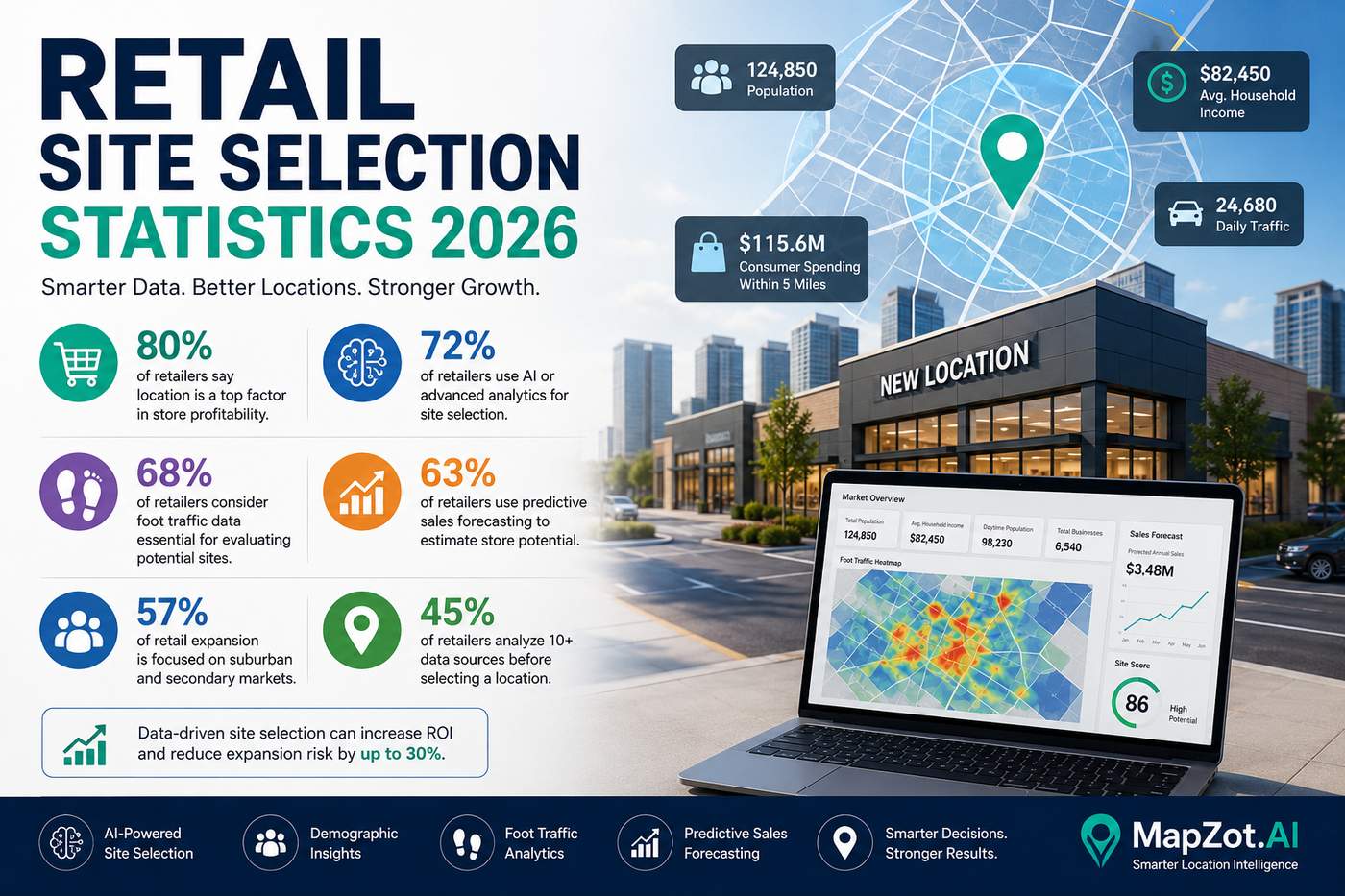
Retail Site Selection Statistics 2026
Selecting the right retail location has never been more important. In 2026, retailers are no longer relying solely on intuition or traditional demographic reports. Instead, businesses are using artificial intelligence (AI), location intelligence, foot traffic analytics, predictive sales forecasting, and real-time market data to identify high-performing locations before investing.
Whether you're a retailer, franchise brand, commercial real estate (CRE) professional, or developer, understanding the latest retail site selection statistics can help reduce investment risk, improve profitability, and accelerate expansion.
This guide highlights the most important Retail Site Selection Statistics for 2026, explains why they matter, and shows how AI-powered solutions like MapZot.AI help businesses make data-driven location decisions.
Key Retail Site Selection Statistics 2026
Nearly 80% of retailers consider location one of the most important factors influencing store profitability.
Businesses increasingly use AI-powered location intelligence to evaluate new markets before opening stores.
Foot traffic analytics is now a standard part of retail expansion strategies for many multi-location brands.
Retailers analyze demographics, consumer spending, traffic patterns, and competitor density together rather than relying on a single metric.
Predictive sales forecasting helps businesses estimate potential revenue before committing to a location.
Franchise brands continue expanding into suburban and secondary markets due to lower operating costs and population growth.
Mobile location data has become a valuable source for understanding customer movement and trade areas.
Retail chains increasingly combine internal sales data with external market intelligence to improve expansion accuracy.
Why Retail Site Selection Matters
A poor location can reduce sales, increase operating costs, and slow long-term growth. Conversely, selecting the right location helps businesses:
Increase customer traffic
Improve sales performance
Reduce expansion risk
Strengthen brand visibility
Maximize return on investment (ROI)
Modern site selection is no longer just about finding available real estate—it's about identifying locations where customer demand, accessibility, competition, and purchasing power align.
AI is Transforming Retail Site Selection
Artificial intelligence is changing how retailers evaluate locations.
Instead of manually reviewing spreadsheets and maps, AI platforms analyze thousands of data points simultaneously, including:
Demographics
Consumer spending
Foot traffic
Competitor locations
Population growth
Mobility patterns
Real estate availability
Sales forecasting
AI enables businesses to identify high-potential markets much faster than traditional analysis.
Foot Traffic Analytics Continues to Drive Smarter Decisions
Understanding customer movement is one of the biggest advantages of modern retail analytics.
Foot traffic data helps businesses answer questions such as:
How many people visit an area?
What times are busiest?
Where do visitors come from?
How long do customers stay?
Which nearby businesses attract similar audiences?
By combining foot traffic insights with demographic analysis, retailers can better estimate future store performance.
Demographic Data Remains a Core Decision Factor
Demographics continue to influence location decisions across every retail segment.
Key demographic indicators include:
Population density
Household income
Age distribution
Employment
Education
Family size
Consumer spending patterns
Retailers increasingly combine demographic insights with behavioral and mobility data to build a more complete picture of each market.
Predictive Sales Forecasting Reduces Expansion Risk
Predictive sales forecasting allows retailers to estimate potential revenue before opening a new location.
AI models analyze historical sales, local demand, competition, demographics, mobility, and economic indicators to generate forecasts that support better investment decisions.
Benefits include:
Better budgeting
Improved ROI planning
Lower financial risk
Faster expansion decisions
Commercial Real Estate is Becoming More Data-Driven
Commercial real estate professionals now rely heavily on location intelligence to help clients identify suitable retail sites.
Common data sources include:
Property availability
Foot traffic
Demographics
Drive-time analysis
Market demand
Competitive landscape
Consumer behavior
Data-driven recommendations improve confidence for both developers and retail tenants.
Retailers Are Expanding Beyond Major Cities
One of the biggest trends in 2026 is expansion into suburban and emerging markets.
Businesses are targeting these regions because they often offer:
Lower occupancy costs
Growing populations
Less competition
Improved infrastructure
Increasing consumer demand
AI helps retailers identify underserved markets before competitors.
Key Metrics Used During Retail Site Selection
Successful retailers evaluate multiple indicators before selecting a location.
These include:
Population growth
Foot traffic
Household income
Competitor density
Accessibility
Parking availability
Consumer spending
Trade area size
Drive time
Sales forecasting
Market saturation
Economic growth
Using multiple data sources produces more accurate recommendations than relying on a single metric.
Challenges Retailers Face
Despite advances in technology, retailers still encounter challenges such as:
Inaccurate demand estimates
Rapidly changing consumer behavior
High real estate costs
Limited market visibility
Increasing competition
Economic uncertainty
AI-powered location intelligence platforms help businesses adapt to these challenges with continuously updated market insights.
How MapZot.AI Supports Smarter Site Selection
MapZot.AI combines AI, location intelligence, and predictive analytics to help retailers make more informed expansion decisions.
Key capabilities include:
AI-powered site selection
Sales forecasting
Foot traffic analytics
Demographic analysis
Trade area insights
Retailer matching
Market opportunity analysis
Competitive intelligence
By integrating business-specific data with external market information, organizations can improve forecasting accuracy while protecting data privacy.
Best Practices for Retail Site Selection in 2026
Businesses should:
Combine AI with human expertise.
Validate assumptions using multiple data sources.
Monitor competitor activity regularly.
Analyze customer mobility patterns.
Compare several candidate locations before making a decision.
Use predictive analytics to estimate future demand.
Continuously monitor store performance after opening.
Frequently Asked Questions
What is retail site selection?
Retail site selection is the process of evaluating and choosing the best location for opening a new retail store using factors such as demographics, foot traffic, accessibility, competition, and market demand.
Why is AI important for retail site selection?
AI analyzes large volumes of data quickly, helping businesses identify opportunities, forecast demand, and reduce expansion risk.
What data is most important when selecting a retail location?
Important factors include foot traffic, demographics, household income, competitor locations, consumer spending, accessibility, and predictive sales forecasts.
How does foot traffic affect retail performance?
Higher-quality foot traffic can increase customer visits and improve revenue potential, especially when it aligns with the retailer's target audience.
Can predictive analytics improve expansion decisions?
Yes. Predictive analytics helps estimate future sales and market demand before investing in a new location.
Conclusion
Retail site selection in 2026 is driven by data rather than guesswork. Businesses that combine AI, location intelligence, foot traffic analytics, demographic insights, and predictive sales forecasting are better positioned to identify high-performing locations and reduce investment risk.
As retail competition continues to increase, organizations that embrace data-driven site selection strategies can make faster, more confident expansion decisions while improving long-term profitability.
Ready to identify your next high-performing location? Explore how MapZot.AI helps retailers, franchise brands, and commercial real estate professionals make smarter site selection decisions using AI-powered insights, predictive forecasting, and location intelligence.

1 Comment
One shift that stands out is that site selection is becoming less about finding the "best" location and more about reducing uncertainty before committing capital.
AI doesn't remove the decision, but it can help narrow the range of outcomes by combining signals that are difficult to evaluate together manually. That feels like a more realistic value proposition than suggesting AI can simply pick winning locations.