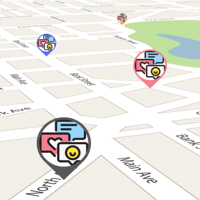
Messagedrop
Connecting digital content with real places.
One of the features I personally like most in MessageDrop is the ability to connect private notes, images, and documents with real places.
A location on a map is often more than just coordinates. It can be connected to a memory, a plan, an idea, or something useful you want to keep exactly where it belongs.
With MessageDrop, you can create private, place-based content such as:
📍 Notes about a location you want to remember
🖼️ Images connected to a meaningful place
📄 Documents related to a specific location
🧳 Travel ideas and planning details
❤️ Personal memories tied to where they happened
For example, you could:
save a note about a beautiful viewpoint,
attach travel information to your accommodation,
keep a document connected to an important place,
or preserve a private memory directly on the map.
What I like about this idea is that it gives digital content a natural context.
Instead of disappearing in folders, notes apps, or endless timelines, it can be found again through the place it belongs to.
And because this is personal content, privacy matters. MessageDrop is designed to store as much of it as possible encrypted directly on the user’s own device, rather than keeping everything centrally on a server.
The app is already live:
🌍 Website:
https://messagedrop.de/
🚀 App:
https://app.messagedrop.de/
I’m curious:
Would you use place-based private notes or memories — and if so, for what?

MessageDrop is not built by a large company or a big product team.
It is an independent project that I develop step by step as a solo developer — which means that the work behind it is often much broader than what users see on the surface.
The visible parts are things like:
🗺️ Maps and location-based content
📍 Public messages and local discovery
🗂️ Private notes, images, and documents connected to places
💬 Connections and chat
🌤️ Weather and air quality data
🎟️ Experiences nearby
But behind those features, there is also a lot of less visible work:
🔐 Privacy-focused architecture and encryption
⚙️ Backend services and data handling
📱 Responsive UX across devices
🧪 Testing and bug fixing
📝 Legal texts, moderation flows, and compliance questions
🚀 Deployment, hosting, performance, and reliability
📣 Positioning, launch preparation, and figuring out how to reach users
Some days are about building a feature that is immediately visible.
Other days are about solving a technical, legal, or product problem that no one will ever notice directly — but that still matters a lot.
That is one of the things I enjoy most about building MessageDrop: it combines creativity, engineering, product thinking, and a constant stream of new challenges.
The app is already live:
🌍 Website:
https://messagedrop.de/
🚀 App:
https://app.messagedrop.de/
I’m still learning a lot while building it — especially about balancing product ambition with the realities of time, focus, and doing many different roles at once.
For other solo founders and indie developers: what part of building your product takes much more time than people usually expect?
Privacy has been one of the most important ideas behind MessageDrop from the very beginning.
I didn’t want to build an app that collects as much personal data as possible just because it can. Instead, I wanted to explore how a useful, location-based product could work while keeping unnecessary data collection low.
That decision shaped MessageDrop in a very practical way.
The app makes a clear distinction between:
🌍 Public content
Messages, tips, and discoveries that users intentionally share on the map.
🔒 Private content
Personal notes, images, documents, and location-based information that are meant only for the user.
💬 Private communication
Connections and chats with people the user knows.
For private content, MessageDrop is designed to store as much as possible encrypted directly on the user’s own device, rather than keeping everything centrally on a server.
This approach makes some parts of development more challenging. It requires more thought about architecture, data flows, backups, usability, and what really needs to exist on the server at all.
But for me, that is exactly the point:
Privacy should not be something added at the end to satisfy a requirement. It should influence the product from the start.
MessageDrop is already live:
🌍 Website:
https://messagedrop.de/
🚀 App:
https://app.messagedrop.de/
I’m curious how other founders and developers think about this:
At what point does privacy become a core product decision in your own projects — and not just a compliance task?
MessageDrop is still a young project, but there is already quite a lot you can explore and use today.
At its core, MessageDrop connects digital content with real places on a map. But the app can be used in several different ways:
📍 Discover public messages and local tips
Explore what other people have shared at specific locations — from thoughts and hints to recommendations and small discoveries.
🎟️ Find experiences nearby
MessageDrop can help you discover activities and experiences around the area you are viewing on the map.
🗂️ Connect private content with places
You can create private notes, save images or documents, and link them to specific locations — useful for personal memories, planning, or keeping location-based information organized.
🌤️ Check weather and air quality data
For selected places, you can access local weather information and air quality data directly in the app.
💬 Connect and chat
You can connect with people you know and communicate with them inside MessageDrop.
The app is already live:
🌍 Website:
https://messagedrop.de/
🚀 App:
https://app.messagedrop.de/
For me, one of the interesting challenges is that MessageDrop is not just one narrow use case. It combines public discovery, personal location-based content, and private communication in a single product.
I’m still working on how to explain that balance clearly and simply.
Which of these use cases feels most immediately useful or interesting to you?
I’m building MessageDrop, a map-based app that connects digital content with real places.
The idea started with a simple question:
Why does so much digital content live in feeds, profiles, and algorithms — but so little is connected to the places where it could actually matter?
With MessageDrop, people can open a map and discover public messages, local tips, thoughts, or experiences tied to specific locations.
At the same time, the app also has a more personal side: users can connect private notes, images, and documents with places, check weather and air quality data, connect with people they know, and chat with them.
Privacy is a core part of the product. I want MessageDrop to collect as little unnecessary data as possible. That is why a lot of personal content is designed to be stored encrypted directly on the user’s device instead of being kept centrally on a server.
The app is already live:
🌍 Website:
https://messagedrop.de/
🚀 App:
https://app.messagedrop.de/
I’m building MessageDrop independently and still learning a lot about product positioning, distribution, and how to explain a product that sits somewhere between local discovery, personal location-based content, and social interaction.
I’d be especially curious to hear:
Does the core idea — connecting digital content with real places — immediately make sense to you, or would you describe it differently?
Comment