
Micro SaaS Examples
Explore 400+ real micro SaaS products across 36 categories
In June, I updated the Micro SaaS Examples website, and since then, we have started seeing some good traffic from Google.
In the last 28 days, the site got 1.2k clicks from Google, which feels pretty amazing for a small project like this.
This month, my goal is to start testing monetisation on the website and keep growing the newsletter.
The newsletter currently has 200+ subscribers. Every Wednesday, I share one new Micro SaaS idea to build, along with some cool and fun products I found during the week.
Still early, but it feels nice to see the website slowly growing through search.
🌈 If you are looking for new ideas to build, you can check out the newsletter here:
https://microsaasexamples.substack.com/


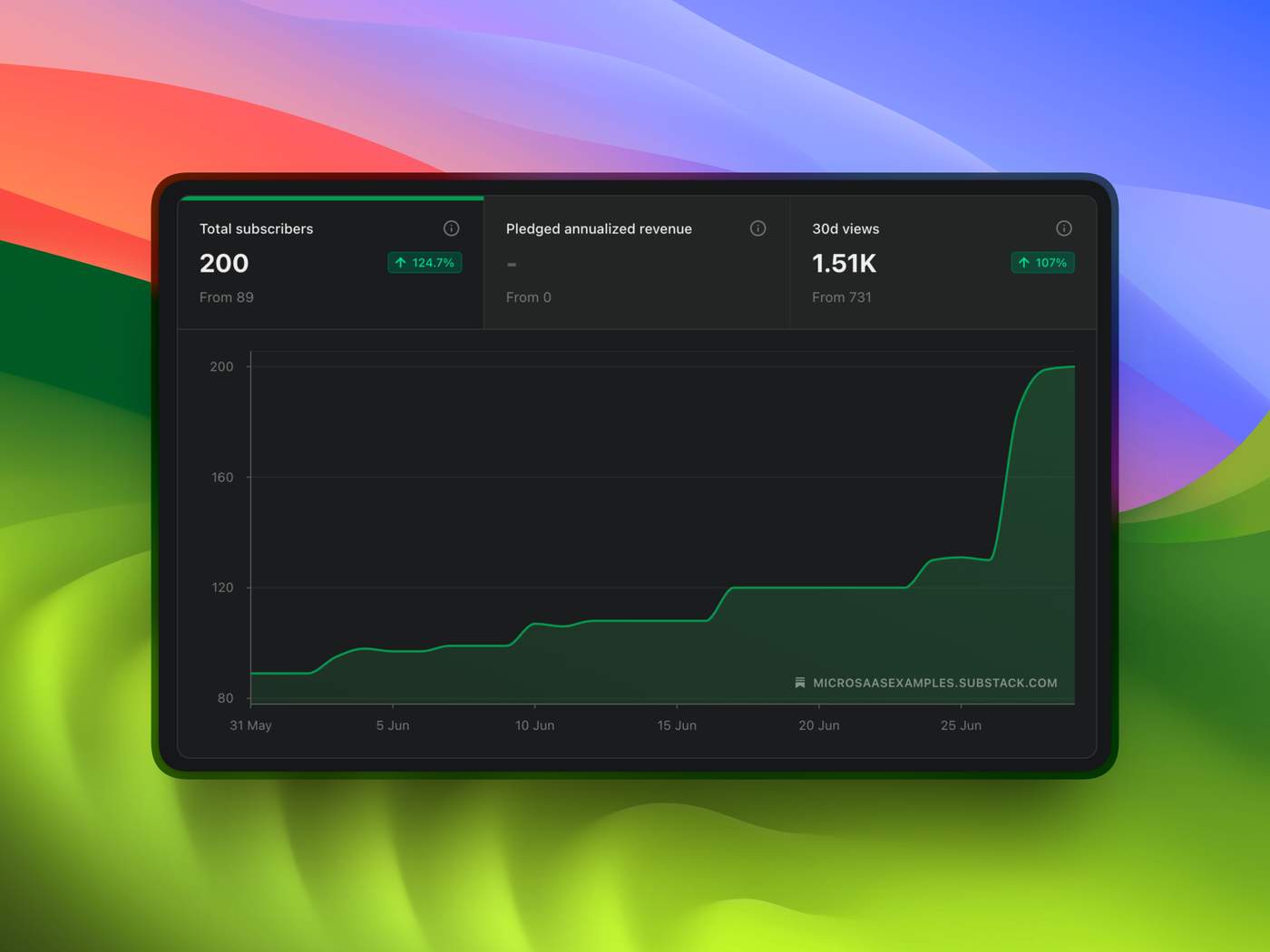
I relaunched the newsletter 6 weeks ago, and it has been really nice to see people subscribing, replying, and finding the ideas useful.
The goal is still simple:
Find interesting Micro SaaS ideas, real products, and small software businesses from across the internet, then share them in a short and useful format.
Still early, but this small milestone feels good.
If you like discovering small SaaS products or want new ideas to build from, you can subscribe here for free 👇
-
2
One thing I like is that you're treating idea discovery as a repeatable research process rather than a creativity exercise. The pattern you described—looking at recurring complaints, overlooked niches, and existing products—feels much more actionable than the usual "here are 10 startup ideas" content. The consistency from building the directory to growing the newsletter also shows the thesis is becoming a system rather than a one-off project.
-
1
thanks man
-
1
You're welcome.
One thing I'm curious about: as the system grows, do you see yourself helping founders generate more ideas, or helping them decide which ideas actually deserve to be built?
Those feel like very different businesses.
-
1
i share the trend/ideas and why they should build it now (and a couple more similar ideas as well)
-
1
That's helpful context.
The interesting part isn't the ideas themselves—it's how you decide the evidence is strong enough to tell founders "this is worth building now."
I have a couple of thoughts on that decision, but they're easier to explain than squeeze into a thread.
If you're interested, what's the best email to reach you on?
-
-
-
-

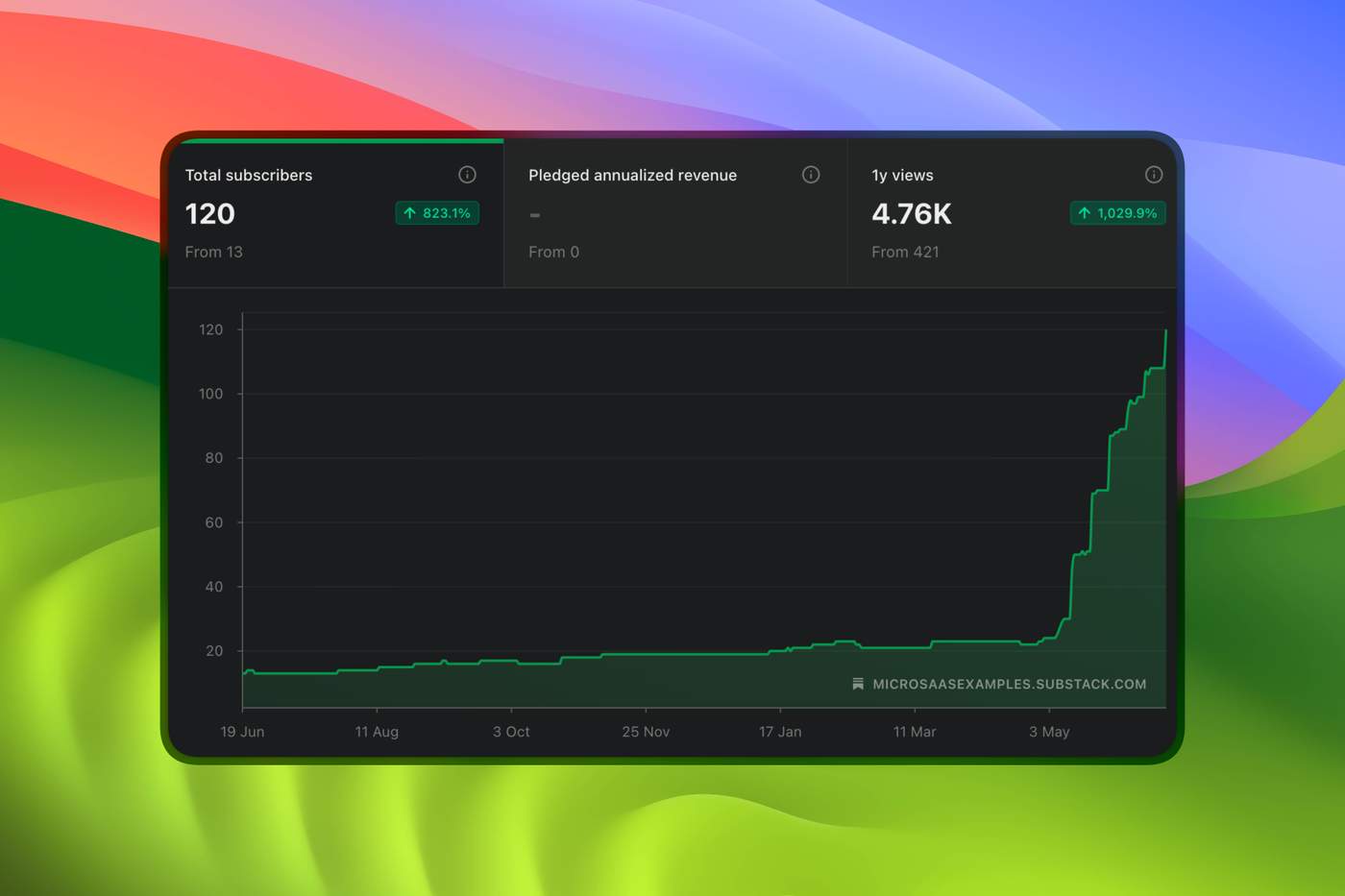
I relaunched the newsletter 4 weeks ago, and it just crossed 120 subscribers.
It’s still a small milestone, but it feels really good.
The goal is simple:
I spend hours finding interesting Micro SaaS ideas, real products, and small software businesses from across the internet, then share the best ones in a short and useful format.
No long theory.
No generic startup advice.
Just ideas, examples, and products that can spark something.
If you are building, researching ideas, or just like discovering small SaaS products, you can subscribe here 👇

I have been working on this website from last couple of weeks and finally its LIVE
MicroSaaSExamples.com is a directory of 400+ real micro SaaS products across 36 categories like productivity, ai, marketing, design, apps, no code, and more.
each broken down by:
> what it does
> why it works
> who it's for
> what similar ideas you can build
Would love to hear your feedback
We are just getting started, this month goal is 5x these numbers this month.
SEO tasks for this month:
- Move website from no code website builder
- add category and tag pages
- improve product page
- add TOFU articles
- backlinks

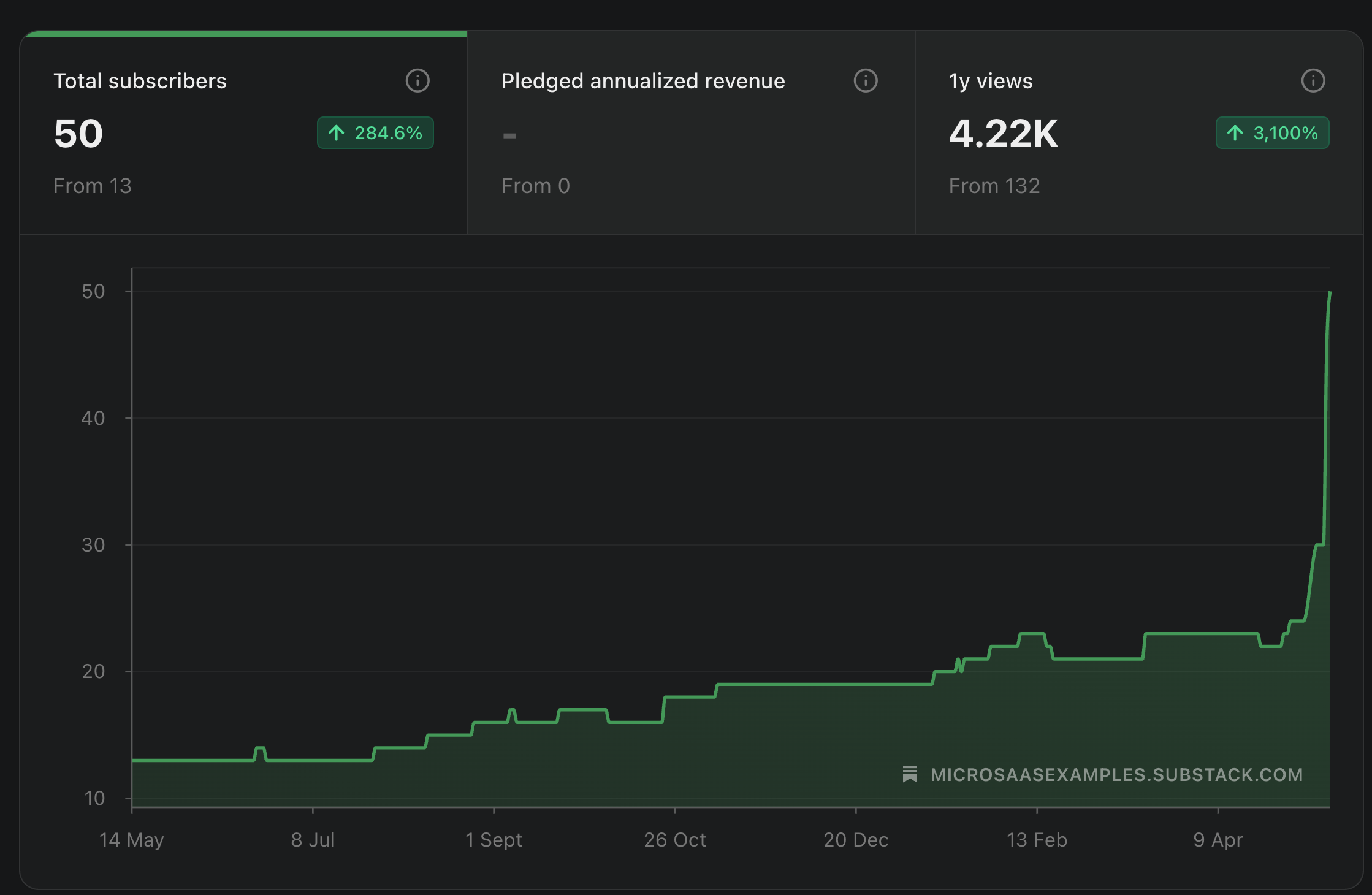
I relaunched the newsletter last week, and it crossed 50 subscribers today 🔥
It’s a small milestone, but it feels really good.
The goal is simple:
I spend hours finding interesting Micro SaaS ideas, real products, and small software businesses from across the internet, then share the best ones in a short, useful format.
No long theory.
No generic startup advice.
Just ideas, examples, and products that can spark something.
If you are building, researching ideas, or just like discovering small SaaS products, you can subscribe here 👇
I spent the last year collecting and studying micro SaaS ideas, and I noticed one pattern:
The best ideas don’t look like startup ideas at first.
They usually hide in plain sight:
repeated Reddit complaints
small tools with ugly UIs
boring niches nobody talks about
failed launches with real reviews
communities where people vent every week
That’s what led me to build Micro SaaS Examples, a website where founders can discover real micro SaaS products, examples, and niche ideas.
Now I’m launching a weekly newsletter for founders who want fresh micro SaaS ideas in their inbox.
Every Wednesday, I’ll share:
one micro SaaS idea worth building
interesting products from across the internet
market gaps and patterns I’m noticing
one fun product idea of the week
The latest edition is about a 3D city for Instagram creators, a fun example of how creator tools, gamification, and social proof can become micro SaaS opportunities.
You can read it here:
https://microsaasexamples.substack.com/p/a-3d-city-for-instagram-creators
And subscribe here:
https://microsaasexamples.substack.com/
Would love to hear your feedback, especially from indie hackers who are always looking for their next small, profitable software idea.
-
2
What I like about collections like this is they prove you don’t need some revolutionary billion-dollar idea to build a profitable business. Most successful micro SaaS products are surprisingly simple — they just solve one annoying problem clearly and consistently.
A lot of founders underestimate how powerful niche positioning can be. Small pain point + specific audience + strong distribution is often a better formula than trying to build the next “all-in-one” platform.
Also a great reminder that execution speed and customer understanding usually matter more than technical complexity. The boring-looking products are often the ones quietly making the most money
-
2
I like this angle.
A lot of micro SaaS ideas really do seem to come from small, repeated frustrations rather than big “startup ideas.” Reddit complaints, ugly tools, and niche communities are probably more useful than most trend lists.
I’m building small apps myself, so I’m always interested in seeing how other founders spot these patterns.
The weekly format also makes sense — one idea at a time feels much easier to digest than a huge list of random ideas.
Good luck with the newsletter. I’ll check it out.
-
2
I remember sometime back, IH used to send me weekly news letter about micro saas as well as. full fledged saas ideas that I could bring to life. Is this your path too? Great job. Will check it out and see if I can pull a few off.
-
1
did not know that, currently that is the plan, thanks
-
-
2
Wish everything goes well. By the way, could you please explain the difference between this and the case studies of indie hackers?
-
1
thanks, the case studies of IH is to share the ideas and products that are full fledged products/saas that are doing good revenue. in micro saas examples we share new, one feature products along with that we share ideas in our newsletter which u can get inspire from and build a small micro saas product of our own
-
-
2
Subscribed, all the best :)
-
2
thank u, it means a lot
-
-
1
The comment from Ahmed Meer touches something important — the gap between "good idea" and "right idea for me" is where most people stall.What I've noticed going through hundreds of SaaS tools: the micro SaaS that survive long-term usually have one thing in common — the founder was already the customer. Not "I researched this niche" but "I was annoyed by this every week."
The Reddit complaint and failed launch angles work precisely because those are places where real, frustrated users articulate exactly what they wished existed. That's already half the product spec. One question for you Manish: in your research, do you notice a difference in idea quality between niches where there's already a dominant ugly tool (clear incumbent to beat) vs niches where there's genuinely nothing (blank space)? Curious which one converts better for the builders you follow.
-
1
there are 2 possibilities for a blank space (one is there is no demand, second there is a demand but requires lot of money to educate) so i think neither of it valuable for small founders.
-
-
1
This is a useful framing, especially the part about ideas hiding in repeated Reddit complaints, ugly tools, failed launches, and communities people return to every week.
I’m researching a related question for Tradi right now: how early-stage founders decide which tools, ideas, or software opportunities are actually worth trusting before spending too much time or money on them.
Curious, when you’re studying these micro SaaS opportunities, what makes a pattern feel real enough to pay attention to?
Is it repeated complaints, people already paying for bad existing tools, strong Reddit comments, failed products with real reviews, or seeing the same problem show up across multiple communities?
-
1
The "failed launches with real reviews" angle is the most underrated one on your list. Most founders treat failure posts as noise but the comment sections on those are often the clearest signal of unmet demand you'll find anywhere. What's been the most surprising niche that's come out of that pattern so far?
-
1
The 'best ideas hide in plain sight' framing is right, but the gap between an idea and a business is the part most founders skip. I see this from the investor side constantly. A curated list of ideas is a starting point, not an asset. The real question for your newsletter is whether you can pair each idea with the kind of operator profile and distribution edge that would actually win it. A 'CRM for laundromat owners' looks great on paper, but only matters if a reader knows three laundromat owners they could ship to next week. If the newsletter teaches readers how to evaluate fit (their fit, their network, their cost of customer access), it's a lot more useful than another idea drop.
-
1
I really like this 'hide in plain sight' framework — especially hunting through Reddit complaints and failed launches. The 3D city for Instagram creators is a fun example. Instead of just dashboards, it turns growth into a game creators would actually want to share.
Curious about your take — for someone building Bexra (Helping entrepreneurs find, build & grow), what's the most overlooked 'vent community' you've found for validating early ideas?"
-
1
This is a solid resource for founders stuck in "idea debt." The pattern you noticed — ideas hiding in Reddit complaints, ugly tools, boring niches — is exactly where real opportunities live.
One thing that would make your newsletter even more powerful: validating those ideas before sharing them. A "this idea has X search demand and Y competitor gap" note turns a good idea into a confident bet.
That's what I built TrendyRevenue for — AI validation in 10 seconds: market demand, competitor gaps, revenue potential. Free tier gives you one analysis (no card). If you want to add a "validated idea of the week" section, the Pro plan ($39/mo) gives you source‑cited competitor gaps + revenue modeling — real data your readers can act on.
Imagine your audience not just getting an idea, but knowing exactly why it's worth building. That's trust and repeat subscribers.
Run one of your upcoming ideas through the free tier. See what the data says. If it adds value, Pro will make your newsletter a must‑read for serious builders.
Keep curating — this kind of work helps more founders than you know. 🔥
-
1
thank u but i think the best way to validate the idea is to put the buy button on the internet
-


As a solopreneur with three years of freelancing experience, I love building quick product tests using no-code tools. This hands-on work has taught me how to turn ideas into real products fast.
I've always enjoyed finding and sharing small software tools that solve specific problems. This led me to create Micro SaaS Examples - a simple directory where people can discover and share their own micro SaaS products.
I built this platform to help others find new ideas and the right tools to build their own successful products. Whether you're just starting out or have been running your business for years, Micro SaaS Examples is here to help you see what's possible in the world of small software businesses.
-
1
Great project for entrepreneurs looking for inspiration! The concept behind Micro SaaS Examples effectively addresses the need to discover practical ideas and tools without complex setups. A valuable resource for both beginners and seasoned pros.
-
1
Congrats on the launch! I checked out the website - would be really cool to have filters to help users find products relevant to their interests. Are you still working on this project? How are you measuring what features resonate / don't resonate with users?


Comment