
Momen
Build your MVP and scale it, no code needed.

Momen is a full-stack web app builder designed for non-technical founders who want to build robust, scalable applications without coding.
We often get compared to Bubble, and for good reason - we're both no-code platforms enabling founders to build web apps. But while we share the same mission, our approaches and strengths are quite different.
TL;DR
Momen: Performance-focused, developer-friendly, native PostgreSQL
Bubble: Mature ecosystem, extensive features, larger community
Key Differentiator: Architecture philosophy and performance trade-offs
The Raw Performance Numbers
Momen: 5000 rows/sec
Bubble: 100 rows/sec
Page Load Times:
Momen: ~0.8s
Bubble: ~3-4s
Core Philosophical Differences
Bubble's Approach
Reimagined development concepts
Custom terminology (e.g., "things" for database rows)
Prioritizes accessibility over standards
Momen's Approach
Embraces industry standards
Native PostgreSQL integration
Developer-friendly architecture
Feature-by-Feature Breakdown
Database & Backend
            Momen               Bubble

Database    Native PostgreSQL    PostgreSQL (NoSQL-like)

API         GraphQL             Custom API

Performance 5000 rows/sec       100 rows/sec
Development Experience
                Momen               Bubble

Version Control Basic              Advanced (with branching)

Preview        Real-time          Refresh needed

Components     React support      HTML/JS plugins

Reusability    In development     Strong
Best Use Cases
Choose Momen For:
1. Data-intensive applications
2. API-first projects
3. Projects needing developer control
4. Performance-critical applications
Choose Bubble For:
1. Team-based development
2. Mobile-first projects
3. Projects needing extensive plugins
4. Complex workflow requirements
Technical Deep Dive
Architecture Differences
Momen: Client-rendered SPA by default (can be SSR)
Bubble: Server-rendered pages
Momen: True PostgreSQL capabilities
Bubble: JSONB storage approach
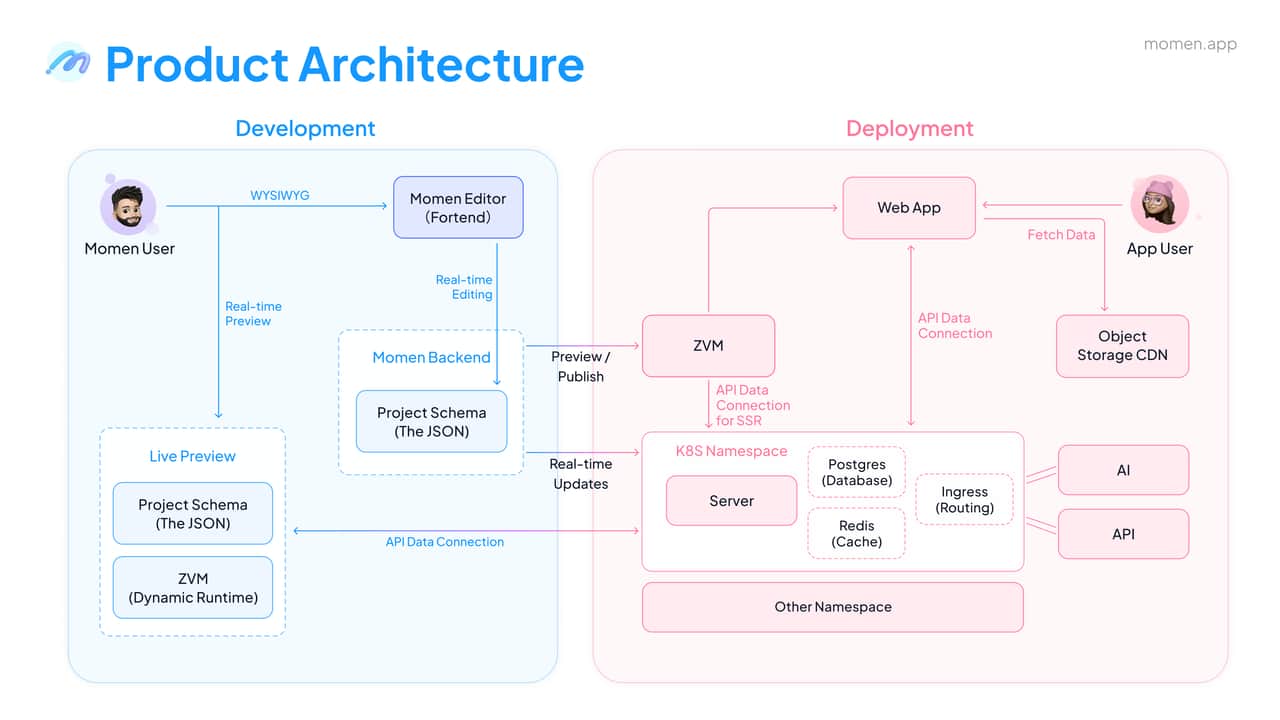
API Capabilities
Momen: GraphQL with single round-trip data fetching
Bubble: REST-like APIs with multiple endpoints
Scaling & Costs
Infrastructure Options
Momen:
Single-tenant: $120/month/instance
BYOC options available
Bubble:
Dedicated instances: $3,500/month
Usage-based pricing
Future Roadmap
Momen (2024-2025):
Frontend reusability features (EOY 2024)
Mobile platform development (2025)
Enhanced collaboration tools
Current Limitations:
1. Less mature ecosystem
2. Fewer plugins
3. Basic version control
Would love to hear your thoughts and experiences about no code tools!


Hey IH! 👋 I'm the founder of Momen (a no-code web app builder), and I want to share the unfiltered story of our Product Hunt launch. No fluff, just real numbers and lessons learned.
The Raw Numbers 📊
500% increase in web traffic
~500 new signups on launch day
2.4k backlinks in 24 hours
Reached #1 Product of the Day
The Reality Check (What No One Tells You)
1. Getting Featured Isn't Guaranteed
Here's the truth - only 30-40% of products make it to the homepage. We spent weeks studying PH's featuring guidelines and optimizing our listing. It's not just about having a good product; presentation matters enormously.
2. Competition is Brutal
We initially planned for 600 upvotes based on historical data. Big mistake. We ended up needing 700+ because of unexpected competition that day. Lesson learned: whatever your target is, add 20% as a buffer.
3. The Quality Paradox
Here's something interesting: We noticed that votes from users with gold/silver badges carried significantly more weight. One high-quality comment showing genuine product value often did more for us than multiple basic upvotes.
4. The Critical 4-Hour Window
Product Hunt has sophisticated algorithms to detect voting patterns. Our strategy:
Hour 1-4: Focused purely on organic traffic
After 4 hours: Activated our network strategically
Avoided any suspicious voting patterns
What I'd Tell My Past Self
On Preparation
Start community building 3 months before
Create twice the assets you think you need
Have a backup plan for everything
On Launch Day
Sleep is overrated (kidding, but not really)
Have someone dedicated just to comment and responses proactively (this really matters, we got 100+comments)
Monitor competitors hourly
The Hard Truths
Your network matters more than you think
Timing can make or break your launch
Product Hunt is just the beginning - have a post-launch plan
Questions for the IH Community:
Has anyone here launched multiple times on PH? How did the experiences differ?
What's your take on the best day to launch? (We chose Tuesday, but I'm curious about others' experiences)
How did you maintain momentum after the launch?
P.S. Happy to share more specific details about our strategy - just ask!
Comment