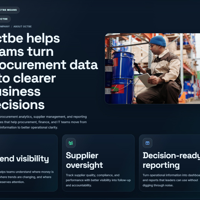
Octbe
Procurement analytics, spend analysis, and supplier manageme
Hey everyone 👋
I’m Bogdan, and I’m building Octbe — a procurement analytics and supplier management platform.
The idea came from a pretty simple observation:
companies already have a lot of procurement data… but they don’t actually use it.
In most cases, teams are stuck with spreadsheets, scattered tools, and manual reporting.
Answering basic questions like:
Where are we overspending?
Which suppliers are underperforming?
How can we reduce costs?
…takes way more time than it should.
I kept seeing the same pattern:
data existed, but clarity didn’t.
That’s where Octbe started.
We’re building a platform that turns procurement data into something actionable — helping teams track spend, evaluate suppliers, and make better decisions without relying on manual work.
Right now, we’re focused on:
simplifying how data is structured and visualized
making insights easy to understand (not just dashboards)
helping teams actually act on the data
We’ve just started putting it out there and getting early feedback.
If you’ve ever dealt with procurement, finance, or messy internal data, I’d really love to hear:
👉 how you currently manage it
👉 what tools you use (or hate)
👉 what you wish existed
Happy to share more about what we’re building and learn from your experience 🙌

1 Comment
It is a significant financial risk when a company has the data to save thousands in overhead but that information is buried so deep in a fragmented spreadsheet that nobody has the time to actually find it.
The real advantage of a dedicated procurement platform is that it shifts the focus from "data entry" to "strategic sourcing" because once the software automatically identifies duplicate suppliers or price discrepancies the team can focus on negotiating better contracts instead of cleaning up rows of text.
Since you are focusing on making the data actionable are you looking into an automated "Savings Alert" feature that flags whenever a specific category of spend spikes unexpectedly or deviates from your historical averages?