ollasync
Exploring Smarter and More Secure Communication for Modern T
As more startups move toward remote and distributed teams, communication tools have become part of the everyday infrastructure of a business. Founders may use video meetings for customer calls, messaging for internal discussions, and recordings for documentation or training. But when those conversations contain customer information, product plans, financial details, or technical discussions, security becomes more than just another feature on a pricing page.
One thing I think founders should look at is how encryption actually works. Instead of simply asking whether a platform is encrypted, it is worth understanding where encryption happens, what information reaches the server, whether the provider can access the original content, and how encryption keys are handled.
Another interesting area is server-blind communication. The basic idea is to reduce unnecessary access to the actual communication content while still allowing the infrastructure to handle things such as authentication, routing, and communication delivery. For startups dealing with confidential information, this type of architecture can be worth considering.
Video meetings also create their own security questions. Who can join a meeting? Who can invite other participants? Who can record it? Who can access the recording afterward? These questions become particularly important when meetings involve customers, investors, employees, or unreleased product information.
Recordings are easy to overlook. A live conversation may disappear after a meeting ends, but a recording creates persistent data. Founders should therefore think about where recordings are stored, who can access them, how long they are retained, and whether access can be revoked.
Another challenge is tool sprawl. A small startup might use one platform for meetings, another for messaging, another for documents, and another for private collaboration. Each additional service introduces another account, permission system, storage environment, and security policy.
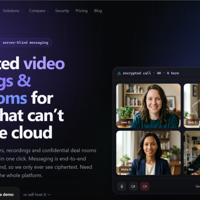
For founders researching different approaches to secure communication, https://www.ollasync.com/ is one example that can be explored alongside other solutions. The important thing is to compare the underlying security model and workflow rather than choosing a tool simply because it has the longest feature list.
There is also a usability question. Security controls need to be practical enough that employees actually use them. If joining a secure meeting or sharing information requires too many complicated steps, people may eventually find unofficial alternatives.
For a startup, I think a useful evaluation checklist would be:
How is communication encrypted?
Can the provider access user content?
How are meetings authenticated?
What permissions do participants receive?
How are recordings protected?
Where is data stored?
How long is information retained?
Can access be revoked easily?
How much infrastructure control does the company need?
Is the security model practical for everyday users?
There probably isn't one perfect communication architecture for every startup. A small team may prioritize simplicity, while a company handling highly sensitive information may prioritize privacy and infrastructure control.
What do other founders prioritize when choosing communication infrastructure: security, usability, self-hosting, price, or integration with existing tools?

Comment