
PANZE AI
Gamified AI Financial Life Simulator

I'm a fintech professional who's spent over a decade building wealth management systems. A few months ago I wanted to plan my own financial future — and got frustrated enough to build something new.
Three things I noticed:
1. Every financial planning tool is boring. Same dashboards. Same charts. Same 30-field forms. They all look like they were designed for accountants, not for real people trying to imagine their future. Nobody wakes up excited to open a retirement calculator.
2. Almost none of them have real AI. In 2026, we have AI that can write code, generate videos, and plan trips — but financial planning is still stuck in the spreadsheet era. A few tools have started adding AI chat, but it's bolted on as an afterthought. The AI can't actually run projections or compare scenarios.
3. People are already asking ChatGPT for financial advice. And it's not bad — for general questions. But when you ask "Should I do a Roth conversion ladder starting at 45?" it gives you a generic paragraph. It has no simulation engine behind it. No way to actually model YOUR numbers across decades. It's a smart friend guessing, not a planning tool calculating.
I kept thinking: what if the AI could actually run the simulation?
So I'm building Panze.
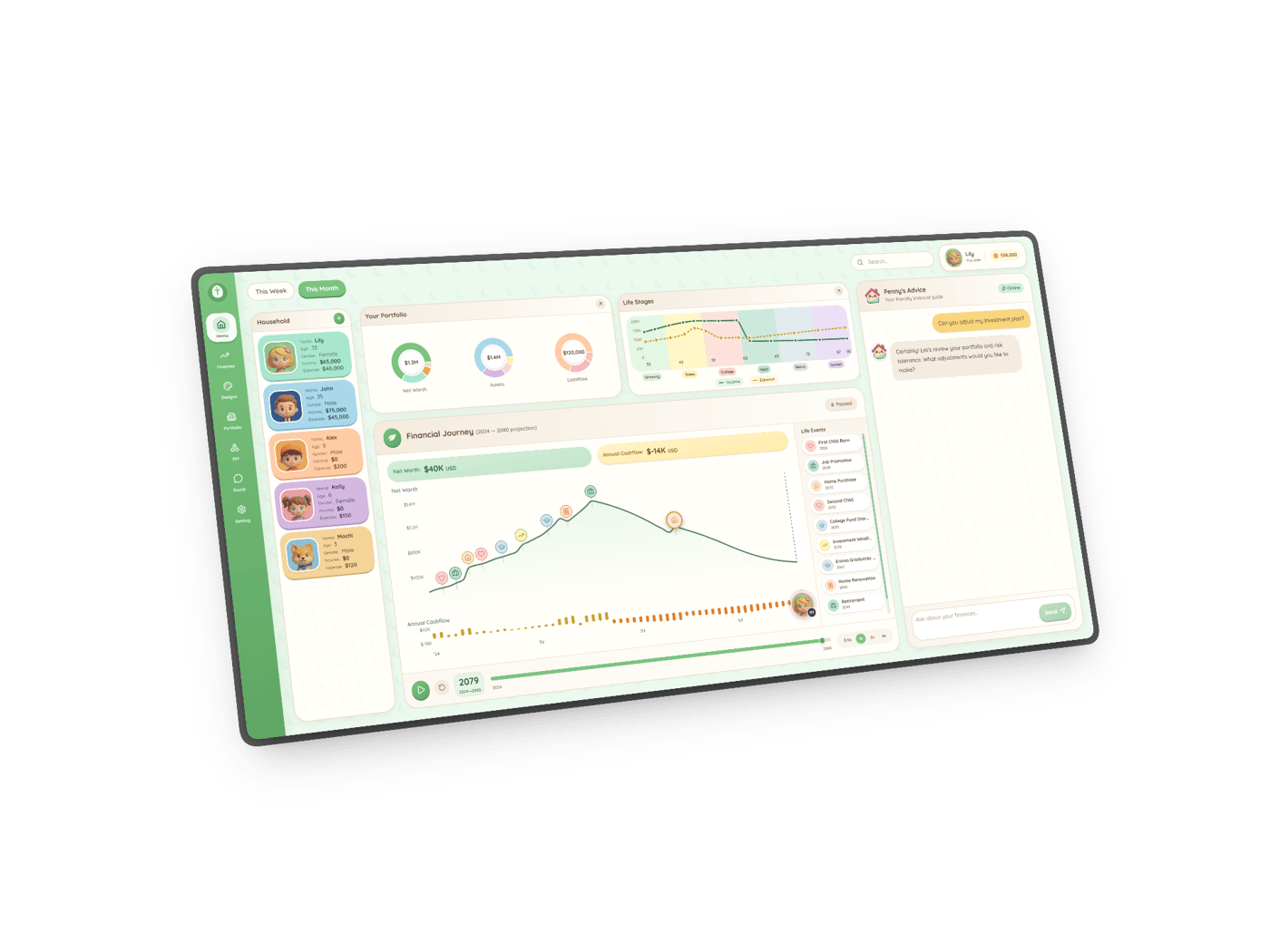
Panze is a gamified financial life simulator. You talk to Penny — an AI companion — who has direct, real-time access to a multi-decade projection engine.
No dashboards. No spreadsheets. Just a conversation:
"What if I retire at 45, convert my 401k to Roth over 5 years, and move to Portugal?"
Penny runs the simulation. Compares it to your current plan. Walks you through what changes and why — in plain language, not financial jargon.
You explore different futures, test wild what-ifs, and watch how every decision ripples across decades. Planning your future should feel like play, not paperwork.
What's under the hood:
Simulate the finances of your whole household
Full US tax modeling — 401k, IRA, Roth, HSA, Social Security, federal + state income tax
Monte Carlo simulation for projected returns (historical block bootstrap and GBM approaches)
Multi-scenario comparison live in conversation
50+ countries supported from day one via intelligent proxy rate tables
Where I am now:
🟢 Working simulation engine with AI agent integration
🟢 Landing page live, collecting waitlist signups
🟡 Solo founder, pre-revenue
🎯 Targeting the FIRE community as first users
I'd love your feedback:
Does "gamified financial simulator with real AI" land — or does it sound like noise?
If you're planning for FIRE or retirement, what "what-if" scenarios do you wish you could simulate?
Is global planning (retire abroad, kids studying internationally) a real differentiator?
Visit: https://panze.app

3 Comments
Targeting the FIRE community with a gamified simulator is a double-edged sword. These users are obsessive about accuracy—they live in spreadsheets for a reason. While 'Penny' sounds like a great UX, you have a massive 'Seriousness Gap' to bridge.
In the wealth management world, 'Gamified' can often be misinterpreted as 'Unreliable' or 'Simplified.' If Panze and your simulation engine aren't being vetted or featured in top-tier financial media like Bloomberg, Forbes, or Wall Street Journal, the high-net-worth FIRE crowd will struggle to trust your 'What-ifs' with their actual life savings.
To win in this niche, you need the media to validate that your engine is just as robust as the boring tools, but twice as smart. Without that high-level media authority, how do you plan to prove that Panze is a serious financial powerhouse and not just a 'financial toy'? In this space, institutional-grade trust is the only way to move from a waitlist to actual revenue.
Really appreciate this feedback — you're touching on the exact tension I think about constantly.
You're absolutely right that the FIRE community demands accuracy. That's actually why I spent so much time on the engine before anything else. Under the hood it runs the same kind of modeling you'd find in professional wealth management systems — progressive tax brackets, Monte Carlo simulation, multi-entity household modeling, year-by-year cash flow projection. I've spent over a decade building these systems professionally, so the depth is there.
The way I think about "gamified" is not dumbed down — it's about removing friction. The math underneath is the same depth, you just don't have to fight a clunky UI to access it. But I totally understand the perception risk you're describing, and it's something I need to be intentional about in how I position it.
Your point about trust and validation is well taken too. My initial thinking is to lean into transparency — show the assumptions behind every projection, let users see the math, and make it easy for people to cross-check against their own spreadsheets. If someone in r/financialindependence can verify the numbers match, that kind of peer validation carries a lot of weight with this audience.
But I hear you — as Panze grows, building that broader credibility layer will matter. Great food for thought. Thanks for taking the time to share this 🙏
That’s a fair point, Max. Peer validation on Reddit is gold for early adopters.
But looking at the long game: when a cautious user Googles 'Is Panze secure?' or 'Panze AI review,' seeing a feature in a top-tier financial publication (like Apnews or Msn) at the top of the search results changes the game.
It moves the needle from 'cool tool I found on Reddit' to 'legit financial powerhouse I can trust with my 401k data.' Peer trust is great, but 'Search Authority' is what converts the skeptics into long-term users. Rooting for you!