PDFLaunch
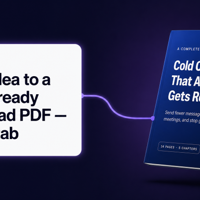
Turn a niche idea into a buyer-ready Gumroad PDF in minutes
I'm Mike, solo founder . Lurked here for months — finally have something to share. I just finished building PDFLaunch and I'm launching on Product Hunt this Wednesday. Wanted to share the build journey before launch day, because the lessons are more interesting than "buy my product."
## The problem I kept seeing
Selling digital products on Gumroad sounds easy. In reality, people bounce between 5 tools:
→ Keyword research tool (what to write about)
→ Niche analyzer (will it sell)
→ AI writer (generate the draft)
→ Design tool (make it look professional)
→ Gumroad's upload flow (publish it)
Each step has friction. Each tool needs configuration. Most people abandon halfway and never publish anything.
## What I built
One pipeline that handles all 4 steps in the same tab:
1. Discover — pick a category, see niches with search volume, competition index, and Gumroad pricing benchmarks
2. Generate — AI writes a structured PDF: chapters with executive summaries and action items (not generic blog draft)
3. Design — 4 A4-ready templates with live preview
4. Publish — one click pushes it to your Gumroad store
First publish is free.
After that $9.99 per publish or $39/mo for 10 publishes.
## Stack
- Next.js + Vercel
- Clerk for auth
- Stripe for billing
- Prisma + Postgres
- Claude API for generation
- Built mostly in Cursor
## The unglamorous part
Hardest week was actually the Gumroad OAuth flow — their API docs are sparse, half the examples are outdated. Took 4 days to get publishing to work end-to-end.
Second hardest: making AI-generated PDFs that don't feel like AI-generated PDFs. Spent 2 weeks just on output quality — chapter structure, executive summaries, action items, typography.
There's a free sample on the site (no email required) if you want to see actual output before judging.
## What I'm hoping to learn this week
Launching publicly for the first time is terrifying.
Honest questions I have:
1. Is the demand data step actually useful, or is it noise?
2. Is $9.99 per publish the right friction, or too cheap to signal quality?
3. Pay-per-publish vs subscription — which fits indie creators?
Anyone here who sells on Gumroad — would love your perspective.
Launching Wednesday. Will post Day 1 results here regardless of how it goes.
— Mike

5 Comments
On your pricing question: $9.99 per publish feels right as a try-before-committing price. Too cheap and people don't value the output, too expensive and they'll just prompt ChatGPT. The real test is whether people come back for a second publish, that's your conversion signal. Also you mentioned this is your first public launch and you're going to PH Wednesday. Run your landing page through PagePulse (pagepulse.page) before then. it returns UX feedback with markers pinned to actual locations on the page, takes 2 minutes. First one's free. If you want to do a mutual PH support swap, I'm launching there soon too. Happy to show up for yours if you'd return the favor.
Direct honest answers since you asked, plus one bigger thing.
Q1 (demand data): mostly noise. Google search volume doesn't predict Gumroad sales because Gumroad PDFs sell through Twitter/IG/CT creator audiences, not Google search. Search volume = topic interest, not commercial intent for a $19 PDF.
Q2 (pricing friction): $9.99/publish is fine in isolation but solves the wrong problem. Gumroad PDF buyers don't have a "publish more PDFs" problem. They have a "my PDFs don't sell" problem. Pricing optimization on the wrong bottleneck doesn't change the math.
Q3 (pay-per-publish vs sub): probably neither. Indie creators who make money on Gumroad do it through audience → product. PDF #1 that sells comes from understanding audience. PDF #50 that doesn't sell is 50x the disappointment.
The bigger thing: PDFLaunch optimizes for publishing, not selling. "Create + publish in one tab" is well-executed but solves the easy half. The hard half (getting buyers) isn't touched. Users will figure this out after PDFs 2-3 sell zero copies and churn.
The fix isn't a different price model. It's either adding a real distribution layer (audience-building, IG cross-post, niche newsletter) or repositioning to a different buyer who actually has a publishing-speed problem (info-marketers running known funnels, not first-time creators).
Landing's well-executed. Product isn't the issue. Buyer model is.
This is a really good critique, and I think you're right about the core risk.
Right now PDFLaunch removes friction from creating and publishing digital guides. But creation friction and distribution friction are not the same thing — and distribution is the harder half by far.
A lot of first-time creators believe their bottleneck is “I can’t make the product.” In reality, after AI, the bottleneck quickly becomes:
audience
positioning
trust
distribution
So I agree that “publish faster” alone is not enough long term, especially for zero-audience creators.
Where I still think there’s value is for people who already have:
an audience
niche expertise
a newsletter
consulting traffic
X/IG distribution
lead-gen funnels
For them, speed actually matters. Turning existing knowledge into polished products quickly is a real workflow improvement.
I also think there’s a bigger opportunity beyond PDFs themselves:
niche validation
distribution assets
repurposing content
launch workflows
audience capture
The current version is intentionally focused and narrow, but I don’t think the end state is “AI PDF generator.” That market gets commoditized fast.
Appreciate the thoughtful breakdown — especially the point about optimizing for publishing vs selling. That distinction matters a lot.
One of the cleanest real-time ICP reframes I've seen. Most founders defend their positioning. Naming "creators with existing audience" as the actual buyer is the right pivot.
But your reframed ICP isn't on the landing yet. "Launch a PDF guide in minutes" + "First guide always free" speaks to first-time creators. Established creators with audiences aren't discovering whether they can make a PDF — they're productizing existing knowledge fast. Different buyers, different value props.
Three days isn't enough to rebuild, but enough for one change: hero adjustment + a section for established creators ("Already have an audience? Here's why velocity matters"). Otherwise Wednesday validates the wrong buyer.
If you want a second pair of eyes on the new positioning before you ship, HiveMind (myosin.xyz/hivemind) is built for exactly this — AI strategy copilot, contrarian by design. Rooting for Wednesday either way.
This comment was deleted 4 months ago