
Promvia
AI visibility: does ChatGPT recommend you?
Yesterday we switched on something I have wanted to exist for a while: a public page that measures, every Monday, which sources seven AI answer engines actually cite for a fixed panel of 40 buyer questions, and publishes all of it (prompt list, per-engine tables, movers, an engine changelog, JSON under CC BY 4.0). It costs us about EUR 2 a week to run. Page: promvia.app/ai-source-index
Week one, across the answer engines (ChatGPT, Perplexity, Gemini, Claude, Google AI Overviews, AI Mode; Bing organic kept separate):
youtube.com was cited in 36 of 40 questions, reddit.com in 33. Those two are the spine.
- Editorial and review publications came next: Forbes 10, TechRadar 7, Tom's Guide 7, RTINGS 5, CNBC 4. Mostly "best X" roundups, not news.
- Review directories (G2, Capterra, TripAdvisor, idealo, AlternativeTo): under 1% of citations. On consumer questions the "alternatives to X" slot went to blog posts and vendors' own /vs pages, not marketplace grids.
- About 80% of citations were the long tail nobody has a name for: vendors' own pages, retailers (Best Buy in 14 questions), niche blogs.
The engines eat different diets for the same questions. Gemini leaned on Reddit (26/40) and YouTube (25/40); AI Overviews on YouTube (24) and Reddit (18); ChatGPT's top sources were YouTube (7), Tom's Guide (6) and Forbes (5); Perplexity's were Reddit (6), Forbes (5), CNBC and the NYT; Claude cited almost nothing but review publications. "Reddit dominates AI citations" is true for Google's surfaces and not for ChatGPT or Perplexity.
Two things the first live week caught in our own product, which is the real reason to build in public:
Gemini's grounding API does not return the page it read; it returns an opaque redirect URL that 302s to the real source. We had been storing the redirect host as the "source" for weeks. Every Gemini citation in the customer product was effectively blank. Fixed the same day, backfilled the week, and we now log the day the fix landed so it never reads as a platform change later.
2. Google AI Mode emits shopping cards (google.com/search?...) next to real citations. Not sources. Filtered.
Caveats we print on the page: one sample per engine per question, so a move of one or two questions is noise; source types come from a rule list, so an unknown domain lands in "other"; movers and the observed changelog only start with the second week (this Monday).
What I would like from IH: if you run a product site, look up your own category's questions on the page and tell me whether the citation set looks like yours. And if you think the panel is missing a question shape, say which; the panel is versioned, so additions are new ids, never edits.
Business status, since this is IH: launched August, EUR 0 MRR, one paying-tier customer would cover the index for a year. Building in public, honest numbers only.

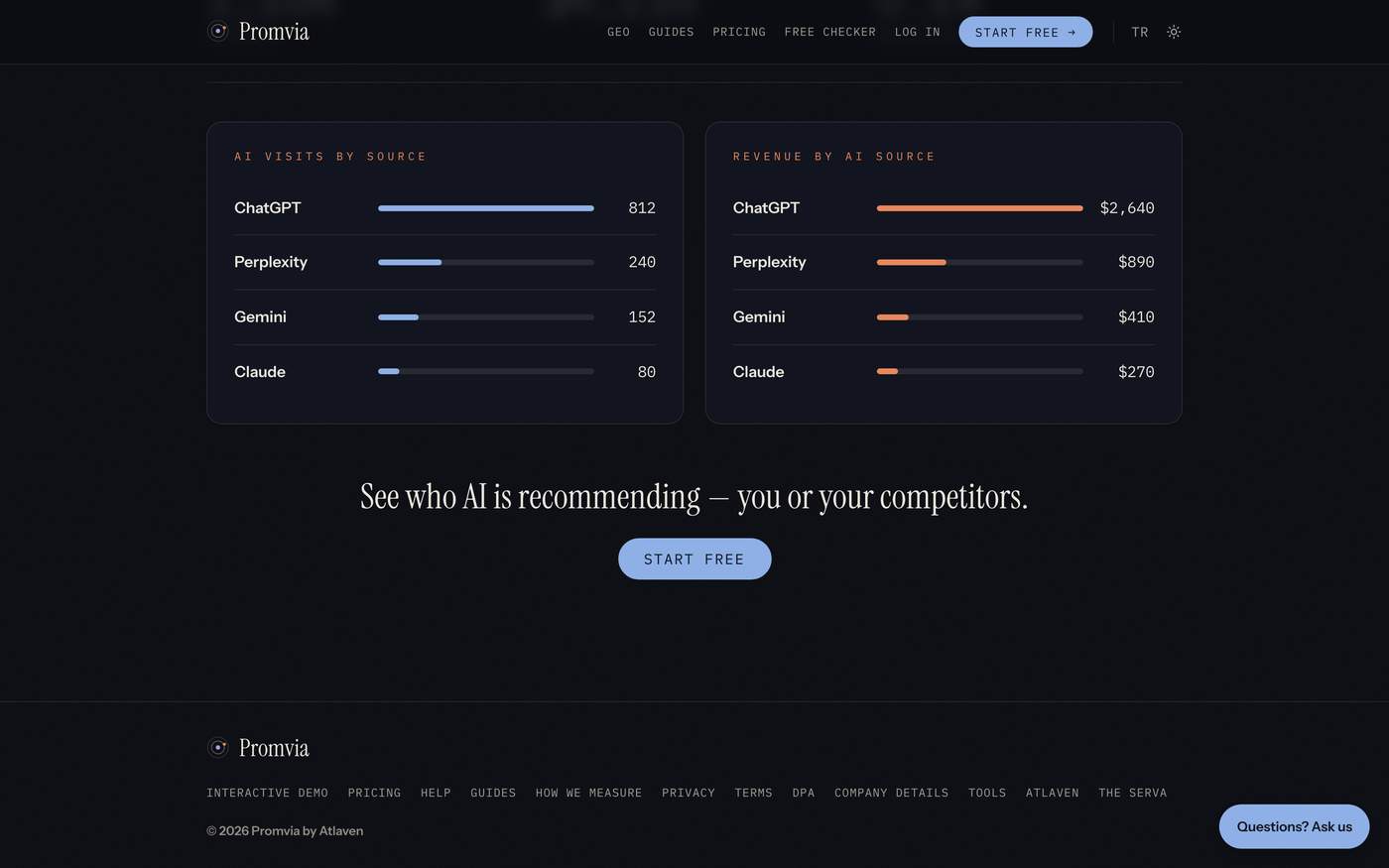
Hi IH — I'm Anil, solo and bootstrapped, building Promvia: it checks whether ChatGPT, Perplexity, Gemini and Google's AI answers actually name your product when buyers ask for a recommendation, and what those answers send your site. Launched August 2026, €0 MRR so far, building in public. Disclosure up front: the numbers below come from our own tracking.
The thing worth sharing is a finding, not a feature. We track a fixed set of buyer prompts every week across six answer engines and log every URL the answers cite — about 2,150 cited URLs over 14 days in one niche (software tools). Two things fell out:
"Alternatives to X" prompts cite comparison-shaped pages (paths like /vs, /alternatives, /compare — vendor pages and blogs included, not just G2 or Capterra) in 34–43% of citations. "Best X" prompts: 2.8%.
When we first counted by directory DOMAIN instead of page shape, the effect looked ~10x smaller. The domain list was a bad proxy. What gets cited is the page type, wherever it lives.
The practical version: a well-structured /alternatives or /vs page on your own domain competes for the same answer slot as a G2 grid. "Get listed on directories" and "build comparison pages" are sold as two tactics; at the citation level they look like one. And the cited pages had almost no organic traffic — winning the SERP and being chosen for an answer are different games.
Caveats, honestly: one niche, two weeks, URL-path labeling rather than rendered pages. Direction solid, magnitudes indicative. We pre-registered a follow-up (vendor-authored vs third-party comparison pages) and will publish it on Sep 7 whatever it says.
We eat our own cooking: Promvia's own domain scored 0 on day one, and we publish our own weekly run live at promvia.app/live so the score is a public number rather than a promise.
Question for people running product sites here: do your /vs or /alternatives pages pull AI citations (or AI referral traffic) out of proportion to their organic traffic? That publisher-side number is the one nobody seems to have.
-
1The 2,150 cited URLs make the finding much more interesting than another AI-visibility claim. Have you seen /vs or /alternatives pages produce meaningful qualified traffic from AI answers yet, or is citation volume still the stronger signal?
-
1Honest answer: citation volume is the stronger signal for us so far, and I would not claim qualified traffic yet. Two reasons, both measurement rather than marketing. 1. Most assistants open links with no referrer, so the visit lands in analytics as Direct. We keep two buckets apart: confirmed (a referrer, or an assistant user-agent like ChatGPT-User fetching the page on a user's behalf) and inferred (Direct sessions landing cold on a deep /vs or /alternatives URL, which typed-in Direct almost never does). The inferred bucket runs roughly 2 to 3x the confirmed one. That gap is the honest size of the attribution hole. 2. On our own domain the numbers are small enough to say out loud: a handful of AI-referred visits and no attributed revenue. The comparison pages that got cited in the dataset were third-party ones, and we do not have their analytics, which is exactly the publisher-side number I was asking for. What I can say: the citations are weekly and reproducible, the traffic is not yet. We started publishing the source side in the open today (promvia.app/ai-source-index, 40 fixed buyer questions across seven engines every Monday), and the first week already showed the engines leaning on YouTube and Reddit far more than on any directory for consumer questions. If your /vs pages show AI referrals out of proportion to organic, I would genuinely like to see the numbers.
-
1That attribution gap is the interesting part, especially the confirmed vs. inferred split. I’d be interested in comparing notes on what the /vs pages are actually driving. What’s the best email to reach you on?
-
1Happy to compare notes: support@promvia.app reaches me directly. If you send the /vs URLs you are looking at, I can run them through the same weekly panel and share what the engines cite for their questions, no strings.
-
1
Thanks! I’ve just sent it over.
Looking forward to hearing your thoughts whenever you have a chance.
-
-
-
-

Comment