Rain Viewer
Weather radar app
AI can write code, summarize news, and even mimic your voice. But when it comes to short-term weather forecasting — especially the kind you need right now — radar still wins.

Radar Sees. AI Interprets.
Most AI-powered weather tools repurpose existing forecast data. They might say, “light rain at 4:10 PM.” But where’s the storm now? Is it coming your way?
That’s where radar-based apps shine. They use real-time Doppler data to visualize actual rain movement — updated every 5–10 minutes. It’s not a guess. It’s what’s happening.
Why AI Isn’t Enough (Yet)
Generative models like ChatGPT don’t pull raw weather data. They rely on output from numerical models that may be hours old — and often lack hyperlocal precision.
Meanwhile, radar-based apps (like Rain Viewer) use optical flow algorithms (Lucas-Kanade, DARTS via PySTEPS) to track storm cells and predict their paths up to 1 hour ahead.
In fast-changing weather, radar-driven nowcasting remains more accurate than most AI-based summaries.
No Sensors, No Forecast
AI models don’t replace hardware. They need data from radars, satellites, and weather stations to function. Without those, it’s just math in the dark.
Radar ≠ Prediction. It’s an Observation.

Visualization Beats Verbalization
Reading “40% chance of rain” is one thing. Seeing a storm approaching on a map? That’s how people make decisions in real time — especially when driving, hiking, or flying.
Final Thought
We use AI in Rain Viewer — but as an assistant, not a replacement. Until AI can see the sky directly, radar remains the most reliable source for live weather awareness.
Use AI for context. Trust your radar app for reality.

Right now, the U.S. is in the thick of hurricane season - a time when millions of people check the radar before they check their email. Living in Florida, I know that accurate, timely weather data can mean the difference between safety and disaster.
I’m Oleksii Schastlyvyi, founder of Rain Viewer, a mobile weather radar app with global coverage. Here’s how modern weather apps evolved into life-saving tools - and how we built one to handle the chaos of hurricane season.
From Static Forecasts to Real-Time Radar
In the early App Store days, weather apps were basically digital thermometers with a static forecast pulled from national agencies. No zoom. No interactivity. No location-based alerts.
Everything changed with interactive radar maps. Users could now pan, zoom, and overlay layers for rainfall, clouds, and wind. Building this required:
Tiling large geospatial datasets for mobile.
Deliver frequent radar updates (every 5–10 minutes).
Efficiently animate precipitation movement on top of the basemap
The Power of Hyperlocal Alerts
The next breakthrough was personalized, GPS-driven notifications. Instead of “Rain in your city,” you’d get “Heavy rain in 15 minutes - 0.6 inches/hour.”
This meant:
Integrating device geolocation APIs.
On-device filtering for alert thresholds (e.g., precipitation >10 mm/h, wind >50 km/h).
Scaling push notifications to millions without alert fatigue.
For hurricanes, personalization means tracking the exact projected path relative to a user’s location and updating it as frequently as possible.
How Rain Viewer Works
Rain Viewer started as a side project. Now it processes data from 1,000+ weather radars worldwide into a single map.
Key tech components:
Ingesting radar data from NOAA, NHC, and global agencies.
Aligning radar frames to a common grid using geospatial transforms.
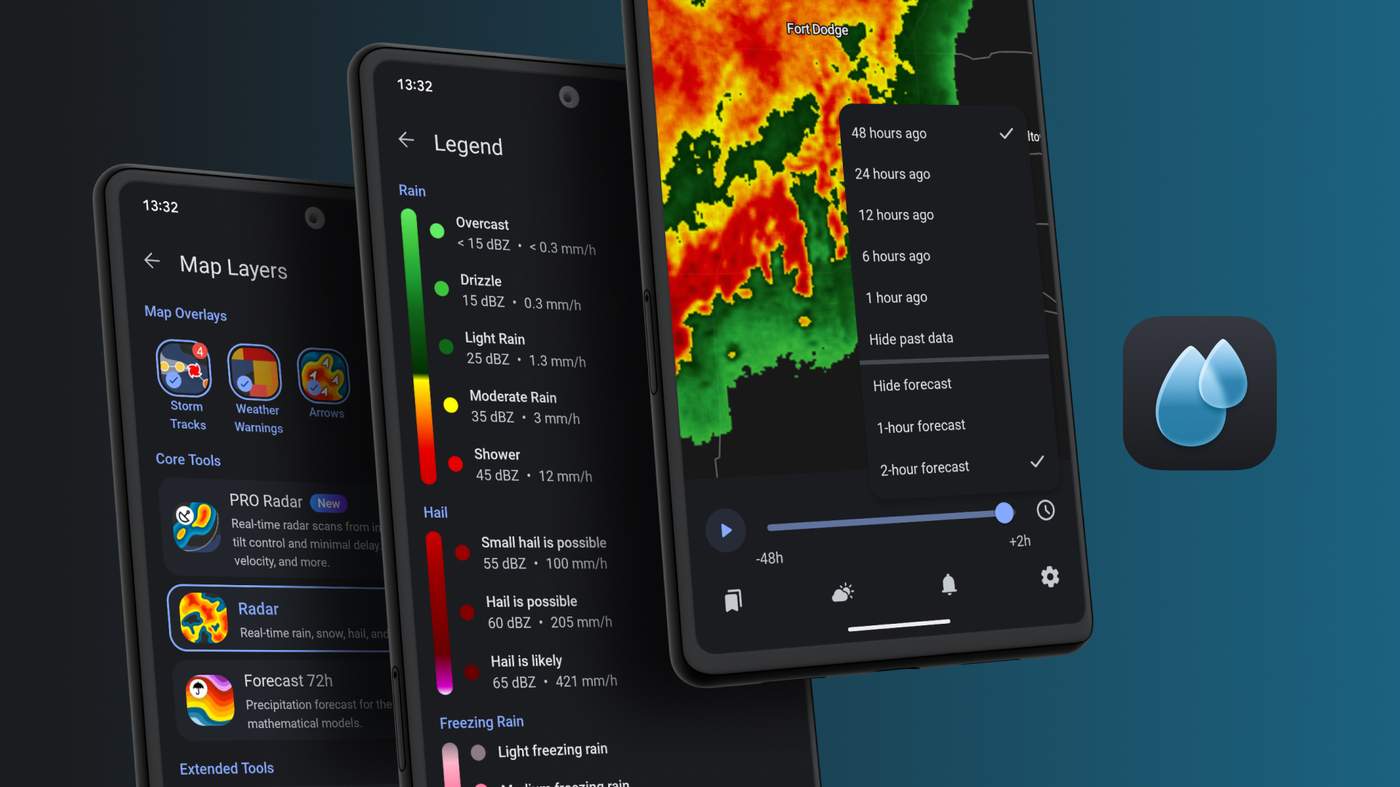
Nowcasting models to predict precipitation for the next 2 hours.
Client-side OpenGL rendering for smooth animations on mobile.
During hurricane season, users get:
Live storm path & category tracking.
Wind speed heatmaps for the next 48 hours.
Rainfall intensity charts for timing the heaviest bands.
Why It Matters This Season
The radar map shows the location of the likely occurrence of tornadoes (which usually occur before hurricanes). The radar map also shows where the center of the hurricane is now. The app also has notifications about dangerous weather phenomena. And there are separate notifications about the hurricane zone - if you are in this zone, Rain Viewer notifies you how close and when a particular hurricane will pass by you.
For developers, hurricane season is a reminder that real-time, high-accuracy data delivery isn’t just a nice-to-have - it can save lives. That’s the challenge that keeps me shipping code, even when the weather outside is calm.
When I launched Rain Viewer, there was no expansion framework or market strategy. The early growth was entirely organic - just me trying to solve a real problem for myself and people like me. Within a few years, the app had users in over 90 countries and was translated into 33 languages.
The first 11 translations weren’t based on downloads. I looked at the countries with the most traction and hired translators via Upwork. It turned out to be the easiest win imaginable: some languages boosted installs 10x (from 100 to 1,000/day).
Localization didn’t just help - it was essential. People trust and use apps more when they’re in their native language.
Weather Culture Is Real
I used to think weather apps were universal. But each region has its own “weather culture.” In the U.S., radar chasers care about tornado signatures. In Southeast Asia, people watch for typhoons. In parts of Europe, people just want to know when it’ll stop raining.
Usage patterns vary too. Some users open the app every day for six months, then disappear. Others only use it in storm season. And that's fine - retention in weather apps often should be seasonal.
Feature Growth ≠ Feature Bloat
We never wanted to be an “everything weather” app. Rain Viewer focuses on precipitation - the one thing people really care about when they step outside.
When we add new features (like tropical storm tracking or radar tilt layers), it’s based directly on user feedback. But we’ve learned to say no often. Some features that seemed like a great idea (like AI-generated forecasts or user-submitted weather reports) actually led to higher uninstall rates.
Rule of thumb: if a feature makes users wait, think, or explain it - it's probably not worth it.
What Actually Drove Growth
We didn’t have a big marketing budget. Still don’t. Most of our 4M+ installs came from three things:
ASO (App Store Optimization)
Screenshots, titles, and keywords matter more than most people think. Recently changing the first screenshot cut our downloads in half. We changed it back and doubled again.
SEO (Search Engine Optimization)
Having even a basic website helped a lot. We over-optimized it for search engines early on, and that continues to bring in traffic.
Embeddable Widgets / Viral Loops
Our radar maps could be embedded on third-party websites. This generated backlinks, API adoption, and higher trust signals for Google.
No paid ads. No influencer campaigns. Just long-tail discovery and useful tools people could share.
What Helped Retention
Push notifications. Not “get Premium now” - but useful, respectful ones like “Rain starting in 12 minutes.” Those drive real re-engagement. 10–15% open rates on those alerts directly boosted retention metrics.
Retention is also where good features prove their value. You can see the difference in Day 1 retention when you ship something useful vs something trendy.
Global ≠ One Size Fits All
One of the biggest surprises? Saudi Arabia became a top market. Despite the hot climate, rain causes major problems there (think: flash floods, not summer showers). That demand for storm alerts was real - and unexpected.
The hardest part of global scaling wasn’t translation. It was deep localization.
Color preferences vary by culture.
UI expectations differ.
People in Asia, Europe, and South America expect different default views.
Localization is more than language - it’s UX, context, and relevance.
Team & Support Across Time Zones
We're a small remote team of 12, spread across different time zones. We prioritize human support and work to connect users with real team members whenever possible. Our support is asynchronous, and we focus on providing thoughtful, personalized responses.
We aim to respond promptly, with timing dependent on the complexity of the client's issue. We respond in English, and when needed, provide translations in the user's native language alongside the English version.
This personal approach is important to us, especially when our app serves as a safety tool during severe weather.
If You’re Building for the World
If you’re a solo dev or small team dreaming about global reach:
Remember that localization is a must have.
Obsess over your app listing - it’s your actual homepage.
Build features slowly and deliberately - quality always beats quantity.
Play the long game - 2 years of consistent product work > 2 months of launch hype.
Weather isn’t glamorous, but it’s one of the few app categories people need. Make something useful, trustworthy, and calm - and it’ll spread.
Want to see how it turned out? Check Rain Viewer on iOS & Android.

I didn’t set out to build a weather startup — I just wanted to know exactly when it was going to rain.
Living outside the US, I was frustrated by how limited most weather apps were. They’d show vague forecasts like “scattered showers,” but no live radar, no real-time animations, no storm movement. Meanwhile, American apps had all the eye-candy: moving precipitation maps, storm tracks, even alerts for rotating cells.
I thought: This data must exist. Why can’t the rest of the world see it?
That curiosity led to a late-night side project that eventually became Rain Viewer — today a weather radar app with 4+ million users in 90+ countries, known among weather geeks, hikers, and storm chasers for its precision and global reach.
Why Build Another Weather App?
Let’s be honest: the weather app market is brutally competitive. Big tech and national agencies dominate. But here’s the catch: most apps are hyper-localized, and global radar coverage was practically non-existent.
That was our opening.
Rain Viewer became the first mobile app to aggregate radar from 1,000+ stations worldwide, including regions usually “off the map” for popular apps — parts of Asia, and the Middle East. We turned scattered national data into a single interactive global radar, updated every 5 minutes.
Today, if you open Rain Viewer in Croatia or Iceland, you can see exactly where rain is falling — even above a specific building.
Behind the Scenes: From Raw Radar to a Smooth Map
Radar data is messy. Every country has its own formats, refresh rates, and quirks. Some post live data via APIs, others upload GIFs to FTP like it’s 1998.
We built a backend that ingests and normalizes all this chaos, then serves clean tiles for our mobile apps. Our iOS and Android apps (Swift + Kotlin) share a custom radar rendering engine that can smoothly animate storms even on budget phones — because performance is everything when a thunderstorm is moving your way.
Growing Rain Viewer: Community and Product
Some of RainViewer’s early traction came from unexpected corners of the world.
Central Europe turned out to be a hidden gem: countries like Poland and Romania had reliable radar coverage, but almost no consumer apps were using that data.
These markets taught us a core lesson: go where your users have weather pain points, not just where you expect high app-store traffic.
In Europe and the US, competition is tougher. But we found that simplicity + accuracy always wins. Our users love:
Fast, clear radar animations
Hyper-local precipitation alerts
Premium tools like storm tracking, 2-hour precipitation forecasts, and historical radar maps
Lessons for Indie Developers
If you’re thinking of building a consumer tool like Rain Viewer, here’s what worked for us:
Solve a real frustration – I built Rain Viewer because I needed it.
Find the gap – Big players ignored global radar coverage. That was our wedge.
Start small and iterate – We began with radar in Europe, then expanded worldwide.
Monetize later – Free-first worked; we added premium subscriptions ($4.99–$19.99) for power features.
Make UX a priority – If your app isn’t instantly clear, users will bounce.
From Side Project to Global App
We’re still a fully remote team of 12, without billion-dollar satellites — but Rain Viewer now serves millions of people checking weather before a commute, a hike, or a storm chase.
What started as a personal annoyance has grown into a global weather platform, giving everyday users access to professional radar data — and helping them literally see the rain above their own homes.
You can find out more about my app (as well as being a weather enthusiast) on the website – rainviewer.com
Comment