
Reconstruct
Mind Tools for Optimal Everyday Performance
Hi IHers
I’m Ashika, founder of Reconstruct.
Over the last year I’ve been obsessed with building tools that make mental fitness as approachable as tracking your steps.
Reconstruct combines practical productivity tools with simple ways to stay mentally resilient:
Vision boards and planners that keep you focused
Quick mind tools like a thought shredder and guided breathing
Activities like coloring and puzzles that give your brain a reset
We launched the app and website a few months ago. Hundreds of people have used the free tools and the feedback has been great — especially from those who struggle with stress or overthinking.
I’ve just introduced Reconstruct Pro, a paid tier with more advanced planners, guided journeys, and downloadable resources designed to help people build daily mental-fitness habits.
Here’s where I am:
I’m looking to get my first paying customer, and I’d love for that milestone to happen here with the Indie Hackers community.
If you value staying sharp, organized, and resilient — I think you’ll find Pro genuinely useful.
👉 You can try it here: Reconstruct Pro
I’d also love to hear how others in this community approached converting early free users into paying ones.
Thanks for being a place where builders can share these moments and learn from each other.

If you’re building something new today, it can feel like everything already exists.
Notes apps, productivity tools, meditation platforms, therapy services — the market is crowded.
So how do you make sure you’re not just adding to the noise?
You find your why.
For us at Reconstruct, that started with spotting a gap.
We noticed that most mental health and productivity apps focus on fixing problems after they show up — meditate when you’re stressed, journal when you’re anxious, go to therapy when things get bad.
But what about the people who just want to stay emotionally strong and clear-minded every day, before things spiral?
That became our why: building a space for mental fitness, not just mental health.
If you’re working on your own product, here are a few things that helped us:
Start by looking for what’s missing, not what’s popular.
Find the specific problem that makes you think, “Why hasn’t anyone solved this yet?”
Define your differentiator so clearly that when someone asks what you do, you can answer in one sentence.
And design something people would use even when nothing is wrong — that’s how you build daily engagement instead of a one-off experience.
Most importantly, keep listening to users early on.
They’ll tell you where the existing solutions fall short and where your product can shine.
And remember, standing out isn’t about shouting louder — it’s about being so useful and so focused that your product feels obvious once it exists.
That’s how you find your why.
And once you have it, everything else — building, marketing, growth — gets a lot easier.
Building Reconstruct has taught me that the hardest part of this journey isn’t the hustle. It’s the wait.
You do the work — you ship the feature, send the pitch deck, submit the app update, publish the newsletter — and then… silence. You refresh dashboards, check emails, and scroll through analytics like they might magically change if you stare hard enough. Nothing moves.
This waiting game can feel like quicksand. You start questioning if the work was worth it, if you should be doing more, or if you’re falling behind. That’s where I remind myself: waiting is part of the work.
At Reconstruct, we’re building tools that help people calm their minds and stay consistent even when things feel out of control. I have to use the same mindset as my users: focus on what I can control today. Plan the next feature. Write the next post. Talk to one more user.
Momentum doesn’t always look like fireworks. Sometimes it looks like a quiet day where you keep showing up, stacking small wins. The response might come tomorrow, next week, or months from now — but the habit of building is what keeps you in the game long enough to see the results.
If you’re in the waiting stage right now, you’re not alone. Keep going. This is where most people quit — and where the builders who stay consistent get their edge.
If you’d like to see what we’re building, here’s where you can find us:
👉 Reconstruct on Android
👉 Reconstruct on iOS

Big news from our side – Reconstruct was selected for the #GoogleforStartups Gemini API Sprint! Honestly, I wasn’t sure when applying if we’d make the cut, but we decided not to overthink it and just hit submit. That decision paid off. If you’re ever debating whether to apply to these kinds of programs, my biggest advice is: don’t self-reject. The worst that can happen is silence, but the upside is exposure, mentorship, and insights you can’t get elsewhere.
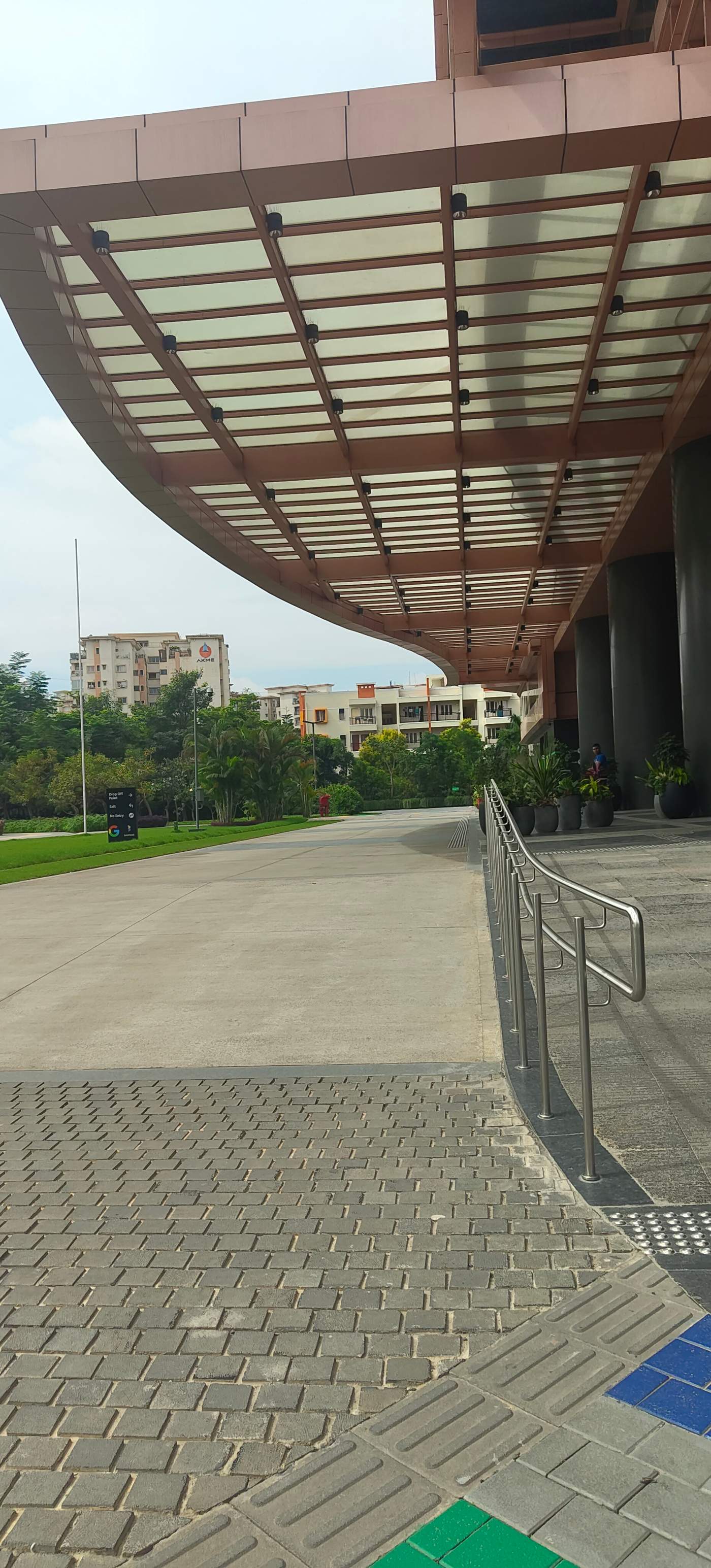
The sprint itself was an intense but eye-opening experience. We had the chance to dive deep into Google AI Studio with guidance from Google experts Harsh Dattani, Nilay Chauhan, and Naveen Narayanan. We explored tools like Gemma 3, Imagen, Live API, Lyria, ADK, and more. A few key learnings stood out for me:
AI works best when tied directly to user problems. It’s tempting to add features because they’re cool, but grounding them in specific pain points ensures they actually stick.
Think in systems, not features. For example, Imagen (for generative visuals) and Live API (for real-time interactions) on their own are impressive, but the real value shows up when you combine them to design richer user journeys.
Iteration beats big launches. The sprint reminded us that starting with small experiments — testing one micro-flow at a time — is a faster way to learn and adapt than waiting to build out a “perfect” AI integration.
Community matters. Meeting other founders working on very different products but facing similar struggles was energizing. It reinforced that the best insights often come from outside your immediate space.
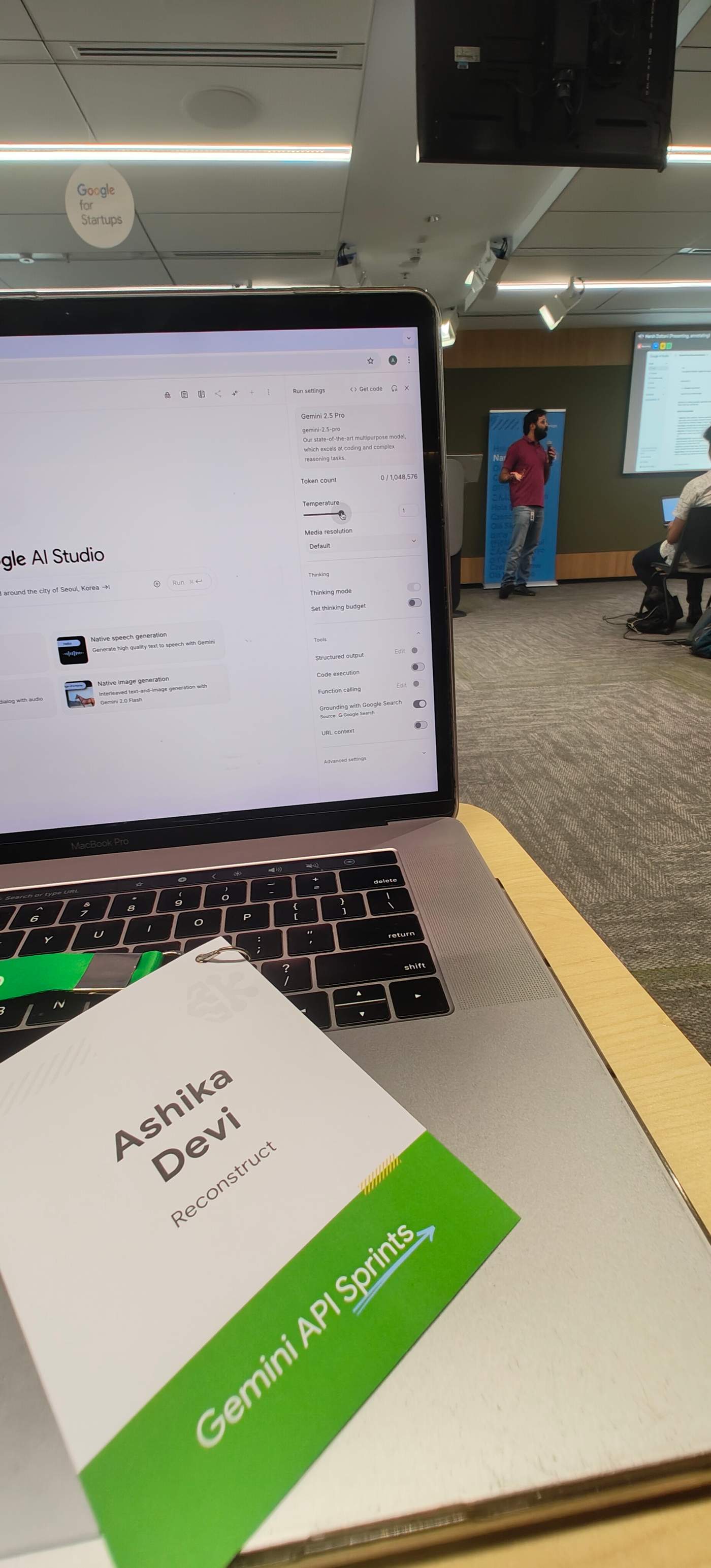
For Reconstruct, the next step is to bring these lessons into our mental fitness platform. Our vision is to use AI not as a flashy add-on, but as a way to make the experience simpler, more personal, and more habit-forming for our users. That could mean AI-guided journaling prompts, adaptive planning tools, or even mood-aware recommendations that evolve with how people use the app.
If you’d like to see what we’re building, here’s where you can find us:
👉 Reconstruct on Android
👉 Reconstruct on iOS
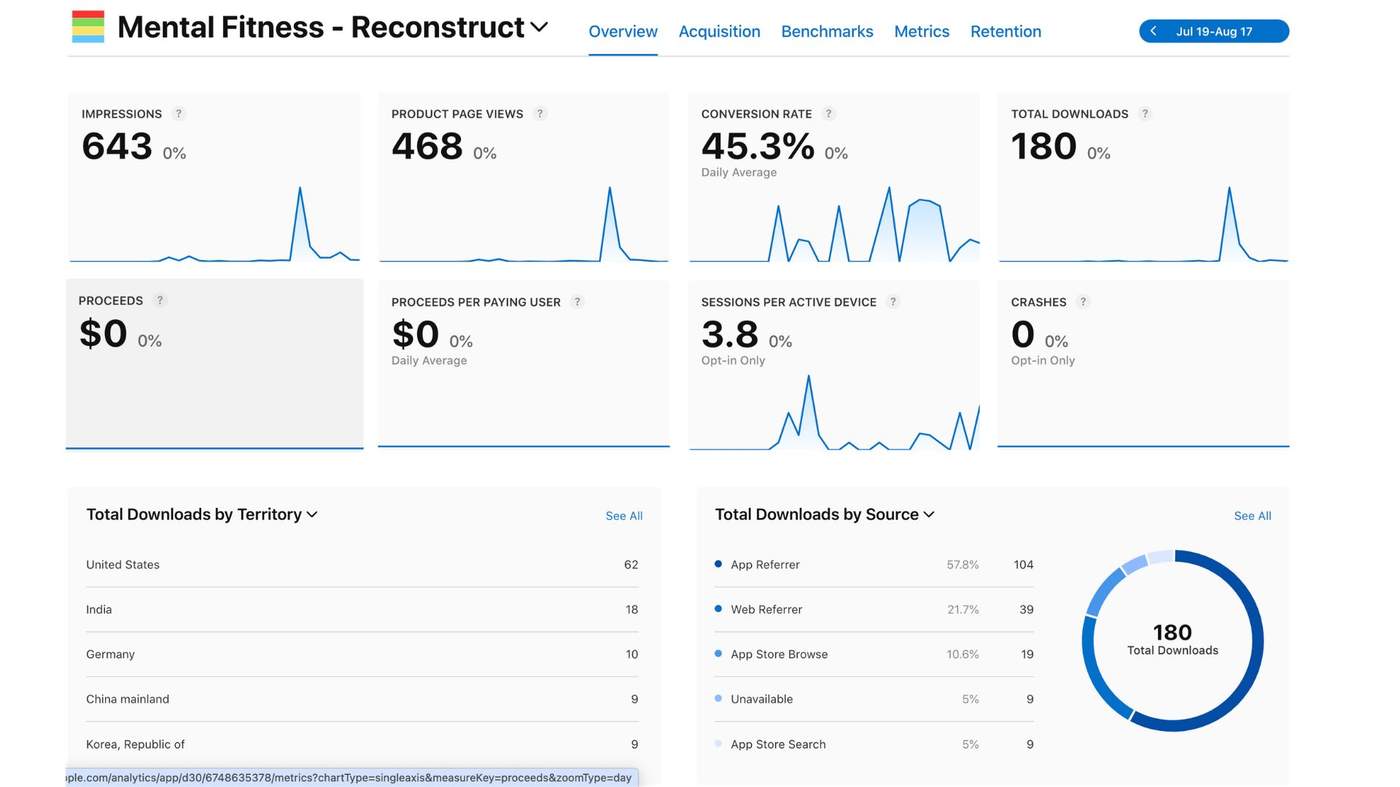
When I saw the first 100 people download my iOS app, my initial reaction was wow, this is actually happening. But then reality set in: downloads alone don’t mean success. If I didn’t act with intention, that momentum would fizzle out.
Here’s what I focused on right after hitting 100:
Talk to the people behind the numbers
I reached out directly to users. Some were excited, others confused, and a few completely dropped off. The feedback was more valuable than any analytics dashboard.Watch retention like a hawk
A download means curiosity, not commitment. I checked how many came back after Day 1, Day 7, and Day 30. Painful, but necessary.Onboarding was my weak spot
A lot of people didn’t stick because the first experience wasn’t clear enough. I learned that if users don’t “get it” within 30 seconds, they’re gone.Make feedback easy
I added a one-tap way to share thoughts inside the app. It surprised me how much more people opened up when the friction was gone.Find where the 100 came from
At first, I thought growth meant chasing new channels. But doubling down on the one or two that already worked was a smarter play.Pick one number to obsess over
Instead of drowning in metrics, I chose one north star (for me, it was weekly active users). Every change I made, I asked: does this move that number?Think in loops, not spikes
Launches are fun, but they’re short-lived. What matters is building repeatable cycles—content, community, small features, referrals—that slowly compound.
The biggest shift for me was realizing: 100 downloads isn’t success, it’s permission to keep going. It’s a signal that there’s potential—but it’s on me to turn that spark into something real.
-
2
Congrats on the milestone. Hitting 100 is a big deal, but I really like how you framed it as just the beginning rather than the finish line. The focus on retention and loops instead of spikes is spot on—most people skip that part and then wonder why growth stalls. Curious, what’s been the most surprising feedback you’ve gotten from users so far?
-
1
Thanks Viggo, I'm just starting off on my email workflows for retention- fingers crossed. Will surely share my learnings here :)
-
-
2
Huge congrats on the first 100 that’s a big validation step 🙌 Now it’s time to double down on learning. Start talking to those early users → what made them try it, what problem are they actually solving with it, and what’s still missing. That feedback loop will guide your next 1000. Treat this phase like discovery, not distribution the growth will follow 🚀
-
2
Yes you're spot on, I've set up a couple of trackers to see what the users are up to. And nothing like actual user conversations. 1000 here I come!
-
2
Niceee 🔥 That’s exactly the right mindset.
Once you combine the data from those trackers with the real user convos, you’ll start spotting patterns you can actually build on and that’s where the compounding starts.
You’re definitely on the path to that 1k 🙌 Keep going!
-
-
-
1
Congratulations on shipping, you did it!
Have you integrated any analytics tools such as PostHog or Mixpanel? Latter is better for checking the "funnel", as in, how many users are dropping off at what stage of onboarding, signup, paywall, etc? If you expect monetisation, have you considered adding a paywall in the flow?


When I first started building Reconstruct — a mental fitness platform with tools like vision boards, planners, and daily notes — I thought that if I just made something really useful, people would come.
They didn’t. At least, not until I made distribution the focus.
It’s easy to fall in love with building. You’re in control, the feedback is instant, and there's a kind of flow to watching your vision come alive. But once you’ve shipped — the real game begins. Distribution isn’t optional. It’s oxygen.
Here are 10 distribution channels I’ve tested (and continue to use) for Reconstruct — with honest thoughts on how each one plays out:
1. Substack
Substack works well when you're ready to go deeper. People who read long-form here actually want to think and reflect — which fits well with Reconstruct's mental fitness focus. It's also great for building a loyal tribe without social algorithm chaos.
Tip: Use Substack to document the journey and share genuinely useful content. I write what I wish someone had told me — and turns out, others needed it too.
2. Medium
Medium has an existing audience and decent SEO. If you're writing about things like wellness, productivity, or mindset — you're tapping into an active search intent. It’s not where your community will form, but it can introduce new people to your brand.
Tip: Cross-post from your blog with a canonical link. Use tags wisely — it boosts discoverability.
3. Reddit
A powerful discovery engine if you nail the context. But it’s also a harsh crowd — especially in wellness or self-improvement spaces where people are skeptical of “apps.” I got banned on two subs even when I tried to be helpful. Lesson learned.
Tip: Engage first, promote much later (if at all). Or create value-laden “educational” posts that point to your tools passively.
4. Quora
It’s long-tail SEO gold if you’re patient. But they’re tightening rules, and bans are real. I lost access to my main account after one helpful reply got flagged. That said, Quora content still ranks, and people clicking through are usually high-intent.
Tip: Answer with depth. Link to blog content, not directly to your app.
5. YouTube Shorts
Shorts have insane reach right now. I’ve posted raw demos of Reconstruct tools (like the Summer Calendar or Daily Notes) and people instantly get what the app is about — no pitch needed. Visual > verbal.
Tip: Focus on showing the experience. You don’t need to speak — just screen record + subtitle + add music.
6. Blog (on your own site)
This is your home base. Google rewards long-term consistency. I’ve started optimizing blog content around mental fitness and productivity tools so Reconstruct can show up on search engines and AI platforms. It’s slow burn but solid foundation.
Tip: Think like a product-led storyteller. Every tool or feature you build = a blog post waiting to be written.
7. Indie Hackers
It’s a community that gets the struggle. Sharing real stories, numbers, experiments, even failures — builds trust fast. I’ve found motivation and feedback here that kept me going when traction felt slow.
👥 Tip: Be transparent and provide value. People don’t care about polish — they care about real progress.
8. Instagram (especially now)
Instagram posts and reels are now getting indexed by Google — yes, your IG content can show up in search results! This makes it a must-focus channel. I’m building up @reconstruct_now and it’s wild how some short, relatable posts bring in engaged followers.
Tip: Treat IG like a visual blog. Use carousels to explain ideas, use reels to show tool walkthroughs. Don’t just post — narrate.
9. Android App (Google Play Store)
The global reach here is real. With one upload, you’re available to users from Nairobi to New York. For Reconstruct, our Android downloads came from 20+ countries in the first week with zero paid ads.
Tip: Your Play Store listing matters. Add video, thoughtful screenshots, and reviews early on.
10. iOS App (Apple App Store)
Same as Android — but with a higher-trust user base. The setup is slightly more annoying (hello, App Store review cycles), but the credibility it gives your product is worth it. Reconstruct being on both stores helped close more conversations.
Tip: Add keywords smartly in the description. Use updates to highlight momentum. Reviews matter a lot here.
11. Email (bonus!)
Most people won’t buy or engage the first time they visit. But email lets you nudge them back. I use email flows inside Reconstruct to suggest daily wellness actions, new features, or tools they haven’t tried yet.
Tip: Segment by interest. Send one line at a time. Be useful before you're promotional.
Final Thought
The hardest part isn’t building the thing. It’s getting people to care enough to check it out.
If I were starting over, I’d pick 3 of the above channels and go deep. Then layer in more as I grow.
The product deserves to be seen — but you have to do the seeing for them first.
– Ashika
-
2
This hits hard 🔥
-
2
Informative Post Related to Branding Platforms.
-
2
I am gonna tell 1st three as a preferential to perform marketing activities on the platform for more detailed and researched content marketing.
-
2
This is a fantastic initiative! Creating accessible and interactive self-help tools is an impactful way to empower people in managing their mental well-being. I especially appreciate the focus on everyday performance and making mental health resources free—it's crucial for lowering the barriers to support.
-
2
Thanks for sharing, Medium and Reddit have been really good for me, I'll definitely add Substack in my list.
-
1
Can you talk a little about your process for creating YouTube shorts? I watch content but don't create it. Is adding subtitles and music native to the YouTube process, or do you rely on 3rd party tools?
-
1
How to start with Substack?
-
1
Love how you broke this down with real pros/cons — refreshing compared to the usual “just post everywhere” advice. Picking 2–3 channels and going deep is such an underrated growth move.
-
1
Nice list, But another thing I would like to point out is that. You have to be sure your audience are in that community to begin with.


After what feels like an emotional triathlon — building, testing, breaking things, starting again — Reconstruct is now officially live on the App Store.
This milestone feels surreal. A few months ago, this was just an idea sitting in my mind. Then came the web version, followed by the Android release. But getting it through Apple’s gates? That’s an entirely different beast. And somehow, here we are.
For those unfamiliar, Reconstruct is my attempt at reshaping how we approach mental wellness and everyday performance.
It’s not therapy.
It’s not a habit tracker.
It’s not productivity.
It's more like a digital amusement park for your mind — a space that feels light, private, and playful, but quietly supports your inner world.
The tools inside are things I personally wished existed when I was going through my own mental funks. Like a “thought shredder” to get intrusive thoughts out of your head. Or calming tools when you're spiraling. Or even simple, no-pressure games like sliding puzzles and coloring sheets to reset your nervous system.
All of it’s editable. Saveable. Trackable.
And now, accessible to iPhone users too.
Why iOS Took Forever
I genuinely underestimated what it takes to launch on iOS.
Apple’s ecosystem is a whole different operating philosophy. The App Store guidelines are deeply specific. One missing declaration can stall you for days. Testing on simulators doesn’t prepare you for actual device bugs. You start to realize that UX polish isn’t optional here — it’s expected.
I hit issues that weren’t on Stack Overflow. I submitted builds at midnight only to find rejections the next morning. And sometimes an endless silent wait.
( pro-tip - never 'submit for review' on weekends cos they review only on weekdays..ya.. ;) )
But I’m glad I pushed through.
Why iOS Matters
This wasn’t just about having a presence across platforms. iOS forced me to tighten the entire product experience. It made me rethink flows, simplify interactions, and pay attention to edge cases I didn’t notice before.
Also — real talk — my target users are more active on iOS.
From a credibility, monetization, and growth standpoint, this launch is a huge unlock. It’s like a quiet signal that Reconstruct isn’t just a “side project” anymore. It’s now a real, usable product available to anyone with a smartphone — no matter their OS.
The Takeaway
If you’re building something for mobile, and putting off the iOS side because it seems “too complex” — trust me, I get it. But do it anyway. Start sooner than you feel ready.
Apple is slow but precise.
TestFlight is your friend.
The polish is worth it.
And you’ll walk away a better builder.
Here’s the link if you’d like to try it out or pass it along to someone who needs a little more control over their mindspace:
🔗 [App Store Link]
🔗 reconstructyourmind.com
If you’ve gone through your own iOS launch war stories — I’d love to hear them.
And if you’re still in the trenches, I’m happy to pass on whatever tips I’ve picked up.
– Ashika
-
2
Finished reading all your content
You are a truly thoughtful and thoughtful founder! Keep up the good work! I believe your product will grow bigger and bigger
-
1
thanks so much @NeoR2, this means a lot, will continue to share my learnings :)
-
-
2
Super helpful. I’ve been procrastinating the iOS version of my app just because of the review stress. Appreciate the encouragement — gonna bite the bullet soon!
-
1
yes you must go for it, would love to have an ios friend :) good luck!
-
-
2
facts and you can get smarter by continually learning and expanding your knowledge.
-
1
100%, wishing you the best :)
-
-
1
Congrats on the launch. Interesting concept of a digital amusement park for your mind. Will check it out.
-
1
Congrats on getting your app live — that’s a huge win, especially with all the hurdles Apple threw along the way. Your persistence really shows. Wishing you continued success and smooth sails ahead.
-
1
Congrats on the launch, and thanks for the tips! I didn’t know it was that difficult to publish on Apple. It took me a month of back-and-forth just to get the account approved, but haven't published the app yet. Did you find getting the app approved difficult, or was the account approval the hardest part?


Most mental health apps are obsessed with calm.
White space. Whispery voices. Slow breathing.
That’s not Reconstruct.
Reconstruct is a mental gym.
Not one you go to when you’re zen —
but when your brain’s a war zone.
Because healing isn’t always soft.
Sometimes it’s rage.
Sometimes it’s control.
Sometimes it’s doing something just stupid enough to stop the spiral.
What if meditation was just one machine at your mental gym?
Reconstruct is the full workout:
– 🧠 Vision boards for focus
– 🗓 Calendars for control
– 🗑 Shredders for rage
– 🎴 Memory cards for clarity
– 🎨 Coloring tools for soothing overstimulation
– ❓ Riddles + dice for breaking mental loops
It’s not “mindfulness.”
It’s mental strength.
And every tool is designed for the real-life version of mental health:
the 2 a.m. breakdowns, the frozen-to-the-bed days, the what the hell am I doing hours.
Just a weird, colorful, private space to get your mind back on your side.
👊🏽 This is Reconstruct.
Your mental gym.
Built by someone who needed it too.
Startups look glamorous from the outside. Flexible schedules, bold ideas, indie freedom.
But here’s what no one tells you:
Every single step forward is usually success #1 after failure #100.
That bug that finally got fixed after 3 days? You tried 26 solutions before that one worked.
That app store rejection? You rewrote the build script a dozen times before it passed.
That first paying user? They came after 400 ignored DMs and 3 months of “Maybe later.”
It’s not one clean sprint. It’s a daily decision to keep trying, as if the last 100 tries didn’t just kick your ego in the face.
What Startup Life Actually Feels Like:
You get stuck trying to fix a build error that should take 10 minutes, and it eats your entire week.
You feel like you're spinning wheels while others are shipping prettier, faster, better.
You question whether you're actually cut out for this. (Spoiler: You are.)
And then…
One thing works.
The app builds. The user signs up. The feedback hits home.
And for that moment, it all makes sense again.
Resilience = Mindset + Repetition
What I’ve learned is that resilience isn’t just about “not quitting.”
It’s about trying again with a clean mind — not dragging yesterday’s burnout into today’s attempts.
You try solution #101 like it’s the first time.
You show up to that 10th sales call without letting the last 9 rejections poison your tone.
You launch again, even though last week’s campaign flopped.
This mindset — clear, neutral, patient — is everything.
What’s Helped Me Stay Resilient:
Writing “What worked / What didn’t / What next” every week — just for myself.
Stepping away for a walk before I rage-delete code.
Reminding myself: “Effort compounds. I just can’t see it yet.”
Building a habit of emotional reset: No matter how the last try went, treat the next one fresh.
Final Thought:
Startups don’t reward speed. They reward stamina.
The real edge? It’s not having better code, or better design, or better funding.
It’s having a mindset that’s stronger than the setbacks.
So if you’re stuck in one of those 100 failed attempts — hold your ground. That next try might be the one that clicks. And when it does, it’ll carry the weight of everything that didn’t.
You’re not behind. You’re not broken.
You’re just building something real — and that takes guts.
What’s tested your resilience as a founder, and how did you push through?
Would love to swap war stories 👇
-
2
This resonates deeply. People see startup wins but rarely the quiet grind, the 3AM doubts, and the tiny invisible wins that compound over time. Resilience, I’ve found, isn’t just about enduring — it’s about showing up clear-headed after each hit, choosing to keep momentum even when progress feels microscopic. A few things that have helped me:
Logging “micro-wins” daily so I don’t lose sight of movement.
Reframing setbacks as data points, not personal failures.
Taking deliberate, device-free breaks to reset mental noise.
Reminding myself it’s a marathon, not a highlight reel race.
It’s easy to feel behind when others are shipping shiny updates, but real builders know consistency beats bursts. Thanks for sharing this - it’s the honest reminder many of us need to keep building, calmly and relentlessly, even when the 101st attempt is what finally clicks.
-
1
glad the post resonated with you Usman, your point about reminding ourselves its a marathon and not a highlight reel - is sooo on point. And something I've add to my daily reminders, thanks and keep going :)
-
2
Love how you validated the idea by offering pre-sales. We’re thinking of something similar for Coolla. Curious, how did you handle refund requests?
-
2
Brutally accurate. I’ve spent full weeks chasing a “quick fix” and rewriting outreach messages that never get replies. What’s helped me: short walks, shipping small, and reminding myself that consistency is louder than perfection.
-
2
This captures the startup journey perfectly. What stands out is the reminder that progress isn't linear - those small, invisible steps eventually add up.
A simple practice that's helped: keeping a 'three dots' log each day:
• One thing that moved forward (even slightly)
• One lesson learned (usually from something that didn't work)
• One action for tomorrowIt creates just enough structure without feeling burdensome.
The key insight about stamina is so true. Most breakthroughs happen right after the point where many give up. Keep going - the compound effect is real.
-
1
love this Joan :) , ill incorporate the three dot practice - especially the 'one lesson learned' i think we forget this in the long run
-
1
Exactly! That's why we're building Accio AI to auto-track weekly progress and lessons - turns those 'three dots' into actionable patterns over time. Your method just gave me a great idea for our next iteration.
-
-
-
2
Loved this. Curious how much of your resilience came from experience vs. mindset training. Ever hit a point where you questioned the whole thing? Great breakdown.
-
1
thanks Jake, I'd say it's a bit of both - experience and mindset training. On questioning the whole thing - yes and yes - but i try not to mull on it and quickly change perspective to what can i do now to make this change.
-
-
2
Im in the failed attempt space right now. But wow have i learned a LOT during this time. I think one thing I have going for me is that im self employed already. So im very used to ups and downs and not knowing how mucb money I will make. I've always been an "ideas" person who needed to connect with someone to help me build. Well tfg for Ai; it IS that someone. The tools have finally evolved to a point that helps someone like me and I can try to bring my ideas to life. 2025 and beyond
-
1
so true Mixxsy Labs, AI has been a saviour for me as well, wish you the best on your venture
-
-
2
This hits hard. Especially the “400 ignored messages before the first paying user” — I’m right in that phase now.Building a marketplace in Central Asia, full of challenges, but the mission keeps me going.Thanks for the reminder that the next try might be the one.Just followed — would love to exchange experiences with fellow builders
-
1
Thanks Alee, glad you resonated with the post. It's communities like these that keeps me going - knowing there are many like me on the same mission - I'm sure you'll succeed with InnovaAuto :) my best wishes, keep going
-
-
2
I'm in the midst of bringing something amazing to the world or watch it all dissolve after reaching a wall beyond my technical abilities. How do I find the RIGHT people building a team? Or even a co-founder?
-
1
hey hey Michael, I hear you. for me what works in ' progress'. I ask myself did I make even a small progress towards my brand - and if the answer is yes, I know Im in a good place. About finding the right people - i'd say reddit helped - maybe you could try there
-
-
2
amazing
-
1
thanks :)
-
-
2
Thanks for this,I feel that being a startup founder can be alot like Pinocchio without a carpenter and mixing bits off of you from a Roman Colosseum,you go back home and have to refix your frame because you have to redo it over again the next day or perish.
-
1
yesss exactly @ThePrince, glad you resonate with the post.. let's go :)
-


I’m Ashika, founder of Reconstruct — a mental fitness platform designed to help people build emotional strength through interactive self-help tools like digital vision boards, planners, thought shredders, and breathing exercises.
After a year of building, testing, launching on Android, and getting early traction... I realized: Reconstruct wasn’t growing the way I’d hoped. Here's a breakdown of what went wrong, what I learned, and what I'd do differently if I were starting today.
1. Too Much Tool, Not Enough Problem
I was excited to build creative tools. And I did — from calendars you can color-code to games for mood resets. But I never paused long enough to deeply validate: What core problem am I solving? Who needs this right now?
Lesson: Start with a real pain. Build one tool that solves it really well. Expand only when it sticks.
2. Delayed Monetization Clarity
I waited too long to figure out how I’d make money. I didn’t want to gate access, so I kept everything free. But this meant no clear funnel, no user incentive to pay, and no revenue to reinvest.
Lesson: You don’t need to monetize immediately — but you need a plan. A clear value ladder makes all the difference.
3. No Sharp ICP (Ideal Customer Profile)
My target user was “anyone who wants to feel better.” That’s too broad. I didn’t know who I was really building for — students? burnout professionals? therapy skeptics?
Lesson: Talk to users. Narrow your niche. Build for one person, not everyone.
4. Soft Launches = Soft Growth
I kept launching in whispers — a small tweet here, a quiet Play Store drop there. I was scared of judgment. But if no one knows you exist, no one can try your product.
Lesson: Go loud. Validate in public. Iterate with feedback. Visibility beats perfection.
5. Too Much DIY
I designed, built, wrote, marketed, and supported everything myself. That made me burn out. Worse, it slowed me down.
Lesson: Automate early. Delegate where possible. You don’t have to be the entire engine.
6. Chasing Features, Not Retention
I kept building more tools to “impress” users. But I never focused enough on retention. Are people coming back? Are they using it daily?
Lesson: Retention is the holy grail. Track it. Optimize for it. Delight returning users before acquiring new ones.
7. I Was Too Quiet About My Mission
Reconstruct was born from a deep personal need — to make mental fitness engaging and stigma-free. But I rarely told that story. I only showed the tools.
Lesson: People connect with why. Don’t just share what your product does — share why it matters to you.
What I’m Doing Now:
Pivoting messaging around mental fitness and emotional strength — a clearer lane.
Building a smarter onboarding journey based on user mood.
Prioritizing repeat use over feature overload.
Opening up the platform to iOS + better SEO to increase discovery.
Talking more openly (like this post).
Final Thoughts
If you're building something meaningful but growth feels slow — you're not alone. It’s okay to make mistakes. What matters is learning fast, staying honest, and showing up again tomorrow.
If you’ve faced something similar, I’d love to hear from you.
— Ashika
ReconstructYourMind.com
Mental fitness for everyday performance
-
1
Thanks for sharing your experience, This is my first time building a startup. Your experience helps me a lot
-
1
Love this... especially "What core problem am I solving? Who needs this right now?" Helpful to remember to bring it back to basics. 1, 3, 6 hit at a core theme to me about 'focus' which I think is so crucial in startups. Easier said than done for sure, something I'm working on as well


2 Comments
Really like the idea behind Reconstruct — a clear promise, tight scope, and a fast “try → aha” loop. That combo is what gets people to actually stick. If you keep leaning into real user stories (before/after snapshots + one metric that moved), you’ll have a flywheel.
Curious: what single moment best predicts a paying user for you — first “win” captured, a second session within a week, or sharing a result with someone else?
P.S. I’m with Buzz — we design conversion-focused Webflow sites and pragmatic SEO for launches. Happy to share a quick GTM checklist if useful.
thanks so much @Irsa, this means a lot. Yes a GTM checklist would be very useful - I'm at ashika@reconstructyourmind.com , happy to connect and take thiis forward