
SaaS Pegasus
The Django SaaS boilerplate for your next big idea.

After more than four years of indie hacking I’ve finally managed to earn $100k from my projects!
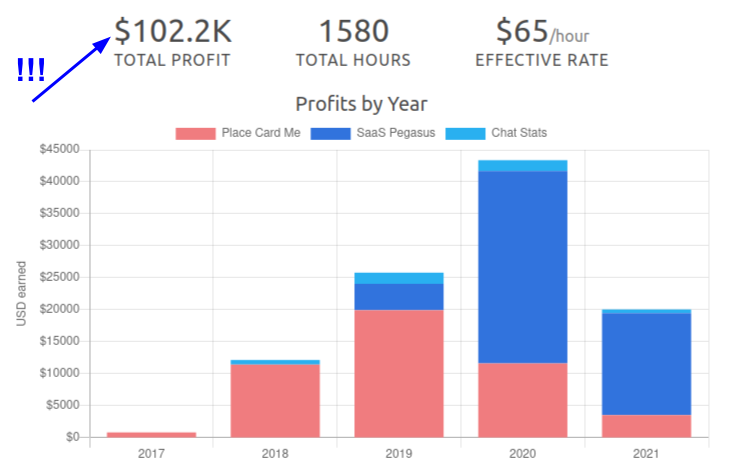
The income breakdown is about 50/50 between SaaS Pegasus - a Django SaaS boilerplate, and Place Card Me, a wedding place card generator, with $5k coming from Chat Stats - an analytics tool for GroupMe groups (if you don't know what that means I'm not surprised).
I'm not sure I have any real wisdom to share on this milestone. It's been a long, slow grind with every product. What I will say, is that big numbers aren't as hard as you think. They just take time and consistency.
In my case I started indie hacking with the goal of earning just $1. That took almost 5 months. But the next dollar only took a few days. And now, more than half my amount have come in the last year (something that I think has been true almost the entire time I've been doing this).
My timeline to big milestones looks like this:
$0 - $1: 5 months
$1 - $10: 6 weeks
$10 - $100: 3 weeks
$100 - $1000: 2 months
$1000 - $10,000: 10 months
$10,000 - $100,000: 30 months
There's a complete set of income and effort broken out by product on my open startup dashboard.
On to $1 million!


After nearly 3 months and several wrong turns SaaS Pegasus finally supports more than one CSS framework! Now my customers can build Pegasus apps with Bootstrap, Bulma, or even both (toggling between them with a setting).
It was quite a journey. Pegasus has historically included Bulma CSS, but I've always wanted to support more than one framework. I initially hoped to add Tailwind CSS, but eventually gave up when - after a long back and forth with Adam Wathan - I realized that partnering with Tailwind UI wasn't an option.
So then I went to Bootstrap. And I will say that - having not used Bootstrap for a while and coming back to it - I really loved it! I found it combined many of my favorite parts of tailwind (e.g. spacing and flex utilities) with my favorite parts of Bulma (Sass and nice components out-of-the-box). I know it's not "cool kid" tech these days, but it I found it to be a super-solid experience. I may even choose it for future projects.
Anyway, this is mostly just a huge load off my shoulders. There was a big unmerged branch sitting there for months and that was stressing me out! Now having everything merged and cleaned up is a big relief that will allow me to move onto other projects.
I also hope this will expand my set of potential customers. I know it already helps several existing customers and have already gotten good feedback from a few.
-
1
Cory, can you share more about why Tailwind won't be supported and what our options are if we wanted to use Tailwind with Pegasus? i.e., is it possible through custom work to support it ourselves?
-
1
Hey @royYYZ - yes, happy to share more.
The short version is that it was going to be more work than I expected. I really wanted to integrate Pegasus with Tailwind UI so I wouldn't have to re-do all the styles myself, but unfortunately that didn't end up being an option.
It is definitely possible to use Pegasus with Tailwind! In fact, you can build Pegasus with a Tailwind pipeline and most of the UI working. I describe it as "not supported" because the current version has many limitations that I wouldn't feel comfortable recommending to my customers. You can find details on Pegasus and Tailwind in the docs here.
My personal recommendation to people who want to use Pegasus with Tailwind is that they also purchase Tailwind UI and then integrate them - which is a straightforward process.
-


In the past few months I've been pushing hard to create useful content about how to build a SaaS application in my technology stack of choice (Django). The content is part of my big picture marketing strategy for Pegasus (a Django SaaS template).
The basic strategy is to create as much great content out there as possible and get it in front of Django developers. I'm hoping this has many benefits including:
- Increasing awareness of Pegasus in the community and getting the content shared
- Establishing credibility of myself / the product by showing I know my stuff
- Creating backlinks that contribute to the site's domain authority
- (Eventually) ranking on search engines for lots of relevant queries related to Django and SaaS
The Guides page I just made is specifically focused on the last point. I realized that I've got all this content that I've put a ton of effort into and that collecting it all in one place is basically a guide to building a SaaS with Django. And, since I want Pegasus to rank on Google for everything related to "SaaS" and "Django" I'm hoping this page can be the content that achieves that!
It's unclear so far how well this strategy has been working. The content does get shared and appreciated, but thus far it hasn't really converted many people - mostly I think because the type of people interested in reading it would much rather build it themselves than "cheat" and buy a template. But hopefully some of the longer term / bigger picture effects around backlinks and SEO start working for me!
-
4
Here's a lesson I've learned: Marketing content, even great content, involves between 10x and 100x more effort than you might initially be inclined to expect. It doesn't mean the content is at fault if it doesn't go viral overnight.
-
1
Thanks, that's encouraging!
Any suggestions on how best to market? My standard process is:
- Share with my audience
- Post on relevant communities (e.g. reddit, FB groups, etc.)
- Cross publish on other platforms (e.g. dev.to, medium)
- Search for relevant discussions on places like Quora and add an answer + pointer.
Probably lots I'm missing, though!
-
1
Track each platform and figure out return on your time. I stopped sharing to dev.to since it brought in ony like 5 clicks per article.
Three tactics I like:
- respond to comments on HN/reddit that are relevant and drop your link
- get on YouTube. Easiest source of organic traffic out there
- boost each piece of content with 100 buck of paid advertising to get the ball rolling
-
1
awesome, thanks for the suggestions!
-
2
This comment was deleted 3 years ago
-
2
Thank for the shout-out. You do SEO stuff yourself?
BTW I don't know if you've stumbled upon it, but I have a video summarizing everything I know about SEO: https://www.youtube.com/watch?v=gOE_sQTyQOo
-
1
This comment was deleted 3 years ago
-
-
-
-
3
Really nice work. I was thinking recently that I should write a "javascript tooling for backend devs" post, since it's been really confusing for me, but I couldn't do a better job than what you did in part 2 of this guide. I wish this had existed when I was just getting started with React a few months ago!
-
1
Thanks Ben! That is basically the exact reason I created the guide so glad to hear it looks useful!
p.s. fun to see you on here :)
-
-
2
Nice breakdown. While I'm building with Laravel/VueJs, it's good to read about the process on Django 👍
-
1
Hey @czue, I'm curious how you handle licenses for Pegasus. Is there a service that handles this for you?
-
2
Hey - at the moment it's all on a trust system. There's no equivalent of DRM or whatever that prevents my customers from breaking the license terms. I decided that I'd rather operate that way and make things easy for my customers, even if it costs me some money.
If you're looking for a licensing system I recommend https://keygen.sh/ by fellow Indie Hacker @ezekg
-



May was a massive month for Pegasus. I almost tripled my previous best month with over $4K in profit.
The increase in profit has come from two complimentary things that I did this past month:
- Creating a promoting a guide to integrating Django and Stripe.
- Adding an "Unlimited license" at a price point of $550 - slightly below 3x the cost of a single-site license.
The Django Stripe guide did really well on Reddit and has gotten picked up by a few popular Twitter accounts, including @ThePracticalDev (190k followers) and @fullstackpython (50k followers). It appears to have created a small, but significant step change in traffic, even after I stopped promoting it. And I know of at least two sales I've made to people who found Pegasus through the article.
As for the Unlimited License - I added it after a few people asked about using Pegasus on multiple projects, and seeing a similar option in related products. I was definitely not expecting to make any sales quickly, but ended up making three in the first week for a total of $1650 revenue - more than any previous month in total. Goes to show how big a lever pricing can be.
I wrote about these in more detail in my monthly open retrospective here, in case you want more details.


After spending the better part of the last month working on it, I finally decided to pull the trigger and publish my Django Stripe Integration Guide.
After publishing, I posted it on /r/django and made #1 for most of a day. All of the feedback has been super positive, which helps me feel better about all the effort that I put into making it.
And with basically zero other (successful... damn you Hacker News!) promotion it's also getting picked up in other places, including on someone's Google Assistant home screen, as well as getting Tweeted by @fullstackpython on Twitter (which has 50k followers). This re-affirms my content strategy of "make above and beyond content, and people will naturally share it".
I haven't seen a super-meaningful uptick in sign ups or sales yet, but hopefully that will come later as more people find the guide and then (eventually) convert to customers.

After literally months of coding I've finally shipped the biggest release to Pegasus since the project has started - the addition of Stripe Subscriptions for your app. This represents the culmination of hundreds of hours of work, including building out an entire subscription tier on another one of my apps (Place Card Me) that I did almost entirely as a learning exercise to help inform the design of this feature.
Now with a clean install, a bit of config in Stripe, and a few one-line commands, it's possible to set up subscription billing in under 10 minutes. It was pretty difficult to decide what level of customization and flexibility to support, versus making it dead-simple, but I'm pleased with where I ended up. And I've already gotten some really positive feedback on the feature from some existing and new Pegasus customers which is validating.
Honestly, with this release Pegasus finally feels like a compete, first-class product. I rode that whole "if you're not ashamed of your product, you launched too early" advice for the better part of a year. But Pegasus is finally something I am not ashamed of. Hooray!
-
2
i'm super-psyched to see you're still working on this.
at first i checked out the new subscription/stripe functionality and was like, "That's it?"
but i see now it was a ton of work. terrible/boring work, too, imo, so ++good.
i hope to never code again so i'm interested in Pegasus to be able to have someone else quickly prototype new projects for me.
i would love to see more example apps -- like the 'Employees' object lifecycle app. I don't have a specific idea in mind, but maybe a short video on...."ok, here's your base install, now we're going to build the Employees CRUD."
And, that's a heck of a name for an app -- 'Object Lifecycle'. I get it, but....I might go with "CRUD 'Employee' App". 'Object Lifecycle' makes it sound like I'm worrying about the intricacies of memory management and/or/with React/js/python.
And I'm not sure how to think about that example app -- is that the correct way to do things in Pegasus? Is there a correct or correct-ish way? I personally tend to dig both SPAs and non-SPAs for their particular use cases.
and i had a difficult-ish time finding this -- i kept looking for "commercial python framework (like laravel spark)" and things like that (and I knew about Pegasus from reading IH a few months ago).
i'm also trying to decide between Pegasus and Laravel Spark.
but, good job, happy to see it moving forward.
cheers!
-
1
Thanks for the support and feedback, @atlrox!
at first i checked out the new subscription/stripe functionality and was like, "That's it?"
Out of curiosity, what else were you expecting? Would be good to know for a future release...
i hope to never code again so i'm interested in Pegasus to be able to have someone else quickly prototype new projects for me.
If you hope to never code again, you might want to go with Webflow or another no code tool ;)
And, that's a heck of a name for an app -- 'Object Lifecycle'. I get it, but....I might go with "CRUD 'Employee' App". 'Object Lifecycle' makes it sound like I'm worrying about the intricacies of memory management and/or/with React/js/python.
Good feedback! I'll think on this. It actually used to be CRUD but people didn't like that either. Naming things is hard...
And I'm not sure how to think about that example app -- is that the correct way to do things in Pegasus? Is there a correct or correct-ish way? I personally tend to dig both SPAs and non-SPAs for their particular use cases.
Yeah, same. Pegasus is actually designed for both cases. After I finish my Django-Stripe integration guide, the next content marketing piece is going to be an opinionated treatise on the various ways to do modern front-end + Django, but the TL;DR is to mix in both SPA concepts where you need them, and do boring old normal stuff when you don't, which is how Pegasus works.
and i had a difficult-ish time finding this -- i kept looking for "commercial python framework (like laravel spark)" and things like that (and I knew about Pegasus from reading IH a few months ago).
Good to know! I haven't done much SEO or marketing, so hopefully this improves over time as I'm now shifting my focus there since I think the product is "good enough"...
i'm also trying to decide between Pegasus and Laravel Spark.
Honestly, by far the most important aspect of this decision will be whether you want to work in Django or Laravel. Both Pegasus and Spark will jump start you and save you a huge amount of time up front, but if you're successful then the overwhelming amount of work will still be everything that happens after you get going. So I'd optimize for the underlying technology and worry less about comparing the two e.g. on a feature-basis. Just my two cents.
thanks again for the support and don't hesitate to reach out if you have any other questions or feedback!
-
1
Out of curiosity, what else were you expecting? Would be good to know for a future release...
nothing I could think of -- just 'more'.
but i figured out part of my confusion -- the home page makes it seem like Pegasus is just 'User Management, Teams, and Subscriptions' -- nothing else.
because of the way the page is laid out.
i.e. there is not a section called 'Features/Benefits' with a list of the 20 or however many things I'm paying my $200+ for -- it looks like just those first three things.
to me, it did, anyways.
-
1
Thanks, that makes sense. Will think about ways to position it better!
-
-
-
-
1
Hi Cory,
Congrats on building such an awesome product in saas Pegasus. I have a couple of questions (perhaps silly). Would be great if you could help answer them.
- Does Pegasus have any support for multi-tenancy ? If so could you briefly share how is multi-tenancy supported.
2.Are there any tracking codes in Pegasus ? For maybe licensing reasons etc. Or is the product completely independent once purchased.
- What kind of charts are natively supported in Pegasus, also if you could share the charting library that is used.
Thanks & Best Regards,
Deepu-
1
Hey Deepu,
No such thing as a silly question! ;)
- Does Pegasus have any support for multi-tenancy ? If so could you briefly share how is multi-tenancy supported.
Yes. Kind of. How I describe it is that Pegasus ships with the bones for multi-tenancy, but you still have to use those to build out your app. The architecture uses a single site-wide database and relies on foreign keys and application logic to manage multi-tenancy. It also ships with utility functions and patterns for how to implement multi-tenancy in your app layer for both a user and team-based app.
I'm aware of more enterprisey set ups, but find this model is great for 90+ percent of projects as it is a good balance of secure but also easy to set up, manage, and deploy.
2.Are there any tracking codes in Pegasus ? For maybe licensing reasons etc. Or is the product completely independent once purchased.
No, the licensing set up relies on an honor system and there are not currently any tracking or "phone home" checks on licenses.
- What kind of charts are natively supported in Pegasus, also if you could share the charting library that is used.
Just a basic pie chart and bar chart at the moment using c3.js. Though if there are any specific charts or libraries you're interested in I'd love to hear what they are so I can expand on that in a future release!
cheers,
Cory-
1
Hey Cory,
Many thanks for the detailed explanations. It is a really cool product. Especially love the support background tasks in celery and its progress reporting in the front end.
I truly appreciate the effort that would have gone into making this,
however I think the price might be bit too steep for potential users. Perhaps the current price of 1 website would be ok for unlimited sites, or same price as now but with more features would be great.By more features I mean:
-some kind of base to setup other multi-tenancy options as well , like different subdomains and linked schema for each teams.
-multiple styling options/templates for UI and landing page.
-support for quick CRUD generation involving multiple models.
-more builtin charting options.I know all of these could be coded on top of the base template rather easily , but it would be great if the template can have them pre-baked :)
Lastly , I am a total noob in web development, although I have a technology and developer background its in old clunky enterprise applications involving technologies which would now be considered "legacy" .So please excuse me if whatever I have said above doesn't make sense or is total crap :)
Best Regards,
Deepu-
1
Hi Deepu,
Thanks for the feedback!
What you said definitely makes sense, although I don't necessarily agree with all of it. ;)
Here's another way of looking at it:
To get to the starting position that Pegasus provides you would require, in all honesty, probably 40-80 hours of time from an experienced developer. Maybe more. But let's call it 60.
At a typical rate for an experienced developer, say $100/hour, that means the value you are getting is $6,000. For just $200 ($300 starting next month).
Obviously if you can code and have the time (or prefer to learn by doing it yourself) then this value proposition doesn't make sense but for many people Pegasus is actually a steal!
That said I am working on some of the features you mentioned - and Pegasus is getting better and better with every release!
cheers,
Cory-
1
Hey Cory,
I think I agree with you, your explanation makes sense. Being a novice in web development field , my judgement of the effort and complexity of building something like that from scratch cannot be accurate. Thanks for clarifying that.
Am eagerly following the developments of Pegasus while parallely building up my skills to be able to make good use it some day :).Cheers and have a nice weekend,
Deepu
-
-


When I was doing my annual end of year reflections, I realized that Pegasus is a perfect flywheel product for my current life.
"Flywheel product", is a riff on the flywheel business concept: a circular feedback loop in your business in which every element feeds into other elements in a virtuous growth cycle. Once you have a flywheel business you just have to get it spinning and then it grows and improves from there—almost on its own.
The most popular example of the flywheel comes from Amazon, where their focus on product selection and price brings in more customers, who then attract more sellers, further increasing the selection of products and reducing price. And continuously growing the flywheel.
So how is Pegasus a flywheel product?
Well its whole purpose is to make launching SaaS products faster and easier. And meanwhile, my whole career revolves mostly around launching and growing SaaS products.
So Pegasus makes my job way easier. But that's only half the wheel.
The other half is that every new project I launch is an opportunity to improve Pegasus itself. My first experience using Pegasus led to a handful of new features, improved docs and cleaner code. Next, I’m going to add subscriptions to one of my products, and that’s going to end up back in Pegasus as soon as I figure it out.
Literally every new thing I build is an opportunity to make Pegasus better. For everyone. Forever.
So I’m super stoked about this revelation. Because I really enjoy building and launching new things. And getting to use and improve Pegasus with every new product launch just makes it all that sweeter.
Synergy!
(This thought was part of my annual year-in-review post here: http://www.coryzue.com/writing/master-plan/)
-
1
Hi Cory, awesome work on Pegasus and great episode on the IndieHackers podcast, thanks for sharing your learnings and experiences. I’m thinking of launching a Node.js boilerplate (basically what I have been using to build products for some years now, including my startup https://www.loclpal.com). What’s the situation with licenses and selling software built on open source software (in this case Django and various packages)?
-
1
Hey Iraklis,
Thanks!
I'm not a lawyer, but my general understanding is that most open source licenses are quite commercially friendly. The one you really have to watch out for is GPL, which basically stipulates that if you use it then your whole project also has to be open source. But almost all big OSS is licenced under MIT, Apache, BSD, or some other commercially-friendly version.
More details here: https://choosealicense.com/
-
1
Hey there, great, thanks for this, will definitely check it out!
-
-


A few days ago I decided to double the cost of Pegasus (which I am going to do later today).
Before I did that I emailed my list with the news that prices were going up soon and that it was the last chance to get in on the early-access discount. In the four days between the email going out and the price hike I made 5 sales! That number represents more than 30% of my all-time total.
Creating a sense of urgency really works!
Some more details in my monthly retro: http://www.coryzue.com/writing/aug-2019/
-
2
Nice to hear you gained some valuable knowledge! You may want to make your language more positive by not using negative terms like "threatened" and "time pressure" to describe your relationship with your clients. I'd rather use more positive terms like "announced" and "missing out on an opportunity" respectively.
-
2
Thanks for that feedback. Language - and particularly knowing what might raise eyebrows despite the best of intentions - is definitely not a strong suit of mine.
Just made some edits that hopefully makes it more positive/neutral.
Appreciate the input - one of my top goals is to serve my customers and would hate for that to be misconstrued!
-


Less than two months from launch, Pegasus just landed its 10th customer!
The primary source of customers continues to be new people discovering Pegasus for the first time via organic search. Which is great news in terms of it being a steady revenue stream. Though at the same time I'm realizing that there's an inherent cap on the number of people who are searching for "django saas" that probably limits me to about 5-ish sales / month if the current trends continue.
So I think in addition to increasing prices (which I still plan to do this month). I need to start thinking about what my next inbound lead stream will be. Guessing it is going to involve content marketing around technical django topics that I think would be relevant to prospective customers...

... to a grand total of three sales! Which makes four sales all time! :)
Of course growth is quite a bit easier when you're starting from such a low starting position, but I'm still excited about the future of Pegasus.
To me the most exciting part is that two of the three sales came from inbound leads that just popped up this month (one was someone on my list who I had already been in touch with). This implies to me that the revenue is more sustainable than e.g. if they were all from my launch mailing list.
Apart from that, July was punctuated by the #30daysofgrowth challenge I participated on here.
More details on July here: http://www.coryzue.com/writing/jul-2019/
-
3
Have you thought about raising prices? You might be leaving a lot of money on the table.
-
2
Yes! Agreed.
I'm definitely going to raise prices substantially in the next six months and will probably double it to $200 at the end of August as a start.
The exact timing and details of how to roll out pricing changes are a little unclear to me but I want to try and use it as a way to put some time-pressure on people who are on the list so they consider getting in at the lower price.
Will report how it goes soon!
-
1
Look forward to hearing about it
-
-

26 Comments
I bought SaaSPegausus in March. Picked it from Google Search!
Great progress @czue
That's awesome, thanks for the support! Don't hesitate to let me know if you have any suggestions for how to make it better!
congrats!!
thanks!
Congrats! Awesome achievement. And reassuring too—my Jamstack book's growth has been slow but I'm reminding myself that it's my first product, my wife just had a baby, and I'm working on it gradually while promoting it as well. So it's understandable that it'll take time to grow (and the next product will probably as well!)
I love your dashboard. Is this custom? Where are you pulling the sales data from?
First off - congrats! We had #2 last September. Definitely changes how much time you have for side-hustles!
But yeah, I'm a big advocate of "slow and steady", even though that's not always what happens in the stories you read about.
Re: the dashboard, yeah it's custom. I export data from Stripe and Toggl (time tracking), process it in Python, and render it in Chart.js. One of those little indulgence projects to have fun on a Friday. :)
Thanks! This is #2 for us too...it's a whole new world with toddler plus baby, lol...
Very cool, I haven't done an experiment like these charts in a while, especially not on my personal website. This is definitely inspirational!
haha, yep! the only saving grace for us was that at least the baby was easier the second time around....
Yeah for us too. The toddler however...lmao.
Oh sweet. I could use something like SaaS Pegasus.
I spent like 3 days trying to launch with cookie cutter django. Can I use it for APIs?
Hey - yeah you can definitely use it for APIs.
It ships with a few examples of how to integrate with APIs using DRF, including a react or vue-based object demo for creating/editing/deleting things, as well as a chart integration, and some other API examples around Teams.
The one caveat I'll add is that it's not designed to be used in projects where your Django backend is for APIs ONLY and you have a completely decoupled front-end built in a JS framework. Some customers do use it that way, but it's not the smoothest experience out of the box.
Congrats! What do you use to track the earnings and the time invested?
Earnings are all sourced from Stripe, and then I do a bit of manually accounting to take out any extra costs.
Time data comes from Toggl - I've been tracking all of my time spent working for the last 4+ years as a way to understand where my time goes and hold myself accountable!
I'm working on something like SaaS Pegasus just in a different space. How/Where did you reach out to people to let them know about it and get them using it?
The overwhelming source of customers/traffic is organic / SEO.
I started creating content about Django probably 2 years before Pegasus launched, and by the time I started working on it I had a couple articles that were getting consistent traffic for certain related queries. Then maybe 6-8 months before it launched I had a landing page and an email list that I attempted to drive traffic to by "advertising" it on those posts. Post launch, I've doubled down on that strategy by creating and promoting guides for doing various things with Django (that Pegasus solves for you). When I release a new guide it's an opportunity to market the guide (e.g. on reddit, newsletters, etc.), which then also increases the overall awareness of Pegasus.
Also I'll say transparently that some percentage of people find/buy it because they follow my journey either here on Indie Hackers, or on my blog/Twitter where I also do the "build in public" thing. This is definitely a minority of my customers, though.
Thanks so much for sharing that. I like the idea of doing guides on how to do things, which happen to use your product. That would then help with posting in places like reddit and not just seen as blatant self-promotion.
May I also ask if you find people are more often going with the unlimited project purchase option vs just the one? Was wondering how to go about pricing things. Was thinking keeping it low and then having a small 'maintenance' fee ongoing so they continue to get updates and support.
Yep exactly! And if they're good enough they get shared even beyond that initial marketing push.
Re: single vs unlimited I don't actually have the data but my instinct is that it's maybe 40% unlmited / 60% single (from a revenue perspective, so much more single sales). For single licenses, I expire upgrades after 1 year and have just had my first few people renew @ $89 for another year. So that's been nice. :)
One thing that is common with boilerplates is that people customize the code so much that they don't bother upgrading to later versions (unless there's something they really want). So I'd keep that in mind if you're planning on making the majority of your business model based on maintenance.
Great point on the maintenance piece. Will totally have to think about that one.
Congrats! Way to keep on grinding
Haha, thanks! "Your Whole Goal Is to Not Quit" -- @csallen
Awesome @czue! Thanks for sharing. I remember being super excited when I ran into SaaS Pegasus, but ultimately I wasn't able to use it, since at the time I didn't see that there was a way to support a custom JS framework.
Glad to see that has changed. Will recommend to a fellow Django dev friend that is about to start his app. On to 1 million!
Awesome! Feel free to have your friend reach out to me directly on Twitter or email if they have any questions.
Great Story and helpful for the many of us that are midway in your journey :)
Thanks. Best of luck!
This is inspiring. Thanks so much for sharing.
Glad to hear and you're welcome! Thanks for letting me know.