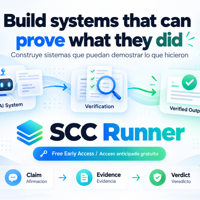
SCC Runner
Verify what your AI systems actually did
I built SCC Runner because I kept running into the same problem while working with AI agents and automations:
the system said “done”, but I still had to check what actually happened.
Not whether the command returned success.
Not whether the API answered 200.
Not whether the agent produced a convincing explanation.
I mean whether the real system state matched the claim.
That distinction sounds small, but it becomes increasingly important once AI starts writing code, calling tools, changing infrastructure, updating databases and triggering multi-step workflows.
So I started building a separate verification layer.
The basic idea is:
Claim → Authority → Evidence → Verdict
If an automation says a service is running, check the service manager.
If it says a database write succeeded, check the database.
If it says a deployment is live, inspect the deployed system.
If an AI coding agent says a change fixed something, verify the observable effect instead of relying only on the agent’s own interpretation.
What I’m trying to learn now is not simply whether SCC Runner can save manual checks.
I’m more interested in whether it can become an objective feedback layer for AI-assisted development and automated systems.
A layer that helps answer questions like:
Did the code change actually produce the intended effect?
Did the agent modify the system it was supposed to modify?
Does the observed runtime state match the claim?
When something fails, can we distinguish between a false claim, missing evidence and an unavailable authority?
Can the system give an AI coding agent better feedback about the real consequences of its actions?
In that sense, SCC Runner is not only about verification after the fact.
It can also improve system observability, give coding agents a more objective view of what their actions actually changed, and eventually provide a stronger basis for deciding whether an automated workflow should continue, retry or stop.
I’m deliberately starting small.
My preferred onboarding is:
Give SCC Runner one claim you already verify manually.
Run it in parallel.
Compare the evidence.
Repeat.
If it proves useful consistently, give it more responsibility later.
Eventually, for the right workflows, that can become:
Claim → Authority → Evidence → Verdict → PASS / BLOCK
But I don’t want users to trust SCC Runner just because I say it works.
It should earn that authority through evidence.
SCC Runner is now available in Free Early Access:
https://scc.taiwildlab.com/signup
I’d genuinely like to hear from other founders and builders:
Where do you still rely on manual checks because your AI agent, automation or backend can report success without proving the resulting system state?

Comment