
Social Market
Social Infrastructure for Integrated Commerce
Commerce platforms are usually presented as tools designed to help people sell more, reach new customers, and grow their businesses. That is the promise they all share. However, when you stop focusing on what they say and start observing what they actually incentivize, a very different reality emerges.
Each platform only solves the part of the process that aligns with its own business model. A marketplace facilitates selling, but charges a fee on every transaction. An e-commerce platform allows you to set up a store, but leaves the task of acquiring customers to the entrepreneur. A delivery app connects orders with couriers, but turns logistics into an intermediated service from which it takes a permanent commission. An administrative system organizes inventory and finances, but usually arrives only after the business has already managed to survive on its own. None of them accompanies the full journey of the entrepreneur, because none of them was designed to do so.
I don’t believe this happens out of bad intent. I believe it is the natural consequence of a deeper principle: every system eventually becomes a reflection of what it incentivizes.
If a platform earns its revenue by charging a commission on each sale, it will end up optimizing transactions. If it depends on advertising, it will optimize attention. If it lives on subscriptions, it will add features that justify continued payment. Every design decision ultimately responds to the economic mechanism that sustains the system. That logic is not a flaw; it is an inevitable consequence of the incentives it is built upon.
The problem arises when the success of the platform no longer depends on the success of the people who use it.
At that point, the entrepreneur begins to follow a fragmented path. They need one tool to validate their idea, another to build their store, another to manage inventory, another to control finances, another to attract customers, another to sell, another to deliver orders, and another to communicate with buyers. None of them understands the full context of their business. None of them knows what stage they are in. None of them asks whether they are actually building a sustainable company. Each one correctly fulfills the function it was created for, but the collective result is still a system that forces entrepreneurs to adapt to platforms, instead of platforms adapting to entrepreneurs.
Over time, I came to understand that the problem was not the absence of better applications.
It was the absence of infrastructure.
There is a massive difference between a tool and infrastructure. A tool solves a specific task. Infrastructure enables many different tasks to function as part of a single system. Cities do not thrive because they have excellent traffic lights or wide avenues; they thrive because their infrastructure allows people to work, move, produce, and exchange value efficiently. I always wondered why digital commerce was still being built as a collection of isolated tools instead of a coherent infrastructure.
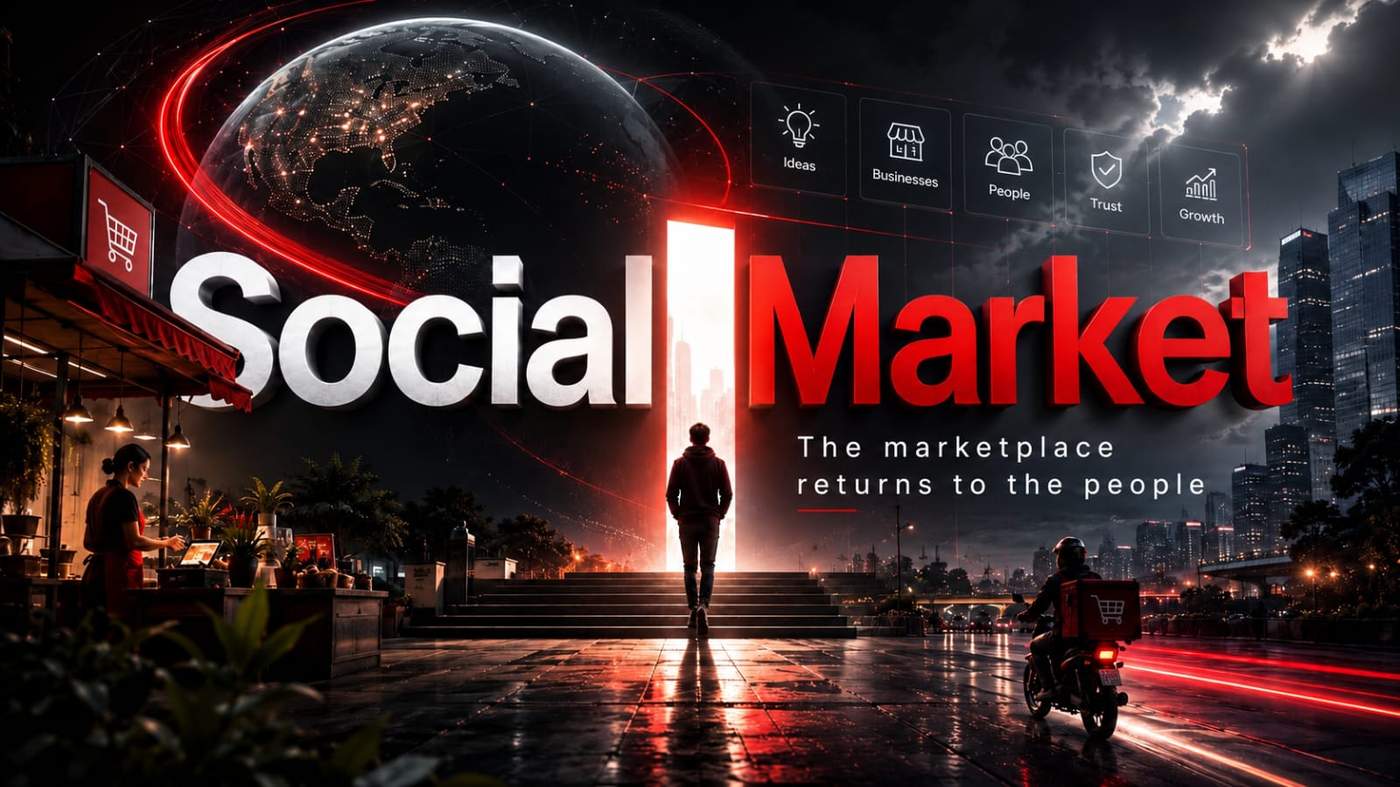
That question eventually became Social Market.
Social Market was not created to be another marketplace. Nor to compete only with e-commerce platforms, delivery apps, administrative systems, or commercial social networks. It was created because I realized that all those services represent parts of the same problem, and solving them separately only produces more fragmentation.
I believe entrepreneurship should feel less like learning to use dozens of different platforms and more like following a natural path where each stage prepares the next. Before a business exists, there is a person. Before a sale exists, there is an idea. Before growth exists, there is a need to prove that such growth is possible. Before managing a business, you have to build one that has a real chance of survival.
Yet almost no platform starts there.
Most assume that the decision to start a business has already been made, and that the business deserves to exist simply because someone decided to launch it. From that moment on, they offer tools to sell, charge, or manage, but they never stop to ask whether the project has sufficient foundations to sustain itself. Paradoxically, platforms continue generating revenue even if the business fails a few months later. The risk belongs entirely to the entrepreneur.
I have always found it strange that the system is designed to monetize even failure.
That is why one of the first questions that gave birth to Social Market was not how to sell more, but how to increase the probability that a business will still exist in five or ten years. That difference completely changes how a platform is designed. When the goal stops being facilitating isolated transactions and becomes the survival of the business itself, all priorities shift. Education stops being an additional service and becomes the starting point. Administration stops being software and becomes part of decision-making. Reputation stops being an aesthetic score and becomes a long-term asset. Even visibility is no longer treated as a product that can be bought, but as a resource that must be distributed fairly so the ecosystem remains healthy.
I believe the strongest markets are not those where a few participants dominate all attention, but those where the largest possible number of people has a real chance to compete.
For decades, we have accepted as normal that visibility depends on money, that algorithms favor those who can invest more in advertising, and that growth opportunities gradually concentrate in the hands of those who are already large. Yet a healthy market requires the opposite. It must constantly discover new participants, allow good ideas to emerge regardless of the size of those who propose them, and ensure that reach is not a privilege reserved for those with larger budgets.
Technology has the power to amplify inequality, but it can also correct it. Everything depends on the incentives with which it is designed.
This same philosophy extends to other aspects that usually remain invisible. Outdated information, abandoned businesses, posts that never disappear, and data accumulated over years without real utility create a distorted representation of the economy. A system that never cleans its information eventually stops describing reality and becomes nothing more than a historical archive. I have always believed that infrastructure should resemble a living organism more than an infinite storage of data. Information only retains value when it still reflects what is actually happening.
I also believe that informal and formal commerce should never have been separated the way they are today. Both are part of the same economy, respond to the same human needs, and often represent different stages of a single entrepreneurial journey. Artificially separating them has left millions of people outside the tools that could help them grow. A truly useful infrastructure should not force a choice between one world and another; it should allow seamless movement between both as the entrepreneur’s needs evolve.
Of course, a platform needs to be economically sustainable. No project can transform reality if it cannot sustain itself over time. However, I have always believed that sustainability should be a consequence of the value created, never the reason that determines every design decision. When the business model forces the original purpose to be sacrificed, the system eventually stops serving people and begins to serve itself.
That is, perhaps, the idea that has most guided the development of Social Market.
Not building a platform whose success depends on capturing entrepreneurs, but an infrastructure whose success depends on entrepreneurs no longer needing to look elsewhere for what they should find within a single ecosystem. An infrastructure that reduces complexity instead of increasing it; that removes barriers instead of creating new dependencies; that accompanies people from the birth of an idea to the consolidation of a company, without forcing them to rebuild their work every time they switch tools.
I do not believe the current state of commerce exists by accident. I believe it is producing exactly the outcomes it was designed to produce. And precisely for that reason, I also believe it can produce entirely different outcomes if we change the incentives that shape it.
Social Market was born from that conviction. Not from the idea of building yet another app, but from the possibility of rethinking the infrastructure on which millions of people try to build their future. Because when infrastructure is designed well, the true protagonist is no longer the platform—but the person who was always meant to be at the center: the one who chooses to create value.

5 Comments
What stood out to me is that you're framing fragmentation as an infrastructure problem rather than a software problem.
Most platforms optimize one stage of entrepreneurship because that's where their business model lives. You're asking what changes when the system is designed around the long-term success of the business instead. That's a fundamentally different design philosophy.
Thank you very much. This is exactly the idea I'm trying to convey.
I believe fragmentation doesn't exist because we're missing better tools, but because every platform optimizes only the part of the process that aligns with its own economic incentives. As long as a platform's success is not tied to the long-term success of the entrepreneur, we'll continue building isolated solutions.
I'm convinced that once the success of the infrastructure becomes dependent on the success of the entrepreneur, everything changes: design decisions, priorities, and ultimately, the system you end up building.
Interesting.
Reading your reply made me think less about the infrastructure itself and more about what happens once a product's incentives become structurally tied to the entrepreneur's long-term success.
I don't think I can do that line of reasoning justice in a thread without flattening it.
If you're open to it, what's the best email to reach you on?
Thank you, Aryan. I completely agree; exploring how to structurally align those incentives is a profound shift that deserves a much broader conversation than a comment thread allows.
You can reach me at Connect-Vhallferra @ outlook com I look forward to continuing this discussion via email.
Thanks! I’ve just sent it over.
Looking forward to hearing your thoughts whenever you have a chance.