Veltrox
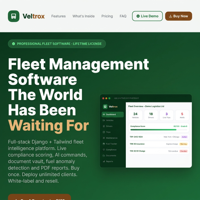
Fleet compliance software with AI commands
I want to share the full story of how and why I built Veltrox, because I think the problem itself is more interesting than the product.
I kept watching logistics companies manage million-dollar fleets in WhatsApp groups and shared Excel files.
Not small operations. Companies with 20, 30, 50 vehicles - trucks, tankers, heavy equipment, running routes worth tens of thousands of dollars per week. And their entire compliance operation was a group chat and a spreadsheet that nobody updated consistently.
The consequences were real and recurring:
A roadside inspector stops a vehicle. The roadworthiness certificate expired three weeks ago. The vehicle is impounded, the fine arrives, the delivery contract is at risk. And the information that could have prevented it, that certificate expiry date was sitting in a spreadsheet that nobody checked.
I heard this story from multiple operators before I started building. The pattern was identical every time.
Why no good solution existed for this market
Some enterprise tools charge $30-50 per vehicle per month and focus on GPS hardware and live tracking. For a 20-truck fleet that is $800/month, $9,600/year and the compliance management features are weak or nonexistent.
Some SME companies with 5-50 vehicles have been completely ignored. They cannot afford enterprise pricing. They do not need GPS hardware. They need document tracking, compliance visibility, and maintenance scheduling. Nobody built that for them at a price that made sense. That gap is where Veltrox lives.
What I built:
Veltrox is a fleet compliance and operations platform. Every vehicle gets a live compliance score from 0 to 100 that recalculates automatically on every page load. When insurance lapses, a permit expires, or maintenance is overdue, the score drops and the alert fires. Fleet managers see the risk before regulators do.
The features that took the most thinking:
Fuel anomaly detection. Every fuel entry is automatically compared against the vehicle's expected km-per-litre ratio. Statistical outlier detection in pure Python, no ML, no external service. If a driver claims 380 litres on a route that should consume 260, a red alert badge appears immediately. No manual calculation, no spreadsheet audit.
I chose pure Python math deliberately. This runs on every single fuel log, an ML inference call on every entry would be expensive and fragile. A ratio threshold check is deterministic, fast, and completely explainable to a fleet manager who asks why an entry was flagged.
The AI command interface. I wanted fleet managers to be able to ask plain-English questions. "Expiring documents," "Overdue maintenance," "Active trips," Instant results.
I considered OpenAI, I decided against it. Here is why: this is a $197 one-time product. An ongoing LLM subscription bill would either eat the margin on every sale or require a SaaS pricing model. Instead I built rule-based keyword matching and queryset routing. It handles the real queries fleet managers actually ask, Zero API cost, Zero latency, Fully deterministic, Works offline.
Was that the right call? Probably yes for this market. A logistics company deploying this on their own server does not want a dependency on an external AI service they cannot control.
The architecture decision I thought most about. The compliance score recalculates on every page load rather than using a scheduled background job. Every single request, fresh from the database.
The argument against this is obvious - it is less efficient than caching. The argument for it: if a document expired overnight, the fleet manager opening the dashboard at 8am needs to see that immediately. A cached score from midnight is dangerous. It creates false confidence.
At current scale the queries are fast, indexed foreign keys, organization-scoped filters, under 20ms on PostgreSQL. I would add Redis with document-update signals at 10x fleet size. For now, freshness is worth the cost.
The model I chose and why:
I sell the full source code at $197 with a lifetime license and white-label rights. Not SaaS.
The reasons:
Logistics companies in most markets want on-premise deployments. Their vehicle and driver data is operationally sensitive. Cloud-hosted tools require trust in the provider, data sovereignty decisions, and often procurement approval. Source code they deploy themselves removes all of that friction.
Developers and IT consultants who serve transport clients need the code, not a subscription login. They buy it, rebrand it, deploy for a client, and charge monthly. The $197 recovers in the first billing cycle. Everything after is recurring income.
$197 one-time is a personal card decision. It takes minutes. $200/month requires someone to approve a subscription. The sales cycle is completely different.
The stack:
Django 4.2, Python 3.11, Tailwind CSS via Play CDN (no build step - I made this choice deliberately to keep deployment simple for operators without Node.js experience), PostgreSQL 15, Docker Compose, Gunicorn, Nginx, ReportLab for PDF generation.
10 Django apps. 35 HTML templates. Multi-tenant with row-level organisation isolation. Role-based access - Admin, Fleet Manager, Driver, Viewer. Docker-ready deployment that runs in under 10 minutes on Coolify, Railway, Render, or any VPS.
Where I am now:
Listed on Gumroad, Whop, Payhip, Selar.co. Whop Affiliate programme running at 35% commission.
I have not made a sale yet. I am sharing that honestly because I think the Indie Hackers community appreciates transparency over polished success stories.
What I have: a production-ready product that solves a real problem, a working demo with live data and active listings across multiple platforms.
What I am still figuring out: the fastest path from zero to first sale with direct outreach as the primary channel right now.
The demo is live
Watch it here (5+ minutes): https://www.loom.com/share/3b1692e91b0b4837824e68f2945f1d30
Get the source code: https://auroredev.gumroad.com/l/tlusn
Questions I genuinely want answered by this community
Has anyone sold B2B source code targeting a non-tech industry? What did the first sale look like and where did it come from?
For those who have been in this position - zero sales, real product, right audience - what was the thing that finally moved the needle?
I will respond to every comment.

Comment