
VentureLens
AI that analyses startup pitch decks like a VC in 60 seconds
Hi everyone,
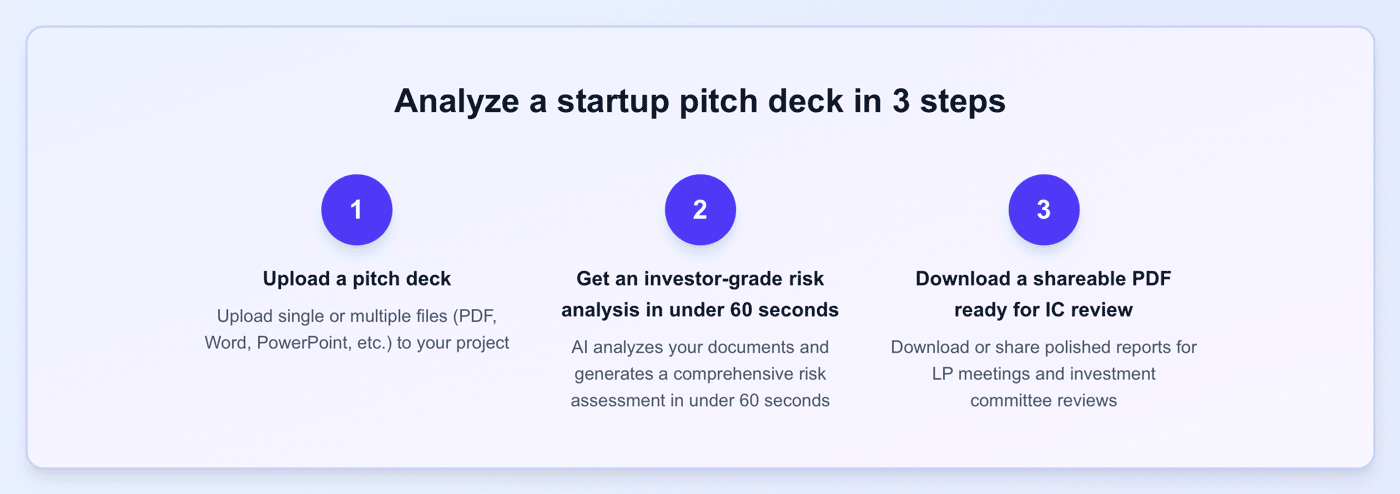
I recently built a tool called VentureLens that analyses startup pitch decks using AI and generates an investor-style report in under 60 seconds.
The idea came from a real situation. A family friend was considering investing in a startup but wasn’t sure how to evaluate the pitch deck. I used AI to help analyse the deck and quickly surfaced strengths, risks, and missing information.
That experience made me realise many investors — and founders — face the same challenge. Pitch decks are often reviewed quickly and subjectively, and important details can be missed.
So I built VentureLens to automate part of that process.
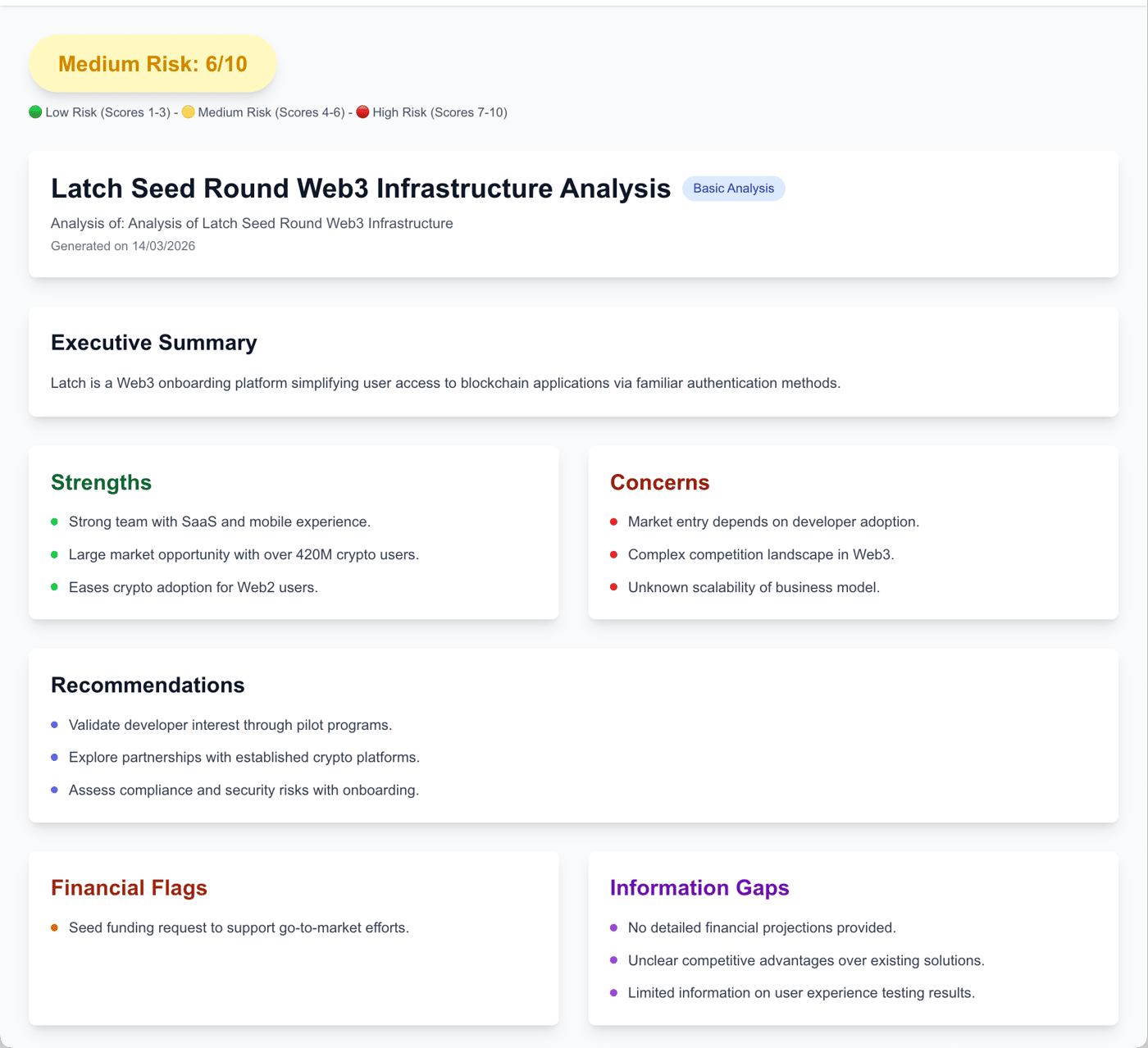
You upload a pitch deck and it generates a structured analysis including:
• Executive summary
• Strengths and concerns
• Financial red flags
• Market notes
• Missing information investors often look for
The goal is to help investors screen deals faster and help founders understand how their deck might be evaluated.
I’d really love feedback from the Indie Hackers community.
Do you think something like this would be useful before sending a deck to investors?
You can try it here:

12 Comments
This is genuinely useful timing - I'm a founder actively prepping a deck for an incubator submission and this caught my eye.
My main question before I'd upload anything: how does the security work on the backend? Pitch decks have cap tables, financials, unreleased product details. Founders are paranoid about that stuff for good reason.
Does the deck get stored? Who has access to it? Is it processed in memory and discarded, or does it sit somewhere?
Not trying to poke holes - I'd actually use this. Just need to know it's not floating around after I hit upload. Would love to hear how you've thought through that side of it.
Quick update based on your comment — I’ve now added a Private Analysis Mode to VentureLens.
When this mode is enabled, which is the default behaviour, the uploaded deck and generated report are automatically deleted after analysis, and the user is prompted to download the PDF immediately. The report also won’t appear in the account history.
The idea is to let founders analyze a deck without leaving a stored copy on the server if they prefer maximum privacy.
Really appreciate you raising the security question — it directly helped shape this feature.
Great question — and totally fair. Founders should absolutely be cautious about where they upload their decks.
Currently the way VentureLens handles this is:
• Pitch decks are only accessible to the user who uploaded them — other users cannot view them.
• Files are processed directly by the backend for analysis and are not stored locally or written to temporary files during processing.
• Access to stored data is restricted to the system/database level for maintenance and operations.
The goal is to minimize how long and where sensitive data exists during processing.
I'm also actively thinking about additional improvements like optional automatic deletion after analysis and stronger isolation for uploaded files.
Really appreciate you raising this — security around sensitive pitch data is something I take seriously. If you end up trying it while preparing your incubator deck, I’d love to hear how useful the feedback is.
Really like that this came from a real use case rather than "what if we add AI to X." The missing infLove that this came from a real uLove that this came from a real use case. The gap flagging sounds really useful for founders who don't know what they're missing.se case. The gap flagging is the most valuable part — founders often
Thanks a lot for your comment! That’s exactly the insight that led me to build it. When people read a pitch deck, the hardest part isn’t understanding what’s there — it’s knowing what isn’t there and what questions should be asked next.
The “information gaps” section tries to highlight things investors typically look for but that might be missing from the deck. I’m hoping it helps founders strengthen their decks and helps investors review opportunities faster.
Still early, so I’m very interested to see which gaps people find most useful.
Curious — when you review a deck, what’s usually the first missing piece you look for?
Cool concept. Does it give feedback similar to what investors focus on, like problem clarity and market size?
Yes — that’s exactly the idea behind it.
The analysis tries to mirror how investors typically evaluate a deck. It looks at things like problem clarity, market size, differentiation, business model, traction signals, and potential risks.
If certain areas are unclear or missing (for example TAM/SAM estimates, traction metrics, or go-to-market assumptions), VentureLens flags them in sections like “Concerns” or “Information Gaps”.
The goal isn’t to replace investor judgment, but to quickly highlight the kinds of questions investors usually ask when reviewing a deck.
Out of curiosity — when you review a deck, what’s the first thing you usually look for?
Cool origin story — building something because a real person in your life actually needed it is how most of the best tools start. I'm an investor myself (mostly stocks but I've looked at a few private deals) and honestly the hardest part is always knowing what you don't know about a deck. Like you read it and think it sounds good but you're not sure what questions you should be asking. The "missing information" flag sounds really useful for that. How do you handle decks that are intentionally vague on financials? Some founders leave that stuff out on purpose.
That’s a great point, and it’s actually one of the things VentureLens tries to surface.
When decks are vague on financials (which happens quite often), the system doesn’t try to guess numbers. Instead it flags those gaps in the “Information Gaps” or “Financial Flags” sections and highlights what an investor would typically expect to see there — things like revenue projections, CAC/LTV assumptions, burn rate, or unit economics.
The idea is less about saying whether the startup is good or bad, and more about helping investors quickly see what questions they should be asking next.
Curious to hear your perspective as someone who has looked at private deals — do you usually expect financial projections in early-stage decks, or are you comfortable when founders keep them high level?
mükemmel bir fikir geçekten.
This comment was deleted 6 months ago