100+ Article Submission Sites That Actually Improve SEO
Search engine optimization has changed significantly over the last decade, but one strategy continues to deliver value when used correctly—Article Submission Sites. While search engines now prioritize quality over quantity, publishing original content on reputable platforms remains an effective way to expand your online reach, build authority, and attract relevant visitors.
Many marketers mistakenly believe article directories no longer work because of outdated spam tactics. In reality, the right platforms combined with high-quality content can strengthen your digital presence, generate referral traffic, and create opportunities for natural backlinks. Instead of submitting the same article everywhere, successful businesses focus on trusted publishing websites that value informative and original content.
This guide explains how article submission works in modern SEO, why it still matters in 2026, how to choose the right websites, and the best practices that produce long-term results. You'll also discover expert tips, practical examples, and a carefully researched list of platforms later in this guide.
What Are Article Submission Sites?
Article Submission Sites are online publishing platforms where individuals, businesses, and marketers can publish informative articles for a broader audience. Depending on the platform, authors may receive an author profile, referral traffic, brand exposure, and opportunities to earn contextual backlinks or links in their author bio.
Unlike traditional blogging on your own website, article submission allows your content to reach audiences who may never have discovered your brand through search alone.
Today, these platforms are used for much more than link building. They help businesses:
Increase online visibility
Demonstrate industry expertise
Reach new readers
Build trust with potential customers
Support a broader content marketing strategy
When combined with reputable guest posting sites, article submissions become a valuable part of a diversified off-page SEO campaign.
Why Article Submission Still Matters for SEO
Search engines reward websites that consistently demonstrate expertise, authority, and trustworthiness. Publishing useful content on reputable platforms helps reinforce these signals while expanding your online footprint.
Here are some of the biggest SEO advantages.
Increase Brand Visibility
Every quality article introduces your business to a new audience. Readers who find value in your content often explore your website, subscribe to newsletters, or follow your brand across other channels.
Over time, this consistent exposure strengthens brand recognition and supports long-term organic growth.
Earn High-Quality Referral Traffic
One of the most overlooked benefits of article marketing is referral traffic.
Instead of relying entirely on Google rankings, your articles can attract visitors directly from publishing platforms where your target audience already spends time.
These readers often have higher engagement because they intentionally chose to read your content.
Build Authority Through Valuable Content
Google increasingly favors websites that demonstrate real expertise.
Publishing detailed, well-researched articles on respected websites helps establish your reputation within your industry. The more consistently you share useful knowledge, the stronger your perceived authority becomes.
This aligns closely with Google's EEAT principles:
Experience
Expertise
Authoritativeness
Trustworthiness
Rather than focusing solely on backlinks, businesses should focus on becoming recognized sources of helpful information.
Support Natural Link Building
High-quality articles naturally attract citations, mentions, and editorial links from other websites.
While links should never be the only reason for publishing content, they often become a valuable by-product of creating genuinely useful resources.
Many businesses also combine article marketing with free article submission sites to diversify their backlink profile while maintaining quality standards.
How Article Submission Works in 2026
Article marketing has evolved considerably.
Years ago, marketers copied the same article onto hundreds of directories simply to create backlinks. That strategy no longer works and may even harm SEO performance.
Modern article submission focuses on originality and value.
The process typically looks like this:
Research reputable publishing platforms.
Create an original article that solves a real problem.
Follow each website's editorial guidelines.
Add relevant internal and external references.
Include a professional author bio.
Promote the published article across your marketing channels.
Measure traffic, engagement, and conversions.
The emphasis is now on quality rather than quantity.
Publishing ten outstanding articles on trusted websites is generally more valuable than publishing one hundred low-quality articles on weak directories.
How to Choose the Best Article Submission Platform
Not every publishing website deserves your time.
Before submitting an article, evaluate each platform carefully.
Domain Authority and Reputation
A well-established website with consistent editorial standards generally provides more value than newly created directories.
Look for websites that publish useful, original, and professionally edited content.
Relevant Audience
Publishing on a website related to your niche increases the chances of attracting engaged readers.
For example:
Marketing businesses should publish on digital marketing websites.
Health brands should choose health-focused publications.
Technology companies should target software or IT communities.
Relevance matters more than publishing everywhere.
Editorial Standards
Good platforms review submissions before publication.
Editorial screening often indicates higher content quality and greater trust from readers.
Avoid websites that automatically publish every submission without review.
Content Quality
Browse several published articles before submitting your own.
Ask yourself:
Are articles informative?
Is the content original?
Are headings easy to read?
Are sources cited?
Does the website appear trustworthy?
If the platform is filled with duplicate or poorly written articles, it is usually best to look elsewhere.
Expert Insight: Why Quality Beats Quantity
One of the biggest misconceptions in SEO is that more backlinks automatically lead to higher rankings.
In reality, a handful of mentions from respected websites often provide greater long-term value than hundreds of low-quality links.
Imagine two businesses.
Business A publishes one comprehensive article on a respected industry publication. The article receives shares, comments, and earns additional citations from other websites.
Business B submits the same generic article to 150 low-quality directories with little editorial oversight.
Although Business B creates more backlinks initially, Business A is far more likely to build lasting authority, attract qualified visitors, and strengthen its organic visibility.
This illustrates why modern SEO emphasizes relevance, originality, and user value rather than sheer volume.
Key Benefits at a Glance
Here is a quick summary of why article marketing continues to be effective:
Expands brand visibility
Builds topical authority
Supports EEAT signals
Generates referral traffic
Creates long-term marketing assets
Encourages natural backlinks
Diversifies your content distribution strategy
Reaches new audiences beyond search engines
Strengthens your overall digital presence
Complements content marketing and guest posting sites strategies
100+ Article Submission Sites for SEO in 2026
Choosing the right publishing platform is just as important as writing a great article. The websites below have been categorized to help you find the best opportunities based on authority, niche, and submission model.
Note: Domain Authority (DA) changes over time as SEO metrics are updated. Use these values as approximate ranges rather than fixed numbers.
High-Authority Article Submission Sites
These platforms have established reputations and large audiences, making them excellent choices for publishing high-quality content, increasing brand awareness, and building online authority.
Medium
Approx. DA: 95+
Niche: Multi-Niche
Submission Type: Free
LinkedIn Articles
Approx. DA: 99
Niche: Business
Submission Type: Free
HubPages
Approx. DA: 90+
Niche: Multi-Niche
Submission Type: Free
Vocal Media
Approx. DA: 80+
Niche: Multi-Niche
Submission Type: Free & Paid
EzineArticles
Approx. DA: 85+
Niche: General
Submission Type: Free
Sooper Articles
Approx. DA: 60+
Niche: General
Submission Type: Free
ArticleCube
Approx. DA: 55+
Niche: General
Submission Type: Free
SelfGrowth
Approx. DA: 70+
Niche: Self Improvement
Submission Type: Free
Buzzle Archive
Approx. DA: Archive
Niche: General
Submission Type: Limited
Tumblr
Approx. DA: 85+
Niche: Blogging
Submission Type: Free
Business & Marketing Platforms
These websites are ideal for marketers, agencies, entrepreneurs, startups, and business professionals looking to share industry insights.
Business 2 Community
Approx. DA: 80+
Submission Type: Free
Thrive Global
Approx. DA: 85+
Submission Type: Free
Data Driven Investor
Approx. DA: 70+
Submission Type: Free
Hacker Noon
Approx. DA: 85+
Submission Type: Free
Tech Bullion
Approx. DA: 75+
Submission Type: Free & Paid
Customer Think
Approx. DA: 70+
Submission Type: Free
Site Pro News
Approx. DA: 70+
Submission Type: Free
Marketing Profs Community
Approx. DA: 80+
Submission Type: Limited
D Zone
Approx. DA: 85+
Submission Type: Free
Dev
Approx. DA: 80+
Submission Type: Free
Technology & Developer Platforms
If you're in the software, SaaS, or technology industry, these platforms are excellent for reaching technical audiences.
Git Connected
Approx. DA: 70+
Submission Type: Free
Hashnode
Approx. DA: 80+
Submission Type: Free
Code Project
Approx. DA: 80+
Submission Type: Free
GeeksforGeeks Articles
Approx. DA: 90+
Submission Type: Limited
Daily dev Community
Approx. DA: 75+
Submission Type: Free
Codementor Community
Approx. DA: 70+
Submission Type: Free
CodeNewbie
Approx. DA: 65+
Submission Type: Free
Java Code Geeks
Approx. DA: 70+
Submission Type: Free
TechGig Blogs
Approx. DA: 65+
Submission Type: Free
OpenSource
Approx. DA: 80+
Submission Type: Limited
General Article Publishing Websites
These platforms accept content from a wide variety of industries and topics.
ArticleBiz
Approx. DA: 50+
Submission Type: Free
Amazines
Approx. DA: 50+
Submission Type: Free
ArticlesFactory
Approx. DA: 45+
Submission Type: Free
ArticleCity
Approx. DA: 45+
Submission Type: Free
ArticleAlley
Approx. DA: 50+
Submission Type: Free
StorifyMe
Approx. DA: 50+
Submission Type: Free
Write as
Approx. DA: 70+
Submission Type: Free
LiveJournal
Approx. DA: 90+
Submission Type: Free
Bloglovin
Approx. DA: 90+
Submission Type: Free
Scoop it
Approx. DA: 90+
Submission Type: Free & Paid
Education & Knowledge Sharing Platforms
These websites are well suited for educational, research-based, and informational content.
Academia edu
Approx. DA: 90+
Submission Type: Free
ResearchGate
Approx. DA: 90+
Submission Type: Free
SlideShare
Approx. DA: 95+
Submission Type: Free
Issuu
Approx. DA: 94+
Submission Type: Free
Scribd
Approx. DA: 94+
Submission Type: Free
Quora Spaces
Approx. DA: 93+
Submission Type: Free
Goodreads Articles
Approx. DA: 92+
Submission Type: Free
Wattpad
Approx. DA: 93+
Submission Type: Free
Edutopia Community
Approx. DA: 80+
Submission Type: Limited
Zenodo
Approx. DA: 85+
Submission Type: Free
Startup & Entrepreneur Communities
Perfect for startup founders, entrepreneurs, and SaaS businesses looking to build authority.
Indie Hackers
Approx. DA: 80+
Submission Type: Free
Product Hunt Discussions
Approx. DA: 92+
Submission Type: Free
BetaList Community
Approx. DA: 75+
Submission Type: Free
GrowthHackers
Approx. DA: 80+
Submission Type: Free
Founder Institute Blog
Approx. DA: 70+
Submission Type: Limited
Y Combinator Community
Approx. DA: 90+
Submission Type: Limited
SaaS Hub
Approx. DA: 60+
Submission Type: Free
Failory
Approx. DA: 65+
Submission Type: Free
StartupNation
Approx. DA: 70+
Submission Type: Free
Startup Grind Community
Approx. DA: 80+
Submission Type: Free
Best Free Article Submission Sites
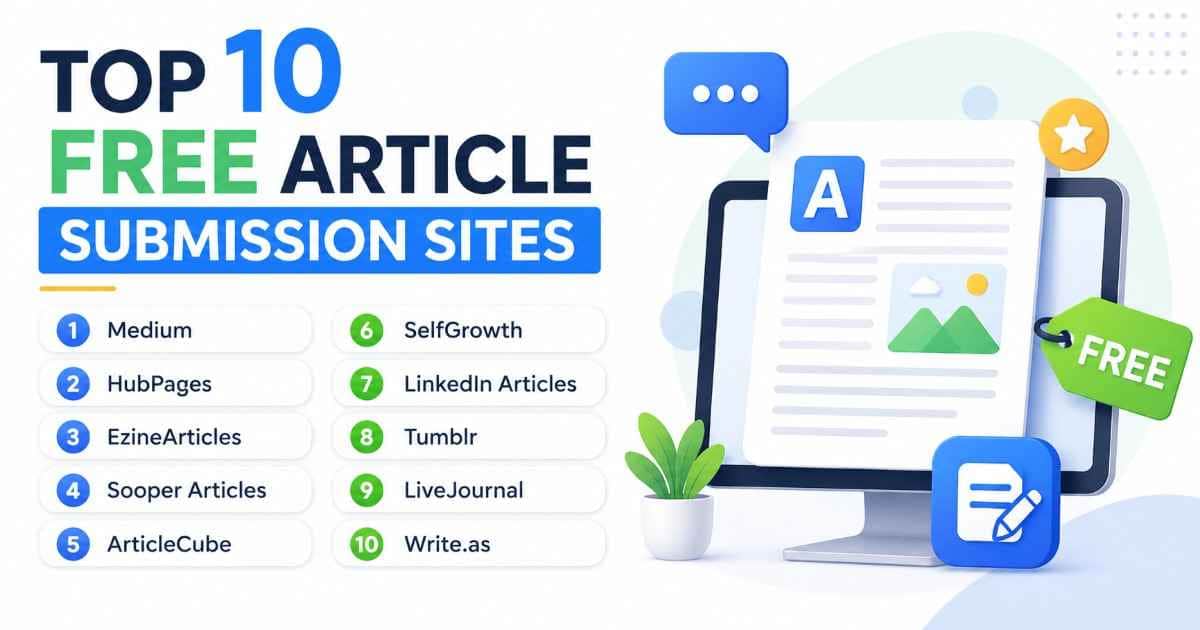
If you're looking for platforms that don't charge submission fees, consider these options:
Medium
HubPages
EzineArticles
Sooper Articles
ArticleCube
SelfGrowth
LinkedIn Articles
Tumblr
LiveJournal
Write as
Dev to
Hashnode
HackerNoon
DZone
CodeProject
Quora Spaces
Scoop it
Vocal Media
ArticleBiz
ArticlesFactory
Additional Article Submission Platforms
To further diversify your content marketing strategy, explore these publishing platforms:
ArticleBase Archive
PRLog
The OmniBuzz
MerchantCircle
Local com Blogs
Blogger
WordPress com
Weebly Blog
Wix Blog
Substack
Ghost
Publish0x
Tealfeed
NewsBreak Contributor
Flipboard Creator
Behance Articles
Dribbble Stories
Vocal Creators
Minds
Hive blog
Steemit
PublishDrive Blog
Notion Sites
Bear Blog
Feather so
Read cash
Mirror xyz
Peerlist
Daily dev
Cakeresume Blog
Newsvine Archive
Blogarama
Blog Engage
Growth Mentor
eLearning Industry
SitePoint Community
Smashing Magazine Community
DesignFloat
Moz Community
Search Engine Journal (Contributor)
Search Engine Land (Contributor)
Social Media Today
CMSWire
TechTarget Community
VentureBeat Contributor
ReadWrite
Entrepreneur Leadership Network
Fast Company Executive Board
Forbes Councils
Business com
Terkel
Help A B2B Writer
WriterAccess Blog
Contently
ClearVoice
Copyblogger Community
Digital Journal
Benzinga Contributor
CoinMonks
Hackster io
How to Get the Best Results from These Platforms
Publishing your content is only the first step. To maximize the value of your efforts:
Write original, in-depth articles tailored to each platform.
Follow the site's editorial guidelines before submitting.
Include relevant internal and external references where appropriate.
Use a compelling headline and engaging introduction.
Add a professional author bio with a link to your website if allowed.
Promote your published articles through social media, email newsletters, and your own blog.
Track referral traffic and engagement using analytics tools to understand which platforms perform best.
Best Practices for Article Submission That Delivers Real SEO Results
Publishing content on multiple platforms can be beneficial, but success depends on how you approach the process. Search engines reward original, user-focused content rather than repetitive articles created solely for backlinks.
Follow these proven best practices to maximize the value of every submission.
Create Original Content Every Time
One of the biggest mistakes marketers make is publishing the same article across dozens of websites.
Instead, write unique content for each platform. Even if you're covering the same topic, change the:
Headline
Introduction
Examples
Structure
Conclusion
Original content is more valuable to readers and reduces the risk of duplicate content issues.
Example
Instead of publishing one article titled:
10 SEO Tips for Beginners
Create variations like:
Beginner's Guide to SEO in 2026
Common SEO Mistakes New Websites Make
Simple SEO Strategies for Small Businesses
How to Build Organic Traffic Without Paid Ads
Each article targets a similar audience while offering fresh value.
Prioritize Helpful Content Over Backlinks
A common misconception is that article marketing exists only to build links.
The real goal should be helping readers solve problems.
Ask yourself before publishing:
Does this answer a real question?
Is the information accurate?
Would someone bookmark or share it?
Does it offer unique insights?
When readers find genuine value, backlinks, shares, and engagement often follow naturally.
Choose Relevant Publishing Platforms
Relevance matters more than authority alone. Publishing your content on websites that closely match your industry helps you reach the right audience, improve engagement, and build stronger topical authority.
Here are some examples of choosing the right platform based on your niche:
Digital Marketing: Marketing blogs and digital marketing publications.
Finance: Business websites, financial magazines, and investment platforms.
Healthcare: Medical websites, healthcare publications, and wellness blogs.
Technology: Developer communities, tech blogs, and software-focused platforms.
Education: Educational websites, learning platforms, and academic communities.
Travel: Travel blogs, tourism websites, and destination guides.
By selecting niche-relevant publishing platforms, you can connect with readers who are genuinely interested in your content. This not only increases engagement and referral traffic but also strengthens your website's topical authority, making your overall SEO strategy more effective.
Write Headlines That Encourage Clicks
Your headline determines whether people read your article.
Strong headlines should:
Solve a problem
Include numbers
Create curiosity
Stay clear and specific
Good Examples
15 SEO Mistakes That Cost You Traffic
Beginner's Guide to Content Marketing
How Small Businesses Can Increase Organic Traffic
Proven Ways to Build Website Authority
Avoid clickbait that doesn't match the content.
Improve Readability
Readers often scan content before reading every word.
Make your articles easy to consume by using:
Short paragraphs
Clear headings
Bullet points
Numbered lists
Bold text for important ideas
Simple language
This improves user experience on both desktop and mobile devices.
Include Credible Sources
Supporting your claims with reliable data increases trust.
Whenever possible, reference:
Industry research
Government publications
Academic studies
Official company reports
Google documentation
Reliable sources strengthen your content's credibility and support EEAT principles.
Optimize Your Author Bio
Your author profile is often the first place readers learn about you.
Include:
Your name
Professional expertise
Company
Website
Social profiles (if allowed)
A well-written bio helps establish authority while encouraging readers to explore your website.
Common Article Submission Mistakes to Avoid
Even experienced marketers occasionally make mistakes that reduce SEO value.
Here are the most common ones.
Publishing Duplicate Content
Copying the same article across dozens of websites offers little value today.
Instead, create unique content tailored to each audience.
Ignoring Editorial Guidelines
Every publishing platform has different requirements.
Some specify:
Word count
Formatting
Image rules
Link limits
Writing style
Following these guidelines increases your approval rate.
Overusing Keywords
Keyword stuffing hurts readability and may negatively affect rankings.
Instead of forcing keywords into every paragraph, write naturally.
Search engines now understand context much better than exact repetition.
Focusing Only on Domain Authority
High authority is useful—but relevance matters just as much.
A niche website with an engaged audience can outperform a larger but unrelated publication.
Using Low-Quality AI Content
AI can assist with research and drafting, but articles should always be reviewed, edited, and improved by humans.
Readers value:
Original experience
Practical advice
Personal insights
Real examples
Quality always wins over quantity.
Forgetting to Promote Published Articles
Many marketers publish an article and never share it again.
Instead:
Share it on LinkedIn
Post it on X (Twitter)
Include it in newsletters
Add it to your website
Link to it from future articles
Promotion helps extend the lifespan of your content.
Practical Example: A Smarter Submission Strategy
Imagine you run a digital marketing agency.
For example, if you run a digital marketing agency, you can tailor your content to different platforms based on their audience:
Medium: SEO Trends for 2026
LinkedIn Articles: Building Brand Authority Through Content
HackerNoon: Technical SEO for SaaS Companies
HubPages: Beginner's Guide to Local SEO
Business 2 Community: Content Marketing Strategies for Small Businesses
Each article targets a different audience while reinforcing your expertise.
This approach generates:
Higher engagement
More referral traffic
Better brand recognition
Stronger authority
Sustainable SEO growth
Expert Tips for Long-Term Success
Professionals who consistently succeed with article marketing follow a structured process rather than publishing randomly.
Build a Publishing Calendar
Plan one or two quality articles each month instead of rushing multiple submissions in a single week.
Consistency builds momentum over time.
Refresh Existing Content
Update older articles with:
New statistics
Recent examples
Improved formatting
Updated screenshots
Better calls to action
Fresh content often performs better than constantly creating new articles.
Measure Performance
Track key metrics such as:
Organic traffic
Referral traffic
Bounce rate
Average engagement time
Conversions
Backlinks earned
Use these insights to identify which platforms deliver the best results.
Repurpose Your Content
A single article can become multiple pieces of content.
For example:
LinkedIn post
Newsletter
Infographic
YouTube script
Podcast outline
Social media thread
Repurposing extends the reach of your work without starting from scratch.
Focus on Building Relationships
Editors and publishers appreciate contributors who consistently provide valuable content.
Maintain professional communication, submit high-quality articles, and engage with readers through comments or discussions. Strong relationships often lead to recurring publishing opportunities.
Featured Snippet: Do Article Submission Sites Still Work for SEO?
Yes, article submission sites can still improve SEO when used correctly. The key is to publish original, informative content on reputable websites that are relevant to your niche. Instead of chasing hundreds of backlinks, focus on building authority, attracting referral traffic, and providing genuine value to readers. High-quality submissions support a well-rounded content marketing strategy and can contribute to long-term organic growth.
Frequently Asked Questions (FAQs)
The following questions are inspired by Google's People Also Ask section and address the most common concerns about article marketing and SEO.
1. What are article submission sites?
Article submission sites are online platforms where individuals and businesses can publish informative articles to reach a wider audience. These platforms help increase brand awareness, generate referral traffic, and establish industry authority when used as part of a well-planned content marketing strategy.
2. Do article submission sites still help SEO?
Yes, they can still support SEO when you publish original, high-quality content on reputable websites. Instead of focusing solely on backlinks, modern article marketing improves visibility, builds topical authority, and attracts engaged readers who may later become customers.
3. Are free article submission sites worth using?
Many free publishing platforms are valuable, provided they maintain strong editorial standards and have an active audience. Before submitting content, review the site's quality, relevance, and publishing guidelines to ensure it aligns with your marketing goals.
4. How often should I submit articles?
Consistency is more important than volume. Publishing two to four well-researched articles each month is generally more effective than submitting dozens of low-quality posts. A steady publishing schedule helps build authority and keeps your content marketing efforts sustainable.
5. Can article submission replace guest posting?
No. Article submission and guest posting sites serve different purposes and work best together. Guest posting usually involves publishing on niche blogs with editorial oversight, while article submission platforms allow broader content distribution. Combining both strategies creates a stronger and more diverse off-page SEO profile.
6. What makes a good article for submission?
A successful article should:
Solve a real problem for readers.
Include accurate and up-to-date information.
Be well-structured with clear headings.
Use simple, engaging language.
Offer original insights or practical examples.
Include a compelling call to action where appropriate.
High-quality content is far more likely to earn engagement, shares, and long-term search visibility.
7. Should I publish the same article on multiple websites?
No. Publishing identical content across many platforms can reduce its effectiveness. Instead, create unique versions tailored to each website and audience. Original content provides a better user experience and aligns with search engine best practices.
8. How do I choose the best article submission platform?
Look for websites that have:
Strong domain authority and reputation.
Relevant audiences within your industry.
Clear editorial guidelines.
Regularly updated content.
Positive user engagement.
Opportunities to build long-term credibility.
Choosing quality platforms is more beneficial than submitting content to hundreds of low-value websites.
Final Thoughts
Although SEO continues to evolve, publishing valuable content on trusted Article Submission Sites remains an effective way to expand your online presence, strengthen brand authority, and support long-term organic growth.
The key is to focus on quality rather than quantity. Instead of chasing hundreds of backlinks, invest your time in creating original articles that genuinely educate, solve problems, and provide value to readers. When your content is published on reputable platforms and supported by a consistent content strategy, the benefits extend far beyond search rankings. You'll build credibility, attract qualified visitors, and create lasting digital assets that continue working for your business over time.
Remember that article marketing should complement—not replace—other SEO activities such as technical optimization, keyword research, content creation, digital PR, and outreach. A balanced strategy delivers the strongest results.

