5 Ways AI Restaurant POS Systems Help Owners Make Better Decisions
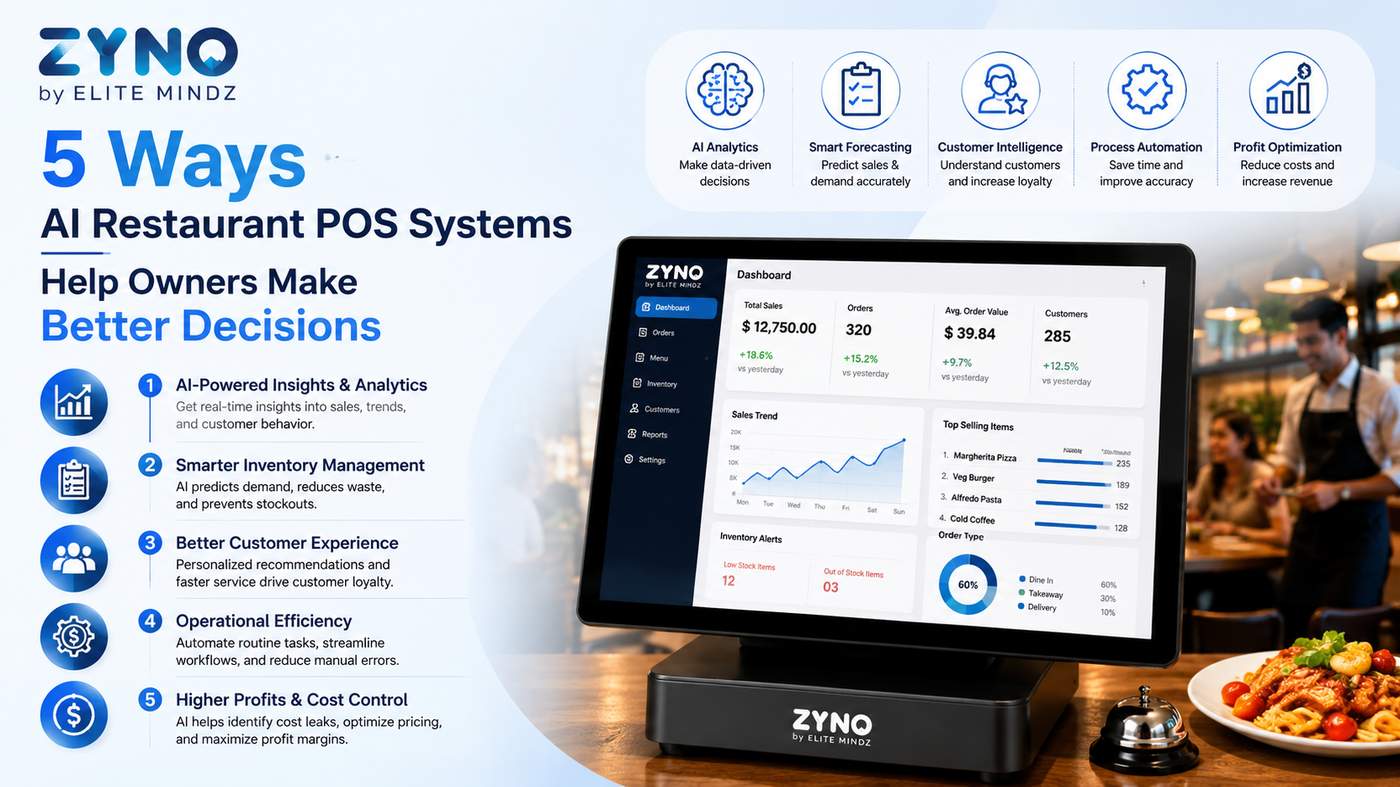
Running a restaurant involves hundreds of decisions every week. How much inventory should you order? Which menu items are actually profitable? When do you need more staff? Why are sales falling on certain days? And which customers are most likely to return?
Traditionally, restaurant owners answered many of these questions using experience, spreadsheets, basic sales reports, or even instinct. While experience remains valuable, today's restaurant businesses generate far more data than any owner can realistically analyze manually.
That is where an AI restaurant POS system can make a difference.
Unlike a traditional point-of-sale system that mainly records transactions, an AI-powered restaurant management system can help organize and analyze sales, inventory, menu, customer, and operational data. Instead of simply showing what happened, modern restaurant data analytics tools can help owners understand patterns and make more informed decisions.
Here are five practical ways AI-powered POS technology can support smarter restaurant management.
1. AI Turns Restaurant Sales Data Into Actionable Insights
A standard restaurant POS system may tell you how much revenue your restaurant generated yesterday.
An AI-enabled system can potentially tell you much more.
By analyzing historical transactions and recurring patterns, restaurant sales analytics can help owners understand:
Which days and hours generate the highest sales
Which menu categories perform best
Which products are frequently purchased together
How average order value changes throughout the week
Whether dine-in, takeaway, or delivery channels are growing
How current performance compares with previous periods
For example, imagine a restaurant owner notices that Friday revenue looks strong. At first glance, there may be nothing to investigate.
However, deeper POS analytics for restaurants could reveal that while overall revenue is increasing, the average order value is falling because customers are buying fewer appetizers and desserts.
That gives the owner something specific to investigate.
Instead of making a general decision such as, "We need to increase sales," the restaurant can consider more targeted actions, such as changing menu placement, creating meal combinations, training servers on appropriate upselling, or reviewing pricing.
Better Decision:
Use actual purchasing patterns instead of assumptions when planning promotions, menus, and sales strategies.
This is one of the biggest advantages of data-driven restaurant management: owners can move from asking "What do I think is happening?" to "What does the data suggest is happening?"
2. AI Helps Restaurants Forecast Demand and Manage Inventory
Food inventory is one of the most difficult areas of restaurant management.
Order too much and ingredients may expire before they are used.
Order too little and the restaurant may run out of popular dishes during a busy service.
An AI inventory management system for restaurants can help reduce some of that uncertainty by analyzing historical sales patterns and ingredient usage.
Depending on the capabilities of the POS platform, forecasting models may consider information such as:
Previous sales
Day of the week
Seasonal demand
Menu popularity
Historical ingredient consumption
Promotions
Special events
Sales trends
This type of restaurant POS sales forecasting can help managers estimate future demand more systematically.
For instance, if a restaurant consistently sells significantly more grilled chicken meals on Friday and Saturday evenings, its system can highlight that pattern when managers prepare upcoming stock orders.
This does not mean AI should completely replace an experienced kitchen or purchasing manager. Unexpected events, local conditions, supplier issues, or sudden changes in demand can still affect requirements.
Instead, AI becomes another decision-support tool.
Better Decision:
Combine demand forecasting with staff experience to make more accurate purchasing decisions and reduce unnecessary food waste.
Effective restaurant inventory management can also improve cash-flow visibility because owners have a clearer understanding of how much money is tied up in ingredients.
3. AI Reveals Which Menu Items Are Really Performing
One of the most common mistakes in restaurant management is judging a menu item only by how often it sells.
A popular dish is not automatically a profitable dish.
Suppose two menu items each sell 300 portions per month.
Dish A may require expensive ingredients, longer preparation time, and greater food waste.
Dish B may have simpler ingredients, faster preparation, and a healthier contribution margin.
Looking only at sales volume could make both dishes appear equally successful.
A smart restaurant POS connected with recipe costs, inventory information, and sales data can provide a more complete view of menu performance.
Owners may be able to examine metrics such as:
Number of units sold
Revenue by item
Ingredient cost
Estimated gross margin
Modifier popularity
Sales by daypart
Product combinations
Items with declining demand
This makes menu performance analysis far more useful.
Restaurant owners can then separate menu items into practical categories such as:
High sales + strong margins:
Items worth protecting, promoting, or featuring prominently.
High sales + weak margins:
Items that may require portion, ingredient, or pricing reviews.
Low sales + strong margins:
Items that could benefit from better placement or promotion.
Low sales + weak margins:
Items that may need to be redesigned or removed.
Better Decision:
Make menu changes based on both popularity and profitability instead of popularity alone.
Over time, these insights can support better food cost control, smarter menu engineering, and improved restaurant profitability.
4. AI Helps Owners Schedule Staff More Efficiently
Labor is another major operational challenge.
Too many employees during quiet periods increases labor costs.
Too few employees during peak periods can lead to slow service, stressed teams, order mistakes, and unhappy customers.
This is where restaurant business intelligence and demand forecasting can help.
By analyzing historical transaction patterns, a modern restaurant performance tracking system can show owners exactly when demand tends to rise and fall.
For example, data might show that:
Monday afternoons are consistently quiet.
Thursday dinner demand begins increasing around 6:00 p.m.
Saturday lunch has become busier during the past three months.
Delivery orders peak later than dine-in orders.
Managers can use those patterns when creating employee schedules.
If the restaurant POS is connected with workforce management software, some platforms may also help compare sales with labor hours.
This can make labor cost management more precise.
However, staffing decisions should never rely on algorithms alone. Employee skills, availability, customer service expectations, local labor requirements, planned reservations, and unusual events still require human judgment.
Better Decision:
Schedule employees according to expected demand while allowing managers to adjust for real-world operating conditions.
The goal of AI is not simply to reduce staffing. It is to help restaurant owners place the right resources where customers need them most.
5. AI Helps Restaurants Understand Customer Behavior
Every restaurant transaction can reveal something about customer preferences.
When those transactions accumulate across hundreds or thousands of orders, identifying patterns manually becomes difficult.
This is where restaurant customer data analytics can become valuable.
When implemented responsibly and in accordance with applicable privacy requirements, restaurant technology can help businesses understand patterns such as:
Returning versus new customers
Average customer spend
Favorite menu items
Typical ordering times
Frequently purchased combinations
Loyalty activity
Promotion response
Order frequency
For example, a restaurant may discover that customers who regularly order family-sized meals tend to purchase on Friday evenings.
Instead of sending the same promotion to every customer, the restaurant could create more relevant offers for specific customer groups where its marketing and consent setup allows it.
AI may also help identify customers whose visit frequency appears to be declining, giving the restaurant an opportunity to investigate broader retention trends.
Better Decision:
Use customer behavior insights to create more relevant loyalty programs and marketing campaigns instead of relying on one-size-fits-all promotions.
This is particularly valuable when an AI restaurant POS system connects with a restaurant's loyalty or customer relationship management tools.
From Reporting to Better Restaurant Decisions
The real value of AI in restaurant technology is not that it eliminates decision-making.
It is that it can improve the information available before a decision is made.
Traditional reports often tell owners:
What happened?
Modern restaurant decision-making tools can help them investigate:
Why might it have happened?
And forecasting tools can support another important question:
What is likely to happen next?
Consider a simple example.
A restaurant's monthly profit is declining.
Without detailed analytics, the owner might immediately increase menu prices.
But an AI-powered restaurant management system could help reveal that:
Revenue is relatively stable.
Ingredient costs have increased.
Food waste is concentrated around several low-selling dishes.
Overtime is increasing during specific shifts.
A high-margin menu category is receiving fewer orders.
With better information, the restaurant owner has several options to investigate before making a broad price increase.
That is the difference between simply collecting data and using data to support decisions.
What Should Restaurant Owners Look for in an AI POS System?
Not every platform marketed as an "AI POS" offers the same capabilities.
Before choosing the best AI POS system for a restaurant, owners should focus on practical business requirements rather than the AI label itself.
Look for features such as:
Real-Time Restaurant Analytics
Dashboards should make important information easy to understand without requiring owners to manually combine multiple reports.
Sales Forecasting
Useful forecasting tools should analyze historical sales and identify patterns that can support planning.
Inventory Integration
Connecting POS transactions with ingredient inventory can provide better visibility into purchasing and consumption.
Menu Analytics
Owners should be able to understand both item popularity and its financial contribution.
Labor Reporting
The ability to compare staffing levels, labor hours, and sales can support more informed scheduling.
Customer and Loyalty Insights
For restaurants operating loyalty programs, customer analytics can help identify purchasing patterns while respecting applicable privacy and consent requirements.
Automated Restaurant Reporting
Useful systems should reduce repetitive reporting work and surface meaningful information without forcing owners to search through dozens of dashboards.
Integrations
A cloud-based restaurant POS should ideally work well with the other technology the restaurant already depends on, such as accounting, inventory, online ordering, payment, workforce, or delivery systems.
AI Should Support Restaurant Owners, Not Replace Their Judgment
Restaurant businesses involve factors that software cannot always understand.
A dashboard may identify declining sales, but an experienced manager may know that nearby construction reduced foot traffic.
An algorithm may recommend lower staffing based on historical transactions, while the manager knows that a large reservation is arriving that evening.
A forecasting model may predict normal inventory requirements, while the chef knows a local festival will dramatically increase demand.
For this reason, successful adoption of AI for restaurants should combine technology with human experience.
Think of AI as a decision-support system.
It processes large volumes of information and identifies patterns.
Restaurant owners and managers provide the context.
Together, they can lead to stronger decisions.
Final Thoughts
Modern restaurants generate valuable information every time a customer places an order.
The challenge is turning that information into useful action.
An AI restaurant POS system can help restaurant owners improve decision-making by supporting:
Restaurant sales analytics
AI inventory management and demand forecasting
Menu performance analysis
Labor planning and operational efficiency
Restaurant customer data analytics
The most effective systems do more than produce reports. They help owners understand what deserves attention and provide information that can guide the next decision.
For restaurant owners trying to improve efficiency, control costs, understand customers, and build a more profitable business, AI POS software can become a valuable part of their restaurant management strategy.
The important question is no longer simply:
"How much did we sell today?"
It is:
"What can today's data help us do better tomorrow?"
Frequently Asked Questions
What is an AI restaurant POS system?
An AI restaurant POS system combines traditional point-of-sale functions with analytics, automation, forecasting, and machine-learning capabilities. Depending on the platform, it may help restaurants analyze sales, inventory, menu performance, customer behavior, and operational trends.
How can AI help restaurant owners?
AI can help restaurant owners analyze large amounts of operational data more efficiently. Common applications include sales forecasting, inventory optimization, menu analysis, customer behavior insights, automated reporting, and restaurant performance tracking.
Can an AI POS system reduce food waste?
AI cannot eliminate food waste on its own, but demand forecasting and inventory analytics can help managers make better purchasing decisions. Restaurants still need accurate inventory processes, recipe information, and employee oversight.
Can restaurant POS systems predict sales?
Some modern POS and restaurant analytics platforms use historical data and forecasting models to estimate future demand. The accuracy of restaurant POS sales forecasting depends on factors such as data quality, available history, changing market conditions, and the forecasting method used.
Is an AI-powered POS suitable for small restaurants?
It can be. Small restaurants may benefit from automated reporting, inventory visibility, menu analytics, and forecasting, but owners should compare the cost and complexity of a system with the actual problems they need to solve.
Will AI replace restaurant managers?
AI is better viewed as a tool for supporting restaurant managers rather than replacing them. Restaurant management still requires human judgment, leadership, hospitality experience, employee management, and an understanding of local business conditions.

