
ERP Software
Looking for the Perfect ERP Software for Your Business?
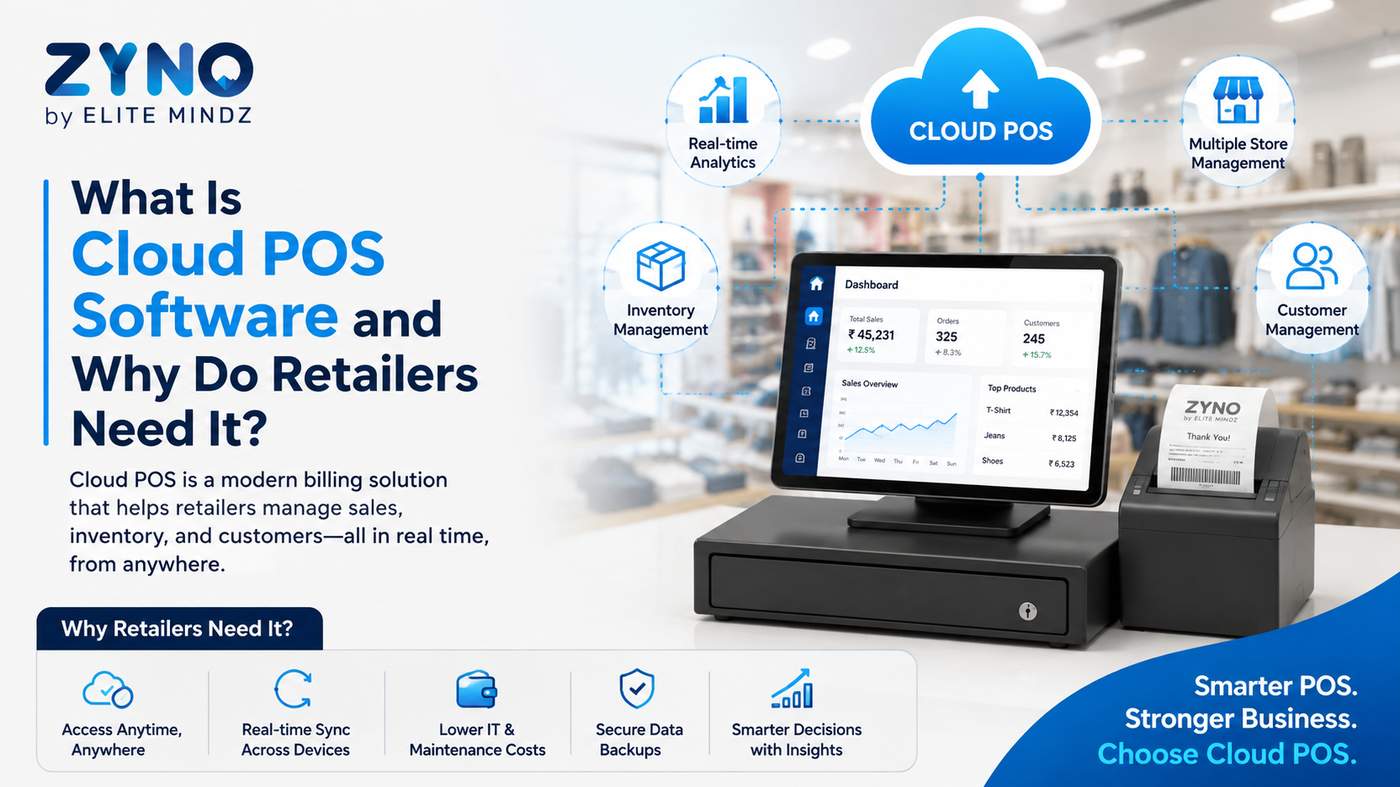
Retail businesses today need more than a billing counter. Customers expect fast checkout, multiple payment options, accurate stock information, personalized service, and a smooth experience whether they shop at one store or across several locations.
This is where cloud POS software can make a major difference.
Unlike traditional point-of-sale systems that rely heavily on a local computer or server, a cloud-based POS system stores and synchronizes business information through the cloud. Retailers can access sales, inventory, customer information, and reports from authorized devices and locations.
Modern cloud-based retail platforms can also make it easier to scale to new stores, receive software updates, and manage inventory across physical and online channels.
So, what is cloud POS software, how does it work, and why do retailers need cloud POS software? Let's understand.
What Is Cloud POS Software?
Cloud POS software is a point of sale software solution that processes retail transactions while storing and synchronizing operational data online.
A traditional POS may keep most information on a computer or local server inside the store. A cloud POS system, on the other hand, allows authorized users to access business information through the internet.
Modern cloud point of sale software can typically manage:
Billing and invoicing
Product information
Inventory
Customer records
Discounts and promotions
Digital payments
Returns and exchanges
Sales reports
Multiple stores
Employee access
Purchase information
This means a retail POS system is no longer just a checkout tool. It can become an important part of a retailer's overall retail management software.
How Cloud POS Software Works
Understanding how cloud POS software works is fairly simple.
When a cashier completes a sale, the POS billing software records the transaction. The information can then synchronize with the cloud platform and update related records such as inventory, customer history, and sales reports.
For example, if a customer buys three products, the system can:
Process the bill.
Record the payment.
Reduce those products from inventory.
Update daily sales figures.
Add the purchase to the customer's history when applicable.
Make updated information available to authorized managers.
Because information is centrally managed, owners can often monitor the business without being physically present at every store.
This ability to synchronize sales and inventory is a key characteristic of a modern cloud-based POS system.
Why Are Retailers Moving to Cloud POS Systems?
The retail industry has become more complex.
Businesses may sell through stores, websites, marketplaces, mobile devices, and social channels. At the same time, customers expect inventory information and service to remain consistent.
Traditional disconnected systems can make this difficult.
A modern POS system gives retailers a way to connect different parts of their operation and access more accurate information.
Here are some of the biggest benefits of cloud POS software.
1. Access Business Information From Anywhere
One of the main advantages of online POS software is accessibility.
Retail business owners do not always want to visit every outlet just to check daily sales.
With a cloud platform, authorized users can often access:
Sales reports
Inventory information
Store performance
Customer information
Transaction records
Product performance
from a computer, tablet, or mobile device.
This is especially helpful for owners managing several locations.
2. Real-Time Inventory Management
Inventory management is one of the most important parts of retail.
When stock information is inaccurate, retailers can face stockouts, overstocking, missed sales, and unnecessary purchasing.
A POS software with inventory management can automatically update stock whenever an item is sold or returned.
This supports real-time inventory management and gives retailers a clearer view of what is available.
A strong POS inventory management system may also provide:
Low-stock alerts
Product-level inventory
Stock transfers
Purchase tracking
Store-wise stock
Product variants
Reorder information
When connected with inventory management software or cloud inventory management, retailers can manage inventory with less manual work.
3. Easier Multi-Store Management
Managing one shop is very different from managing five, ten, or fifty outlets.
Cloud POS software for multiple stores helps retailers centralize information instead of maintaining separate records for every location.
A good multi-store POS software solution can help management view:
Branch-wise sales
Store inventory
Product pricing
Promotions
Employee activity
Customer information
This can also support multi-store inventory management.
If one branch has excess stock while another branch is running low, management can identify the situation and transfer products when appropriate.
For this reason, cloud systems can be particularly useful as POS software for growing retail businesses.
4. Faster and More Accurate Billing
Checkout remains one of the most important functions of a POS.
Modern retail billing software helps employees scan products, calculate taxes, apply discounts, accept payments, and generate receipts quickly.
Integration with barcode billing software can further reduce manual product entry.
For businesses operating under GST requirements, integrated GST billing software capabilities can also help simplify invoice creation and tax calculations.
A faster checkout experience benefits both employees and customers.
5. Automated Inventory Management
The next stage of inventory technology involves greater automation.
Instead of manually checking stock every day, automated inventory management can help identify products that need attention.
A smart POS software platform may help retailers monitor stock movement, identify low inventory, analyze fast- and slow-moving products, and support replenishment decisions.
More advanced platforms are also beginning to combine POS data with artificial intelligence.
An AI-powered cloud POS or AI POS system may use sales trends and historical information to support inventory forecasting, customer analysis, or decision-making.
6. Better Retail Analytics
Every transaction produces valuable business information.
A modern digital POS system can turn these transactions into useful reports instead of leaving retailers to analyze spreadsheets manually.
Retailers may use retail analytics to understand:
Best-selling products
Slow-moving items
Sales by location
Peak shopping periods
Average transaction value
Popular payment methods
Customer purchase patterns
When combined with AI-powered retail analytics, sales tracking software, and customer behavior analytics, retailers can gain deeper insight into business performance.
This information can also support retail sales forecasting.
7. Better Customer Management
Customers increasingly expect businesses to recognize their preferences and provide relevant experiences.
Integrating customer management software with POS information can help retailers maintain purchase histories, loyalty information, contact details, and customer preferences.
Retailers may use this information for:
Loyalty programs
Personalized promotions
Rewards
Repeat-customer offers
Purchase recommendations
A connected system helps employees understand customers without maintaining multiple separate databases.
8. Omnichannel and Unified Commerce
Customers no longer shop through only one channel.
Someone might find a product online, buy it in a physical store, and later request a return through another channel.
Omnichannel POS software helps retailers connect these experiences.
A unified commerce POS goes further by bringing orders, inventory, customers, payments, and sales channels into a more connected environment.
This can help businesses provide consistent stock and customer information across online and offline retail.
For companies investing in retail digital transformation, this type of integration is becoming increasingly important.
9. Mobile POS, SoftPOS, and Smarter Checkout
The checkout counter itself is also changing.
A mobile POS system allows employees to process transactions using portable devices rather than requiring customers to visit a fixed counter.
SoftPOS technology can allow compatible devices to accept contactless payments without traditional payment-terminal hardware in supported environments.
Retailers are also exploring smart checkout technology to reduce queues and improve convenience.
A contactless POS system and digital payment POS can support customers who prefer cards, mobile wallets, QR-based payments, and other digital options.
Connecting the system with payment processing software can also help keep payment information aligned with sales records.
10. Easier Retail Automation
Retail teams often spend significant time on repetitive administrative work.
Retail automation can reduce some of this workload.
A cloud POS platform may automate tasks such as:
Inventory updates
Sales reporting
Stock alerts
Customer loyalty points
Price synchronization
Tax calculations
Store-wise reporting
Automation allows staff to spend less time maintaining records and more time serving customers.
Where Does ZYNO POS Fit In?
Retailers comparing cloud POS software for retail businesses can also consider ZYNO POS by Elite Mindz.
ZYNO POS is positioned as a cloud-based retail platform that combines billing, inventory, customer management, supplier management, multi-branch operations, and business analytics. Its cloud POS offering supports centralized multi-branch synchronization, role-based access, remote monitoring, third-party integrations, and an offline billing mode designed to synchronize transactions once connectivity returns.
For retailers, some relevant ZYNO POS capabilities include:
Cloud-based billing
Real-time inventory tracking
Barcode scanning
GST billing
Multi-store management
Customer and loyalty management
Sales and business reports
Multiple payment methods
Purchase and supplier management
AI-powered analytics
ZYNO POS also supports centralized management of products, pricing, promotions, sales, and inventory across outlets.
This makes it an option worth evaluating for businesses searching for cloud-based POS software for retail stores or a connected platform that can grow with multiple outlets.
Cloud POS System for Small Businesses
A cloud POS system for small business does not need to be complicated.
For a small retailer, the most important features may simply be:
Quick billing
Inventory tracking
Customer management
Barcode support
Digital payments
Sales reports
Tax management
Cloud backup
When comparing affordable cloud POS software for retailers, businesses should consider total cost rather than only the subscription price.
Ease of use, implementation, hardware requirements, support, integrations, and scalability also matter.
How to Choose the Best Cloud POS Software for Retailers
The best cloud POS software for retailers is not necessarily the platform with the longest feature list.
It should fit your business.
Before choosing a retail POS software solution, consider:
How many stores do you operate?
How many products do you manage?
Do you sell online as well as offline?
Do you need real-time inventory?
Which payment methods do customers use?
Do you need GST billing?
Do you manage loyalty programs?
Will you open more locations?
Does the POS integrate with other software?
What happens if the internet connection goes down?
For a single small store, simplicity may be the priority. For a retail chain, centralized inventory, multi-store controls, analytics, integrations, and scalability become much more important.
Final Thoughts
So, why do retailers need cloud POS software?
Because retail has moved far beyond simple billing.
A good cloud POS system can connect sales, inventory, customers, payments, reports, and multiple locations while giving business owners greater visibility over everyday operations.
Features such as real-time inventory management, multi-store POS software, retail automation, mobile POS systems, AI-powered retail analytics, digital payments, and omnichannel POS software are making cloud POS platforms more valuable for modern retailers.
Solutions such as ZYNO POS also demonstrate how cloud POS technology can bring billing, inventory, customers, purchasing, and analytics together within one connected platform.
Ultimately, the right cloud POS software should make your retail business easier to manage—not more complicated. Whether you operate one outlet or a growing chain, choose a system that fits your current needs while providing enough flexibility to support future growth.

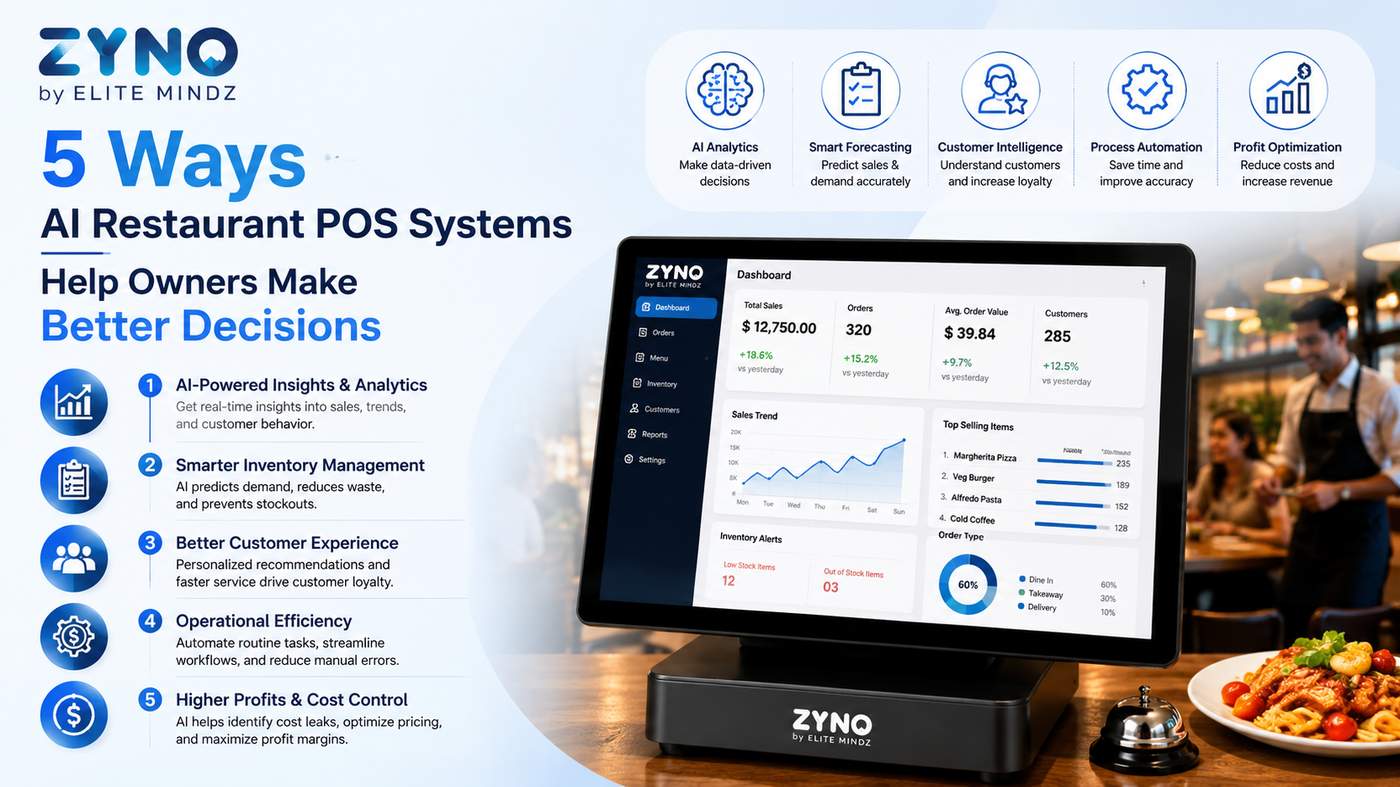
Running a restaurant involves hundreds of decisions every week. How much inventory should you order? Which menu items are actually profitable? When do you need more staff? Why are sales falling on certain days? And which customers are most likely to return?
Traditionally, restaurant owners answered many of these questions using experience, spreadsheets, basic sales reports, or even instinct. While experience remains valuable, today's restaurant businesses generate far more data than any owner can realistically analyze manually.
That is where an AI restaurant POS system can make a difference.
Unlike a traditional point-of-sale system that mainly records transactions, an AI-powered restaurant management system can help organize and analyze sales, inventory, menu, customer, and operational data. Instead of simply showing what happened, modern restaurant data analytics tools can help owners understand patterns and make more informed decisions.
Here are five practical ways AI-powered POS technology can support smarter restaurant management.
1. AI Turns Restaurant Sales Data Into Actionable Insights
A standard restaurant POS system may tell you how much revenue your restaurant generated yesterday.
An AI-enabled system can potentially tell you much more.
By analyzing historical transactions and recurring patterns, restaurant sales analytics can help owners understand:
Which days and hours generate the highest sales
Which menu categories perform best
Which products are frequently purchased together
How average order value changes throughout the week
Whether dine-in, takeaway, or delivery channels are growing
How current performance compares with previous periods
For example, imagine a restaurant owner notices that Friday revenue looks strong. At first glance, there may be nothing to investigate.
However, deeper POS analytics for restaurants could reveal that while overall revenue is increasing, the average order value is falling because customers are buying fewer appetizers and desserts.
That gives the owner something specific to investigate.
Instead of making a general decision such as, "We need to increase sales," the restaurant can consider more targeted actions, such as changing menu placement, creating meal combinations, training servers on appropriate upselling, or reviewing pricing.
Better Decision:
Use actual purchasing patterns instead of assumptions when planning promotions, menus, and sales strategies.
This is one of the biggest advantages of data-driven restaurant management: owners can move from asking "What do I think is happening?" to "What does the data suggest is happening?"
2. AI Helps Restaurants Forecast Demand and Manage Inventory
Food inventory is one of the most difficult areas of restaurant management.
Order too much and ingredients may expire before they are used.
Order too little and the restaurant may run out of popular dishes during a busy service.
An AI inventory management system for restaurants can help reduce some of that uncertainty by analyzing historical sales patterns and ingredient usage.
Depending on the capabilities of the POS platform, forecasting models may consider information such as:
Previous sales
Day of the week
Seasonal demand
Menu popularity
Historical ingredient consumption
Promotions
Special events
Sales trends
This type of restaurant POS sales forecasting can help managers estimate future demand more systematically.
For instance, if a restaurant consistently sells significantly more grilled chicken meals on Friday and Saturday evenings, its system can highlight that pattern when managers prepare upcoming stock orders.
This does not mean AI should completely replace an experienced kitchen or purchasing manager. Unexpected events, local conditions, supplier issues, or sudden changes in demand can still affect requirements.
Instead, AI becomes another decision-support tool.
Better Decision:
Combine demand forecasting with staff experience to make more accurate purchasing decisions and reduce unnecessary food waste.
Effective restaurant inventory management can also improve cash-flow visibility because owners have a clearer understanding of how much money is tied up in ingredients.
3. AI Reveals Which Menu Items Are Really Performing
One of the most common mistakes in restaurant management is judging a menu item only by how often it sells.
A popular dish is not automatically a profitable dish.
Suppose two menu items each sell 300 portions per month.
Dish A may require expensive ingredients, longer preparation time, and greater food waste.
Dish B may have simpler ingredients, faster preparation, and a healthier contribution margin.
Looking only at sales volume could make both dishes appear equally successful.
A smart restaurant POS connected with recipe costs, inventory information, and sales data can provide a more complete view of menu performance.
Owners may be able to examine metrics such as:
Number of units sold
Revenue by item
Ingredient cost
Estimated gross margin
Modifier popularity
Sales by daypart
Product combinations
Items with declining demand
This makes menu performance analysis far more useful.
Restaurant owners can then separate menu items into practical categories such as:
High sales + strong margins:
Items worth protecting, promoting, or featuring prominently.
High sales + weak margins:
Items that may require portion, ingredient, or pricing reviews.
Low sales + strong margins:
Items that could benefit from better placement or promotion.
Low sales + weak margins:
Items that may need to be redesigned or removed.
Better Decision:
Make menu changes based on both popularity and profitability instead of popularity alone.
Over time, these insights can support better food cost control, smarter menu engineering, and improved restaurant profitability.
4. AI Helps Owners Schedule Staff More Efficiently
Labor is another major operational challenge.
Too many employees during quiet periods increases labor costs.
Too few employees during peak periods can lead to slow service, stressed teams, order mistakes, and unhappy customers.
This is where restaurant business intelligence and demand forecasting can help.
By analyzing historical transaction patterns, a modern restaurant performance tracking system can show owners exactly when demand tends to rise and fall.
For example, data might show that:
Monday afternoons are consistently quiet.
Thursday dinner demand begins increasing around 6:00 p.m.
Saturday lunch has become busier during the past three months.
Delivery orders peak later than dine-in orders.
Managers can use those patterns when creating employee schedules.
If the restaurant POS is connected with workforce management software, some platforms may also help compare sales with labor hours.
This can make labor cost management more precise.
However, staffing decisions should never rely on algorithms alone. Employee skills, availability, customer service expectations, local labor requirements, planned reservations, and unusual events still require human judgment.
Better Decision:
Schedule employees according to expected demand while allowing managers to adjust for real-world operating conditions.
The goal of AI is not simply to reduce staffing. It is to help restaurant owners place the right resources where customers need them most.
5. AI Helps Restaurants Understand Customer Behavior
Every restaurant transaction can reveal something about customer preferences.
When those transactions accumulate across hundreds or thousands of orders, identifying patterns manually becomes difficult.
This is where restaurant customer data analytics can become valuable.
When implemented responsibly and in accordance with applicable privacy requirements, restaurant technology can help businesses understand patterns such as:
Returning versus new customers
Average customer spend
Favorite menu items
Typical ordering times
Frequently purchased combinations
Loyalty activity
Promotion response
Order frequency
For example, a restaurant may discover that customers who regularly order family-sized meals tend to purchase on Friday evenings.
Instead of sending the same promotion to every customer, the restaurant could create more relevant offers for specific customer groups where its marketing and consent setup allows it.
AI may also help identify customers whose visit frequency appears to be declining, giving the restaurant an opportunity to investigate broader retention trends.
Better Decision:
Use customer behavior insights to create more relevant loyalty programs and marketing campaigns instead of relying on one-size-fits-all promotions.
This is particularly valuable when an AI restaurant POS system connects with a restaurant's loyalty or customer relationship management tools.
From Reporting to Better Restaurant Decisions
The real value of AI in restaurant technology is not that it eliminates decision-making.
It is that it can improve the information available before a decision is made.
Traditional reports often tell owners:
What happened?
Modern restaurant decision-making tools can help them investigate:
Why might it have happened?
And forecasting tools can support another important question:
What is likely to happen next?
Consider a simple example.
A restaurant's monthly profit is declining.
Without detailed analytics, the owner might immediately increase menu prices.
But an AI-powered restaurant management system could help reveal that:
Revenue is relatively stable.
Ingredient costs have increased.
Food waste is concentrated around several low-selling dishes.
Overtime is increasing during specific shifts.
A high-margin menu category is receiving fewer orders.
With better information, the restaurant owner has several options to investigate before making a broad price increase.
That is the difference between simply collecting data and using data to support decisions.
What Should Restaurant Owners Look for in an AI POS System?
Not every platform marketed as an "AI POS" offers the same capabilities.
Before choosing the best AI POS system for a restaurant, owners should focus on practical business requirements rather than the AI label itself.
Look for features such as:
Real-Time Restaurant Analytics
Dashboards should make important information easy to understand without requiring owners to manually combine multiple reports.
Sales Forecasting
Useful forecasting tools should analyze historical sales and identify patterns that can support planning.
Inventory Integration
Connecting POS transactions with ingredient inventory can provide better visibility into purchasing and consumption.
Menu Analytics
Owners should be able to understand both item popularity and its financial contribution.
Labor Reporting
The ability to compare staffing levels, labor hours, and sales can support more informed scheduling.
Customer and Loyalty Insights
For restaurants operating loyalty programs, customer analytics can help identify purchasing patterns while respecting applicable privacy and consent requirements.
Automated Restaurant Reporting
Useful systems should reduce repetitive reporting work and surface meaningful information without forcing owners to search through dozens of dashboards.
Integrations
A cloud-based restaurant POS should ideally work well with the other technology the restaurant already depends on, such as accounting, inventory, online ordering, payment, workforce, or delivery systems.
AI Should Support Restaurant Owners, Not Replace Their Judgment
Restaurant businesses involve factors that software cannot always understand.
A dashboard may identify declining sales, but an experienced manager may know that nearby construction reduced foot traffic.
An algorithm may recommend lower staffing based on historical transactions, while the manager knows that a large reservation is arriving that evening.
A forecasting model may predict normal inventory requirements, while the chef knows a local festival will dramatically increase demand.
For this reason, successful adoption of AI for restaurants should combine technology with human experience.
Think of AI as a decision-support system.
It processes large volumes of information and identifies patterns.
Restaurant owners and managers provide the context.
Together, they can lead to stronger decisions.
Final Thoughts
Modern restaurants generate valuable information every time a customer places an order.
The challenge is turning that information into useful action.
An AI restaurant POS system can help restaurant owners improve decision-making by supporting:
Restaurant sales analytics
AI inventory management and demand forecasting
Menu performance analysis
Labor planning and operational efficiency
Restaurant customer data analytics
The most effective systems do more than produce reports. They help owners understand what deserves attention and provide information that can guide the next decision.
For restaurant owners trying to improve efficiency, control costs, understand customers, and build a more profitable business, AI POS software can become a valuable part of their restaurant management strategy.
The important question is no longer simply:
"How much did we sell today?"
It is:
"What can today's data help us do better tomorrow?"
Frequently Asked Questions
What is an AI restaurant POS system?
An AI restaurant POS system combines traditional point-of-sale functions with analytics, automation, forecasting, and machine-learning capabilities. Depending on the platform, it may help restaurants analyze sales, inventory, menu performance, customer behavior, and operational trends.
How can AI help restaurant owners?
AI can help restaurant owners analyze large amounts of operational data more efficiently. Common applications include sales forecasting, inventory optimization, menu analysis, customer behavior insights, automated reporting, and restaurant performance tracking.
Can an AI POS system reduce food waste?
AI cannot eliminate food waste on its own, but demand forecasting and inventory analytics can help managers make better purchasing decisions. Restaurants still need accurate inventory processes, recipe information, and employee oversight.
Can restaurant POS systems predict sales?
Some modern POS and restaurant analytics platforms use historical data and forecasting models to estimate future demand. The accuracy of restaurant POS sales forecasting depends on factors such as data quality, available history, changing market conditions, and the forecasting method used.
Is an AI-powered POS suitable for small restaurants?
It can be. Small restaurants may benefit from automated reporting, inventory visibility, menu analytics, and forecasting, but owners should compare the cost and complexity of a system with the actual problems they need to solve.
Will AI replace restaurant managers?
AI is better viewed as a tool for supporting restaurant managers rather than replacing them. Restaurant management still requires human judgment, leadership, hospitality experience, employee management, and an understanding of local business conditions.
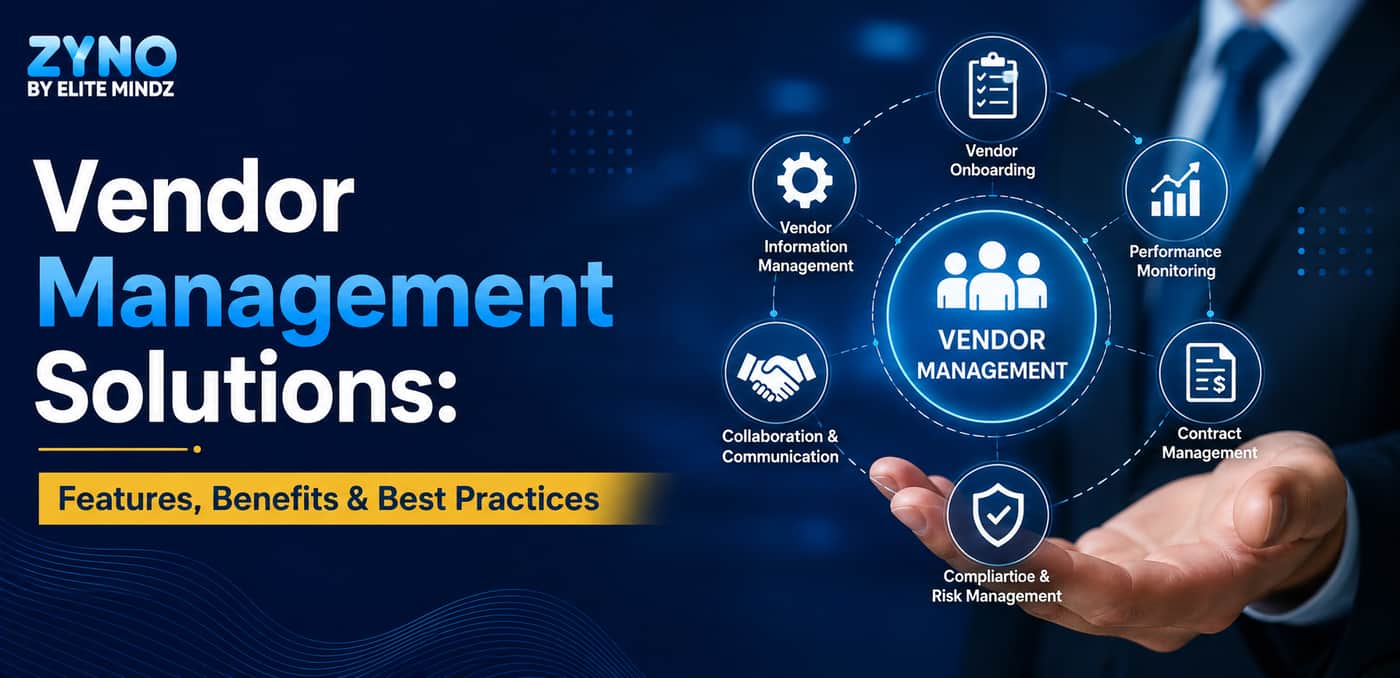
Managing vendors effectively is essential for businesses that depend on multiple suppliers, service providers, and external partners. As vendor networks grow, spreadsheets, emails, and manual processes can make it difficult to track contracts, performance, compliance, payments, and supplier relationships.
Vendor management solutions provide a centralized way to organize and automate these activities. From vendor onboarding and evaluation to performance tracking and risk management, modern solutions help procurement teams build stronger supplier relationships while improving operational efficiency.
What Are Vendor Management Solutions?
Vendor management solutions are software platforms designed to help businesses manage their complete vendor lifecycle from a single system. They can centralize vendor information, automate onboarding, monitor supplier performance, manage documentation, and support procurement activities.
A vendor management system gives procurement and finance teams better visibility into supplier-related activities. Instead of maintaining information across different spreadsheets and email conversations, businesses can store vendor profiles, contracts, certifications, payment information, and performance data in one place.
Modern vendor management software can also integrate with procurement, ERP, accounting, and inventory systems to create a connected supplier management process.
Why Do Businesses Need Vendor Management Solutions?
Managing vendors manually can create several challenges, including duplicate records, missing documents, delayed approvals, poor communication, and limited visibility into supplier performance.
A centralized vendor management platform can help businesses:
Maintain accurate vendor information
Automate vendor onboarding
Track supplier documents and contracts
Monitor vendor performance
Manage vendor risks
Improve procurement visibility
Standardize vendor evaluation
Support compliance requirements
Strengthen vendor relationships
For growing organizations, supplier management software can make vendor-related processes more structured, transparent, and scalable.
Key Features of Vendor Management Solutions
1. Vendor Onboarding
Vendor onboarding software helps businesses create a standardized process for adding new suppliers. Teams can collect vendor details, documents, certifications, tax information, and other required data through a centralized workflow.
Automated approvals can also reduce delays and ensure that vendors meet internal requirements before they become active suppliers.
2. Vendor Database Management
A centralized vendor database allows businesses to store supplier information in an organized format. Users can quickly access contact details, contracts, documents, payment information, categories, and other relevant records.
This makes vendor database management easier and reduces dependency on scattered spreadsheets.
3. Vendor Performance Management
Understanding how suppliers perform is important for maintaining quality and controlling costs. Vendor performance management allows businesses to monitor metrics such as delivery times, product quality, responsiveness, pricing, and service levels.
Procurement teams can use this information to identify high-performing suppliers and address recurring vendor issues.
4. Vendor Evaluation
A vendor evaluation software solution can help businesses assess suppliers using standardized criteria. Companies can evaluate vendors based on pricing, quality, compliance, delivery performance, service, and risk.
Consistent evaluation makes supplier selection more transparent and data-driven.
5. Vendor Risk Management
Supplier-related risks can affect business continuity, costs, compliance, and customer satisfaction. Vendor risk management features help organizations identify and monitor potential supplier risks.
Businesses can track certifications, compliance documents, contracts, financial information, and performance indicators to support better risk decisions.
6. Contract and Document Management
Businesses often manage numerous supplier agreements, certificates, licenses, and compliance documents. Vendor management tools can provide centralized document storage and help teams monitor expiration dates and renewal requirements.
This can reduce the risk of missing important deadlines.
7. Vendor Compliance Management
Vendor compliance management helps organizations ensure that suppliers meet defined business, legal, regulatory, and operational requirements.
Automated reminders and document tracking can make it easier to identify missing or expired information.
8. Vendor Analytics and Reporting
Data-driven reporting is another important capability of modern vendor management solutions. Procurement teams can analyze supplier spending, performance, delivery timelines, quality, risks, and other key metrics.
These insights can support better supplier negotiations and procurement decisions.
Benefits of Vendor Management Solutions
Improved Supplier Visibility
A centralized vendor management system provides a single source of information about suppliers. Procurement teams can quickly understand vendor status, performance, documentation, and relationships.
Better Vendor Relationships
Effective vendor relationship management improves communication and collaboration between businesses and suppliers. Clear performance expectations and centralized communication can help build stronger long-term partnerships.
Reduced Manual Work
Automating onboarding, approvals, documentation, evaluations, and reporting reduces repetitive administrative work. Teams can spend more time on strategic procurement activities.
Better Supplier Performance
Regular monitoring through supplier performance management helps businesses identify problems early and work with suppliers to improve service levels.
Stronger Risk and Compliance Management
Centralized records and automated reminders make it easier to monitor supplier risks and compliance requirements.
Improved Procurement Efficiency
When vendor information and performance data are easily accessible, procurement teams can make faster and more informed purchasing decisions.
Vendor Management Best Practices
Implementing software alone is not enough. Businesses should also follow effective vendor management best practices.
Define Clear Vendor Selection Criteria
Before onboarding suppliers, establish clear criteria covering pricing, quality, delivery, compliance, experience, and service capabilities.
Standardize Vendor Onboarding
Use a consistent onboarding process for collecting information, verifying documents, and approving new vendors.
Monitor Vendor Performance Regularly
Establish measurable KPIs and review supplier performance periodically. This can help identify both opportunities and potential problems.
Maintain Accurate Vendor Data
Keep supplier records updated and remove duplicate or outdated information. Accurate data improves reporting and decision-making.
Assess Vendor Risks
Regularly evaluate suppliers based on operational, financial, compliance, cybersecurity, and other relevant risks.
Build Strong Supplier Relationships
Effective vendor management should not focus only on cost. Communication, collaboration, transparency, and long-term value are equally important.
How to Choose the Right Vendor Management Solution
When comparing best vendor management solutions, consider your organization's size, supplier network, procurement processes, and future requirements.
Look for a solution that provides:
Easy vendor onboarding
Centralized vendor profiles
Supplier performance tracking
Vendor risk management
Contract and document management
Vendor compliance management
Automated workflows and approvals
Reporting and analytics
Procurement integrations
Scalable cloud-based access
A vendor management solution for procurement should also integrate smoothly with existing ERP, accounting, purchasing, and procurement systems.
The Future of Vendor Management
Vendor management is becoming increasingly automated and data-driven. Automated vendor management solutions can help businesses reduce manual processes, improve supplier visibility, and accelerate approvals.
AI-powered technologies can further support vendor evaluation, risk identification, document analysis, supplier recommendations, and performance insights.
As businesses continue working with larger and more complex supplier networks, cloud-based vendor management software can provide the flexibility and scalability needed to manage vendors from different locations.
Conclusion
Effective vendor management is essential for controlling costs, improving supplier performance, reducing risks, and maintaining reliable procurement operations. Vendor management solutions bring these activities together through centralized data, automation, analytics, and structured workflows.
Whether you need better vendor onboarding, supplier performance management, compliance tracking, or vendor risk management, the right vendor management software can help create a more transparent and efficient procurement environment.
For businesses looking to improve supplier relationships and streamline procurement, investing in a scalable vendor management platform can provide long-term operational value.
FAQs
1. What are vendor management solutions?
Vendor management solutions are software platforms that help businesses manage supplier information, onboarding, performance, compliance, contracts, risks, and relationships from a centralized system.
2. What are the benefits of vendor management software?
Vendor management software can improve supplier visibility, automate manual processes, monitor performance, strengthen compliance, reduce risks, and improve procurement efficiency.
3. What is the difference between vendor management and supplier management?
Vendor management generally focuses on managing external vendors and their activities, while supplier management often covers the broader relationship with suppliers involved in providing products, materials, or services.
4. What features should vendor management software have?
Important features include vendor onboarding, vendor database management, supplier performance tracking, document management, compliance monitoring, risk management, reporting, analytics, and workflow automation.
5. How does vendor management software improve procurement?
It centralizes supplier information, automates approvals and onboarding, provides performance insights, and helps procurement teams make faster and more informed supplier decisions.
6. What is vendor performance management?
Vendor performance management is the process of monitoring suppliers against predefined KPIs such as quality, cost, delivery, responsiveness, and service levels.
7. Is cloud-based vendor management software suitable for growing businesses?
Yes. Cloud-based vendor management software can provide scalable access, centralized data, easier collaboration, and flexible vendor management as the supplier network expands.
Read Articles:
Top 15 Small Business ERP Systems for 2026
Top 15 Business Management Software
How Manufacturing ERP Helps Ethiopian Factories
10 Best ERP Software for Metal Manufacturing Companies
20 Best ERP Software in Japan
Manufacturing ERP Software Buying Guide
Traceability in Manufacturing
ERP Training Best Practices

Manufacturing has moved far beyond machines simply running on fixed schedules. Today's factories are expected to respond to demand shifts in real time, catch quality issues before they become expensive, and keep every department, from procurement to dispatch, working off the same live data. This shift is what's driving the rise of smart manufacturing, a model where connected systems, sensors, and software work together to make production smarter, faster, and far less reliant on guesswork.
For manufacturers still running on disconnected spreadsheets and manual coordination, the gap between traditional and smart manufacturing is becoming harder to ignore. In this blog, we'll look at what smart manufacturing actually means, how it works, and the real impact it's having on modern production.
What Is Smart Manufacturing?
Smart manufacturing refers to the use of connected technology, including IoT sensors, automation software, and AI-driven analytics, to create a production environment where data flows continuously between machines, systems, and people. Instead of departments operating in isolation, smart manufacturing systems tie production, inventory, quality control, and supply chain data into one connected ecosystem.
At the center of most smart manufacturing setups is a smart manufacturing ERP, which acts as the backbone connecting shop floor data with business operations like procurement, finance, and order management.
How Smart Manufacturing Works
Smart manufacturing typically operates through a few connected layers:
Sensors and IoT devices on machines collect real-time data on performance, output, and potential faults.
Manufacturing software processes this data, turning raw machine signals into usable insights like predicted downtime or quality deviations.
Smart manufacturing ERP systems connect this shop floor data with broader business functions, so a delay on the production line can automatically update delivery timelines or trigger a procurement alert.
AI and analytics layers sit on top of this data, identifying patterns humans would likely miss, such as a machine that tends to underperform under certain load conditions.
This connected structure is what separates smart manufacturing technology from traditional automation, which usually handles isolated tasks without feeding that data into the bigger operational picture.
Key Ways Smart Manufacturing Transforms Production
1. Real-Time Production Visibility
Traditional factories often rely on end-of-shift reports to understand what happened on the floor. Smart manufacturing solutions provide live dashboards showing machine status, output rates, and bottlenecks as they happen, allowing managers to intervene immediately instead of reacting after the fact.
2. Predictive Maintenance
Rather than waiting for a machine to break down, smart factory automation uses sensor data to predict when a component is likely to fail, scheduling maintenance before it causes unplanned downtime. This alone can significantly reduce lost production hours.
3. Improved Quality Control
Smart manufacturing systems can flag quality deviations in real time using sensor and vision-based inspection data, catching defects at the point of production rather than after a batch has already moved downstream.
4. Demand-Responsive Production Planning
With AI in smart manufacturing feeding demand forecasts directly into production planning, factories can adjust schedules based on actual order trends instead of static monthly plans, reducing both overproduction and stockouts.
5. Connected Supply Chain and Inventory
Smart manufacturing ERP platforms sync inventory levels with production and supplier data automatically, so raw material shortages get flagged and addressed before they stall the production line.
6. Reduced Manual Coordination
When production, inventory, and procurement systems are connected, teams spend far less time manually updating each other on order status or material availability, since the system handles those updates automatically.
The Role of AI in Smart Manufacturing
AI plays a growing role in how smart manufacturing systems make decisions. Rather than just displaying data, AI in smart manufacturing analyzes patterns across historical and real-time data to generate predictions, such as which machines are likely to need maintenance soon or which products are likely to see demand spikes.
This is where smart manufacturing software increasingly overlaps with broader AI manufacturing trends, since the value isn't just in collecting data but in using it to make faster, more accurate operational decisions.
Platforms like ZYNO Manufacturing ERP are built around this connected approach, bringing together production planning, inventory, and AI-driven insights into a single system, which helps manufacturers move toward smart manufacturing without needing to stitch together multiple disconnected tools.
Smart Manufacturing Technology Trends to Watch
A few trends are shaping where smart manufacturing solutions are heading next:
Increased use of AI-driven predictive analytics for both maintenance and demand planning
Greater integration between ERP and shop floor sensors, reducing the gap between operational data and business decisions
Wider adoption among small and mid-sized manufacturers, not just large enterprises, as cloud-based smart manufacturing software becomes more affordable
Growing interest in autonomous decision-making, where systems don't just alert teams but take limited, pre-approved actions automatically
Stronger focus on sustainability tracking, using connected data to monitor energy use and material waste across production
Getting Started With Smart Manufacturing
Manufacturers don't need to overhaul their entire operation at once to benefit from smart manufacturing. Many start with one connected layer, such as real-time inventory tracking or predictive maintenance, before expanding into fuller smart factory automation across the plant.
The businesses that see the strongest results are typically the ones that choose smart manufacturing solutions built to connect with their existing ERP and production systems, rather than adding another disconnected tool to an already fragmented tech stack.
Read More :
Which AI ERP platforms are best suited for small and mid-sized manufacturing businesses in India?
How does AI-powered ERP software improve production planning and inventory management in manufacturing?
How do I implement AI ERP software in a manufacturing unit without disrupting existing operations?
Frequently Asked Questions
What is the difference between smart manufacturing and traditional automation? Traditional automation handles isolated, repetitive tasks on the shop floor, while smart manufacturing connects data across machines, inventory, and business systems so decisions can be made using real-time, cross-functional information.
Do small manufacturers benefit from smart manufacturing technology? Yes, small and mid-sized manufacturers increasingly adopt smart manufacturing software, particularly for inventory tracking and production visibility, since cloud-based solutions have made these tools more affordable than they used to be.
How does AI fit into smart manufacturing? AI analyzes data collected from sensors and connected systems to generate predictions, such as maintenance needs or demand trends, helping manufacturers make faster and more accurate decisions than manual analysis alone would allow.
What industries benefit most from smart manufacturing solutions? Industries with complex production processes and tight margins, such as automotive, electronics, and industrial manufacturing, tend to see the biggest gains, though the benefits extend to most manufacturing sectors dealing with inventory and quality control challenges.
Is a smart manufacturing ERP necessary to implement smart manufacturing? While not strictly mandatory, a connected ERP system makes it significantly easier to tie shop floor data to broader business operations like procurement and order management, rather than managing disconnected tools separately.
How long does it take to see results from smart manufacturing implementation? Many manufacturers see improvements in visibility and coordination within the first few months, while deeper gains from predictive maintenance and demand-responsive planning typically build up over several quarters as more data is collected.

Running a successful business requires more than just selling products or services. You also need a reliable system to manage billing, inventory, customer information, payments, and business performance. This is where the Best POS Billing Software becomes an essential investment. Whether you own a retail store, supermarket, restaurant, pharmacy, or multi-location business, the right POS solution can improve efficiency, reduce errors, and support long-term growth.
However, with so many POS solutions available in the market, choosing the right one can be challenging. This guide explains the key factors to consider when selecting POS Billing Software for your business and how a modern solution like ZYNO POS by Elite Mindz can help simplify daily operations.
What Is POS Billing Software?
POS Billing Software (Point of Sale Software) is a digital system that manages sales transactions and integrates with other business functions, such as inventory management, customer records, employee management, and financial reporting.
Unlike traditional cash registers, today's Cloud POS Software offers real-time business insights, secure payment processing, automated inventory updates, and centralized management for businesses of all sizes.
Why Choosing the Right POS Software Matters
The right POS system impacts almost every aspect of your business. A well-designed solution helps you:
Process sales faster
Reduce billing mistakes
Track inventory automatically
Improve customer satisfaction
Generate business reports instantly
Manage multiple stores from one dashboard
Support business expansion without operational complexity
Selecting the wrong software, on the other hand, may lead to slow billing, inaccurate stock levels, poor reporting, and higher operational costs.
Factors to Consider When Choosing the Best POS Billing Software
1. Understand Your Business Requirements
Every business has different operational needs.
For example:
Retail stores need inventory tracking and barcode billing.
Restaurants require table management and kitchen order integration.
Pharmacies need batch and expiry management.
Supermarkets require fast billing and multi-counter support.
Before comparing software, identify your daily operational requirements, number of users, business locations, and future expansion plans.
2. Choose Cloud-Based POS Software
Modern businesses increasingly prefer Cloud POS Software because it offers flexibility and accessibility.
Cloud-based systems allow you to:
Access business data from anywhere
Eliminate expensive local servers
Receive automatic software updates
Improve data security
Scale your business easily
Cloud technology also ensures that business information remains synchronized across all stores and devices.
3. Look for Easy Billing and Payment Processing
Fast checkout directly improves customer experience.
The best POS software should support:
Barcode scanning
Quick invoice generation
GST-compliant billing
Digital wallets
UPI payments
Credit and debit cards
Split payments
Cash transactions
A simple and user-friendly billing interface also reduces employee training time.
4. Inventory Management Is Essential
Inventory control is one of the biggest advantages of modern Retail POS Software.
Look for features such as:
Real-time inventory updates
Low stock alerts
Purchase order management
Product categorization
Batch and serial number tracking
Stock transfer between branches
Inventory valuation reports
Automated inventory management helps businesses avoid stock shortages and overstocking.
5. Multi-Store Management
If your business operates more than one outlet—or plans to expand—your POS software should support centralized management.
A robust Multi-Store POS Software allows businesses to:
Monitor all branches from one dashboard
Track inventory across locations
Compare store performance
Manage centralized pricing
Generate consolidated reports
This reduces manual coordination between different business locations.
6. AI-Powered Features
Modern businesses are increasingly adopting AI-Powered POS Software to improve operational efficiency.
AI capabilities may include:
Sales forecasting
Demand prediction
Smart inventory recommendations
Customer purchase analysis
Automated business reports
Personalized promotional campaigns
These intelligent features help businesses make faster and more informed decisions.
7. Detailed Business Reporting
A POS system should do much more than process payments.
Choose software that provides reports on:
Daily sales
Product performance
Employee productivity
Customer purchasing behavior
Profit margins
Tax reports
Inventory movement
Payment summaries
Accurate reporting enables business owners to make data-driven decisions rather than relying on assumptions.
8. Customer Management Features
Building customer loyalty is easier when your POS software includes CRM functionality.
Useful customer management features include:
Customer database
Purchase history
Loyalty programs
Reward points
Discount management
SMS and email promotions
Birthday and anniversary offers
These features encourage repeat purchases and improve customer retention.
9. Scalability
Many businesses purchase software based only on current needs.
Instead, choose a solution that grows with your business.
Your POS software should easily accommodate:
Additional users
Multiple branches
New product categories
Increased transaction volume
New business modules
A scalable platform prevents the need for frequent software replacement.
10. Integration Capabilities
Businesses often use multiple applications such as accounting software, ERP systems, eCommerce platforms, payment gateways, and CRM solutions.
Your POS software should integrate seamlessly with these systems to eliminate duplicate work and improve data accuracy.
11. Security and Data Protection
Business data is valuable.
The best POS Billing Software should include:
Secure cloud storage
User access controls
Role-based permissions
Automated backups
Data encryption
Audit trails
These features protect sensitive business information from unauthorized access and accidental loss.
12. Technical Support and Training
Even the best software requires ongoing support.
Choose a vendor that provides:
Implementation assistance
Employee training
Regular software updates
Technical support
Product documentation
Fast issue resolution
Reliable customer support ensures minimal disruption to business operations.
Why Businesses Choose ZYNO POS by Elite Mindz
ZYNO POS by Elite Mindz is an AI-powered POS Billing Software designed for modern businesses across retail, restaurants, supermarkets, pharmacies, and multi-store enterprises.
The platform combines billing, inventory, CRM, analytics, and business automation into one integrated solution.
Key capabilities include:
AI-powered billing and reporting
Cloud-based access
GST-compliant invoicing
Inventory management
Barcode billing
Multi-store management
Customer loyalty programs
Real-time dashboards
Multiple payment integrations
Sales and profitability reports
Secure cloud infrastructure
Easy scalability for growing businesses
Instead of managing separate software for billing, inventory, and customer management, businesses can operate everything through a single platform.
Common Mistakes to Avoid
When selecting POS software, avoid these common mistakes:
Choosing software based only on price
Ignoring future business growth
Overlooking customer support quality
Purchasing software without testing it
Selecting systems with limited reporting
Ignoring cloud capabilities
Choosing software that lacks integration options
Taking time to evaluate your options helps prevent costly changes later.
Final Thoughts
Choosing the Best POS Billing Software is an important business decision that affects efficiency, customer experience, and profitability. Rather than focusing only on billing features, look for a solution that supports inventory management, customer engagement, business reporting, cloud accessibility, and future scalability.
Whether you operate a small retail store or a large multi-location enterprise, investing in the right POS Billing Software helps automate routine processes, improve decision-making, and support sustainable business growth.
If you're looking for a comprehensive solution, ZYNO POS by Elite Mindz offers AI-powered automation, cloud technology, inventory management, analytics, and multi-store capabilities in one powerful platform, making it a reliable choice for businesses ready to streamline operations and grow with confidence.

Choosing the right ERP software is essential for improving production efficiency, inventory control, procurement, quality management, and overall business performance. This guide explores the top 10 ERP solutions for metal manufacturing businesses in 2026, comparing their features, strengths, AI capabilities, and scalability to help manufacturers select the best solution for long-term operational success and business growth.
1. ZYNO ERP
ZYNO ERP is designed for manufacturers looking for an integrated platform that combines production planning, procurement, inventory, warehouse management, finance, CRM, and AI-powered automation. Its configurable workflows make it suitable for businesses with unique manufacturing processes.
Best For
Mid-sized manufacturers
Enterprise businesses
Multi-plant operations
Key Features
BOM & MRP
Production Planning
Inventory Management
Warehouse Management
Procurement Automation
Quality Management
AI Prompt-Based ERP
Real-Time Dashboards
Mobile ERP
2. SAP S/4HANA
SAP S/4HANA is widely used by large manufacturing enterprises. It offers advanced production planning, supply chain management, analytics, and global compliance capabilities.
Best For
Large enterprises
Global manufacturers
3. Microsoft Dynamics 365
Microsoft Dynamics 365 combines ERP and CRM with intelligent business applications. It offers production planning, finance, inventory, procurement, and AI-driven analytics for growing manufacturers.
Best For
Growing manufacturing companies
Multi-location businesses
4. Oracle NetSuite
Oracle NetSuite is a cloud-based ERP solution offering financial management, inventory control, procurement, CRM, and manufacturing capabilities suitable for expanding businesses.
Best For
Multi-location manufacturers
Cloud-first organizations
5. Epicor Kinetic
Epicor Kinetic focuses on manufacturing operations with strong capabilities in production scheduling, shop floor management, inventory, and quality control.
Best For
Industrial manufacturers
Metal fabrication businesses
6. Infor CloudSuite Industrial
Infor CloudSuite Industrial offers advanced manufacturing functionality including production planning, warehouse management, supply chain optimization, and analytics.
Best For
Industrial manufacturing
Complex production environments
7. Odoo Manufacturing
Odoo Manufacturing is an affordable ERP solution for small and medium manufacturers. It includes inventory, production, procurement, accounting, and CRM modules.
Best For
SMEs
Budget-conscious businesses
8. Plex ERP
Plex ERP is built for smart manufacturing with capabilities like production monitoring, quality management, inventory control, and real-time analytics.
Best For
Smart factories
Automotive and industrial manufacturing
9. Acumatica Manufacturing Edition
Acumatica provides cloud ERP with production planning, inventory management, CRM, finance, warehouse management, and manufacturing analytics.
Best For
Mid-market manufacturers
10. ERPNext Manufacturing
ERPNext is an open-source ERP solution suitable for small manufacturers needing essential production, inventory, accounting, and procurement features.
Best For
Small manufacturing companies
Startups
Key Features to Compare Before Choosing an ERP
When evaluating ERP vendors, compare solutions based on:
Bill of Materials (BOM)
Material Requirement Planning (MRP)
Production Planning
Shop Floor Management
Machine Scheduling
Inventory Management
Warehouse Management
Batch & Lot Traceability
Quality Management
Procurement
Finance & Accounting
CRM
AI Automation
Business Intelligence
Mobile Accessibility
Cloud Deployment
API Integrations
Customer Support
Scalability
Choosing software with these capabilities ensures your ERP can support both current operations and future business growth.
Benefits of ERP for Metal Manufacturing
Implementing a Metal Manufacturing ERP offers measurable operational improvements:
Better production planning
Lower inventory costs
Reduced material wastage
Improved machine utilization
Faster procurement
Real-time production visibility
Enhanced product quality
Better financial control
Increased customer satisfaction
AI-powered decision-making
By connecting departments into one platform, ERP eliminates duplicate work and improves collaboration across the organization.
How AI Is Transforming Manufacturing ERP
Modern ERP platforms now include AI-powered capabilities that improve manufacturing performance.
Examples include:
AI production planning
Predictive maintenance
Demand forecasting
Smart procurement recommendations
Automated financial reports
Prompt-based ERP search
Inventory optimization
Machine performance analytics
AI reduces manual effort while enabling manufacturers to make more informed business decisions.
Cloud ERP vs On-Premise ERP
Cloud ERP has become the preferred choice for many manufacturers due to its flexibility and lower infrastructure costs.
Cloud ERP Benefits
Remote access
Automatic updates
Lower maintenance costs
Easy scalability
Enhanced collaboration
Faster implementation
On-premise ERP may still be suitable for organizations with strict internal infrastructure requirements, but cloud deployment offers greater agility for most growing manufacturers.
How to Choose the Right ERP Solution
Before investing in ERP software, ask vendors the following questions:
Can the ERP support multiple manufacturing plants?
Does it include BOM and MRP?
Can it automate production planning?
Does it support barcode scanning?
Is batch and heat number traceability available?
Can it integrate with existing machines?
Does it provide AI-powered insights?
Is the software mobile-friendly?
Can workflows be customized?
How long does implementation take?
Comparing these factors helps ensure the ERP aligns with your operational goals and future expansion plans.
Why ZYNO ERP Is a Strong Choice for Metal Manufacturers
ZYNO ERP is built to address the day-to-day challenges of modern manufacturing businesses. It integrates production planning, procurement, inventory, warehouse management, finance, CRM, quality control, and AI-powered automation into a single platform.
Manufacturers benefit from:
Customizable workflows
Advanced production scheduling
Intelligent procurement
Real-time inventory tracking
Warehouse management
AI-powered reporting
Interactive dashboards
Mobile ERP access
API integrations
Scalable cloud architecture
Its flexibility allows manufacturers to adapt the system to their specific production processes without relying on multiple disconnected applications.
Conclusion
Selecting the right ERP Software for Metal Manufacturing is a strategic investment that can improve efficiency, reduce costs, and support long-term growth. Rather than focusing solely on pricing, manufacturers should evaluate ERP solutions based on production capabilities, inventory control, AI features, customization, implementation support, and scalability.
Whether you're a small fabrication company or a large multi-plant manufacturer, the right ERP solution can help streamline operations, improve decision-making, and keep your business competitive in 2026 and beyond.

In today’s fast-changing academic landscape, schools and institutions need smarter ways to manage daily operations. From admissions and attendance to exams, fees, communication, and reporting, handling everything manually can quickly become overwhelming. That is why many institutions are turning to the best education management software to simplify administration and improve overall efficiency.
A modern school needs more than just basic record-keeping tools. It needs a powerful school management software or education management system that connects teachers, students, parents, and administrators on one platform. With the rise of digital transformation, many institutions are now looking for the best school ERP software and education ERP software that can streamline operations while improving learning outcomes.
What Is Education Management Software?
Education management software is a digital platform designed to manage academic and administrative processes in schools, colleges, coaching centers, and training institutions. It helps automate everyday tasks such as student enrollment, attendance tracking, fee collection, timetable scheduling, report generation, and communication.
A complete school management system India is especially useful for institutions that need scalable, localized, and user-friendly solutions. Whether you run a private school, a multi-campus institution, or a growing academy, the best school management software India can help you save time, reduce manual errors, and improve productivity.
Why Schools Need the Best Education Management Software
The best education management software is no longer a luxury. It is a necessity for schools that want to stay organized and competitive. Manual systems often lead to delays, data loss, communication gaps, and inefficiencies. With a digital system in place, schools can centralize data and automate repetitive processes.
Here are some of the main benefits:
1. Streamlined Administration
A school management software brings all administrative tasks into one place. This reduces paperwork and makes it easier to manage admissions, student records, attendance, fees, and academic reports.
2. Better Communication
An education management system improves communication between the school and parents. Notices, reminders, progress updates, and announcements can be sent instantly through the platform.
3. Improved Accuracy
Using education ERP software reduces the chances of human error. Data is stored digitally, making it more accurate, secure, and easy to access.
4. Time Savings
Automation helps schools save valuable time. Teachers and staff can focus more on education and student development instead of repetitive manual tasks.
5. Enhanced Decision-Making
The best school ERP software provides insights and reports that help administrators make data-driven decisions about performance, attendance, finance, and staffing.
The Rise of AI in School Management
Technology is evolving rapidly, and artificial intelligence is now playing a major role in education. Many institutions are adopting AI-based school management software to make school operations smarter and more efficient.
An AI-powered education management system uses intelligent automation to improve tasks such as attendance tracking, performance analysis, communication, and scheduling. This is where the future of school administration is heading.
AI in School Administration
AI in school administration helps reduce manual workload and supports better planning. It can analyze data, identify trends, and automate routine tasks. This allows schools to operate more efficiently and make better decisions faster.
AI Attendance Management System
One of the most practical uses of AI is the AI attendance management system. It can automate attendance tracking through facial recognition, smart logs, or real-time data capture. This saves teachers time and improves accuracy.
AI-Based Student Information System
An AI-based student information system stores and analyzes student data intelligently. It helps schools understand student performance, attendance trends, behavior patterns, and academic progress more effectively.
AI School ERP
An AI school ERP combines the power of ERP software with artificial intelligence. It offers smarter automation, personalized insights, and better resource management for modern schools.
AI Fee Management Software
Fee collection is another area where AI can help. AI fee management software can automate reminders, track payments, generate invoices, and reduce billing errors. This improves cash flow and makes financial operations smoother.
Artificial Intelligence in School Management
Artificial intelligence in school management is not just about automation. It is about building a more responsive, efficient, and intelligent school ecosystem. Schools that adopt AI-based systems are better equipped to manage complexity and improve outcomes.
Features to Look for in the Best School Management Software
When choosing the best school management software, schools should look for features that support both academic and administrative needs.
Student Information Management
The system should store student details, academic records, attendance, parent information, and health data securely.
Attendance Tracking
An advanced AI attendance management system can make attendance faster and more reliable.
Fee Management
The software should support online payments, fee reminders, invoice generation, and accounting reports.
Timetable Scheduling
A strong school ERP should make it easy to manage class schedules, exams, and staff assignments.
Examination and Result Management
Schools should be able to manage tests, marks, report cards, and performance analytics with ease.
Communication Tools
Parents and teachers should be able to communicate through notifications, messages, and announcements.
Mobile Access
A modern AI school management software should be mobile-friendly so users can access information anytime.
Secure Cloud Storage
Security is essential. The software should provide cloud-based data protection, backups, and access control.
Why ZYNO Eduvibe Stands Out
If you are searching for a smart, modern solution, ZYNO Eduvibe is designed to meet the needs of today’s institutions. It is built to support schools that want a powerful and flexible AI-powered education management system.
ZYNO Eduvibe offers features that help institutions manage admissions, academics, communication, fees, and more in one place. As an AI-based school management software, it helps reduce repetitive work and improves operational efficiency. For schools looking for a reliable school management system India, ZYNO Eduvibe provides the tools needed to modernize administration and create a better experience for all stakeholders.
Whether you need AI school ERP, education ERP software, or the best school ERP software, ZYNO Eduvibe offers a future-ready solution for schools of all sizes.
How to Choose the Best School ERP Software in India
There are many options available, so choosing the right one requires careful evaluation. Here are a few tips:
Look for a user-friendly interface
Check whether the software supports customization
Make sure it includes communication and reporting tools
Ensure it offers strong data security
Compare pricing and support services
Ask for a demo before making a decision
The best school management software India should not only meet your current needs but also scale as your institution grows.
Conclusion
The demand for the best education management software is growing because schools need better ways to manage operations, improve communication, and support learning. Whether you are looking for school management software, education management system, best school ERP software, or AI-based school management software, the right platform can transform the way your institution works.
With features like AI attendance management system, AI-based student information system, AI fee management software, and AI in school administration, modern solutions are making schools smarter and more efficient than ever before.
If you want a future-ready platform, ZYNO Eduvibe is a strong choice for institutions that want to embrace artificial intelligence in school management and build a better digital experience for students, parents, and staff.
Frequently Asked Questions
1. What is the best education management software?
The best education management software is a digital platform that helps schools manage admissions, attendance, exams, fees, communication, and reporting from one system. It improves efficiency and reduces manual work.
2. How is school management software useful for schools?
School management software helps automate daily administrative and academic tasks. It saves time, improves accuracy, and makes it easier for teachers, students, parents, and administrators to stay connected.
3. What is an education management system?
An education management system is software designed to handle school operations such as student records, timetable scheduling, fee collection, result management, and communication in a centralized way.
4. Why is the best school ERP software important?
The best school ERP software helps schools manage everything in one place. It supports smooth administration, better reporting, and improved decision-making while reducing paperwork.
5. What is AI-based school management software?
AI-based school management software uses artificial intelligence to automate tasks and provide smarter insights. It can help with attendance, fee tracking, student data analysis, and communication.
6. How does AI school management software help schools?
AI school management software makes school operations faster and more efficient. It reduces manual workload, improves accuracy, and helps schools make better decisions using intelligent automation.
7. What is AI in school administration?
AI in school administration refers to the use of artificial intelligence to automate and improve administrative tasks such as attendance, fee management, reporting, and student data analysis.
8. What is an AI attendance management system?
An AI attendance management system is a smart tool that tracks attendance automatically using technologies like facial recognition, smart entry logs, or digital records. It saves time and improves accuracy.
9. What is an AI-based student information system?
An AI-based student information system stores and analyzes student data intelligently. It helps schools monitor performance, attendance patterns, behavior, and academic progress more effectively.
10. Why is AI fee management software useful?
AI fee management software automates fee collection, sends reminders, generates receipts, and tracks payments. It reduces errors and improves financial management for schools.

A point of sale transaction is a payment made when a customer buys goods or services at the exact place and time of purchase. In simple terms, it is the moment your money is exchanged for a product or service through a card, UPI, wallet, or other digital payment method at a store, restaurant, website, or service counter.
If you have ever paid with a debit card at a shop, tapped your card on a machine, entered your PIN, or used a QR code to pay at a store, you have already taken part in a point of sale transaction. These transactions are common in retail stores, supermarkets, fuel stations, salons, restaurants, pharmacies, and even online stores.
In banking terms, the phrase POS transaction may also appear on your bank statement. This usually means a payment was made through a card machine or a merchant payment terminal. Many people search for POS transactions on bank statements because they want to identify whether the debit was a purchase, a subscription, or a card payment at a store.
Today, point of sale systems are an important part of modern business. They help merchants collect payments quickly, track sales, manage inventory, and improve customer experience. That is why understanding what a point of sale transaction is useful for both customers and business owners.
How Point of Sale Transactions Work
A point of sale POS transaction starts when a customer decides to pay. The merchant enters the amount into the POS terminal, and the customer chooses a payment method. This can be:
Debit card
Credit card
UPI payment
Wallet payment
Contactless tap payment
QR code scan
Cash, in traditional systems
If a card is used, the terminal sends the payment request to the bank or payment network. The bank checks whether the account has enough balance or whether the card is valid. If approved, the payment is completed and the receipt is generated.
This process happens in seconds, which is why point of sale transactions are preferred for fast and secure payments.
Point of Sale Transaction Examples
Here are some simple point of sale transaction examples:
Paying by debit card at a grocery store
Swiping a credit card at a petrol pump
Tapping a card at a café using contactless payment
Paying through QR code at a local shop
Using UPI at a clothing store checkout counter
Paying at a restaurant bill counter through a POS machine
These are all real-world point of sale transaction examples because the payment happens at the point where the sale is made.
POS Transaction in Debit Card
A POS transaction in a debit card means money is deducted directly from your bank account when you make a purchase using your debit card. This is one of the most common uses of point of sale systems.
For example, if you buy groceries worth ₹1,500 and pay with your debit card at the merchant terminal, the amount is instantly blocked or debited from your account. On your statement, you may see a description like POS transaction, POS debit, or the merchant name.
This is different from ATM withdrawal because the money is not being withdrawn as cash; it is being used to pay a merchant.
POS Transaction on Bank Statement
When you notice a POS transaction on bank statement, it usually indicates a card-based purchase made at a merchant outlet. It may include details such as:
Merchant name
Transaction date
Amount deducted
Terminal or reference number
If you do not recognize the merchant, check whether it was an online purchase, a recurring subscription, or a payment made by a family member. In some cases, a POS transaction on bank statement could also be a fraud-related concern, so it is important to verify unfamiliar entries quickly.
Is UPI a POS Transaction?
This is a common question. Is UPI a POS transaction? The answer depends on how the payment is processed.
If UPI is used at a physical merchant outlet through a QR code or payment terminal, it can be considered a point of sale transaction in a broad sense because it happens at the point of purchase.
However, in banking terminology, POS usually refers more specifically to card-based payments made through a POS machine.
So while UPI payments at shops are part of retail point-of-sale activity, they are not always recorded as traditional POS transactions in banking systems.
Is POS Transaction Done by an ATM?
No, is POS transaction done by an ATM is generally answered as no. An ATM is used for cash withdrawal, balance enquiry, and some banking services. A POS transaction happens at a merchant checkout point, not at an ATM.
That said, some people confuse ATM withdrawals with card transactions because both use a card and PIN. But a POS payment is for purchasing goods or services, while an ATM transaction is for withdrawing cash.
What Is an Example of a POS Transaction?
If you are asking, what is an example of a POS transaction?, here is a simple one:
You visit a bookstore, choose a book, and pay ₹800 using your debit card on the card machine. The payment is approved and the amount is deducted from your bank account. This is a POS transaction.
Another example is paying for dinner at a restaurant using a credit card terminal. Both are classic POS use cases.
What Is the POS Limit per Day?
The question of what is the POS limit per day is depends on your bank, card type, and merchant rules. Banks often set daily spending limits for debit and credit cards to protect users from fraud and overspending.
For example:
Debit card POS limits may vary from bank to bank
Credit card limits depend on the available credit limit
Some banks allow customers to customize card usage limits through mobile banking
Always check with your bank for the exact POS limit per day on your card.
What Is the Disadvantage of POS?
People also ask, what is the disadvantage of POS? There are a few possible drawbacks:
Requires power and network connectivity
Can face technical failures
Transaction charges may apply for merchants
Risk of fraud if card details are stolen
Customers may face payment declines due to low balance or card issues
Despite these disadvantages, POS systems are still widely used because they are fast, convenient, and efficient.
What Are the Three Types of POS?
A common question is, what are the three types of POS? In many business contexts, POS systems are generally categorized as:
Traditional POS – Installed at a fixed checkout counter
Mobile POS (mPOS) – Works on tablets or smartphones
Cloud-based POS – Stores data online and can be accessed from multiple devices
These three types help businesses choose the right setup based on size, budget, and customer needs.
How Is POS Calculated?
If you are wondering, how is POS calculated?, the meaning depends on context.
For merchants, POS calculations often include:
Total sales amount
Taxes
Discounts
Processing fees
Net revenue
For example, if a sale is ₹2,000 and a discount of ₹200 is applied, the POS system calculates the final payable amount as ₹1,800.
For banking transactions, POS calculation may also refer to how much is charged, authorized, or settled after payment processing fees.
Can I Withdraw Money from POS?
A frequent query is, can I withdraw money from POS? Generally, POS machines are for making payments, not cash withdrawals.
However, in some places and under certain banking programs, merchants may offer cash withdrawal services through card payments or cash-back options. This is not the same as standard POS usage and depends on local regulations and bank policies.
In most cases, if you want cash, you should use an ATM or cash withdrawal service instead.
What Is POS Transaction in Debit Card?
To repeat this important concept: what is POS transaction in debit card means a purchase made using your debit card at a merchant terminal. The amount is directly deducted from your linked bank account.
This is one of the safest and most convenient ways to pay for daily purchases. It helps avoid carrying cash and provides a clear transaction record in your bank statement.
Final Thoughts
A point of sale transaction is more than just a card payment. It is the complete process of completing a purchase at the exact place where the sale happens. Whether you are paying with a debit card, credit card, UPI, or QR code, understanding point of sale transaction, what is point of sale transaction, and point of sale pos transactions helps you manage your money better.
For businesses, POS systems improve speed, record-keeping, and customer service. For users, they offer convenience, security, and easy tracking. From point of sale transaction examples to POS transaction on bank statement, this topic is important in everyday financial life.
If you are a consumer or a business owner, knowing how Point of sale transaction in pos works can help you make smarter payment decisions.
FAQ
What is a point of sale transaction?
A point of sale transaction is a payment made when a customer buys something from a merchant at the exact moment and place of purchase. It usually happens through a debit card, credit card, UPI, QR code, or card machine. In simple words, it is the process of paying for goods or services at the checkout counter, online checkout, or any merchant payment point. Many people search for what is point of sale transaction because it appears on bank statements and card payment records.
What is an example of a POS transaction?
A common POS transaction example is paying for groceries at a supermarket using a debit card on a POS machine. Other examples include paying at a restaurant, buying petrol at a fuel station, or using a credit card at a clothing store. These are all point of sale POS transactions because the payment happens directly at the point where the sale is made.
Is UPI a POS transaction?
UPI can be used in a POS environment, but it is not always classified as a traditional POS transaction in banking terms. If you scan a QR code or make a UPI payment at a shop, it is part of the point-of-sale payment process. However, POS usually refers more specifically to card-based transactions made through a POS terminal. So, UPI is often used at the point of sale, but it may be recorded differently by banks.
Is POS transaction done by ATM?
No, a POS transaction is not done by ATM. An ATM is used mainly for cash withdrawal, balance enquiry, and other banking services. A POS transaction happens when you pay a merchant for a product or service. If you are withdrawing cash from an ATM, that is an ATM transaction, not a POS transaction.
What is the POS limit per day?
The POS limit per day depends on your bank, card type, and account settings. Banks usually set a daily spending limit to protect customers from fraud and overspending. This limit may be different for debit cards and credit cards. You can often check or change this limit through internet banking or the bank’s mobile app. If you want the exact limit, it is best to contact your bank directly.
What is the disadvantage of POS?
One disadvantage of POS systems is that they depend on electricity, internet connection, and working payment devices. If the machine stops working or the network is slow, payments may get delayed. Another disadvantage is that merchants may have to pay transaction charges. Also, if card details are misused, there can be fraud risk. Still, POS systems are very useful because they make payments faster and easier.
What are the three types of POS?
The three common types of POS systems are traditional POS, mobile POS, and cloud-based POS. Traditional POS systems are fixed at billing counters, mobile POS systems run on tablets or smartphones, and cloud-based POS systems store data online. Each type is useful for different business sizes and needs.
How is POS calculated?
POS is calculated based on the total transaction value, discounts, taxes, and sometimes processing fees. For example, if a product costs ₹2,000 and a discount of ₹200 is applied, the final POS amount becomes ₹1,800 plus applicable tax if any. In business, POS calculation also helps track sales, stock movement, and revenue accurately.
Can I withdraw money from POS?
Normally, you cannot withdraw cash from a POS machine because it is designed for payment, not cash withdrawal. POS machines are used to pay merchants for goods and services. In some special cases, banks or merchants may offer cash-back services, but that is not the standard use of POS. For withdrawing money, an ATM is the usual option.
What is POS transaction in debit card?
A POS transaction in debit card means you use your debit card to pay a merchant directly from your bank account. The amount is deducted from your available balance and transferred to the merchant through the payment network. This is one of the most common forms of digital payment and is often shown on bank statements as POS transaction on bank statement.
Why does POS transaction appear on my bank statement?
A POS transaction appears on your bank statement when you make a purchase using your card at a merchant outlet or online store. The entry usually includes the merchant name, date, and amount. If you see an unfamiliar POS entry, it may be from an online subscription, a family member’s purchase, or in rare cases, unauthorized activity. It is always a good idea to verify unknown entries quickly.
Is POS transaction safe?
Yes, POS transactions are generally safe when you use trusted merchants and protect your card details. Modern POS systems use encryption, chip cards, OTP verification, and secure payment networks. However, users should still be careful about card skimming, fake terminals, and sharing card PINs. Safe usage habits make point of sale transactions very secure.
What is the difference between POS and ATM transaction?
A POS transaction is used to make a purchase at a store or merchant, while an ATM transaction is used to withdraw cash or access banking services. In a POS payment, money goes to the merchant for goods or services. In an ATM transaction, money is withdrawn from your bank account as cash. Both use cards, but their purpose is different.
Can POS transactions fail?
Yes, POS transactions can fail for several reasons such as low balance, card expiry, wrong PIN, network issues, or terminal errors. Sometimes the payment is deducted but the merchant does not receive confirmation immediately. In such cases, the bank usually reverses the amount after a short time if the transaction was unsuccessful. If the issue continues, you should contact your bank.

Modern businesses need more than spreadsheets and disconnected software to stay competitive. As organizations grow, managing finance, inventory, procurement, sales, HR, manufacturing, and customer operations through separate systems becomes inefficient and costly.
This is where ZYNO ERP by Elite Mindz comes in. It is a comprehensive Custom ERP Software designed to streamline business operations, improve productivity, and support digital transformation. Whether you're a startup, SME, or large enterprise, ZYNO ERP provides a scalable, cloud-based solution that adapts to your business processes instead of forcing you to change them.
If you're looking for the best ERP Software India has to offer, ZYNO ERP combines AI-driven automation, real-time analytics, and industry-specific customization to help businesses make smarter decisions and achieve sustainable growth.
What is Custom ERP Software?
Custom ERP Software is an Enterprise Resource Planning solution specifically designed around your company's workflows, industry requirements, and operational goals. Unlike generic ERP systems, a custom ERP integrates all departments into one centralized platform while offering flexibility to add or modify features as your business evolves.
ZYNO ERP by Elite Mindz enables businesses to automate operations, eliminate manual work, improve collaboration, and gain complete visibility across departments through one intelligent platform.
Why Businesses in India Need Modern ERP Software
Today's competitive market demands speed, efficiency, and data-driven decision-making. Companies using traditional software often face:
Data duplication
Manual reporting
Delayed approvals
Inventory inaccuracies
Procurement inefficiencies
Lack of business visibility
Higher operational costs
A modern Enterprise Resource Planning Software addresses these challenges by connecting every business function into one integrated ecosystem.
With ZYNO ERP, businesses can automate routine tasks, improve collaboration, reduce operational costs, and make informed decisions using real-time dashboards.
Why Choose ZYNO ERP by Elite Mindz?
ZYNO ERP is designed for businesses seeking flexibility, scalability, and intelligent automation. Unlike off-the-shelf solutions, it delivers industry-specific features that align with your business objectives.
AI-Powered Automation
ZYNO ERP uses AI-driven workflows to automate approvals, procurement, reporting, inventory management, and operational processes. Businesses save time while reducing manual errors.
Fully Customizable ERP Platform
Every business operates differently. ZYNO ERP can be customized according to your workflows, departments, approval hierarchies, compliance requirements, and reporting needs.
Cloud ERP Software
Being a modern Cloud ERP Software, ZYNO ERP enables secure access from anywhere, allowing remote teams and multiple business locations to work seamlessly.
Real-Time Analytics
Business leaders gain instant visibility into KPIs, inventory, finance, procurement, sales, and operational performance through interactive dashboards.
Enterprise-Level Security
Role-based access, encrypted data, audit logs, and compliance features ensure your business information remains protected.
Core Modules of ZYNO ERP
Finance & Accounting
General Ledger
Accounts Payable
Accounts Receivable
GST Compliance
Budget Planning
Financial Reporting
Procurement Management
Purchase Requisitions
Vendor Management
Purchase Orders
RFQ Automation
Approval Workflows
Spend Analysis
Inventory Management
Warehouse Management
Barcode Tracking
Stock Transfers
Batch Management
Inventory Forecasting
Real-Time Stock Visibility
Sales & CRM
Lead Management
Opportunity Tracking
Sales Forecasting
Customer Management
Quotation Automation
Customer Service
Human Resource Management
Employee Database
Attendance
Payroll
Leave Management
Recruitment
Performance Tracking
Manufacturing ERP
Production Planning
Bill of Materials (BOM)
Material Requirement Planning (MRP)
Shop Floor Management
Quality Control
Production Scheduling
AI ERP Software: The Future of Enterprise Management
Artificial Intelligence is transforming ERP systems into intelligent business platforms.
ZYNO ERP incorporates AI capabilities that help organizations:
Predict inventory demand
Automate procurement approvals
Detect anomalies
Improve financial forecasting
Generate smart business reports
Enhance decision-making
Reduce operational risks
Increase productivity
Businesses adopting AI ERP Software gain a significant competitive advantage by making faster and more accurate decisions.
Industries Served by ZYNO ERP
ZYNO ERP is suitable for multiple industries, including:
Manufacturing
Construction
Retail
Distribution
Healthcare
Pharmaceuticals
Logistics
Education
Automotive
FMCG
Real Estate
Professional Services
Benefits of Choosing a Custom ERP Development Company
Working with a trusted Custom ERP Development Company offers several advantages:
Tailored business workflows
Faster implementation
Industry-specific customization
Easy third-party integrations
Scalable architecture
Lower long-term costs
Better ROI
Continuous support and upgrades
Elite Mindz works closely with businesses to understand operational challenges and build ERP solutions that align with their long-term goals.
Why Elite Mindz is a Leading ERP Software Development Company
Elite Mindz has years of experience delivering enterprise-grade ERP solutions across industries. The company specializes in developing scalable, cloud-based, and AI-enabled ERP systems that simplify complex business operations.
Organizations choose Elite Mindz because of:
Custom ERP expertise
AI-powered automation
Industry-specific solutions
Experienced implementation team
Secure cloud infrastructure
Dedicated support
Seamless integration capabilities
Proven enterprise success
How Cloud ERP Software Accelerates Digital Transformation
Cloud ERP enables businesses to operate more efficiently by providing centralized access to business information from anywhere.
Key advantages include:
Reduced IT costs
Automatic software updates
High scalability
Secure cloud infrastructure
Remote accessibility
Real-time collaboration
Business continuity
Faster deployment
Cloud-based ERP has become the preferred choice for organizations embracing digital transformation.
Why Businesses Across India Choose ZYNO ERP
Whether you're expanding operations, improving procurement, managing manufacturing, or optimizing finance, ZYNO ERP delivers a complete ERP Solution India businesses can rely on.
Its intelligent automation, AI capabilities, cloud architecture, and customizable modules make it one of the most comprehensive business ERP platforms available today.
Conclusion
The future of enterprise management lies in intelligent, integrated, and scalable ERP solutions. Businesses need technology that adapts to changing market demands while improving operational efficiency.
ZYNO ERP by Elite Mindz combines the power of Custom ERP Software, Cloud ERP Software, AI ERP Software, and industry-specific customization to help organizations automate processes, enhance productivity, and accelerate business growth.
If you're searching for a reliable ERP Software Development Company that delivers innovative and future-ready ERP solutions, ZYNO ERP by Elite Mindz is the ideal partner for your digital transformation journey.
Frequently Asked Questions (FAQs)
1. What is Custom ERP Software?
Custom ERP Software is designed according to a company's unique business processes, allowing better flexibility, automation, and scalability.
2. Why choose Cloud ERP Software?
Cloud ERP provides remote access, lower infrastructure costs, automatic updates, better collaboration, and improved data security.
3. How does AI improve ERP software?
AI automates workflows, predicts demand, generates intelligent reports, improves forecasting, and helps businesses make data-driven decisions.
4. Which industries can use ZYNO ERP?
Manufacturing, construction, retail, logistics, healthcare, education, pharmaceuticals, FMCG, automotive, and many other industries.
5. Why should I choose Elite Mindz for ERP development?
Elite Mindz offers customized, AI-powered, scalable ERP solutions with industry expertise, seamless integrations, and end-to-end implementation support.

The banking and financial sector is evolving rapidly with digital transformation, customer expectations, and increasing competition. Modern customers expect personalized banking experiences, quick support, secure transactions, and seamless communication across multiple channels. To meet these growing expectations, banks and financial institutions are increasingly investing in CRM software for customer engagement in banks to improve customer relationships, automate workflows, and enhance service quality.
Today, CRM software for banking industry operations is no longer limited to managing customer data. It has become an essential technology for improving customer engagement, increasing retention, managing leads, automating financial services, and delivering personalized banking experiences. From retail banks and NBFCs to insurance companies, fintech startups, and investment firms, organizations are adopting Banking CRM software to streamline operations and strengthen customer relationships.
## Importance of CRM Software in Modern Banking
Customer engagement has become one of the most important success factors in the banking industry. Customers now expect real-time support, digital communication, personalized financial recommendations, and seamless banking services. A modern CRM system for banks helps businesses centralize customer information, automate communication, and provide better customer experiences.
Banking customer relationship management software enables financial institutions to manage customer interactions from a single platform. Banks can track customer activities, monitor communication history, analyze customer behavior, and provide personalized financial products based on customer preferences.
With the rise of digital banking, financial institutions are increasingly adopting CRM software for financial institutions to improve operational efficiency and customer satisfaction. These solutions help businesses automate sales, customer support, marketing campaigns, and financial workflows while reducing manual efforts.
How CRM Software Improves Customer Engagement in Banks
Personalized Customer Experiences
Modern customers expect personalized communication and financial solutions. Financial CRM software helps banks analyze customer data, understand spending habits, and recommend relevant products and services.
Using AI-powered CRM for banking, institutions can predict customer needs, identify cross-selling opportunities, and provide personalized offers such as loans, credit cards, insurance plans, or investment products. Personalized communication improves customer trust and increases long-term customer relationships.
Faster Customer Support
A major advantage of the best CRM for banks is improved customer support management. CRM systems help banks respond to customer queries faster through automated ticketing, chatbots, and centralized communication platforms.
Customer management software for banks ensures that support teams can access complete customer histories, making it easier to resolve issues quickly and efficiently. This improves customer satisfaction and enhances overall banking experiences.
Omnichannel Communication
Modern customers interact with banks through websites, mobile apps, social media, email, phone calls, and physical branches. Omnichannel CRM for banking industry solutions help banks manage all customer interactions from a centralized platform.
Whether a customer contacts the bank through mobile banking, email, or customer support, banking relationship management software ensures consistent communication and seamless experiences across all channels.
Customer Retention and Loyalty
Customer retention is extremely important in the competitive banking sector. CRM for banking customer retention helps institutions build stronger customer relationships through loyalty programs, personalized offers, automated reminders, and proactive engagement strategies.
Financial customer management software helps businesses monitor customer behavior, identify dissatisfied customers, and take preventive measures to improve customer satisfaction and loyalty.
Role of AI and Automation in Banking CRM
Technology is transforming how banks engage with customers. AI-powered CRM for banking helps financial institutions automate customer support, analyze customer behavior, and improve decision-making processes.
AI tools can recommend financial products, automate responses, detect customer preferences, and identify sales opportunities. This improves efficiency while reducing response times.
Banking automation software also simplifies repetitive tasks such as customer onboarding, follow-ups, loan approvals, and compliance tracking. Similarly, banking workflow automation software streamlines internal operations and improves productivity.
With financial services automation software, banks can reduce manual workloads, improve operational efficiency, and focus more on customer engagement strategies.
Cloud CRM and Digital Banking Transformation
The adoption of cloud CRM for banks has increased significantly because of its scalability, flexibility, and remote accessibility. Cloud-based CRM solutions allow employees to access customer data securely from anywhere while ensuring real-time synchronization across departments.
Digital banking CRM solutions are helping banks transition toward customer-centric business models. These platforms support online customer onboarding, automated notifications, personalized recommendations, and mobile banking integration.
An online banking CRM system enables banks to provide self-service options, instant support, and seamless digital experiences for customers. This helps institutions stay competitive in the digital era.
CRM Solutions for Different Financial Sectors
CRM for NBFC Companies
NBFCs manage large volumes of loans, collections, and customer interactions. CRM for NBFC companies helps streamline customer onboarding, lead management, document verification, and repayment tracking while improving operational control.
CRM Software for Loan Management
Loans are one of the most critical services offered by financial institutions. CRM software for loan management helps businesses manage loan applications, approvals, repayments, customer communication, and document tracking efficiently.
Many financial organizations prefer CRM software with loan tracking to monitor the entire lending lifecycle from application to repayment.
CRM for Insurance Companies
Insurance providers use CRM for insurance companies to manage customer inquiries, policy renewals, claims processing, and communication workflows more effectively. CRM systems help insurers improve customer retention and service quality.
CRM for Investment Firms and Wealth Management
CRM for investment firms and CRM for wealth management companies help organizations manage high-value clients, financial portfolios, advisory services, and investment opportunities more efficiently.
These CRM systems help financial advisors provide personalized investment strategies and improve long-term client relationships.
CRM Software for Mortgage Companies
Mortgage lenders require efficient customer management and document handling systems. CRM software for mortgage companies helps manage mortgage applications, customer communication, approvals, and workflow automation efficiently.
CRM for Financial Advisors and Consultants
Independent advisors and consultants benefit from CRM for financial advisors and CRM software for financial consultants because these systems help organize customer interactions, appointments, financial planning services, and communication history.
Banking CRM for Sales and Lead Management
Sales and lead generation are critical for banks and financial institutions. Banking sales CRM software helps organizations manage customer acquisition, sales pipelines, and cross-selling opportunities effectively.
Banking lead management software enables banks to track leads, automate follow-ups, and improve conversion rates through intelligent sales workflows.
CRM for banking sales and support also helps businesses improve collaboration between sales and customer service teams while delivering better customer experiences.
CRM for Emerging Financial Businesses
The financial industry is expanding beyond traditional banking. CRM software for fintech companies helps startups manage digital customer onboarding, payment integrations, support operations, and customer engagement efficiently.
Similarly, CRM software for microfinance companies helps businesses manage borrowers, repayments, customer communication, and financial records more effectively.
CRM for credit unions also supports member engagement, service management, and operational transparency for cooperative financial institutions.
Security and Compliance in Banking CRM
Security is one of the biggest concerns in the banking industry. Secure CRM software for banks provides encrypted data storage, access controls, audit trails, and compliance management features to protect sensitive financial data.
Banks must comply with strict financial regulations, and CRM systems help organizations maintain accurate records, manage compliance processes, and reduce security risks.
Features to Look for in Banking CRM Software
When selecting the best CRM software for financial services industry, businesses should look for features such as:
* Customer relationship management
* AI-powered analytics
* Omnichannel communication
* Loan and repayment tracking
* Sales and lead management
* Cloud accessibility
* Workflow automation
* Mobile access
* Secure data management
* Reporting and dashboards
Enterprise CRM for banks should also support scalability, integration with banking platforms, and compliance management for large-scale financial operations.
Banking CRM Solutions in India
The demand for Banking CRM solutions in India is growing rapidly as financial institutions focus on digital transformation and customer-centric services. Banks are investing heavily in customer experience software for banks to improve service quality, customer retention, and operational efficiency.
Retail banking CRM software is becoming increasingly popular among Indian banks because it helps manage customer engagement, automate workflows, and improve branch operations.
Mobile CRM for financial services also enables employees to access customer information remotely and provide faster customer support.
Final Thoughts
The banking and financial sector is becoming increasingly competitive and customer-focused. Modern customers expect fast, secure, and personalized banking experiences across digital and physical channels. This is why CRM software for customer lifecycle management has become essential for financial institutions.
A powerful financial services CRM platform helps banks improve customer engagement, automate operations, increase sales efficiency, and deliver personalized financial services. Whether it is a retail bank, NBFC, insurance company, fintech startup, mortgage lender, or investment firm, implementing the right CRM solution can significantly improve operational efficiency and customer satisfaction.
As digital transformation continues to reshape the financial industry, adopting advanced CRM software for finance industry operations will become essential for long-term growth, customer retention, and business success.
Comment