85% of visitors leave our pricing page without buying. sharing our raw funnel data
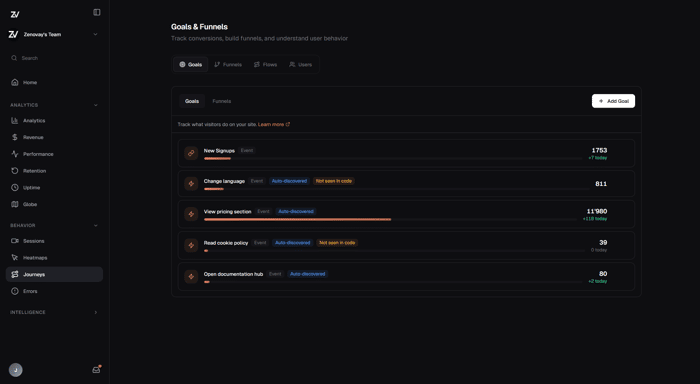
We finally used our own goals and funnels feature to track how visitors actually move through our site. The numbers were a bit of a wake up call.
11980 people viewed the pricing section last month. 1753 signed up. Thats a 14.6% conversion rate from pricing to signup. Sounds okay until you flip it. 85% of people who check pricing leave without converting.
We built two funnels to dig into where the drop off actually happens.
Funnel 1 (homepage to pricing to signup). 24500 visitors hit the homepage, 11980 reached pricing, 1753 created an account. Overall conversion is 7.2%.
Funnel 2 (docs to signup). Only 80 people visited the docs hub but 48 of them signed up. 60% conversion. Tiny group but clearly very high intent.
The pattern is clear. The pricing page is where most traffic dies. We are now testing a simplified layout and adding social proof to see if that changes anything.
This exact headache of finding where users drop off is why we built zenovay. We were tired of complex ga4 setups just to see a basic funnel. Zenovay gives you simple web analytics, automatic funnels and session recordings in one privacy first dashboard.
We are a tiny bootstrapped team with fewer than 20 users right now trying to build an alternative to the massive google monopoly. Its really tough.
We have a free tier that gives you all the core tracking. If any fellow founders want to find their own conversion leaks let me know. Ill happily upgrade your account to the pro plan for a few months for free in exchange for some honest feedback on the tool.
This isnt about self promotion. Its about taking on monopoly power and giving founders a fair simple solution. We are grateful for any feedback.

This is actually a great breakdown thanks for sharing real numbers, not just conclusions.
14.6% from pricing to signup doesn’t look bad at first, but yeah… flipping it to 85% drop-off really changes how you see it.
What stood out to me is the docs funnel. 60% conversion (even on small traffic) usually means those users already understand the value before they see pricing. Maybe the issue isn’t just pricing itself, but that people hitting it from the homepage aren’t fully “sold” yet.
Curious if you’ve tested:
adding clearer value props above the pricing table
or showing a quick “how it works” / use cases before pricing
Also +1 on simplifying analytics. GA4 is honestly overkill for most early-stage founders.
Respect for sharing this openly super useful for anyone building SaaS.
Spot on. We are definitely adding more use cases above the pricing table. The intent gap is real!
Thanks for sharing the actual numbers — this kind of transparency is rare and super valuable. The contrast between your two funnels tells a powerful story. The 60% conversion from docs visitors versus 14.6% from pricing page visitors is a classic intent gap. People who land on docs have already decided they want to use something like your product and are evaluating whether it fits their technical needs. People who land on pricing are still in the consideration phase and might not even understand the value yet. One experiment worth trying: instead of just simplifying the pricing page layout, consider adding an interactive element that lets visitors see their own data before committing. Something like a mini calculator showing estimated insights based on their traffic volume, or a live demo funnel with sample data. The goal is to move the pricing page visitor closer to the intent level of a docs visitor by giving them a taste of the outcome before asking for the commitment. Also, have you looked at where your pricing page traffic is coming from? If most of it is cold traffic from ads or SEO, the 85% drop-off might actually be normal for that traffic temperature. The docs traffic is likely much warmer by nature.
A live demo or calculator is a genius idea. We will test bringing that docs energy straight to the pricing page.
Funnels like this are great at showing where people drop, but they can't tell you why. The 85% who bounce off pricing are the most useful people to hear from, and right now they leave without a word.
One cheap thing that's worked for me: a single-question survey on or right after the pricing page. Something like "what stopped you from signing up today?" with a few options (too expensive, not sure it fits my use case, missing a feature, just browsing) plus an optional text box. Even 30-40 answers usually surfaces a clear pattern, and it turns guessing into knowing.
Then you can fix the actual reason instead of A/B testing in the dark.
Full disclosure, I build a small waitlist, survey and feedback tool for indie founders called Lighthouse, so this is the kind of thing I think about a lot. But any quick form does the job here. The point is just to ask the people who said no.
The 85% drop-off isn’t happening on the pricing page.
It just becomes visible there.
What’s actually happening is:
Users arrive at pricing still trying to answer:
“Do I actually need this?”
Docs visitors convert at 60% because that question is already resolved.
Pricing visitors are still deciding.
So the page is doing two jobs at once:
→ explain the product
→ close the sale
And that’s where it breaks.
We’ve been seeing this pattern a lot -and the biggest lift usually doesn’t come from changing pricing…
…but from removing uncertainty before users get there.
Once someone reaches pricing with clarity, the decision becomes obvious.
Without it, even perfect pricing won’t convert.
Curious: how many of those pricing visitors actually saw a clear “who this is for” before landing there?
That docs-to-signup funnel is the most telling number here. 60% conversion from 80 visitors means the people who take time to understand what you actually do are almost guaranteed to convert. The pricing page visitors are mostly still deciding if they need you at all.
Based on your data, it might be worth testing a short 'how it works' walkthrough or a 30-second video right before the pricing section. If docs visitors convert at 60%, giving pricing visitors even a fraction of that context could move the needle significantly.
yeah cold traffic doesn't know you yet — show them proof before you ask for money. would love to hear how it converts if you run that test
exactly, that's the whole point of having stripe + analytics in one place. right now it's more correlation than causation, but the next step is tagging deploys as events so you can actually see what moved the needle
This is a really useful post because the docs-vs-pricing split gives you a cleaner signal than most founders ever get.
My read: the docs visitors are converting because they already understand the job. The homepage/pricing visitors are still trying to answer "is this for me, and why is this better than my current GA4 + Stripe + Hotjar mess?"
A few experiments I’d run next:
The interesting part here is that this may be less of a pricing-page problem and more of a pre-pricing understanding problem.
If helpful, I do a $1 teardown of SaaS landing pages / pricing flows and would be happy to do one for Zenovay: https://dailo.com.au/?source=external_manual_ih_zenovay_pricingleak_apr15_usd_presell_hv
Wow, incredibly analysis! Thank you
You nailed it: docs visitors already understand the "job to be done," while homepage traffic still needs the "why." We focused too much on layout and missed the messaging gap
We’re definitely going to implement the "why switch" block and test routing users closer to that "aha" moment from the docs. Really appreciate you taking the time!
worthy offering. well done.
Seeing raw funnel data like this is a breath of fresh air. That 60% conversion from your 'Docs' funnel is a huge signal—it means once people understand the 'how,' they are sold.
Since you are fighting the analytics monopoly and looking for real feedback, you should enter Zenovay into the Validation Arena (tokyolore.com).
It’s a 30-day sprint where founders compete to grow their traction.
It’s $19 to enter, and you'll be surrounded by 100+ other builders who all need to fix their own 'conversion leaks.'
The winner takes the grand prize: a trip to Tokyo! 🏆
The timing of this post is almost personal. I have a free tool with decent usage and a $1 paid pack that nobody buys.
I suspect the issue isn't the price — it's that visitors can't immediately see what they get for that $1 vs. the free version. The value gap isn't clear enough.
Did you find that clearer feature comparison helped your conversion, or was it something else entirely?
Got a lot of great insights from the comments. My immediate thought was: 'Is the price tag a bit too steep?'
14.6% pricing-to-signup is actually pretty solid. Our biggest fix was removing the second CTA. Had B2C and B2B on the same hero and visitors with intent were bouncing because the choice created friction. One CTA, one audience.
That 60% conversion from docs is wild. Those people already know what they want, they just need to confirm the tool does it. Pricing page visitors are still shopping around, which explains the gap.
One thing I noticed building my own site: the pricing page drop off wasn't about the price itself, it was about the page answering "why should I pay" instead of "what do I get right now for free." Once I led with the free value and made Pro feel like a natural upgrade, the friction dropped a lot.
For the simplified layout test, I'd focus on reducing the number of decisions on that page. Every toggle, every plan comparison column, every FAQ accordion is a moment where someone thinks "I'll come back later" and never does.
Curious about the session recordings. Do you see people scrolling past certain sections on the pricing page, or do they bounce immediately? That would tell you if it's a messaging problem (they read and leave) or a first impression problem (they don't even engage).
85% drop at pricing usually isn’t a pricing problem, it’s unresolved doubt showing up at the moment of commitment.
The 60% docs conversion proves it, clarity and intent beat traffic every time.
The docs funnel number is the most interesting data point here. 60% vs 14.6% tells you that the people who read technical documentation have already decided they have the problem — they're just validating that your tool solves it. The pricing page catches everyone, including people who are just browsing.
I've seen the same pattern with Valix (a Spanish fiscal ID validation API) — the article I published explaining how to validate NIFs in Python converts much better than the landing page. Someone who lands on a technical guide is already building the thing that needs the validation.
The implication for your pricing page test: it's probably not the layout that's broken, it's that 85% of those visitors don't have the problem yet. Social proof and simplified layout will help the 15% who do — but the bigger lever might be getting more docs-level traffic.
14.6% from pricing to signup is actually not bad — a lot of SaaS products would take that. The more interesting number is the docs funnel (80 visitors to signup). That's a much higher intent audience and presumably converts at a completely different rate. What does that conversion look like?
Pricing page drop-off is usually about three things: wrong audience, unclear value differentiation between plans, or friction in the CTA. What did the funnel data tell you about where exactly people are bouncing? Pricing section to "I need to think about this" vs pricing section to signup flow abandonment are very different problems.
Good point Amanda. We are digging into the session replays right now to see exactly where they abandon the flow.
Session replays will tell you everything. Watch specifically for the scroll depth on the pricing page. If people scroll past the plans without clicking, the value props are not landing. If they click into a plan but drop during checkout, that is a different fix entirely.
One thing I have seen work: tag the replays by traffic source. The behavior of someone coming from a blog post vs someone from a direct ad is completely different. You will find your real conversion rate is being dragged down by one segment.
One thing I'd look at: are visitors arriving at the pricing page with enough context to understand what they're paying for? If they land from an ad or a cold link, 85% bounce is almost expected. The fix isn't always on the pricing page itself — it's in the journey before it. What does the flow look like before someone hits pricing?
Exactly what we are looking at next. The journey needs to build way more context before they even hit the pricing section.
the 60% conversion from docs is the most interesting number here honestly. that tells you something really important — people who take the time to read docs are already sold on the concept, they just want to make sure it actually works. the pricing page visitors are still in "should i even bother" mode. i wonder if adding a link to the docs or a quick interactive demo directly on the pricing page would help bridge that gap. like if someone could see how simple the setup is before committing, you might capture some of that high-intent energy from the docs crowd. appreciate you sharing the raw numbers, this kind of transparency is super helpful for other founders trying to figure out their own funnels
Bridging that gap is the main goal now. Adding a quick interactive demo right there is a solid move.
Hey Zenovay,
Thanks for sharing the raw numbers — 85% drop-off on pricing is brutal but super honest. The contrast between homepage traffic and docs traffic is very interesting.
Good luck with the new pricing layout test.
Would love to try Zenovay if you're still offering free Pro access for feedback.
Absolutely! Just create a free account and use code UNEED100 at the Pro Plan checkout for a free month of Pro.
The pricing page drop-off makes sense when you realize most visitors are in 'comparison mode' — they've just come from a competitor's pricing page and are benchmarking. What I found helpful: knowing when competitors change their pricing, because that often correlates with your own conversion rate changes. If a competitor lowers their price, suddenly your pricing page becomes harder to justify without context.
That makes a lot of sense. Competitor pricing definitely sets the anchor before they even land on our site.
This is exactly why competing in the US/English market is so brutal right now. You're fighting tooth and nail for that 15% conversion rate against massive competitors.
What completely changed the game for me was realizing you don't have to fight that battle. Most of us burn 6 months inventing new apps or optimizing pricing pages for a saturated market.
The real cheat code right now is App Store Geo-Arbitrage.
Find a US app making $10k/mo that only supports English. Scrape the local reviews (French, German, Spanish) to prove demand. You will literally see users begging to pay if it was translated. Then, build the localized clone. Your conversion rate skyrockets because you have zero local competition.
I automated the research part and wrote a full playbook. Since IH doesn't let me post links yet, just search for "Data Scraping Strategy: Finding Underserved App Store" on Devto, or check my Twitter @KazKN. I open-sourced the scraper there.
Don't fight for scraps in English if it gets too tough!
We actually already translated our website into French, German, English, Japanese, Portuguese, and Spanish! The core app is still only in English right now because of how fast things are changing, but full localization inside the app is definitely on our roadmap for the future.
The pricing page drop-off is exactly what I'm dealing with right now. I launched a digital product last week - 130K views across Reddit, 44 Gumroad visits, single digit sales. The traffic isn't the problem, the conversion is. Your docs funnel insight is interesting - 60% conversion from people who read docs means high-intent visitors convert regardless of page design. The pricing page visitors are still in 'browsing' mode. I'm testing adding product screenshots and social proof to my listing right now to see if that moves the needle. Would be curious what changes you see after the simplified layout test
Social proof is huge. Good luck with your Gumroad tests. I will definitely post an update on how our layout changes perform.
Really interesting breakdown — thanks for sharing the raw numbers! That jump from 14.6% on the pricing page to 60% on the docs-to-signup funnel really illustrates how much context and intent matter. It’s easy to assume a page is “fine” until you actually dig in.
I love how you framed this as solving your own problem first — tired of GA4 complexity and just wanting clear insight. That’s something I’ve run into too, trying to figure out why signups stalled, only to realize the tools themselves were part of the headache.
Curious — when you simplified the pricing layout, did you notice any patterns in which social proof elements worked best? Testimonials, numbers, logos, or something else?
Thanks Mobiwolf! Solving our own problem was the only way to stay sane since GA4 was just too much overhead. Regarding the social proof we are seeing that a mix of real usage numbers and recognizable company logos performs the absolute best. Visitors usually just scan the pricing page so raw data and seeing legitimate businesses already on board builds trust much faster than reading long paragraphs of testimonials.
Makes perfect sense. Raw data and logos cut through the noise instantly—they're basically a visual 'shortcut' to trust that long-form testimonials just can't match. It's a great reminder that even in B2B, the best UX is the one that respects the user's time. Good luck with the continued growth!
The 1753 signups vs fewer than 20 active users is the number I'd focus on before touching the pricing page. That's roughly a 1% activation rate. If people sign up and don't activate, redesigning the page to get more signups just moves the bottleneck downstream. What does your onboarding look like between signup and first meaningful action? That gap is usually where the real conversion problem lives.
You hit the nail on the head. Activation is our next massive bottleneck. Our onboarding flow looks like this: the user signs up, enters their name, and adds their domain. Right after that comes our biggest dropoff which is installing the actual tracking script on their website. Once they get past that they can optionally connect their Stripe account to track revenue attribution and then they are fully finished. We are actively brainstorming ways to make that script installation completely frictionless because that is definitely where we are losing them.
the docs->signup 60% number is the real story here. anyone who lands on docs is already self-selecting as high intent. we had the same pattern - pricing page is where tire-kickers fall off, docs is where buyers show up. maybe lean into sending traffic straight to a "how it works" technical page instead of pricing first?
Sending them straight to a technical overview is a great test idea. We might try routing cold traffic there first.
yeah exactly, cold traffic to technical overview is a solid move. way better than hitting them with pricing before they even get what the thing does
The docs-to-signup funnel at 60% is the real signal hiding inside the 14.6% headline. Small volume, high intent, that's not a traffic problem, it's a qualification problem. The pricing page doesn't kill conversion. It just reveals which visitors were never buyers to begin with.
1753 signups last month with fewer than 20 active users. that gap is the real number to fix. what does your signup-to-activated look like, and how are you defining activated?
Thanks RirVC! We define an activated user as someone who successfully installs our tracking script and views their first heatmap or session replay. Our flow is pretty straightforward: signup, enter name, add domain, install the script, and optionally connect Stripe. The massive gap comes entirely from the friction of getting them to actually embed that script on their website.
Something a little bit tangential to your op. How do you know your landing page is working? Are you experimenting with copy, layout etc? Your conversion rates aren’t anything to be scoffed at. If you only have 20 users and seeing a 14% conversion rate that’s a great start. I own a small start up and we have only 4% click through to free trial and then even less to paid users.
This is an area we are actively working on to fix the funnel. Currently we are using post hog for analytics.
We rely heavily on our own visual heatmaps and session replays to see exactly where visitors hesitate or stop scrolling. We are constantly experimenting with the headline copy and the placement of our demo video. A 14 percent conversion is solid but having a completely free tier definitely helps pad that number compared to a strict paid trial. Keep pushing on your funnel!
14.6% pricing-to-signup is actually not bad depending on your traffic source and price point — the real question is what's killing the other 85%. A few things worth testing: adding a free trial CTA on the pricing page itself, an exit-intent prompt with a lower-commitment offer, and a single line of social proof right above the buy button. The drop from homepage to pricing (49%) is also worth attention — that might be a positioning problem more than a pricing one.
Those are fantastic suggestions Amanda. We actually operate on a freemium model so highlighting the free tier directly on the pricing page is our next big test. We will definitely look into an exit intent popup and adding a single strong line of social proof right above the button. You are totally right that the homepage to pricing drop suggests a positioning issue we need to tackle upstream.
Freemium changes the math here. If the free tier is good enough, the pricing page becomes less about convincing and more about showing the upgrade gap. That makes the social proof placement even more important because you need one line that says "here is what you are missing" not "here is why you should buy."
The positioning fix upstream is the bigger win though. If people land on pricing confused about what the product actually does, no amount of CTA optimization will save the conversion.
The docs vs. homepage conversion gap is the real signal here. Docs visitors already know they have the problem — pricing is just confirmation. Cold homepage traffic is a completely different population.
For Scoutivex (B2C SaaS for Vinted resellers), our biggest single-step lift on trial signup had nothing to do with pricing copy or plan structure. It was removing a mandatory phone verification step from the trial flow that we'd added "for fraud prevention." Turned out it was blocking ~30% of people mid-funnel who didn't have their phone handy or didn't want to give it. Removed it, made it optional in settings. Trial starts went up immediately.
The lesson: before testing what's on the pricing page, audit what happens after they click the CTA. Friction post-click kills conversion just as badly as a confusing pricing table pre-click.
That phone verification story is a perfect example of how post click friction ruins everything! We audited our flow and realized the tracking script installation is our version of that exact barrier. We are looking into ways to let users explore a populated demo dashboard immediately after signup so they see the value before doing the hard work of touching their code.
That docs conversion is the interesting part.
Feels like it’s less about pricing being “bad” and more about intent. People hitting docs already know what they’re looking for, so pricing is just confirmation. Homepage traffic is much colder.
We’ve seen something similar where the biggest lift didn’t come from changing pricing, but from filtering who actually reaches it.
One thing that helped was tightening the messaging before pricing so fewer low-intent users got there in the first place.
Are you testing anything upstream of the pricing page, or focusing mainly on the page itself?
We are definitely starting to look upstream Rebecca. Filtering out low intent users by tightening our homepage messaging is a huge priority for us right now. If we can warm them up properly and explain the core value before they ever hit the pricing tab we think that 85 percent bounce rate will shrink significantly.
Yeah that makes sense.
If the core value isn’t clear before pricing, people end up using the pricing page to figure it out, which is where things break.
Once they already understand it, pricing becomes a confirmation rather than a decision point.
The docs to signup funnel at 60% vs pricing to signup at 14.6% tells you something important. People who read the docs already understand the product. People who land on pricing are still deciding if they understand it.
That gap usually means the pricing page is being asked to do two jobs at once: explain the product and close the sale. Most visitors arriving at pricing have not had their core question answered yet, which is "is this actually for me."
The 85% drop makes more sense when you think about it that way. It is probably not the layout or the price. It is that most of those 11,980 people were not ready to make a decision yet because they did not have enough context.
One thing worth testing before redesigning the page: look at where those 11,980 people came from right before hitting pricing. If most of them skipped the feature pages or came straight from an ad, the problem is the journey, not the destination. Adding a short "who this is for" section above the pricing tiers might do more than social proof.
The docs funnel converting at 60% is a strong signal. It means your product sells itself once people understand it. The challenge is getting more people to that level of understanding before they see a price.
You absolutely nailed the analysis. Asking the pricing page to both explain the tool and close the sale is way too much friction. We are digging into our referral sources now to see if people are skipping the feature pages entirely. Adding a clear section about exactly who this tool is built for right above the pricing tiers is a brilliant idea that we are going to implement.
Good call on looking at the referrals first. One thing that usually jumps out when you run that analysis is the gap between visitors who touched at least one feature page before pricing and those who went directly from homepage or ad to pricing. The second group almost always has a bounce rate that is double the first. If you see that split in your data, it tells you exactly where to add the "who this is for" moment, because you are not trying to warm up everyone, just the segment that skipped the warmup.
The other thing worth checking while you are in there is time on page for the pricing bouncers. Under 10 seconds usually means they took one look and knew it was not for them, which is actually fine and probably unfixable. 30 to 90 seconds means they read it, considered it, and still walked. Those are the ones your upstream messaging fix will actually recover.