Auditing Loyalty and Business Benefits Programs with ACHIVX
Loyalty and benefits programs can lift revenue and retention, yet many fail to pay back once reward costs, technology, and operations are included. An audit is the fastest way to determine whether the program adds profit, how it affects lifetime value, and whether liabilities are measured correctly. This rewrite focuses on how an open-source, event‑driven approach like ACHIVX strengthens the audit process. Rather than treating loyalty as a black box, ACHIVX exposes the full chain from customer actions to points issuance, redemption, and accounting entries. Finance and data teams gain a verifiable ledger, reproducible rules, and the ability to model outcomes with realistic numbers. Achivx is available on GitHub.
Data and Methods
The examples below use a stylized mid‑market e‑commerce business. The base case assumes 100,000 active customers, two orders per year, an average order value of 60 dollars, and a gross margin of 40 percent. A loyalty program enrolls 60 percent of customers. When members are active, their annual revenue is 15 percent higher than comparable non‑members. Net reward cost equals 3 percent of member revenue after procurement savings and expected breakage. Annual program operating expense is 150,000 dollars. Lifetime value is estimated from contribution margin and churn using a steady‑state approach. Breakage and liability examples assume long‑run redemption of 67.5 percent. These inputs are not prescriptions; they are reference points a finance team can replace with its own data. No formulas are shown; all interim results are expressed directly.
What ACHIVX Is
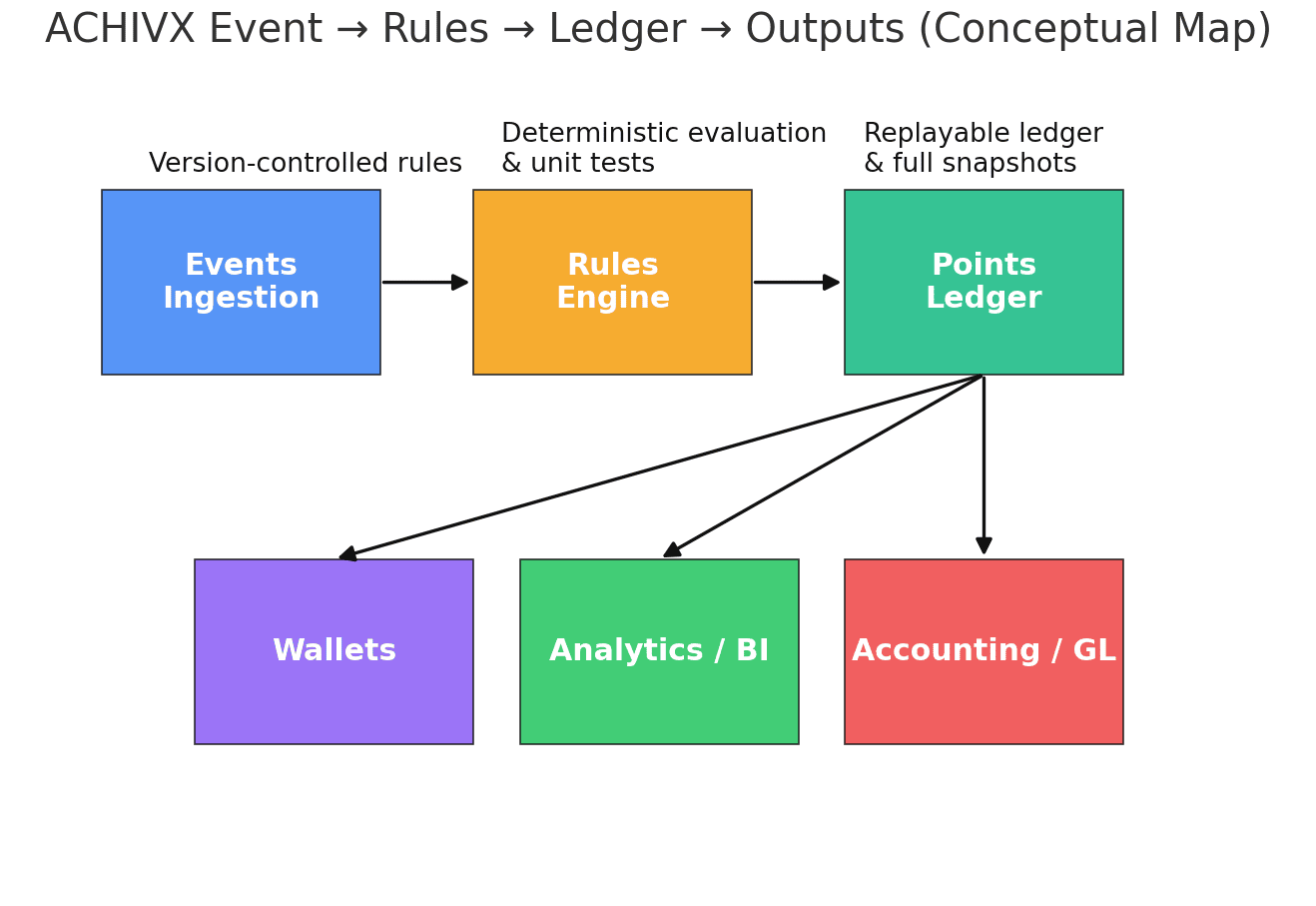
ACHIVX is an open‑source reward system designed around events, rules, and a points ledger. Customer actions—purchases, referrals, reviews, onboarding steps, or custom events—arrive as timestamped records. A rules engine evaluates those events and writes point credits or debits to a ledger that maintains balances over time. Because the logic is transparent and version‑controlled, an auditor can trace any balance movement back to the specific event and rule version that produced it. This matters for profit analysis, because every data point required for revenue uplift, reward cost, and liability can be recomputed from first principles. It also matters for controls, because the same event stream can be replayed to verify that policy changes behaved as intended.
Revenue and Profit Impact with ACHIVX
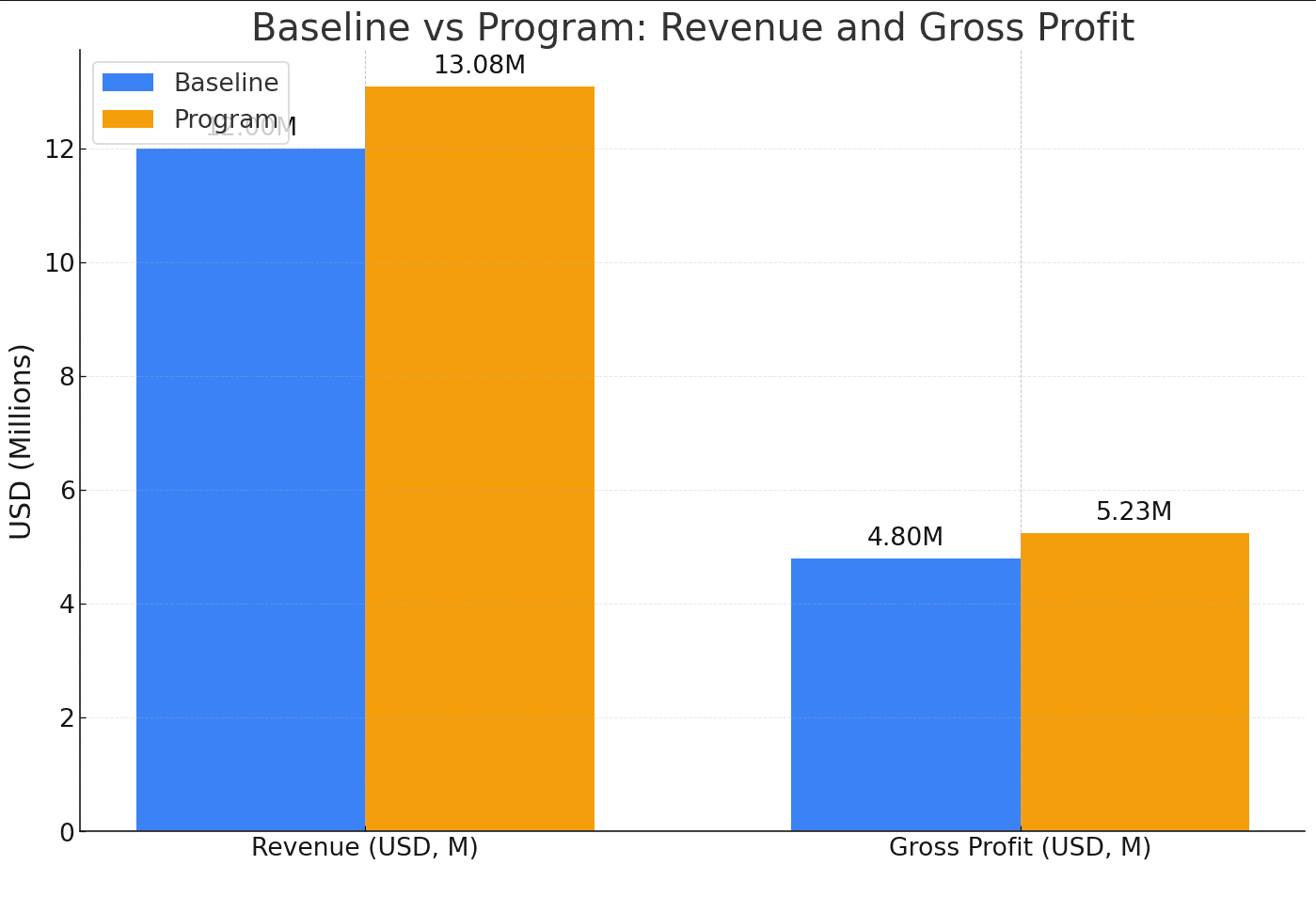
Using the base inputs, the business without a program generates 12.0 million dollars of revenue and 4.8 million dollars of gross profit in a year. Introducing the program shifts member behavior. With 60,000 members and a 15 percent spend uplift, member revenue rises while non‑member revenue remains unchanged. The combined total reaches 13.08 million dollars. The uplift is 1.08 million dollars, or 9 percent year over year on the original base.
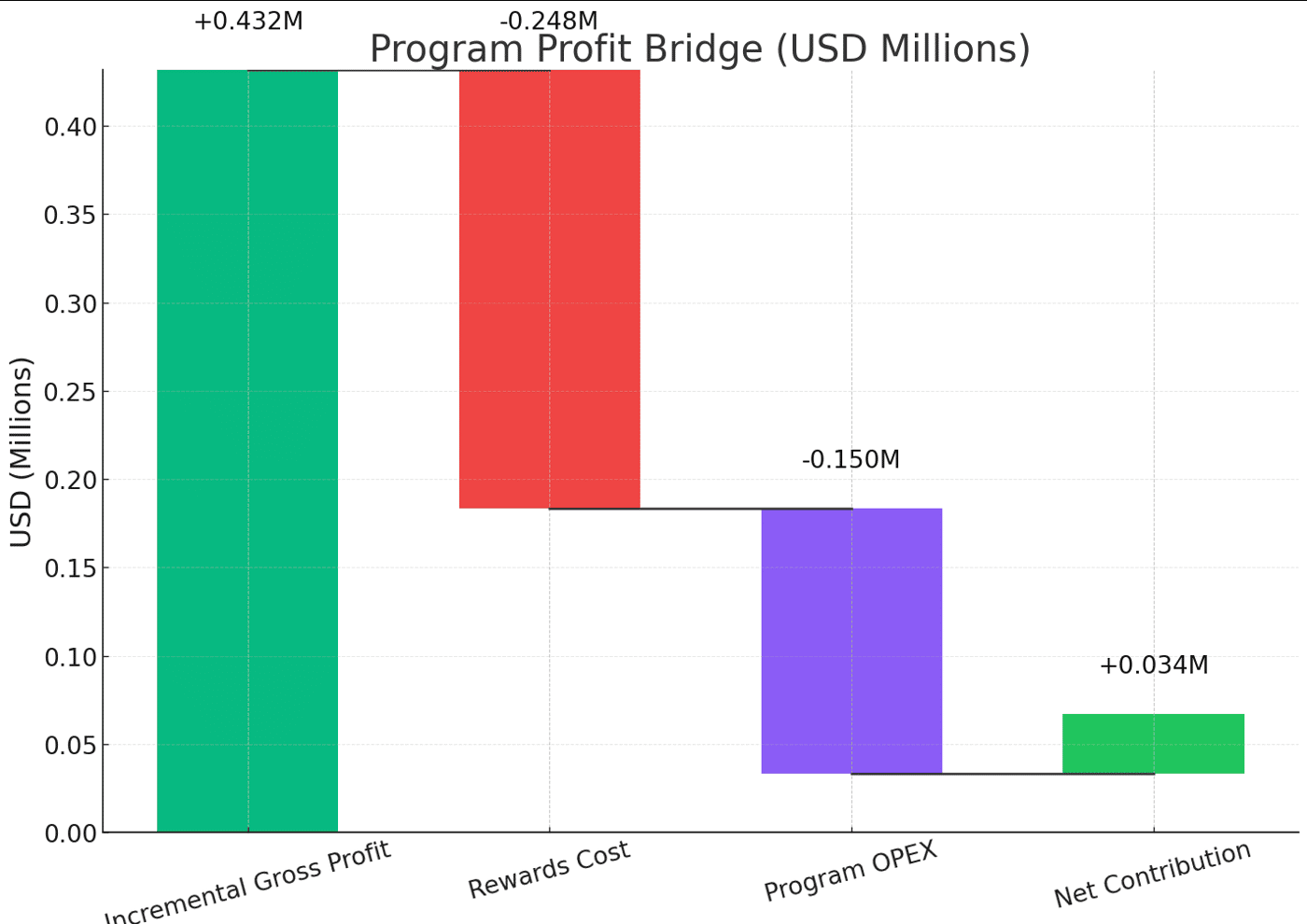
Profitability depends on more than top‑line growth. At a 40 percent margin, the uplift yields 432,000 dollars of incremental gross profit. Reward cost on member revenue is 248,400 dollars. Operating expense is 150,000 dollars. The net contribution is positive but slim at 33,600 dollars. In many audits, this is the moment where confidence falters. ACHIVX helps by turning this single point estimate into a distribution. Because events, rules, and costs are explicit, a team can run counterfactuals for alternative earn rates, different redemption values, or revised action incentives, then observe how the net contribution changes. A small change in earn value or a shift toward more profitable actions can move the program from marginal to clearly accretive.
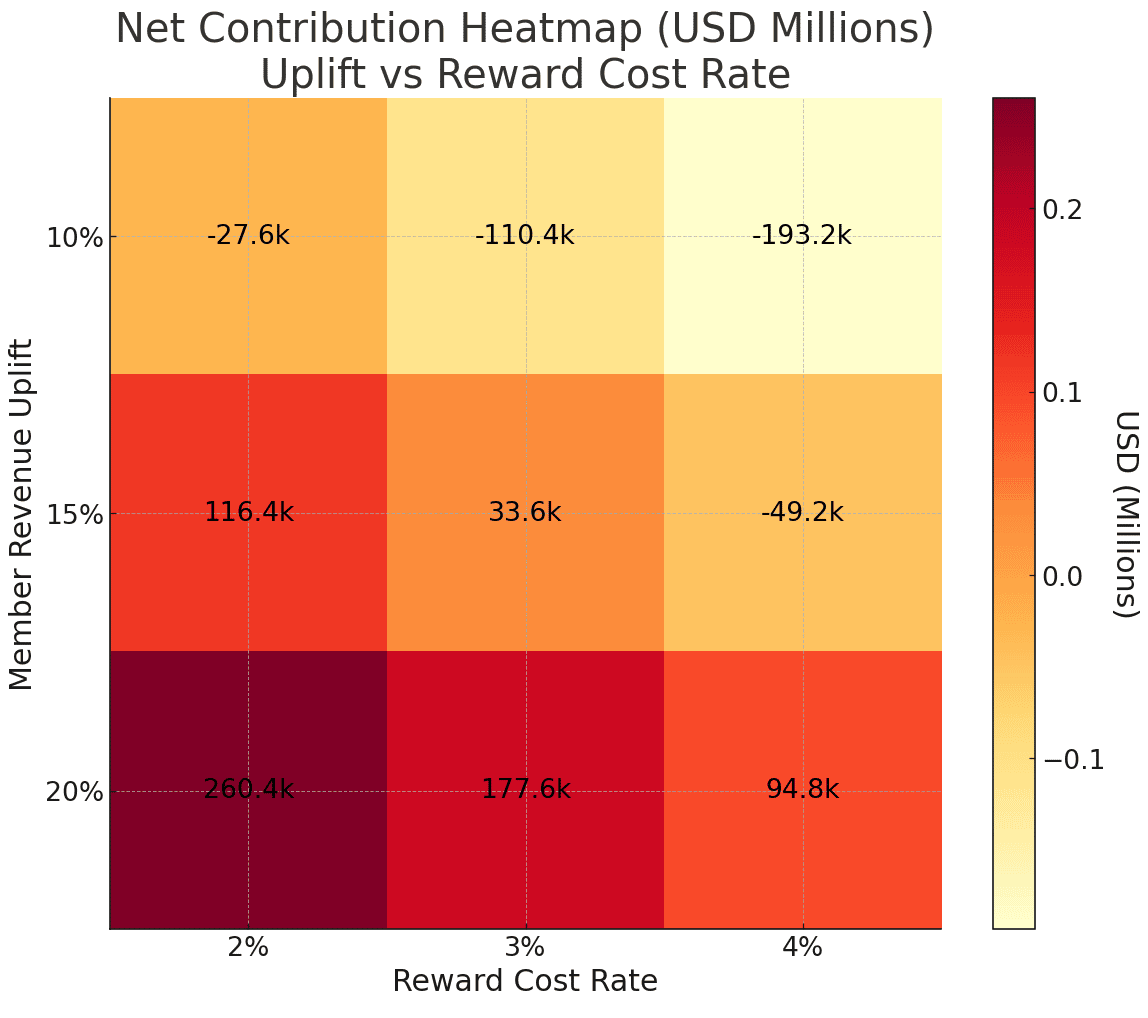
For example, if member uplift rises to 20 percent while costs hold, net contribution increases to 177,600 dollars. If uplift falls to 10 percent, the program turns loss‑making at approximately negative 110,400 dollars. These are not theoretical scenarios when the underlying engine is fully testable.Effect on LTV and Acquisition Efficiency
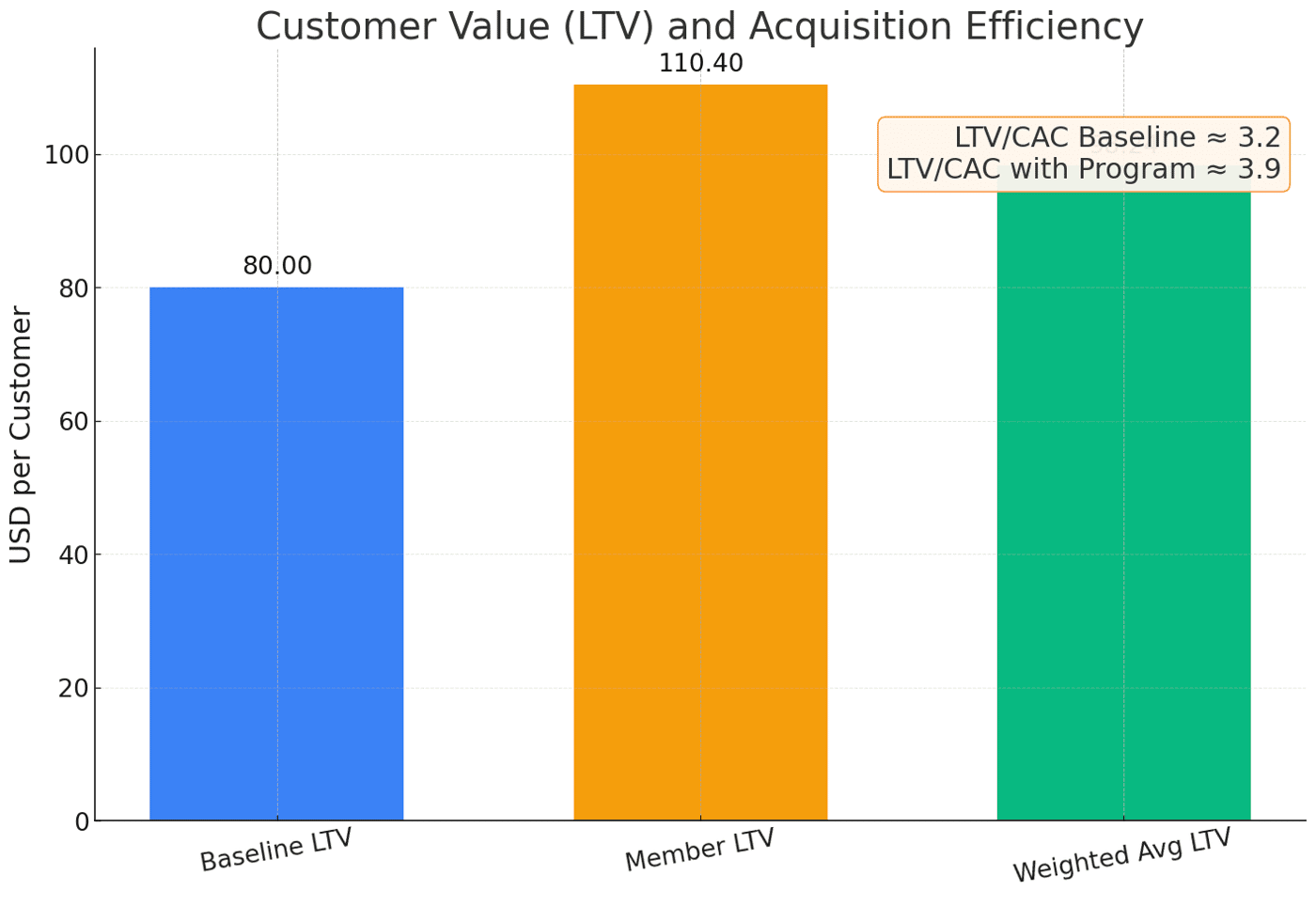
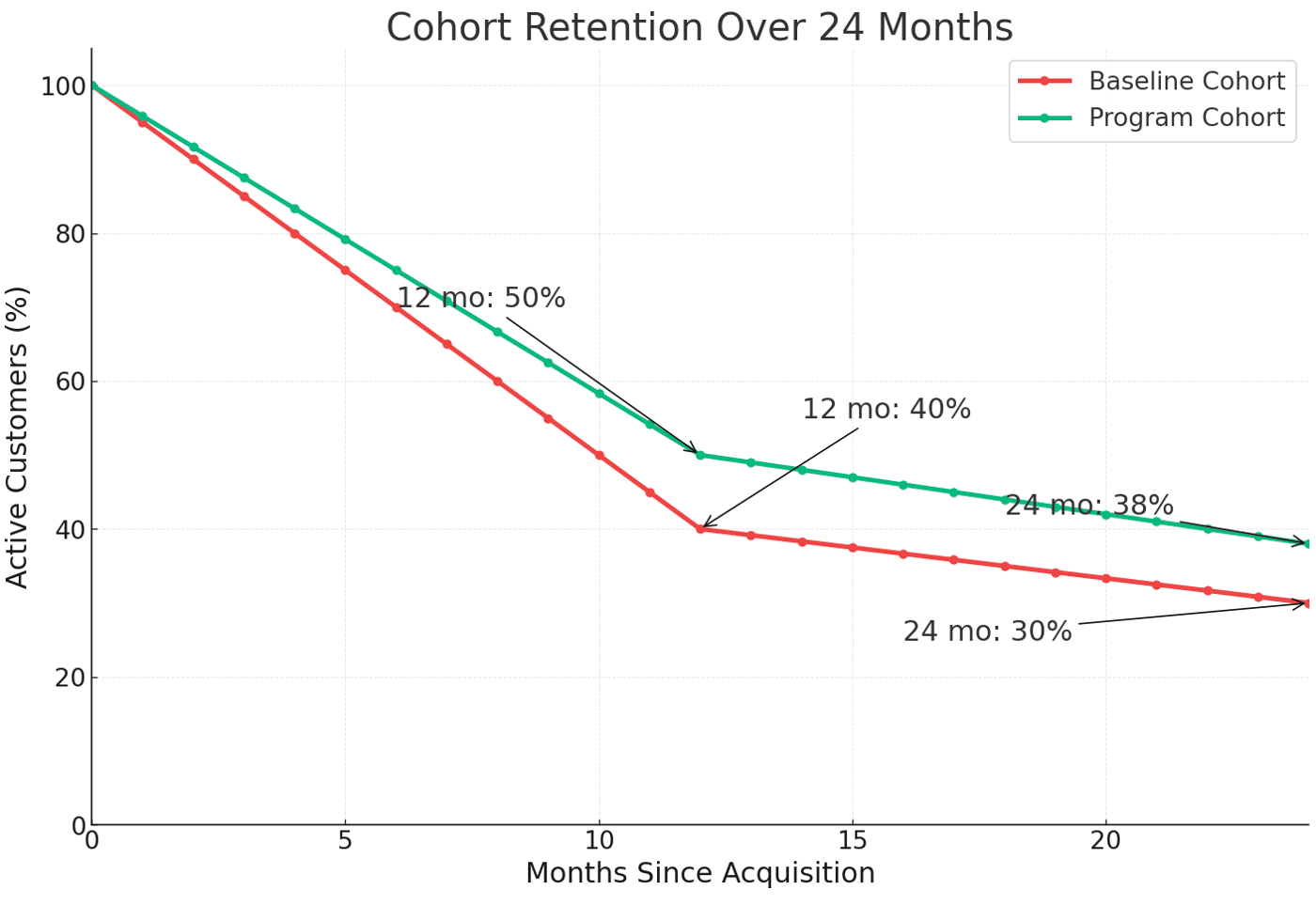
Lifetime value is the strategic lens. In the base case, the average customer produces contribution margin of 48 dollars per year. With churn at 60 percent, the implied steady‑state value is about 80 dollars. Members whose behavior improves under the program generate roughly 55 dollars of annual contribution and churn at 50 percent, which raises their value to about 110 dollars. Because 60 percent of customers are members and 40 percent are not, the weighted average value for the business rises to about 98 dollars. If acquisition cost is 25 dollars and remains steady, the ratio of lifetime value to acquisition cost improves from 3.2 to roughly 3.9. Even when current‑year profit looks thin, this structural improvement supports healthier growth spending. ACHIVX strengthens this analysis by letting the team compute value at the cohort level. A cohort that joined under Rule Set A can be compared directly to a later cohort under Rule Set B, with differences in retention and contribution observed month by month.
Liability, Breakage, and Cash Flow Transparency
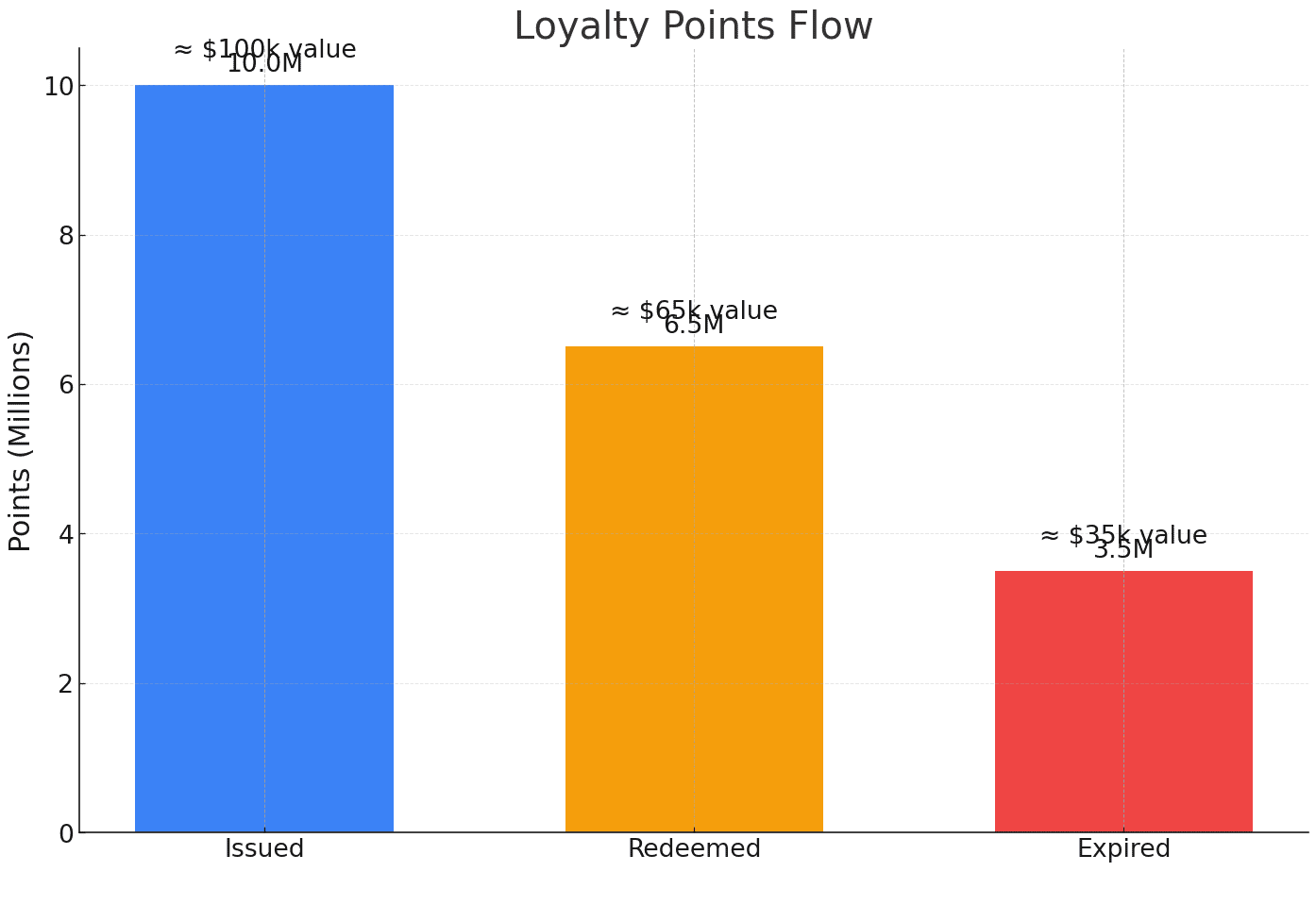
Points and benefits carry accounting consequences. When customers earn a right to future goods or services, part of the original sale is deferred as a contract liability and released when the benefit is redeemed or expires. The challenge is estimating the stand‑alone selling price of points and the expected redemption rate. With ACHIVX, the inputs to those estimates are not guesswork. The ledger exposes every point issued, redeemed, and expired with timestamps and action types. If the business issues ten million points with a nominal customer value of one cent each, the face amount is one hundred thousand dollars. If long‑run redemption is expected at 67.5 percent, the initial liability for that issuance is sixty‑seven thousand five hundred dollars. As redemptions occur, the ledger reduces the liability and records reward cost. As expiries occur, the remaining liability is released to revenue. Because all flows are event‑level, finance can reconcile operational counts to general ledger entries without relying on opaque vendor summaries.
Action‑Based Mechanics and Measurable ROI
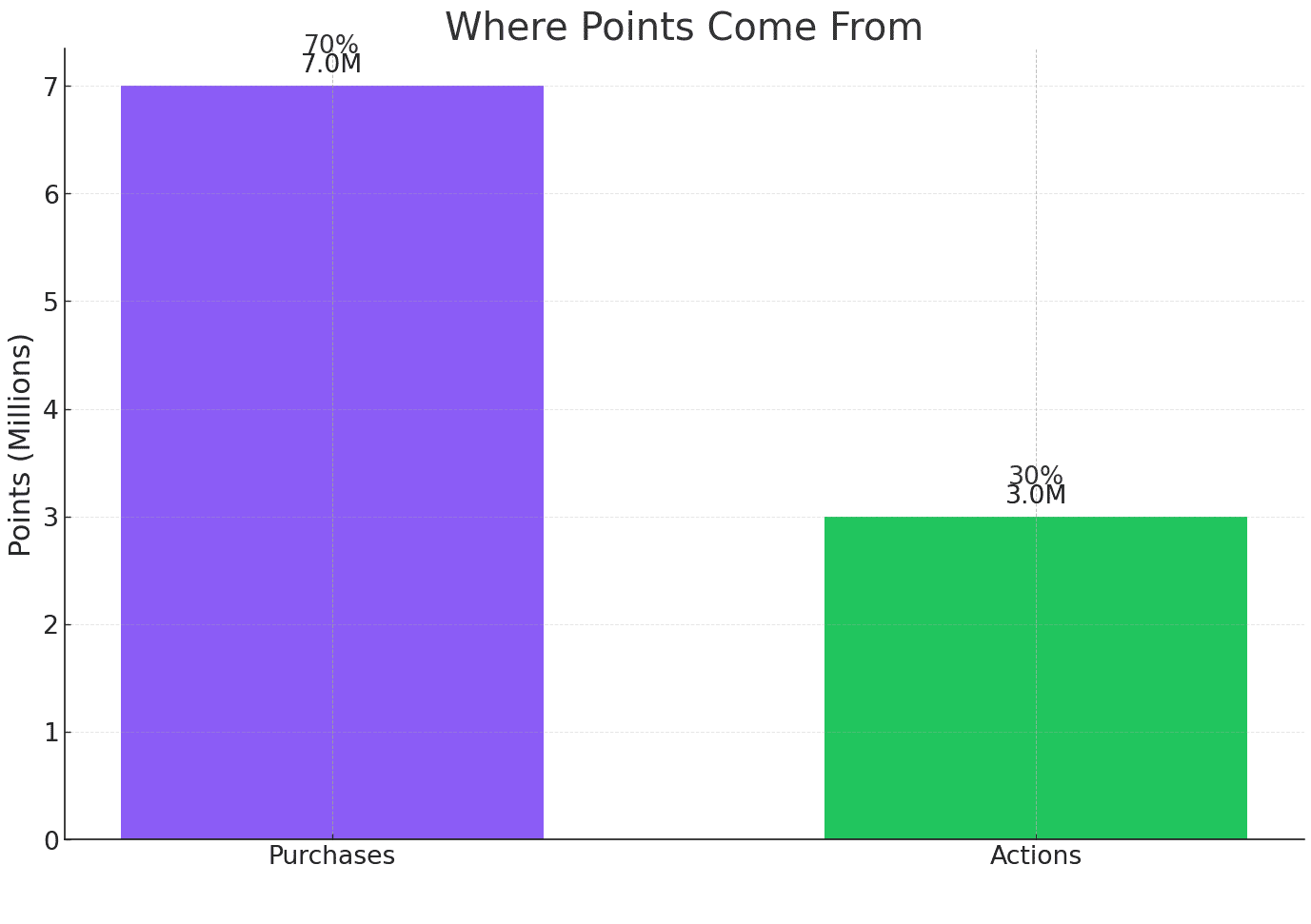
Programs that reward only spend tend to stagnate. Action‑based mechanics—referrals, reviews, content creation, education—can deepen engagement at lower cost if they lead to measurable commercial outcomes. ACHIVX treats actions as first‑class events, so their economics are as analyzable as purchases. Suppose that 70 percent of points in a year are issued on purchases and 30 percent on actions. If five thousand customers send referral invitations and ten percent of those invitations convert into first purchases, five hundred referred customers are added to the base. With an average customer value near 98 dollars, those customers represent roughly 49,000 dollars of value. If the combined reward for a successful referral costs 12 dollars, the total reward cost is 6,000 dollars, leaving a net contribution near 43,000 dollars before considering paid media that may have been displaced. Because every referral event and outcome is logged, the team can check conversion by channel, device, or geography, then shift rewards toward the highest‑return segments.
Implementation Patterns That Support an Audit
ACHIVX works best when it is wired into the analytics stack. The event stream should flow to the warehouse in near‑real time. The rules repository should be version‑controlled, with peer review and documented change tickets for any adjustment to earn or burn values. The points ledger should support full snapshots and a method for recalculating balances from raw events. In an audit, these features make it possible to reconstruct the program state at any date, verify that totals match, and demonstrate that no points were created or destroyed outside the rules. The same integration also accelerates experimentation. A team can stage a new ruleset for a subset of users, collect results for several weeks, and compare revenue, cost, liability, and retention against a control group without waiting for a quarterly vendor release.
Risks and How ACHIVX Mitigates Them
Selection bias is a perennial problem. High‑value customers are more likely to enroll and stay, which can make any program look successful even when incentives add little. ACHIVX reduces this risk by enabling cohort‑based and control‑group analysis at the event level. Over‑redemption risk is another concern. If earn values are too rich or rewards too cash‑like, costs spike. Because rules are explicit, finance can run ex‑ante cost projections under different redemption assumptions and set guardrails, such as monthly caps for susceptible actions. Fraud and gaming also matter. ACHIVX’s event semantics let teams require provenance for actions such as reviews or referrals and reject suspicious patterns, which keeps liabilities and costs aligned with genuine behavior. Finally, change management can be risky. A poorly reviewed rules change can create large, unintended point grants. Version control and required approvals reduce this exposure, and the ability to replay events ensures that errors can be detected and corrected.
What This Means for P&L
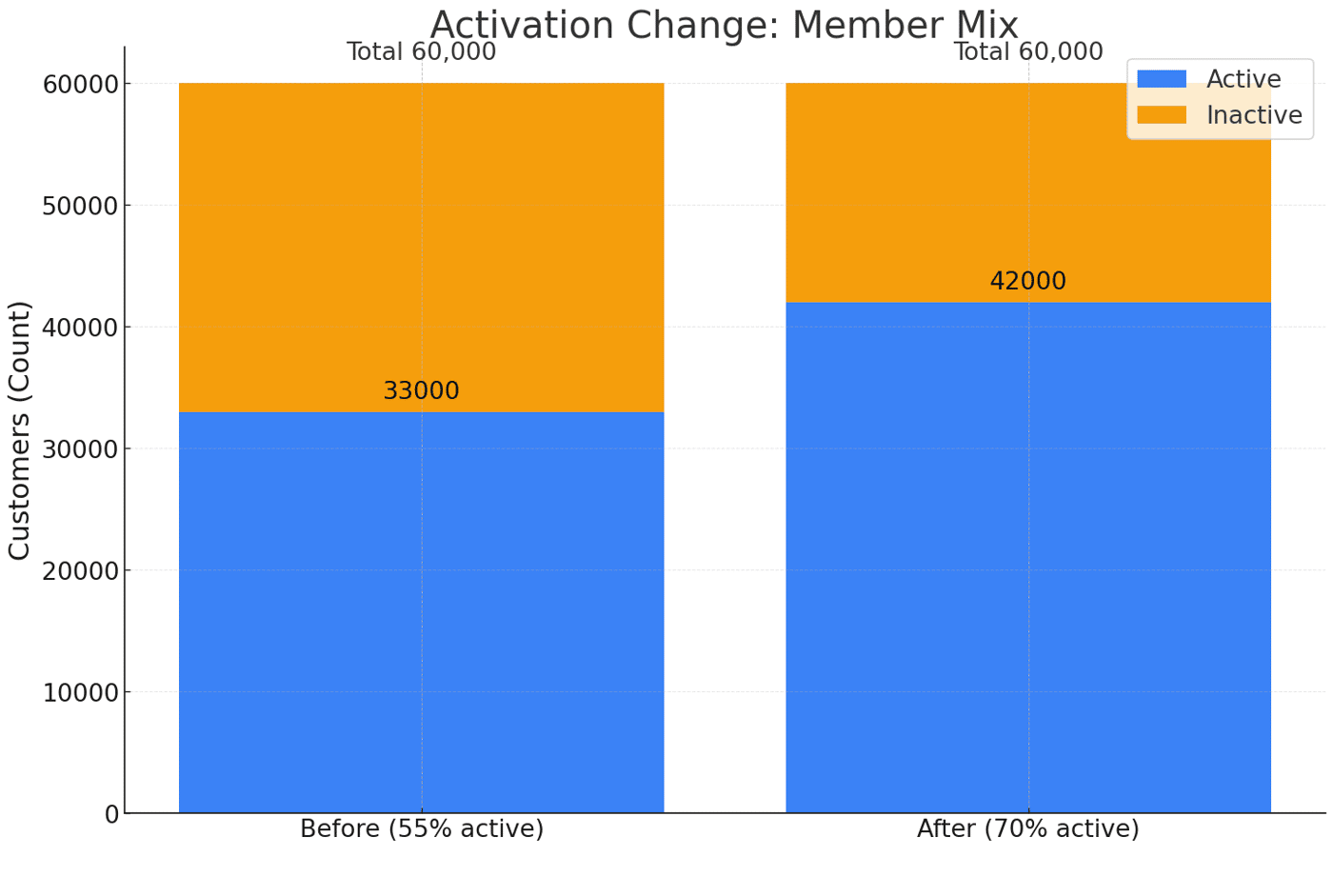
The base case shows a small positive contribution of 33,600 dollars in the first year. That number is not the verdict; it is a starting point. The engine behind ACHIVX turns each element of the profit bridge into a lever. Earn values can be tuned by category margin rather than uniformly. Redemption values can be differentiated so cash‑equivalent rewards are less generous than brand‑building rewards. Action incentives can be moved toward behaviors with demonstrable downstream value. Activation matters as well. If only 55 percent of members are active in a typical year, shifting that share to 70 percent adds nine thousand active customers. If each additionally active member contributes only 15 dollars of extra gross profit annually, the change is worth about 135,000 dollars—more than quadruple the base net contribution—before considering any changes to earn or burn.
Summary
A loyalty program is a financial instrument as much as a marketing tactic. To manage it well, a team needs verifiable data, reproducible logic, and the freedom to experiment without losing control. ACHIVX offers a practical foundation for that discipline. By recording every action, applying transparent rules, and maintaining an auditable ledger, it gives finance and data teams the tools to test assumptions, quantify impact, and keep liabilities accurate. The result is not guaranteed profit, but it is a program that can be steered with confidence: one where a small adjustment to earn rates, redemption values, or action incentives can be evaluated quickly, and where the organization knows, in numbers rather than opinions, whether the program is helping or hurting the business.

