Bootstrapping to 7 figures while competing with best-in-class
tools

After falling into the startup world, Geoff Roberts teamed up with a former employer to build a solution to tool sprawl in small, recurring-revenue businesses.
Since it was an amibitious project, he and his cofounders committed from the get-go to work on Outseta for fifteen years. Now, they're nine years and seven figures in.
Here's Geoff on how he's doing it. 👇
Accidentally getting into startups
I accidentally found my way into the world of tech startups. I went to college to major in writing, but when I graduated in 2008, the economy tanked, and prospects for professional writing or blogging didn't look good. So, I got an MBA and was eventually hired by an early-stage startup in Boston called Buildium.
This didn't sound exciting to me, but I needed a job — and, little did I know, I was walking into a great situation. I was employee #7 at Buildium. Most of the team were engineers, and the company had found product-market fit. They hired me as the first full-time marketer and gave me a ton of freedom to figure out how to grow the business. During my five years leading marketing at Buildium, we grew the company from a startup to $20M in annual revenue; they sold Buildium a few years later for $580M.
Dimitris Georgakopoulos, one of Buildium's cofounders, then became my cofounder at Outseta. Reflecting on all the software tools we cobbled together to support an early-stage SaaS business at Buildium, we recognized that nearly all SaaS companies cobbled together a tech stack of payment tools, authentication, CRM, email, and help-desk software. Everyone needed these tools, yet everyone reinvented the wheel — integrating tools instead of building software incurred a real-time cost. So we set out to address that. Our goal was to deliver all the core software infrastructure needed to launch and grow an early-stage SaaS company. Think "Shopify for SaaS."
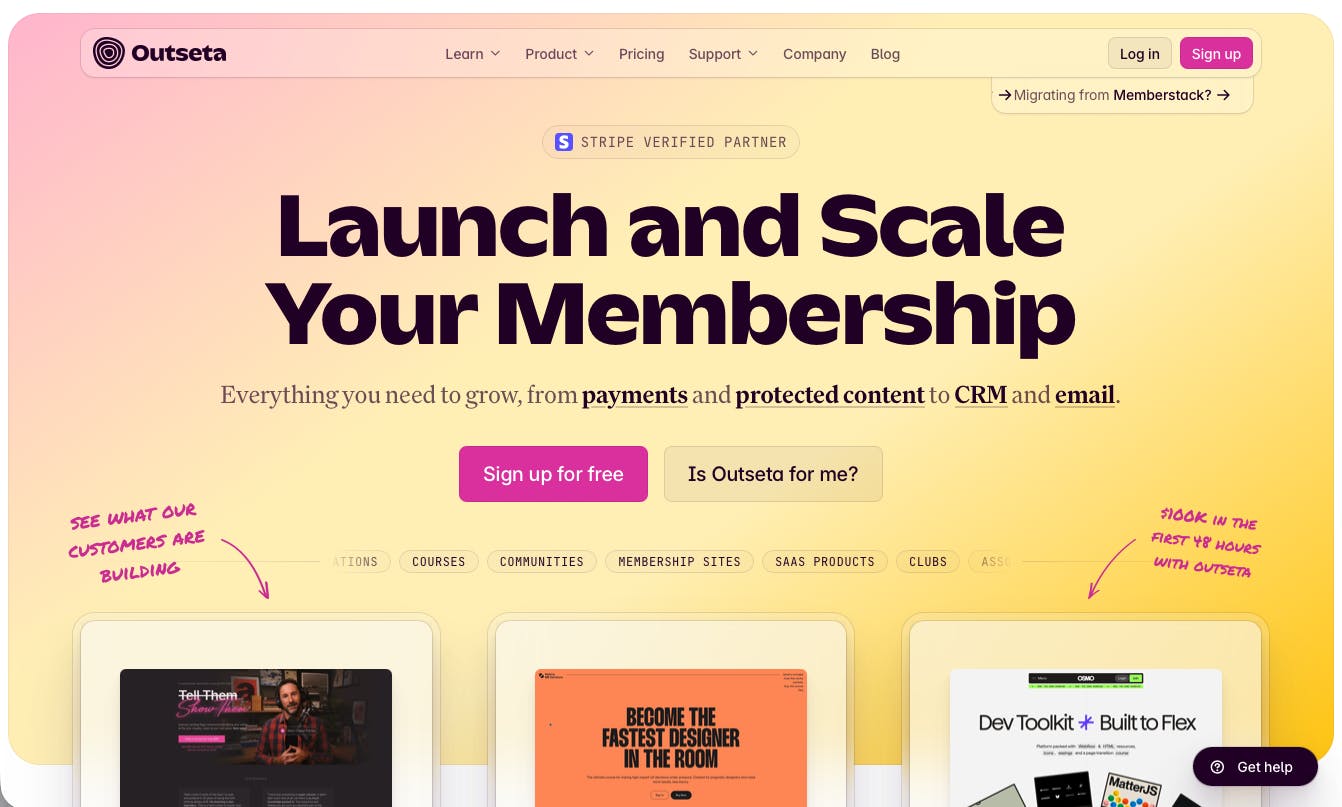
We've worked on that for the last nine years, and our business has expanded to support use cases ranging from SaaS products to membership sites to online courses. Outseta can build any recurring-revenue business where customers pay for access to software, content, or tools.
We don't share revenue publicly, but we are a low 7-figure business.
Long-term bootstrapping
Outseta is a hugely ambitious software product — it's really more like five software tools than one — and we decided to bootstrap it. We knew delivering something "good enough" would take a long time, and we set out to build this business with a 15-year timeline.
After three years of effort, we were only at around $1500 in MRR. Around this time, a global pandemic hit, my wife and I lost our primary sources of income, and we also found out we were unexpectedly having twins. At this point, almost any reasonable person would have quit.
But our team believed an integrated solution was better, and we believed the need for our tools was "durable," so we kept at it. As the product improved, we eventually hit an inflection point. And nine years into this now, I'm happy I continued, despite our lean early years.
Learning from best-in-class software
Outseta offers nothing particularly unique — payments, authentication, CRM, email, and help desk tools are all well-known software categories. Outseta's differentiator is that it uniquely brings these tools together in a single platform, so our customers spend less time wrestling with their business's software infrastructure.
We started building the initial product by meeting one day in Boston and examining all the best-in-class software tools across these categories. We drew inspiration from Chargebee, HubSpot, Intercom, Zendesk, Mailchimp, Auth0, ChartMogul — too many tools to mention here. We extracted the parts we liked and left the "fluff" at the door, while also specifically looking for ways these tools could be more powerful if they communicated without custom-built integrations. Our product today offers countless examples of this.
Then, we started building — email, payments, authentication, CRM, and help desk — roughly in that order. We built it with .NET for the backend and Angular/React for the frontend. We host the product on AWS. And we run the business on Outseta — we were our own first customer.
It took about two years to deliver an MVP that was "good enough" to win business across these feature sets.
Aligning interests
Our business model is simple — we charge a combination of subscription and payment processing fees.
We want our software to be accessible to early-stage companies, so we give all of our tools away at an artificially low rate. For $37/mo, you access payments, auth, CRM, email, and help desk tools that would cost many multiples of that if you cobbled together a tech stack on comparable point solutions.
This gets us "in the door" — then we only grow when our customers grow by taking a 1% fee on successfully processed payments. This aligns our interests with our customers nicely.
Search and integration partnerships
We've grown primarily through search, content marketing, and integration partnerships.
Regarding search, a challenge is that the core software categories we compete in — payments, CRM, email, etc. — are so competitive that it's not worth targeting any of those keywords directly. We're never going to outrank Hubspot for CRM, Stripe for payments, or Mailchimp for email. It's just not happening. So we've leaned into "membership software" as the best-fit, well-understood software category, even though it doesn't perfectly describe what we do.
For content marketing, I primarily write about my entrepreneurial experience as a founder. You can find much of that writing on our blog. I view this as an investment in our brand, but since our audience also tends to be other founders, it directly contributes to new customer acquisition. That's really fun for me — this interview is a perfect example.
For integration partnerships, Outseta is a "headless" business or membership management tool that integrates with almost any website builder or development framework. As a result, we integrate with many tools. Webflow, Framer, Squarespace, Stripe, Notion, Discord, and Circle have all been important to our growth, in addition to code-based integration examples.
The problem with selling to small businesses
We've had our challenges, and almost all of them tie back to:
The size and scope of what we decided to build as a bootstrapped team.
Selling to early-stage businesses.
Regarding #1, we knew we would face longer timelines because we wanted to stay small and independent — but we truly meant our commitment to devote the next 15+ years to building this business.
As for #2, selling to small businesses means we have relatively high churn rates, and customers primarily churn because they close their businesses. This creates a perpetual headwind for growth, and we've needed to learn to account for it — i.e., we must keep customer acquisition costs extremely low, as this drags down customer lifetime value.
Ultimately, I would not recommend selling to startups! All common advice on this topic is correct — focus on customer segments that are more stable and have more budget.
A game-changing organizational model
Outseta's organizational model is our biggest advantage — it's also a major reason our cofounding team decided to work together. We wanted to show that a small, experienced team could compete with much larger companies with the right incentive structure and organizational design.
We called this our "Build your own adventure compensation model." The basics are simple:
We operate Outseta without hierarchy.
Everyone receives the same pay — a full-time Outseta salary is $210,000 per year.
Everyone can choose to work 1 to 5 days per week.
Everyone can also elect to work a portion of their time for equity in the business, and everyone earns equity at the same rate and terms as the founders.
Everyone at Outseta today owns a material portion of the business, ranging from 2% to 29%. This model is not for everyone, but it has been insanely effective at aligning our team, allowing everyone to work autonomously, and creating a pretty crazy inbound recruiting pipeline when we need to hire.
Three things you need to hear
First, more indie hackers should consider building projects in pre-existing markets. Doing so greatly de-risks things and almost guarantees some level of success if you stick with it long enough — because buyers exist!
Second, the market you're in will dictate your growth more than anything else — so choose wisely. In a good market, everything feels easy. In a tough market, you can execute fantastically well, and everything still feels hard.
Third, I advocate for a framework relevant to SaaS growth that Mark Roberge (Hubspot's first CRO) shared with me — he calls it Customer Success, Unit Economics, then Growth. The idea is simple:
Figure out how to make customers successful with your product by any means necessary; it doesn't have to be cost-effective or scalable.
Only once you've done so, figure out how to make it cost-effective (unit economics).
And only once you've done that, focus on growth.
This may sound obvious, but almost everyone launches an MVP and then immediately focuses on growth. Almost every problem in SaaS ties back to this.
What's next?
My goals are to have a great relationship with my family and friends, and to have as much fun as possible. I believe in fun as a KPI — you may have $100M in revenue, but if I'm having more fun, who is really winning?
An enjoyable life certainly includes working on something meaningful. For me, that means building a company I can be proud of, and my goal focuses on our team. When this is all over, I'd love to have 10 or 20 people turn to me and say, "Thank you for building Outseta this way. This company allowed me to do what I wanted with my life." In my eyes, serving the customer really, really well is a pre-requisite — unless we do that, we can't offer the opportunities that I'd like to our team.
I want to create a workplace that allows our team members to chase whatever excites them in life — where they cherish, nurture, and work hard on our business because the company also supports their life outside of work. Work-life harmony is a two-way street.
To learn more, Outseta.com is the place to go! You can also find me on Twitter, Bluesky, or LinkedIn.

Leave a Comment
Competing with established tools is underrated. Distribution and simplicity usually win over features.
Agreed!
The "integrated solution" bet is the hardest one to make as a bootstrapper — and the fact that you survived the two-year MVP phase with sub-$2k MRR says a lot about conviction vs. most teams would have pivoted.
The 1% on successful payments model is clever. It aligns your revenue directly with your customers' outcomes, which solves the classic "you're too expensive for early-stage" objection while letting you grow with them. The risk is that you're funding a lot of development with small payment volumes before customers scale — which explains the three-year slog to $1500 MRR before momentum shifted.
The challenge you mentioned about SEO — competing in categories where Stripe, HubSpot, Mailchimp dominate the SERPs — is one of the hardest distribution problems. How did integration partnerships end up working in practice? Did you get meaningful traffic through partner ecosystems, or was it mostly a conversion signal ("if they're using X and we integrate with X, they trust us more")?
This was a really good read. What I liked most is that it didn’t feel like the usual start-up story where everything works quickly. Three years to $1500 MRR and still deciding to keep going takes a lot of patience. Also the idea of building a company where people can shape their work around their life instead of the other way around is pretty refreshing. Appreciate you sharing the journey.
Nice story games, Like you are the one inspire me and ignite the fuel inside of me to build great things,
I also launched my AI Briefs newsletter this week and AI website (getaibriefs,com) where I post articles that help people utilize and know AI for the best of their lives, if you are interested you can check at the domain.
Thanks for the inspiration and good luck in the journey.
Thank you! I'm happy to hear that.
Really refreshing perspective. The “Customer Success > Unit Economics > Growth” sequence hits hard because so many founders flip it and pay for it later with churn. The 15-year mindset is probably the real differentiator here, it forces better decisions, better culture, and real alignment. Also that $1.5k MRR after three years question… most people wouldn’t survive it. Respect for playing the long game instead of chasing quick wins.
Thank you! For better or worse, a lot of stubbornness was involved.
The "Customer Success > Unit Economics > Growth" sequence is the most underrated framework in SaaS, and Outseta is proof it works. Everyone races to growth before validating that customers actually succeed and then wonders why churn kills them. The 15 year commitment is what makes it click, though. That timeline doesn't just build patience; it changes every decision. You stop optimising for the exit and start optimising for the product and the people. The compensation model is a direct product of that mindset, hard to pull off if you're sprinting toward a Series A. One honest question worth sitting with: how many of us would have survived $1,500 MRR after three years without pivoting or quitting? That gap between commitment and reality is where most bootstrappers wash out.
Yeah, that part really, really sucked. If I wasn't sure of the market, I would definitely have quit.
Motivating article.
Happy to hear it!
Great, I don't want to say more.
The amount of AI on this thread is amazing.. but not surprising. Anywho, this part "Everyone receives the same pay " - I disagree with. I'm not a human resources guy, my expertise is tech systems and operations, but why wouldn't performance-based pay be best? Not everyone pulls equal weight.
Tons of AI—agreed. 100% agree with you that not everyone pulls the same weight. Never have, never will, and that's OK. We're optimizing for simplicity, clear expectations, and people who are motivated by upside beyond the salary that's delivered via equity and profit sharing. We're optimizing for relatively senior people who say "OK this arrangement works for me, let's get after it."
Oh ok, cool!
This was super insightful — especially the point about focusing on customer success and unit economics before trying to “hack growth”.
I’m currently building a real-time stock scanner (Zipston) in a pretty competitive space (tools like Finviz, TradingView etc.), and I’m starting to realize how important it is to really narrow down the niche and understand exactly how traders use the product day-to-day.
Out of curiosity — in the early days, how did you decide which part of the product to focus on first when competing with more established tools?
We built what we needed first—we were our own first customer so we solved for us.
That makes a lot of sense.
I think that’s something I’m learning the hard way — it’s tempting to add features based on what competitors have, instead of focusing on what I personally need as a trader.
For Zipston, I’m trying to stay disciplined and build around the exact setups I trade (low float + high RVOL) rather than expanding too fast.
Appreciate you sharing that perspective.
Truly inspiring read, Geoff. The commitment to a 15-year timeline is rare in today's 'flash in the pan' startup culture. Did that long-term outlook make it harder to make feature decisions early on, or did it actually make it easier to say 'no' to bloat?
I think we knew that what we were building was so large, we had to be super protective of feature creep.
This is a really inspiring and honest journey 👏
Bootstrapping for so many years while competing with best-in-class tools is not easy at all. I really appreciated your focus on customer success, strong fundamentals, and sustainable growth instead of chasing hype or quick exits.
The emphasis on long-term thinking and enjoying the process is refreshing and very relatable for many builders. Thanks for sharing such practical and motivating insights!
Love this story. The 15-year mindset is the real takeaway for me. It’s easy to chase quick wins, but building in an existing market and sticking through the slow years feels like the smarter long game.
This is a masterclass in durable bootstrapping. I’m currently a solo dev building Script Snap , and your point about the 'real-time cost' of cobbling together a tech stack hit home.
I just spent my weekend wrestling with Merchant of Record (MoR) compliance and Zod schemas—literally reinventing the wheel while trying to ship. Your framework (Success -> Unit Economics -> Growth) is the reality check I needed today. 9 years is an incredible journey, thanks for the inspiration!
Really inspiring story — the 15-year commitment and focus on building a sustainable, aligned company culture is refreshing in a world obsessed with hypergrowth. The idea of “fun as a KPI” and truly aligning team incentives stands out. Big respect for the long-term vision and persistence through the tough early years 👏
I appreciate that! Happy to hear the approach resonates with you.
Thanks for sharing your experience openly — really valuable perspective for founders building for the long term. Wishing you and the team continued success with Outseta 🚀
Great story, Geoff! Really relatable story. Stumbling into the right opportunity and sticking with it long term is something I've seen a lot in B2B, building for an existing market and learning from the tools that already work is often what separates sustainable growth from random wins. I'm curious how you decide which features to prioritize early versus what can wait, especially when the team is small and bootstrapped.
We very much built for our own needs (we are our own target customer) in the early days. We actually built email first (needed for transactional email infrastructure as well as to announce what we were building) and then transitioned into a heavy focus on payments and authentication. CRM and help desk generally came later as our need for those feature sets grew.
9-year commitment is the real moat here.
pre-existing market. painful stack. tight wedge (membership).
also respect the honesty on startup churn: most founders learn that too late.
this feels less like feature advantage, more like patience + alignment compounding.
I agree. We don't have much in the way of advantages other than great engineers and a lot of persistence.
The long-term commitment here is impressive (and rare). Not many people would stick around for years before hitting real traction. Thanks for sharing this <3
Thank you! Appreciate you checking this out.
That 15-year commitment from day one is such a powerful mindset shift. In a world obsessed with 2-year exits, it’s refreshing to see someone play the long game. It’s clearly what allowed you guys to survive those lean early years. Total respect for the grind and the transparency !
Thanks! And I agree—when the mindset is "I'm going to do this for the next 15 years" you give yourself a lot of space to think long term and just keeping making incremental progress in the right direction.
The 15-year commitment from day one is such a different mindset than the usual "launch fast, exit faster" narrative. Really refreshing to see.
The "fun as a KPI" line is going to stick with me. It's so easy to get obsessed with revenue numbers and forget that the process is supposed to be enjoyable too.
I'm in a similar space but from a different angle — building FontPreview.online , a set of free tools for designers and developers (font testing, licensing checks, brand analysis). Same audience (SaaS founders), same long-term philosophy. The flat compensation model you described is fascinating — how did you land on $210k as the number? Was it market-driven, or more about what felt sustainable and fair?
Don't get me wrong—I'm highly motivated (and working very hard) on building a company that's a big financial success too. But at the end of the day, there are more important scoreboards that just the revenue your business makes.
The $210k number was pretty much plucked out of thin air—we thought it was a number conducive to hiring excellent, senior people but also reasonable from a "we need to pay everyone this rate" perspective. With the equity agreement and profit-sharing, there's room for the team to make beyond this but it's performance driven and that's clear from the get-go.
Honestly, I respect the honesty even more — "plucked out of thin air" is refreshing compared to the usual "we did extensive market research" answers. It's clear you built the model around people first, not just metrics.
The equity + profit-sharing layer is key — it turns a fixed number into a floor, not a ceiling. That kind of structure says a lot about how you think about the team.
Thanks for sharing — genuinely helpful to see how other founders approach this stuff.
Wow i really enjoyed reading this. Im just starting out building my tech startup and im very much aware that the journey ahead is going to be very long.
But reading how someone spent over 9 years before making 7 figures. What i wished to see was how their revenue started growing.
And also, i can feel the urge to post about my startup journey too! A lot of interesting and equally frustrating things have already started for me in just few weeks in. But im not giving up.
"Everyone at Outseta today owns a material portion of the business, ranging from 2% to 29%" - honestly this is great. I currently work in a startup where I'm a cofounder and a co-owner, and this is the biggest motivator for sure. Knowing that my work will directly impact my monthly revenue is way better than promised "promotions" with moving goalposts!
Absolutely. If you want someone to act like an owner, give them ownership!
It’s so rare to see a startup that doesn't want to 'get rich quick.' Committing to a 15-year journey from day one is incredible—it shows how much you believe in the product. I also love the idea of no bosses and everyone getting the same pay. It sounds like a dream for people who are tired of office politics and just want to do great work.
This article has many things I can learn from UwU
Since there are no 'Manager' or 'Director' titles at Outseta, how do you keep the team excited about their personal growth over such a long 15-year timeline?
I think the equity that everyone holds drives enormous alignment. You need to keep growing yourself and pushing the company forward, but if you do you directly reap the benefits in a very material way.
Great story and inspiring example of long-term bootstrapping. Building an integrated product over many years, focusing on customer success first and aligning incentives through pricing and equity, shows how patience and strong positioning in an existing market can create sustainable growth without outside funding. The organizational model and deliberate niche focus seem to be key reasons they were able to compete against much larger tools.
Agreed!
Great insights, Geoff. Your point about 'Customer Success, Unit Economics, then Growth' is a wake-up call. I’m currently bootstrapping a suite of ad-free tools (ByteCalculators) and I’ve been struggling with whether to focus on features or growth. This confirms that making the early users successful (even if it's manual) is the only way to build a durable business like Outseta. The 15-year commitment mindset is inspiring.
Thank you! It needs to be overwhelmingly obvious that you've figured out how to make customers successful with your product. Once you get there, you 'll be able to figure out how to make it cost effective and scale it. But one problem at a time!
Spot on, Geoff. That specific mindset is actually what inspired me to build this. I've seen too many founders burn through their runway by over-optimizing for costs before they even have a solid product, or vice versa—scaling a winning product while bleeding cash to OpenAI. I built the 'Pivot Point' logic into this simulator to help visualize exactly when that shift from 'customer success at all costs' to 'cost-effective scaling' should happen.
Thanks for the insight—it’s a great reminder that one problem at a time is the only way to reach those 7 figures
The "15-year timeline" commitment is a massive reality check that most founders ignore. It shifts the focus from quick hacks to building actual durability.
Geoff's point about the high churn when selling to early-stage/small players resonates deeply. We are tackling a similar challenge with stockexpertai right now—trying to build a stable, long-term AI tool for retail investors, who are notoriously volatile.
Treating the business as a marathon, not a sprint, is the only way to survive that volatility. Thanks for sharing the unique organizational model; it’s bold.
Appreciate it!
This is inspiring. The 15-year commitment is a refreshing contrast to the "exit in 3-5 years" mentality.
One thing I'm struggling with: How do you position against best-in-class tools when you're the all-in-one alternative? I'm building an AI interview platform and constantly get compared to specialized tools (HireVue for enterprise, Spark Hire for video).
Do you lead with "we're an all-in-one platform" or focus on one use case first, then expand? Outseta seems to have found the balance.
Also curious—did you ever consider going upmarket to compete with HubSpot/Zoho, or did you stay deliberately focused on small SaaS?
The positioning is a really hard problem. Honestly, I don't know that we've ever gotten it quite right.
https://www.outseta.com/posts/what-keeps-me-up-at-night-as-a-start-up-founder
All of that said, I would say that the "all-in-one" aspect of our product is the key differentiator—and we've found that there's absolutely a customer type that this is really meaningful too.
We have said from the get-go we want to be the best solution for companies going from start-up to $10M in revenue—and we're sticking to it. I think we can build the best solution for these customers; we're not going to compete and win with Hubspot up market. It's also just not really worth their time to focus on this market segment, so we will.
Really interesting read. The point about competing with established tools resonates — I'm building a niche SaaS for UK tradespeople and the biggest lesson so far is that you don't need to be better at everything, just significantly better at the one thing your target audience actually cares about. For trades, that's speed and simplicity over feature bloat. Curious how you decided which features to prioritise when you were starting out?
We started our building for our own needs—we are our own target customer so we just built the tools in the order that we needed them.
How long did it take you to feel confident about your startup’s positioning, and would you pay for a tool that helped you get there in under an hour?
What really impressed me was the unique profit-sharing and compensation model. It's hard to imagine such a system working unless every team member is perfectly alinged and maintains an exceptionally high standard of work ethic. Also, as many have noted, addressing 'tool sprawl' is brilliant - it's a major pain point for SMBS, yet I've never seen it solved quite this way.
The team is certainly held to a very high standard, and the equity arrangement goes a long way in terms of driving alignment.
The part about not trying to outrank Stripe for payments really resonated with me. I’m building a payment gateway focused on stablecoins, competing with Stripe on card payments was never the plan, the real opportunity is in a space they don’t cover, also the customer success, unit economics, growth framework is solid, it’s so easy to forget that order when you're eager to scale
How long did it take you to feel confident about your startup’s positioning, and would you pay for a tool that helped you get there in under an hour?
I still don't feel terribly confident about our positioning! But I'd add that I have a healthy amount of skepticism about any tool that claims it can figure this out for us. I've thought about this problem intensely for 9+ years now, have had thousands of conversations with customers, etc. I'd view any tool likely as just an input / external perspective to consider. Happy to take a look.
Really appreciate this perspective and honestly, the skepticism is fair. I don’t think positioning can or should be fully automated either, especially for teams that have already spent years close to their customers.
The direction I’m exploring is less about “figuring it out for you” and more about surfacing external signals teams might be missing things like how competitor messaging is landing in the wild, or patterns in real user language across a niche.
The goal is to act as an additional evidence layer to reduce some of the guesswork, not replace founder judgment.
If you’re open to it, I’d love to get your take once I have an early version especially given the depth of customer conversations and SaaS experience you’ve already had.
The "Customer Success, Unit Economics, then Growth" order is the most ignored advice in SaaS. Everyone rushes to growth before understanding why the first customers actually stay.
The startup churn point is also brutally honest. Your best customers disappear not because they left, but because they closed. That's a completely different problem than product-market fit.
Yup! Not a great target market to be honest, but we're doing out best to make the most of it.
How long did it take you to feel confident about your startup’s positioning, and would you pay for a tool that helped you get there in under an hour?
The "tool sprawl" framing really hits home. I'm building something in the developer tools space (Glue - codebase intelligence for engineering teams) and we see the exact same pattern Geoff describes, just on the engineering side. Teams stitch together GitHub analytics, DORA dashboards, code quality scanners, and dependency trackers - then spend more time managing those integrations than actually improving their codebase.
What really resonated was the "Customer Success, Unit Economics, then Growth" framework. We made the classic mistake early on of trying to scale distribution before we truly understood why our first handful of users stuck around. Turns out it wasn't the dashboards or metrics they loved - it was the contextual intelligence that helped them make better decisions about where to invest engineering effort. That insight completely changed our product direction.
The 15-year commitment is also something I think about a lot. Developer tools especially take time because you're asking teams to change workflows they've built muscle memory around. You can't rush trust in this space. Geoff's point about finding something "durable enough" to commit to long-term is exactly right - the problem of understanding large, evolving codebases isn't going away anytime soon.
Curious about one thing, Geoff: when you were at the $1500 MRR stage, how did you decide which of the five tool categories to prioritize improving first? With limited resources and an ambitious scope, that prioritization must have been agonizing.
How long did it take you to feel confident about your startup’s positioning, and would you pay for a tool that helped you get there in under an hour?
We generally built for what we needed ourselves first. This started with email (so we could announce what we were building, share updates with customers, etc) and then quickly transitioned into a heavy emphasis on payments / auth. CRM and help desk generally came later as our need for those products to be mature came later.
What was your main distribution channel early on? SEO, communities, or something else?Content marketing (mostly just me sharing my entrepreneurial experience), integration partnerships with complimentary tools, and community marketing.
Content marketing makes sense as a long game. How long did it take before content started driving meaningful signups vs just brand awareness? Curious if there was a tipping point.Wow, thanks for sharing your journey! It’s really inspiring to see how you accidentally got into startups, stuck with bootstrapping through tough times, and built Outseta into a sustainable business. I especially like your organizational model giving the team autonomy and equity seems like a game-changer. Appreciate the detailed insights on growth, integrations, and aligning interests with customers!
How long did it take you to feel confident about your startup’s positioning, and would you pay for a tool that helped you get there in under an hour?
Thank you! Appreciate you giving this a read.
Great story, Geoff! Really interesting to hear about Outseta's journey and the "Build your own adventure compensation model." It's inspiring to see a company prioritizing both customer success and team well-being. The point about focusing on customer success and unit economics before growth really resonated. Definitely checking out Outseta!
Awesome! I'm happy to show you around any time.
The tool sprawl problem resonates from the accounting/bookkeeping side too. Small business owners end up with QuickBooks for accounting, a separate invoicing tool, a separate bank feed importer, a separate receipt scanner — and then spend more time managing the integrations than actually doing their books.
The point about SMB churn being mostly business closures rather than product dissatisfaction is one of the most honest things I've read on here. I build tools in the small business finance space and see the same thing — your best customers disappear not because they found something better, but because they closed up shop. The 1% payment processing fee model is clever because it automatically adjusts to that reality: you're not charging a dead business.
Curious about one thing: at $37/mo base price with five tool categories, how do you handle customers who only need 2-3 of them? Do you find they still see enough value, or is there pressure to unbundle?
I think our customers find getting access to everything refreshing, even if they don't use it all. But we picked features we know that almost everyone will need. Not everyone uses them all of course, but we have more people using "the whole thing" than I initially expected, honestly. The people who Outseta appeals to don't want tool sprawl and like managing everything from behind one login.
The 15-year commitment mindset is what really resonates here. Most founders treat their startups like 90-day experiments, then wonder why they hit plateaus. There's something powerful about building for the long game from day one — it completely changes how you make decisions about features, partnerships, and even hiring. The equity model is fascinating too. Aligning incentives so everyone truly shares the upside creates a different kind of team ownership than the standard " scraps for early employees" approach we see everywhere.
Thanks! You better as heck choose an idea that's "durable" if you choose to commit long term, but it's freeing in many ways. You just need to keep making the product and company incrementally better each day and it's almost hard not to have some degree of success.
This resonates deeply — especially the "tool sprawl" angle.
We're seeing the same pattern emerge in the AI agent space right now.
Teams deploying AI agents are stitching together LLM providers, MCP
servers, logging tools, and compliance layers — all separately. The
integration tax is enormous.
I'm building TrustLoop a governance and audit layer
for AI agent tool calls. Same instinct as Outseta: one focused layer
that solves the problem nobody else is sitting on, rather than competing
head-on with the big players.
The bit that really landed for me: "prioritise customer success before
growth, then unit economics." At the pre-seed stage it's so tempting to
chase distribution before you've truly nailed why the first 5 customers
stay. Saving this as a reminder.
Nine years is a long game. Respect for staying the course.
Appreciate it!
and we set out to build this business with a 15-year timeline -- this is really crazy... I just inspired by you I just started building product but I have not planned that many years after seeing your message. One thing cleared we have to give time to things it won't work immediately... But am in situation how to survive when you are spending full time on building company I mean financial wise...
I started out working on Outseta part-time and did so for years. It took about 4 years before the business was making enough money that it could pay be a livable full time salary.
The "growth by elimination" philosophy is refreshing. In a world where every founder is obsessed with adding more features, more channels, more everything — Outseta's story is essentially about saying no to almost everything except what compounds over 15 years. The real moat isn't any single tool, it's the patience to let integration debt become everyone else's problem while you quietly solve it.
Thank you! Yup, that's it. We're trying to eliminate everything but the stuff that matters.
The compensation model is what really caught my eye here. Equal pay at $210k, choose your own hours, everyone gets equity on the same terms as founders — that's radical for a bootstrapped company. I've seen so many startups where early employees get scraps while founders hold 80%+ of the equity, and it always creates resentment down the line.
Also appreciate the honesty about not recommending selling to startups. I've been burned by this exact thing — built a dev tool targeting early-stage teams and the churn was brutal. Half my customers would disappear within 6 months because they ran out of runway, not because they didn't like the product. Moving slightly upmarket to established small businesses (even just 2-3 years old with stable revenue) made a huge difference for retention.
The "Customer Success, Unit Economics, then Growth" framework is one I wish I'd internalized earlier. It's so tempting to jump straight to growth hacking when you should be on calls with every single user figuring out what actually works for them.
The comp model is our attempt build a team of excellent people that are very aligned, and ensure that if Outseta does well everyone does well.
And agree on selling to start-ups! There's a huge difference between someone trying out an idea and someone that's making even $100k annually with their business. One is stable, the other is not!
The 9-year commitment upfront is what stands out most to me. Most indie hackers (myself included) think in 30-day or 90-day cycles. Committing to 15 years from day one is a completely different mental model — and probably the reason they could build something this ambitious without VC money.
The "Shopify for SaaS" positioning is smart too. Competing head-to-head with Stripe or HubSpot on features would be suicidal, but bundling the essentials into one coherent experience for small businesses is a genuinely different product. The competition isn't any single tool — it's the pain of integrating five of them. That's a much more defensible angle than trying to out-feature anyone.
Agreed on both points! Happy to hear you "get it." It's not for everyone by any means, but there's absolutely a market segment that this is really meaningful to.
Competing with established tools is something I think about a lot. I build small focused apps (habit tracker, calorie tracker, padel score tracker) and the instinct is always "but Fitbit/MyFitnessPal/Apple already does this." What I keep learning is that the big players optimize for the average user, not the specific one. My padel tracking app exists because Apple Watch workout tracking treats padel like generic cardio. It doesn't track points or games. That tiny gap is the whole business. Curious what specific angle let you compete at 7 figures though. Was it a feature gap, a UX problem, or just better distribution?
I think existing players is always a good sign—it means there's a market, and to your point you just need to find your angle. I would go so far as to say that MOST indiehackers / SaaS founders / people in our potential target audience aren't looking for something like Outseta. They are technologists and want to assemble all the best in class tools, even if they know objectively that's probably not the best used of their time, because they can and they enjoy it. What's let us compete it I'd say is mostly:
1) Some people really just want to simplify things and the idea of managing their business from within one tool is really appealing to them. Many people are frustrated by SaaS tools sprawl, broken integrations, endless bills, etc.
2) There's a contingent of people who use Outseta because they launch new products often and speed it top of mind. Speed to market is something we enable.
Aside from that, the actual "features" of what we offer are frankly pretty normal in terms of what you see in payments, auth, CRM, and email tools.
The point about focusing on customer success before growth is underrated. In SaaS, do you think demo and onboarding quality play a bigger role in that first stage than founders expect?
In the early stages I think the values of a demos are usually overrated—you're most selling a dream / vision of where you're headed. But back to the point of customer success before growth—if you've "got someone one the line" then onboarding is everything. I don't care if you have to fly to their house to setup your software for them—that's the level of going overboard to make sure they are successful that's needed.
That makes sense — selling the vision early on. When you were at ~$1500 MRR, what specifically made onboarding “click” for customers? Was it hands-on support, clearer positioning, or product maturity?
I would say hands on onboarding. I got on calls with everyone and would setup the software for anyone who would let me. It took us a lot of iterations to get to the point where it was "easy enough" that most people could do it on their own. After onboarding, product maturity played a leading role in making sure people stuck around—that just took time.
That’s insightful — so early traction was really service-heavy before it became product-led. Makes sense why “customer success before growth” isn’t just theory. Appreciate you sharing that.
The 15-year time horizon really stands out. Most founders underestimate how long “good enough” takes, especially when building infrastructure products.
I also found your point about selling to startups interesting — high churn because customers shut down is something people rarely talk about openly.
Curious: if you were starting today, would you still choose early-stage founders as the core segment, or move upmarket from day one?
Six years to go (at least)! I do think we were (are) pretty rare in that we really meant to make that level of commitment from the get-go. We very specifically looked for something "big enough" to hold our attention for that long, and "durable enough" that it would still be relevant.
Selling to any sort of SMB is tough—there's just so much churn that you can't really do anything about. We've very specifically NOT done a lot of things in order to make the business model work.
https://www.outseta.com/posts/growth-by-elimination
All of that said, it's just hard to compound at the rate that you really want to when you spend so much time replacing churned customers. I would not build for this market again if I were starting from scratch, but we're still very deliberately planning to stay focused on this market. We think if our market as SaaS and membership business going from start-up to $10M. The silver lining is if our customers reach any sort of meaningful MRR, they almost never churn.
The co-founder story is what stood out most to me. You built Outseta with someone you already worked with — you knew how Dimitris operated under pressure before you ever committed to a 15-year journey together.
That's the problem I'm building Startr to solve. Most founders don't have that existing relationship to draw from. They're searching for a co-founder blind — on LinkedIn, Reddit, platforms full of bots — with no way to actually test compatibility before committing.
How much do you think your prior working relationship with Dimitris contributed to Outseta surviving those early lean years?
I like the simplicity of your idea. Did you start with an MVP or build everything upfront?
Taking on the giants while bootstrapping is such a bold move. Usually, the 'big' tools become bloated and lose touch with their core users. Did you find that your biggest edge was just being more nimble and offering a better UX, or did you have to carve out a very specific feature that the 'best-in-class' tools were ignoring?
The fifteen-year commitment is the part that really stood out to me. Most founders talk about ambition in terms of speed, but there’s a different kind of conviction in choosing a problem you know will take a long time to solve properly. Also liked the framing around tool sprawl, it’s one of those pains that sounds boring until you’ve actually lived with it. Curious how that long-term mindset has shaped product decisions that might have looked too slow or too opinionated from the outside.
The Customer Success → Unit Economics → Growth framework is something I wish I'd read yesterday instead of today. I launched my first product — a text-first expense tracker called TextLedger — 24 hours ago, and my immediate instinct after seeing the first signup was to start thinking about ads and monetization. This reframed that completely.
I have one real user. One. My job right now is to make that one person successful, understand exactly why they signed up, and figure out what would make them come back tomorrow. Everything else is premature.
Your point about selling to early-stage businesses creating high churn also hits differently when you're building a consumer product. My users are freelancers and side hustlers — people whose financial situations change constantly. I need to think carefully about what keeps someone logging expenses daily when life gets busy.
The 15-year timeline framing is also genuinely reassuring. There's so much pressure in the indie hacker space to hit $10K MRR in 90 days or declare the product dead. Reading about nine years of building something you believed in — through a pandemic, through $1500 MRR, through twins — is a good reminder that the timeline is yours to set.
One question: at $1500 MRR after three years, what kept you convinced the integrated approach was right when the obvious move would have been to narrow scope dramatically?
Such an inspiring story! I'm bootstrapping my first project and out of necessity so things like this do give me hope. I went lookingfor a tool to do a specific simple task but couldn't find one without buying or subscribing into an expensive package which even then couldn't do exactly what I wanted so I've built my own., it does the job & also have several family & friends who now use it who have similar parameters as mine, which gave me the idea that I could possibly market it. But that now is scary part! Thanks, great stor!
This is so nice, I've recently build a SaaS web app which makes studying easier. If anyone want's to try it, check my profile. I would really appreciate a feedback!
This is super interesting — how are you acquiring early users?
Interesting idea. How did you get your first users?
Great story. Very inspiring journey!
Thanks for sharing your journey. It's always motivating to see indie founders building in public. Looking forward to seeing how your product grows!
What stood out to me here is how much of the win seems to come from product framing and integration design, not novelty in the underlying categories. Competing in established markets is one thing but making the value legible when buyers could otherwise bucket you as "just another tool" feels like the harder part. The choice to lean into a clearer wedge like membership software rather than trying to win broad category keywords also seems especially smart.
Interesting approach! I'm currently building a small collection
of developer utilities and trying to simplify workflows by keeping
tools in one place. Curious how you handled user feedback early on.
Really enjoyed reading your journey with Outseta! The commitment to a 15-year timeline and the “build-your-own-adventure” compensation model is eye-opening.
I’m curious about one thing — when you first realized the tool sprawl problem at Buildium, how did you decide which features were essential to integrate into Outseta first, and which could wait?
I’m asking because I’m working on a backend starter kit myself, and balancing scope vs. early usefulness feels tricky. Appreciate any insights!
Wow, Outseta sounds like exactly what i need! What a fantastic idea!!
"My goals are to have a great relationship with my family and friends" What a fantastic goal. Which I share. Through all of this entrepreneuring, I keep thinking of ways to enjoy time with my family as my success increases. Treat people to fun vacations, rent a big cabin together, go on family hiking trips etc. That appeals so much more to me than what I'm going to buy for myself.
Really enjoyed this read.
Your point about building in pre-existing markets resonated. As someone who has run a small business for many years, I’ve seen how powerful it is when real buyers already exist — it removes a lot of risk compared to trying to create demand from scratch.
I also liked the Customer Success → Unit Economics → Growth framework. It’s simple, but it explains why so many startups struggle after launching an MVP.
Curious — looking back over the nine years building Outseta, what do you think was the biggest inflection point where things really started to gain traction?
Thanks for sharing such a detailed look behind the scenes.
Nine years to seven figures as a bootstrapper competing with Stripe, HubSpot, and Mailchimp on individual features — and winning by bundling them — is one of the more counterintuitive plays I seen work.
The 1% on successful payments model is smart alignment. But it also points at something most SaaS infrastructure tools leave unresolved: what happens when those payments fail?
At $83k/mo, Outseta is likely seeing 1-2% card failure rates across the customer base subscriptions. Those are not just missed payments — they are customers who churned without choosing to. Most billing platforms (including Stripe itself) retry but do not send behavioral dunning emails, so the revenue just leaks quietly.
Curious if Outseta has built failed payment recovery sequences into the product, or if that is something customers handle separately? Built tryrecoverkit.com/connect to fill that gap — 30-second Stripe connect, automated Day 1/Day 3/Day 7 recovery emails.
Thank you, This gives newcomers a clearer picture of how these journeys unfold.
Thanks for sharing the behind-the-scenes perspective. It’s helpful for people who are just entering the startup ecosystem and trying to understand how these paths develop.
Bootstrapping to seven figures while competing with established tools is really impressive. It shows that strong execution and focusing on real customer needs can beat bigger competitors.
HELLO! Can we connect on linkedin i am intrested in these stuffs.Can you guide me if it is possible on how to make these services?
Being your own customer is powerful, but I'd add a caveat. I built an app for myself and once it was live, I stopped using it. Loved building it, but the daily pain wasn't there. Made me realize there's a difference between solving a problem you had once versus one you have constantly.
Truly inspiring story👏
The Mark Roberge framework at the end deserves its own post Customer Success → Unit Economics → Growth is the most violated sequence in early SaaS, and almost nobody talks about why it gets violated.
The reason founders skip to growth immediately is psychological, not strategic. Growth metrics are visible and legible MRR, signups, traffic. Customer success is fuzzy and slow. Unit economics require enough data to even calculate. So founders optimize for what they can measure today, and it almost always creates the wrong foundation.
What Outseta's nine-year timeline forces is interesting: you can't fake your way through customer success when you've publicly committed to a 15-year build. Short-term growth hacks are incompatible with that frame. That constraint probably saved the company more than once.
The organizational model is the most genuinely novel thing in this post and it's easy to gloss over. Equal pay at $210k, 1-to-5 days per week, equity available to everyone at founder terms that's not just a perk structure, it's a specific answer to a specific problem: how do you retain senior, experienced people in a bootstrapped company that can't offer VC-scale upside or big-tech salaries? You give them autonomy and ownership instead. The "inbound recruiting pipeline" comment makes complete sense in that context.
One pushback on the "don't sell to startups" advice: it's correct for most founders, but Outseta's entire business depends on startups as customers. The nuance is that they've structured around it extremely low CAC, 1% payment processing that only grows when the customer grows, and patient capital (their own). Most founders give the same advice without building the unit economics to survive it.
The "pre-existing markets" point is underrated. The contrarian instinct in indie hacking is to find a gap nobody's addressed. But gaps often exist because the market is too small or the pain isn't acute enough to pay for. Competing in a known market with a differentiated approach as Outseta does means the buyer education problem is already solved.
7 figures bootstrapped against best-in-class tools is no small feat — the "stay close to the problem" approach clearly compounds over time. One thing I'd add for anyone building in a crowded space with AI components: the quality of your AI workflows matters as much as the product features. Structured prompts (not just raw instructions) give you much more consistent, reliable output at scale.
I built flompt (https://flompt.dev) for exactly this — a visual prompt builder that decomposes any instruction into 12 semantic blocks and compiles to optimized XML. Big difference in consistency when you're delivering at scale.
A ⭐ on https://github.com/Nyrok/flompt would mean a lot — solo open-source founder here 🙏
Really interesting example of how a focused product can compete with best-in-class tools. Instead of chasing features, it seems the strategy was to reduce tool sprawl and simplify the stack for small SaaS teams. Did integrations end up being the biggest growth driver, or was it mostly word-of-mouth from early customers?
The “Customer Success → Unit Economics → Growth” order really stands out here.
A lot of founders (myself included) instinctively flip that and start chasing growth right after launching an MVP, only to realize later that users weren't actually succeeding with the product yet.
The 15-year commitment is also a powerful framing. It almost forces you to optimize for durability instead of short-term hacks.
Curious about one thing: when you were around ~$1500 MRR after those first few years, what signals convinced you the market was still worth committing to long term instead of pivoting?
I love this story. One of the strategies of Outseta is actually one of the things I put put in my own business plan from day one! I LOVE when the same or very similar unique ideas are craft by different people who had no opportunity to influence or effect the other. It's the "Dennis the Menace" validation signal.
I am in the Pre-Launch phase and this story gives me inspiration and asperation.
One pattern I keep seeing with small teams competing against established tools:
they try to compete on product surface area.
That’s usually the wrong battlefield.
Incumbents win on features by default. They have more people, more time, more code.
What small teams can win on is workflow design.
If a product removes friction from one specific workflow — even something very narrow — it can outperform a much bigger tool that technically does “more”.
Most successful bootstrapped products I’ve seen follow a similar path:
narrow use case
→ simplified workflow
→ extremely opinionated product
The interesting question isn’t “how do we compete with them”.
It’s usually:
what workflow are they accidentally making harder for users?
I have heard parts of your story before. My one company, BrickDrop.co uses Outseta as it's membership platform for PHYSICAL product rentals. It took some doing, but I have no regrets. Outseta has been wonder partners too us, and for such a small team the support I have received has been amazing. I don't think you talk enough about the work culture you have created with your unique model, and how it supports your customers. Really appreciate you and your team.
Really interesting perspective on competing with established tools.
Curious, when you were starting out, how did you validate that this niche was big enough to build a real business around?
Focus, disciplined spending, and strong customer value are necessary for bootstrapping to seven figures. Building smarter features, prioritizing user needs, and continuously improving the product based on feedback is the key to competing with best-in-class tools.
Really inspiring to see the patience behind a long-term bootstrap, committing to a 15-year vision takes real conviction. Building durable SaaS infrastructure and staying the course through tough years is seriously impressive.
Best Loan Offer For Your Business. WhatsApp: +447401473736
Hello Mr. or Ms.
This message is for individuals, for anyone in need of a personal loan to boost their business or rebuild their life . Are you looking for a loan to either restart your business, finance a project, or buy an apartment, but you are blacklisted by the bank or your application has been rejected? I am a private lender offering loans ranging from $10,000 to $8,000,000 to anyone able to meet the conditions, and an affordable interest rate of just 2%, we’re here to help you make your goals a reality.
Looking for a Fast and Flexible Loan? 🌟
Whether it’s for personal needs, a big investment, or expanding your business, we’ve got you covered!
Types of Loans We Offer:
Personal Loans 💸
Investment & Real Estate Loans 🏡
House Renovation Loans 🔨
Charity & Community Support Loans ❤️
Debt Consolidation Loans 💳
Business Expansion Loans 📈
Student Loans 🎓
Car Loans 🚗
For a fast response and seamless service, contact us directly and Let us know the amount you need and your preferred repayment period, and we’ll get back to you in no time!
Your financial solution is just an email away.
We look forward to helping you achieve your dreams!
Contact me for more information:
Telegram: @Ranko3222
WhatsApp📞: +447401473736
This is such an inspiring story about bootstrapping to 7 figures while competing with big tools!
I completely agree that focusing on educational content and user experience can make a smaller product stand out.
I recently wrote a detailed guide on optimizing Android apps and mobile productivity tools that aligns with some of your strategies. It might be useful for others in the community: Curious — how do you balance feature growth versus user simplicity when scaling your product?
This is a really great.
The Customer Success → Unit Economics → Growth framework is simple but really powerful.
Too many founders jump straight into growth before users are truly getting value.
Thanks for sharing this.
Thanks for sharing this amazing post, truly inspirational, lot of things to learn, it helps :)
Insightful journey. Bootstrapping in competitive markets proves customer success, strong unit economics, and patience can outperform even well-funded competitors. Inspiring lessons!
This is such an inspiring read! In a startup world obsessed with quick 3-to-5-year exits, Geoff’s 15-year commitment to building Outseta is a massive reality check. It proves that durability and patience win out. We've been taking a similar approach to building focused, durable tools for specific problems because we know that solving one administrative headache perfectly is better than building a bloated, complicated suite. I also really resonated with Mark Roberge’s framework mentioned here: Customer Success, then Unit Economics, and finally Growth. It’s so easy to launch an MVP and immediately obsess over scaling, but doing the unscalable work early on is what builds a true foundation.
Bootstrapping to seven figures in revenue while competing with best-in-class tools requires focus, efficiency, and a strong value proposition. Instead of trying to match large competitors feature-for-feature, successful founders often target a specific niche or underserved problem. By building a lean product, prioritizing customer feedback, and improving continuously, small teams can deliver highly specialized solutions. Organic marketing, strong customer support, and product-led growth help reduce costs. With discipline and consistent value creation, a bootstrapped company can scale sustainably and compete with larger, well-funded tools.
The part that most people are glossing over here is the structural argument behind choosing integration over best-in-class.
There's a pattern I keep seeing in early-stage SaaS: founders assemble a stack of "the best" tools, then spend the next two years maintaining the glue between them. The integration layer becomes invisible overhead that nobody budgets for, but everyone pays for. Support tickets about data not syncing between Stripe and HubSpot. Onboarding flows that break because Zapier changed an API. Silent failures in webhook chains that nobody notices for weeks.
Outseta's bet is essentially that "good enough across five categories, with zero integration cost" beats "excellent in one category, plus the ongoing tax of making five systems talk to each other." That's not a compromise. For a team under 20 people, that's the mathematically correct architecture.
The reason it takes so long to prove (your $1,500 MRR at year three) is that the value only becomes obvious once customers hit the pain of the alternative. Nobody wakes up excited about "I don't have to maintain integrations today." They only notice the absence of friction once they've lived with it.
> Geoff's reply to Will about "optimizing for simplicity" in the comp model is interesting for the same reason. The flat salary and shared equity remove the internal coordination cost that hierarchy creates. It's the same principle applied to org design instead of software architecture: reduce the number of moving parts, and the whole system moves faster.
Interesting approach. Did you focus more on SEO or direct outreach for your first customers?
This is a great example of how discipline, focus, and understanding your market can outcompete supposedly “best-in-class” tools. Bootstrapping to seven figures without deep venture backing requires not just execution, but choosing the right problems where you can deliver meaningful value faster and with fewer resources.
The emphasis on listening to users, iterating quickly, and building defensible differentiation resonates strongly especially in a landscape crowded with feature-laden incumbents.
Thanks for unpacking both the strategy and the mindset behind sustainable, self-funded growth.
Best Loan Offer For Your Business. WhatsApp: +447401473736
Hello Mr. or Ms.
This message is for individuals, for anyone in need of a personal loan to boost their business or rebuild their life . Are you looking for a loan to either restart your business, finance a project, or buy an apartment, but you are blacklisted by the bank or your application has been rejected? I am a private lender offering loans ranging from $10,000 to $8,000,000 to anyone able to meet the conditions, and an affordable interest rate of just 2%, we’re here to help you make your goals a reality.
Looking for a Fast and Flexible Loan? 🌟
Whether it’s for personal needs, a big investment, or expanding your business, we’ve got you covered!
Types of Loans We Offer:
Personal Loans 💸
Investment & Real Estate Loans 🏡
House Renovation Loans 🔨
Charity & Community Support Loans ❤️
Debt Consolidation Loans 💳
Business Expansion Loans 📈
Student Loans 🎓
Car Loans 🚗
For a fast response and seamless service, contact us directly and Let us know the amount you need and your preferred repayment period, and we’ll get back to you in no time!
Your financial solution is just an email away.
We look forward to helping you achieve your dreams!
Contact me for more information:
Telegram: @Ranko3222
WhatsApp: +447401473736
The project name is Ziraxo.
I'm building a small AI tool called Ziraxo that converts images into 3D models.
Still improving it and would love to hear feedback from people working with 3D.
Happy to share a quick checklist I use to evaluate SaaS trust signals if helpful.