Building Noodle, a keyboard-first REST client for the terminal
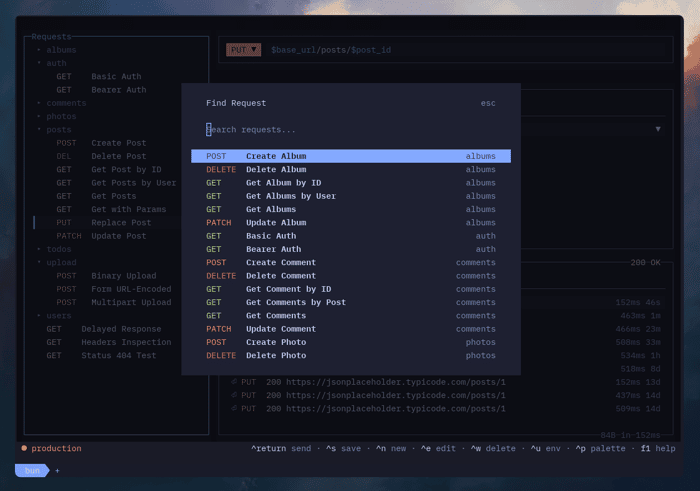
I launched Noodle, a keyboard-first REST client for the terminal.
The idea started from a very personal frustration. I wanted API requests to live as files next to my projects, but I also wanted something more comfortable than maintaining a pile of curl commands. Existing desktop tools can be great, but I kept opening one for a quick request and then going straight back to the terminal.
So I built Noodle around YAML files on disk. A collection is a directory, a request is a .yml file, and the TUI sits on top to help browse, edit, send, and inspect requests.
The first release had the basics. Since then, I have been filling in the gaps that made the workflow feel incomplete:
- Command palette, collection switcher, and fuzzy request finder
- YAML and JSON editing with validation, folding, and variable completion
- cURL import and client code generation
- JSONPath response filtering
- Automation commands for running and auditing collections
- A documented skill for coding agents to work with Noodle collections
The biggest lesson so far is that the project is not competing on feature count yet. Tools like Postman, Insomnia, Bruno, Posting, and Yaak all have strengths. The reason I am continuing with Noodle is narrower: I care about a local, keyboard-first workflow where the requests remain ordinary files that can live in Git.
I am trying to be honest about what is still missing. Scripts, assertions, request chaining, export, OAuth, and a batch collection runner are all still ahead on the road to v1.
The next challenge for me is distribution. I can keep building features, but I need to learn whether this workflow solves a real problem for enough people beyond my own terminal.
If you have launched an open-source developer tool, I would love to hear how you found your first users and how you decided which feedback to prioritize.
A longer update with screenshots and the roadmap to v1:
https://noodlerest.dev/blog/what-changed-since-noodle-launched/

Bruno already proved your market exists: its growth story was developers fleeing Postman's cloud sync, and 'requests are plain files in Git' was the hook. So don't frame Noodle as a REST client with a TUI, frame it as the Git-native option for people who live in the terminal, and recruit users directly from the threads where developers complain about Postman pricing and sync. Your first hundred users are already complaining in public, you just have to go find them.
That is an excellent point. I have been describing Noodle too much by what it is technically, instead of why someone would choose it. The git native, local first workflow is probably the strongest positioning, especially for developers who already live in the terminal and do not want their API collections tied to a cloud account. I also like the idea of looking for users in the places where they are already frustrated with Postman, rather than waiting for them to discover Noodle. Thanks, this is genuinely useful advice.
I really like that. Keeping the requests in the repo appeals to me.
One friction for me: in some situations I still have to use Postman. And it means I would be redefining the same request in both places. I saw "export" is in scope for your v1. In my opinion, it would be more valuable to have a two-way sync with apps like Postman, rather than a one-time export.
But it is not a dealbreaker. The file based, keyboard-first approach is already the draw. That is just the one thing (two-way sync) that would let me go all-in without syncing manually.
That makes sense. A one-time export helps with migration, but it does not solve the problem of having to maintain the same request in two places.
Two-way sync with Postman would be much more useful for teams that cannot fully move away from it yet. It is also quite a bit more complex, especially around IDs, conflicts, and features that do not map cleanly between formats, but I agree it is worth exploring.
For v1, I am keeping the scope smaller and focusing on import/export first. After that, I would like to look into a workflow where Noodle files remain the source of truth and can be synced with other clients.
I am completely okay with import/export if I use it individually. Two-way sync only becomes necessary when part of the team moves to Noodle. If the whole team uses it, the problem disappears on its own.
And in that mixed case your concern about conflicts is real. In my team there is no owner for a request. Everybody can create and edit requests on Postman. So a partial sync would be worse than none, because I would start trusting that the two apps match while they drift apart.
The "requests as YAML files next to the project" model is exactly right — it makes requests versionable and reviewable like the rest of the codebase, instead of trapped in a desktop app's internal state. The documented skill for coding agents is a smart addition too; plain files on disk are the one format agents can pick up without any extra plumbing. Curious how you handle auth secrets in collections — env var references, or something else?
Exactly. Noodle uses environment variable references, with the actual values stored in environment files inside the collection. That keeps secrets separate from individual request YAML files while still making the collection portable.
Cool project - the “requests as files in Git” angle is clear, and that’s the part that makes Noodle feel different from Postman/Insomnia without needing to win on feature count.
On first users for open-source CLI/TUI tools, what’s worked for me (and what I’ve seen work):
Post where people already complain about curl/Postman (HN “Show HN”, Reddit r/commandline / r/webdev, relevant Discord/Slack). One concrete demo beats a feature list.
Answer specific pain in comments (“how do I import this curl?”) - those people convert better than drive-by star-ers.
Prioritize feedback from people who already use the tool weekly; park feature requests from people who haven’t cloned it yet.
For distribution: a 30-second terminal recording of “open collection → fuzzy find → send → filter JSON” will probably do more than another feature right now, especially since you’re honest about what’s missing for v1.
Curious - are you aiming more at solo freelancers or teams that want shared collections in Git? That choice changes where you should show up first.
Right now I am focusing more on solo developers and small teams who already use the terminal, since that is the workflow I know best and the easiest place to validate the idea. That said, shared collections in Git are a natural fit for teams too, especially once batch running, assertions, and CI workflows are complete. I agree that a short terminal demo would probably communicate the value much better than another feature list.
Interesting project. What made you focus on terminal-first development instead of building a traditional web interface first? I'd be interested to hear how your users responded.
It started from my own workflow. I spend most of my development time in the terminal, and I wanted API requests to live as plain files next to the project instead of inside another web or desktop tool. The early response has been small but encouraging, especially from people who already use terminal tools and like the Git-native approach. It is still too early to know how broad the audience is, but that is the group I am focusing on first.
I think this is a real niche, great work.
Claude Code has shown this kind of UI is hip. Related - can you integrate with agents? Seems like an obvious point to have a skill/MCP/Local MCP so agents can use the tool.
Good luck!
Thanks! Agent integration is actually already supported through a Noodle skill for Claude Code, Cursor, Copilot, OpenCode, and other agents. It can create, organize, audit, import, and run collections using Noodle’s automation CLI.
The CLI already supports structured JSON output, so it should provide a good foundation for deeper agent integrations.
Wow, that's impressive.
The ordinary-files-in-Git constraint is the strongest part. I'd put a one-command curl or Postman import ahead of adding more request features, because migration friction can kill the trial before someone even feels the keyboard-first workflow. I ran into a similar lesson building DictaFlow: fitting into the place people already work mattered more than piling on features. A tiny demo repo with real requests, env files, and a pull request diff would probably sell Noodle better than a feature matrix.
That makes a lot of sense. Noodle already supports importing Postman collections and OpenAPI specs from the CLI, but I probably need to make that much more visible and reduce the path from "I have an existing collection" to "I am using Noodle."
There is already an example collection in the repo, but I like the idea of turning it into a more intentional demo. Showing real request files, environments, and a clean pull request diff would communicate the Git-native workflow much better than another feature list.
Thanks for sharing the DictaFlow lesson too. Fitting into an existing workflow is exactly what I want Noodle to do.
Love the “requests as files in Git” angle. That’s a real wedge vs Postman/Insomnia, not just another feature race.
For first users on open-source tools, what usually works for me:
Hang in communities where people already complain about the pain (terminal workflows, API testing)
Reply to “alternative to Postman/curl” threads with the specific niche
Ship one demo-worthy gif/video of the keyboard flow
Prioritize feedback from people who already live in the terminal. Feature requests from GUI-first users will pull you off your wedge.
I built the Make it RAIN app for the distribution/monetization side after shipping, so this distribution question is close to home.
Curious where your first stars/users actually came from so far?
Most of the first users and stars came from Reddit and a few developer communities. Right now I am still focused more on improving the product than monetization, but I agree that I need to spend more time where people are already discussing terminal workflows and Postman alternatives. The advice about prioritizing feedback from terminal-first users is especially useful.
One thing worth separating out: feature requests vs. workflow requests. "Add OAuth support" is a feature ask — easy to prioritize by frequency. But "I want to chain this request into my CI pipeline" or "I want Noodle to diff cleanly in a PR review" are workflow asks — they tell you how deep into someone's actual process the tool has gotten, which is a much stronger signal than raw request volume.
Given your "coding agent skill" feature, I'd watch for a third category too: people asking for things not for themselves, but because their agent needs it (structured error output, predictable exit codes, etc.). That's a different kind of demand signal than a human user complaining, and probably worth tagging separately as you collect feedback.
That is a really useful distinction. Workflow requests are probably a much stronger signal for Noodle than isolated feature requests because they show the tool is becoming part of someone’s actual process. I also like the idea of tracking agent-driven requests separately, especially around structured output, exit codes, and predictable automation behavior. I will start tagging feedback that way instead of treating everything as the same kind of request.
The distribution angle is interesting - you've correctly identified that the terminal-first audience is small but specific. What might help: make it dead simple for someone who uses curl daily to stumble on Noodle. The "requests live in git as YAML files" message is powerful enough that it should sell itself to people frustrated with GUI tools, but they need to find it first. Have you considered reaching terminal tool communities directly (vim/neovim plugin ecosystems, shell scripting forums, the few dev communities that still use forums instead of Discord)? Those tend to be more discoverable than general tech communities.
That is a good point. Most of the early attention has already come from Reddit and smaller developer communities, but I have not focused specifically on Vim, Neovim, shell, and terminal-tool communities yet. Those are probably a much better fit than broad tech channels, especially because discussions there remain searchable and can keep bringing people in over time. I will add them to the distribution plan.
The line that stood out to me is the "documented skill for coding agents to work with Noodle collections." That might end up being a bigger distribution lever than any human-facing feature. Files-on-disk plus YAML is exactly the shape an agent can read, edit, and replay without you building a bespoke API for it, and API testing/auditing is a task people are already delegating to agents. The terminal-native crowd is the right first audience for validation, like the comment above says, but the agent-skill angle might be the one that actually differentiates Noodle from Postman/Insomnia long-term, since those tools are GUI-first and much harder to make legible to an agent. Worth tracking separately whether any of your early adoption comes from someone wiring an agent into a collection rather than typing requests by hand.
I think you may be right. The files-on-disk format makes Noodle naturally usable by agents without needing a separate integration layer, and that could become a stronger differentiator over time. I am going to track agent-driven usage separately from the normal terminal workflow so I can see whether people are actually creating, auditing, or running collections through agents.
I like that you're optimizing for a specific workflow instead of trying to out-feature every existing REST client.
I'll be interested to see which part users keep coming back for after the initial trial. That usually reveals whether the product is really about being keyboard-first, file-based, or simply fitting more naturally into a developer's existing workflow.
That is the question I am trying to answer too. My current guess is that the combination matters: the files make the workflow fit Git, and the keyboard-first interface makes it practical to use every day.
The clearest signal will probably be whether people keep their collections in real projects and come back to run and update them regularly. That is what I want to learn from the next group of users.
That makes sense.
The interesting signal will probably be whether the workflow becomes part of how developers structure their projects, rather than just another tool they occasionally open.
That repeated integration into existing habits is usually where the strongest retention comes from.
Requests as plain YAML files that live in git is the right call, that is the same reason people put up with a terminal tool over a GUI one, the files being real and diffable beats convenience every time. On first users, the ones who stuck for me came from people who already lived in the terminal and were annoyed by exactly the workflow you are describing, not from broad marketing. Distribution past that group is the real problem though, that audience is small and vocal but it does not scale on word of mouth alone, so I would rather over invest in the handful of terminal native corners of Reddit and HN than try to make the pitch legible to GUI users who were never going to switch anyway.
That matches what I have been thinking. I probably need to focus on people who already prefer terminal and Git-based workflows instead of trying to convince GUI users to switch.
The roadmap is still about filling in the gaps around that workflow, with export and import, scripting, testing, and collection automation coming next. I’ll pay attention to which of those terminal users actually ask for, rather than assuming the priorities myself.
Your clarity on the wedge is the best thing here, and rare: "requests are ordinary files that live in Git" is genuinely differentiated against Postman/Insomnia, and you already know not to compete on feature count. Most founders can't articulate their wedge that cleanly. So the distribution question has a sharper answer than "find users."
A Git-native, keyboard-first, files-on-disk REST client has an ICP that isn't "developers." It's a specific tribe: terminal-maximalist devs who live in Neovim/tmux, version-control everything, distrust Electron GUIs, and feel friction every time they leave the terminal for Postman. Small, sharp, highly reachable, and they cluster in specific places. You don't need broad distribution, you need to reach that tribe.
Where they are: r/neovim, r/commandline, Hacker News (Show HN, heavily this crowd), lobste.rs, the TUI/CLI tooling community, and adjacent tools (Bruno users chose it for the same Git-native reason, they've already bought the philosophy, just not keyboard-first, your warmest audience).
On prioritizing feedback: weight by whether it comes from someone already in your workflow vs someone asking you to become Postman. "Add a GUI" is someone who isn't your ICP asking you to abandon your wedge. A tmux/Neovim user asking about request chaining or Git-diff-friendly output is your tribe telling you what completes the workflow. Prioritize the second ruthlessly, politely ignore the first.
Which terminal communities have you posted in so far, and did any one convert better? That's your channel.
Thanks, this is really helpful. I had been thinking about "developers who work with APIs" as one big group, but the workflow is probably the better way to look at it.
So far I have only posted in r/coolgithubprojects, so I do not really have channel data yet. Show HN is next, and I want to try a few terminal and Git-oriented communities after that and see where people actually care.
Your point about feedback also lands. I do not want to build a smaller Postman just because someone asks for a feature. I need to figure out what is missing for people who already like keeping things in files and working in the terminal.
Thanks again, this gave me a much clearer direction.
The workflow-over-demographic reframe is the whole thing, glad it landed. One tactical note for Show HN since it's next and it's your highest-leverage single shot:
HN rewards the origin story and the wedge, not the feature list. The title and first comment should lead with the exact frustration you opened your IH post with, wanting requests as files next to your project, not a pile of curl, not another Electron GUI. That specific pain is what makes terminal people go "finally, someone gets it." Don't lead with "REST client for the terminal" (sounds like one of many), lead with "I wanted my API requests to live in Git as plain files, so I built a keyboard-first TUI." The Git-native angle is your hook, put it first.
One more: HN's terminal crowd will immediately compare you to Bruno and Posting. Get ahead of it in your own post, name them, say what you respect, and state the one thing you do that they don't (keyboard-first TUI + files-in-Git together). Naming competitors honestly reads as confidence and saves the top comment from being "how is this different from X."
The batch-runner and request-chaining items on your roadmap are the ones your actual tribe will care about most. Those are the "I do this in CI / I version my API tests" workflows that only the files-in-Git crowd needs. Worth prioritizing over OAuth, which is more of a GUI-user expectation.
Sharpening that Show HN wedge-and-positioning is the kind of thing I spend my time on, I'm part of the team building Hivemind, an AI strategy copilot. If you want to pressure-test the launch framing before you post, it's worth a try: https://hivemind.myosin.xyz. Either way, good luck, post Tuesday-Thursday morning US time when that crowd is most active.
This is really helpful, thank you. Leading with the frustration instead of the category makes a lot of sense, and I agree that naming Bruno and Posting directly will make the positioning clearer. The point about prioritizing batch running and request chaining over OAuth also fits the Git and CI audience much better. I will check out Hivemind before posting the Show HN.
At Eternity Accountants, we make accounting simple for individuals, small businesses, contractors, and property owners across the UK. Our mission is to save you time, reduce your tax burden, and give you full control over your finances so you can focus on growing your business.https://eternityaccountants.co.uk/