Built a tool that finds which Reddit/HN threads are making ChatGPT recommend your competitors
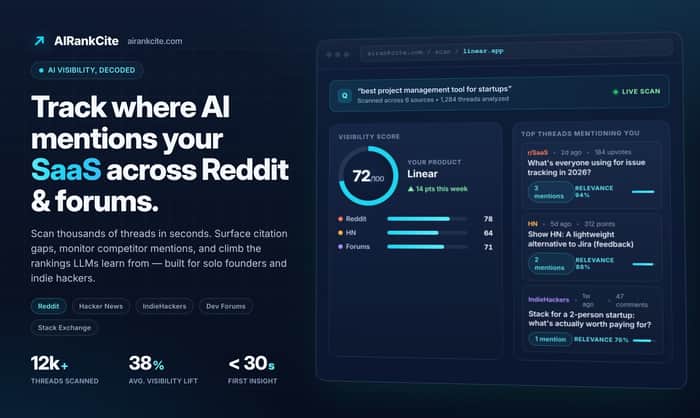
AI answer engines like ChatGPT, Perplexity, and Claude don't pull product recommendations from thin air. They pull them from community threads, Reddit discussions, HN posts, and niche forums where founders and users have already debated the best tools in a category.
Most founders have zero visibility into which threads those are. So they post randomly, hope for the best, and wonder why competitors keep showing up in AI answers instead of them.
AIRankCite fixes that.
You paste your product URL, and it returns a ranked hitlist of the exact Reddit and HN threads currently shaping AI recommendations in your niche. Each result comes with a confidence score showing how much weight that thread carries, plus a tailored seeding kit with word-for-word comment copy you can drop in to start shifting the AI narrative toward your product.
It tracks ChatGPT, Perplexity, Claude, Gemini, and Copilot. Full scan takes under 2 minutes.
Free first scan at airankcite.com
Curious what others here are doing for AI citation tracking. Is this on your radar yet or still too early for most stacks?

Mohamed — the “which threads are shaping the answer” question is real. One caution from the lab: word-for-word seeding kits are how you get banned and how you teach the model a spam pattern. Assistants already discount low-quality forum stuffing, and ChatGPT’s Reddit citation share dropped again in August. Don’t build a strategy that only works if Reddit stays the default source.
What we actually log: a 30-day clipboard of the 20–40 buyer prompts your customers would type, run across four engines, tagged you / competitor / nobody. Then we look at which URLs got cited — a Reddit thread, a comparison page, G2, or nobody — and only then decide where a human comment is worth an afternoon.
If a thread already shows up for the buyer query and already names three competitors, a specific, sourced answer can belong there. A pasted kit does not.
PS — that’s the loop we run as The Money Prompt Lab. A file, not a subscription.
The useful split here is discovery versus action.
Finding the conversations that shape a category is valuable research. But the action layer should probably rank threads by answerability, not just influence: is there a real question, is the thread still active, and can someone add a specific observation without mentioning their product?
Otherwise the tool risks optimizing for placement instead of contribution. The strongest result would be a shortlist of threads where a founder can genuinely help first, then decide later whether a resource is even relevant.
This is a really interesting idea. Something worth trying out for sure
Just tried it out on my own thing i’m building and it gave me a great summary. Glad to know that it really scans my product and learned about it.
Here’s what it said:
“ Lune helps individuals articulate their professional identity and career aspirations through a guided conversation, generating a descriptive summary that highlights their unique skills and fit for roles beyond traditional job titles or resumes. It aims to uncover what truly motivates and fits a person's work style, helping them understand their professional narrative and potential career paths.”
That's awesome to hear! Glad the summary nailed what Lune does - the scanner actually fetches your site content to understand the product before generating prompts and checking AI engines.
Curious - did you check the AI citation cards too? Would be interesting to see if any of the 5 models (ChatGPT, Perplexity, Gemini, Claude, Copilot) already recommend Lune when someone asks about career identity tools. That's where the real insights are - knowing which engines already know about you vs where you're invisible.
If you want, I can take a deeper look at your results and share some quick wins for boosting your AI visibility in the career/professional development space. Just let me know!
This is a really interesting angle. A lot of founders are still thinking about SEO while AI recommendations are increasingly being shaped by community discussions and niche threads. The “which conversations actually influence AI answers” piece feels much more actionable than generic brand monitoring.
Exactly - that's the core insight that got me building this. Traditional brand monitoring tells you "someone mentioned you." Cool. But it doesn't tell you which conversations are actually shaping what ChatGPT or Perplexity recommends next week.
The shift from "rank on Google" to "get cited by AI" is happening fast, and most founders haven't caught up yet. The threads that AI models pull from aren't random - they tend to be high-engagement, well-structured discussions on Reddit and HN. Once you know which ones matter, you can participate meaningfully instead of guessing.
Appreciate the feedback - glad the framing resonates. If you want to see it in action for your own product, run a free scan at airankcite.com and let me know what you think. Always looking for honest feedback from builders who get the space.
The underlying problem is real. A lot of founders still think AI recommendations are some black box, when in practice they’re often downstream of public discussions that already exist.
What I like here is the visibility layer. What I’d be careful with is the “word-for-word seeding copy” angle, because that can drift from genuine participation into something that feels synthetic fast.
Feels like there are really two products hiding in one:
The first one feels universally useful. The second one probably needs very careful framing so it doesn’t become a spam machine.
You're spot on with both points.
On the copy angle - totally fair concern. We actually reworked that entire section recently. The content suggestions are now value-first conversation starters, not promotional drops. Think "here's how to contribute something useful to this thread" rather than "paste this to mention your product." If it reads like marketing, Reddit mods will nuke it anyway, so the copy has to earn its place in the conversation.
On the two-product observation - I see them as two layers of the same workflow. Layer 1 (intelligence) is useful on its own, agreed.
Layer 2 (action) only works if it's grounded in genuine participation.
The guardrail is: if you wouldn't post it without a product to promote, don't post it at all. The tool should help you find conversations where you genuinely have something to add.
Good framing though - keeping those layers clearly separated in the UX is something I'm actively working on. Would love your take on how it feels in practice - try a free scan on your product at airankcite.com and let me know if the intelligence vs action split feels right to you.
The underlying problem is real. The solution raises some questions.
AI citation optimization (or GEO as some are calling it) is genuinely one of the more interesting distribution shifts happening right now — the idea that Reddit threads and HN discussions are becoming the new SEO backlinks is worth taking seriously.
But "word-for-word comment copy you can drop in" is essentially astroturfing automation. Reddit bans for that, and if AI models start detecting coordinated seeding patterns, you'd expect them to discount those threads specifically.
Curious how you're thinking about the long-term defensibility of this approach as platforms and models adapt.
(For what it's worth, I'm building a niche B2B SaaS and the GEO angle is something I'm watching closely — just more from the "be genuinely present in the right conversations" angle than the seeding one.)
Fair challenge, and I appreciate the directness.
On the copy concern - we've moved away from "drop-in" copy entirely. The content suggestions now focus on value-first contributions: sharing relevant experience, answering questions, adding context. If it reads like a planted comment, it fails the test. Reddit mods are sharp, and rightly so.
On long-term defensibility - two thoughts:
The intelligence layer (knowing which threads influence AI recommendations) gets more valuable as AI models evolve, not less. Whether they pull from Reddit, HN, or new sources, understanding the citation pipeline stays relevant.
The engagement side only works if it's genuine participation. If AI models start discounting coordinated patterns, that actually helps legitimate contributors stand out. The defensible approach is: be in the right conversations with something real to say.
The GEO space is early and moving fast. I'm building for the "be genuinely present" angle too - that's the only version that scales without getting burned.
Since you're in the B2B SaaS space and watching GEO closely - run a free scan on your product at airankcite.com. Curious to hear if the results match what you're seeing manually, and where it falls short. Raw feedback from someone thinking critically about this space would be super valuable.
Building something similar—it gathers real online discussions to help validate ideas, pain points and new products. I’m a big believer that the market niche exists before we even find it. People are already talking. It’s just a matter of capturing those voices and making the product a perfect fit. First principles driven.
100% agree on the first principles approach. The discussions are already happening the opportunity is in surfacing the right ones at the right time.
I'm working on a similar angle but specifically for AI citations, tracking which Reddit/HN threads are shaping what ChatGPT, Perplexity, and Claude recommend. Turns out those models pull heavily from community discussions, so the "capture real voices" insight applies directly to AI visibility too.
What's your product focused on - validation research or more ongoing monitoring? Would be curious to compare notes since we're in adjacent spaces.
If you want to see how it works, try a free scan at airankcite.com with your product URL. Always interested in feedback from someone thinking about this from first principles.
Mapping the citation lineage of LLMs is a clever refactor of the traditional SEO playbook for the answer engine era. You are essentially shipping a debugger for brand visibility that turns the black box of AI recommendations into a high-signal roadmap for community seeding.
Are you seeing a specific volume of mentions in a thread before it starts to consistently trigger a citation in Perplexity or Gemini?
We're still collecting data on this, but early signal suggests 3-5 genuine mentions across different threads in the same category is the tipping point for Perplexity. ChatGPT seems to need higher authority threads (100+ upvotes) rather than volume. We're tracking this across users and will share findings soon.
That distinction between volume and authority is a game-changer for strategy. I am building Bunzee.ai to use that same community data to help founders validate their product ideas before they start coding. Since you understand this data so well, I would love your feedback on our approach. Which of those two metrics do you think is harder to influence organically?
Authority is harder to influence organically, by a wide margin. Volume across threads is achievable with consistent effort over a few weeks. Getting a single thread to 100+ upvotes requires either a genuinely viral post, an existing audience, or timing a conversation that the community already wants to have. You can engineer the conditions but you can't force the outcome.
The practical implication: for Perplexity, a distributed seeding strategy works. For ChatGPT, you're really looking for one or two high-authority anchor threads rather than spreading across many. Different tactics for the same goal.
Bunzee.ai using community signal for idea validation before building is an interesting angle, there's a lot of overlap in the data layer. Would be happy to look at your approach, send it over.
Thanks for the reply! The examples you gave really made it click for me it’s much clearer now. I totally agree that since Perplexity and ChatGPT have such different target users and areas of expertise, their strategies definitely need to be worlds apart.
And man, you're so right about the upvotes. Getting over 100 on a single thread is no joke! I’ve been showing up and engaging every single day, but I’ve only managed to hit 30 likes so far. Haha, the grind is real!
By the way, have you had a chance to dive into Bunzee.ai yet? I’d love to hear your take on it I’m eagerly waiting to hear about your experience and any insights you might have!
Glad the examples helped clarify things! The Perplexity vs ChatGPT distinction is something most people miss - they assume "AI optimization" is one strategy, but each model has different source preferences and weighting.
On the upvotes grind - 30 likes with daily engagement is solid progress honestly. The threads that get 100+ usually hit because they solve a very specific pain point at the right moment. Keep showing up consistently and the breakout posts will come.
Haven't looked into Bunzee.ai yet - I'll check it out. What's your experience been with it so far?
By the way, if you want to see how visible your product is across AI engines right now, try a free scan at airankcite.com. Takes 60 seconds and shows you which AI models mention you and where the gaps are. Would love your feedback on how useful the results feel.
Thank you for your reply. I will also try using your service.
Awesome, let me know how it goes! If you run into anything confusing or have ideas on what would make the results more useful, I'm all ears. Still iterating fast based on early user feedback.
This is the right shape of the problem but the hard middle layer is attribution lag. We've tracked AI citations for our marketplace product for 3 months — the Reddit/HN threads ChatGPT cites today were mostly planted 6-18 months ago. So seeding has a lag function: today's effort surfaces in answers next quarter, not next week.
Two things I'd add to the scoring: (1) thread age decay metric — older threads carry more weight in stable niches, less in fast-moving ones, depending on how often the model retrains for that topic. (2) competitor seeding intent inference — a meaningful fraction of 'organic-looking' founder comments in popular threads are placed marketing. Spotting them helps you understand what tone actually converts in the AI cite layer.
Curious what your confidence score weighs — thread upvotes? Recency? Outbound link count?
The attribution lag data matches what I’ve seen too. 6-18 months is the realistic window, which is why framing this as a compounding channel rather than a quick win matters. Today’s seeding is next quarter’s citation.
Both scoring additions are sharp. Thread age decay is already partially baked in but not niche-speed-adjusted yet. A fast-moving category like AI tooling should decay faster than something like accounting software, and that calibration isn’t there yet. Competitor seeding intent inference is not in the current build at all and honestly should be. If you can spot the pattern of placed marketing in high-weight threads, you learn what tone and framing the AI is actually rewarding. That’s a different and more valuable signal than just knowing which threads exist.
On the confidence score: it currently weighs thread engagement depth, recency, and domain authority of the source. Outbound link count is not a direct input yet. Upvotes factor in as a proxy for engagement but not as a standalone signal. That breakdown is worth making explicit in the UI rather than treating it as a black box, which is on the near-term list.
Appreciate the 3-month data point. Would you be open to a short conversation? That attribution lag pattern would be useful to validate more rigorously.
this is a real gap btw, spent the last week watching ChatGPT cite year-old reddit threads that have completely shifted what 'best X' means in some niches. AI citation tracking is going to be its own category soon.
one thing worth flagging though: the seeding kit angle lands very differently with different audiences. people in this thread will read it as competitive intel, but the same flow described as 'word-for-word comment copy you can drop in to shift the AI narrative' reads as astroturf to a non-founder. that's a brand-risk you might be inheriting from the framing more than the product.
could be worth two clearly separated modes: a passive one that just tells you which threads carry weight (great for SEO/positioning research, no concerns), and an active one with a stronger framing like 'genuine founder responses to threads where your product is already mentioned'. same engine, way less landmine.
curious if you've seen that split in how people respond to the demo.
The framing risk is valid and something I’ve been sitting with. “Word-for-word comment copy to shift the AI narrative” is accurate to what it does but reads as manipulation to anyone outside the founder bubble. That’s a messaging problem worth fixing regardless of what the product actually produces.
The two-mode split is the right call. Passive mode: visibility intelligence, which threads carry weight, no action implied. Active mode: founder response kit, framed as genuine engagement in threads where your product is already part of the conversation. Same engine, completely different surface and intent signal.
Yes, the split shows up clearly in demos. Founders with a growth hat on react well to the full kit. Founders with a community hat on, or anyone who’s been burned by astroturf backlash before, visibly tense at the “drop in” framing. That reaction is the product telling me something.
Separating the modes also unlocks a cleaner pricing tier. Passive as a research tool, active as the growth layer.
Appreciate you naming it directly.
The visibility into which threads influence AI answers is interesting. The part I’d question is how stable those signals are. Community threads can shift quickly, and AI outputs don’t always update in a predictable way.
Also feels like there’s a fine line between contributing to those discussions and trying to “seed” them. If it comes across the wrong way, it could backfire. Have you seen consistent movement in recommendations after engaging with the threads you surface?
On stability: threads shift but topic clusters don’t. LLMs weight accumulated engagement over time, so even older threads in the right cluster stay influential. The scan tracks both.
On seeding: the copy it generates is genuine contribution to existing conversations, not promotional filler. Thin comments don’t move citations anyway, Reddit buries them fast.
On results: yes, consistent movement. Typically 3 to 6 weeks depending on the LLM. Run the scan and I can walk you through what it surfaces for your niche.
That makes sense on the topic cluster side.
The 3–6 week movement is interesting as well. That’s faster than I would’ve expected . .. especially given how opaque those systems are.
Feels like the tricky part is knowing how much of that movement is repeatable versus case-by-case depending on the niche.
Have you seen it behave consistently across different categories . . or does it vary a lot?
It varies, and that’s the honest answer. Categories with high community discussion volume and frequent AI query activity move faster. Developer tools, SaaS, productivity, anything where founders are actively asking AI for recommendations daily. Those tend to hit the 3 to 6 week range reliably.
Slower-moving or niche categories take longer, sometimes 8 to 12 weeks, because the AI query frequency is lower so new signals take longer to surface in outputs.
The repeatability question is trickier. The pattern is consistent but the timeline isn’t uniform. What stays repeatable across categories is the mechanic: presence in the right cluster moves citations. What varies is how quickly the LLM reflects the change. That’s the part that’s still more observation than formula.
That’s a good way to frame it.
So the mechanism is consistent, but the speed depends on how active the space is. That makes sense.
Feels like that’s the part most people will underestimate going in.
Exactly. Active categories (dev tools, AI, productivity) can see citation pickup within 2-4 weeks of seeding. Quieter niches take longer but the mentions stick longer too since there's less noise pushing them down. The key insight is consistency over volume
Smart positioning. One axis I'd love to see surfaced: not all citations are equal-weight in actual purchase decisions.
LLMs heavily prioritize threads where the recommendation answers a specific buying-stage question ('looking for X to do Y under €Z') vs. generic 'best Y tool 2026' lists. The former show up in real purchase-intent prompts, the latter mostly inflate visibility scores without converting.
Does AIRankCite differentiate between these in the visibility lift metric, or are all mentions weighted the same?
That distinction is exactly right and currently not fully surfaced. The confidence score weights threads by engagement depth and recency, but it doesn’t yet segment by buying-stage intent vs generic visibility.
A thread answering “looking for X under $Y” ranks higher than a “best tools 2026” list in the raw signal, but that separation isn’t explicit in the output yet.
That’s going on the roadmap. Purchase-intent citation weight as a standalone axis is the right call. Would you want that broken out as a separate score or as a filter on the existing results?
This is on my radar but I think the playbook breaks differently for non-English markets and it's worth flagging.
We're building an email/CRM/voice product for European SMBs. When I asked ChatGPT and Perplexity in French "meilleur logiciel email IA pour PME francaise" the recommendations are wildly thin - mostly translated US tools with bad French support. Almost nothing surfacing from French startup forums because those communities are smaller and AI engines weight English Reddit threads disproportionately.
My current hypothesis: for non-English builders, the citation game has two halves. Half 1 = English threads (Reddit, HN, IH) where you compete with everyone. Half 2 = local-language forums where you can dominate fast because incumbents ignore them. The local half pays off in 6 months when AI engines catch up to non-English content (already happening with Mistral and Claude in French, faster than expected).
Question for you: does AIRankCite handle non-English citation sources well? Specifically curious if you crawl French and German tech forums and weight them appropriately, or if you're English-Reddit-first like most tools in this space. That's the gap I'd pay for.
Going to run a scan on our domain.
Your hypothesis is right and it’s one of the sharper framings I’ve seen of the problem. The two-half playbook maps closely to what the data shows.
To answer directly: AIRankCite is currently English-Reddit-first. French and German tech forums are not yet weighted as standalone citation sources. That’s a real gap, not a roadmap maybe.
The non-English citation layer is planned, and your use case is exactly the brief for it. Local-language forums where incumbents aren’t competing yet, indexed by Mistral and Claude faster than most expect. That’s a high-leverage window and a short one.
Run the scan on your domain. Even the English-side results will show you where the gap is and what you’re up against from US tools in your category.
Would love your feedback when it’s done.
Thanks @simao23, will def run the scan on elixmail.fr this week and report back. The non-English layer is exactly where the moat could live for FR/DE SaaS — getting cited by Mistral on a developpez.com or fr.wikipedia thread feels like a different distribution game than ranking on English Reddit. Quick context: we just shipped Google Play this morning (after Microsoft Marketplace last week), so AI visibility tracking is becoming a real concern for us too. Bookmarking for when the non-English layer lands.
This is one of those products where the wedge is stronger than the current name.
The real value is not “AI citation tracking.”
It’s competitive narrative control.
Founders are not paying to see which Reddit thread matters.
They’re paying to understand why competitors keep getting recommended and how to change that before it compounds into distribution loss.
That’s the real product.
AIRankCite explains what it does.
It also traps it in a narrow SEO/tooling frame.
If this expands beyond “find citations” into “shape recommendation share,” the product likely outgrows the current name fast.
Exirra.com fits that direction much better.
Sharper, more defensible, and broad enough to hold a larger competitive intelligence layer once this becomes less about tracking citations and more about controlling category narrative.
Really appreciate this framing, you're articulating the bigger vision better than I have. You're right that 'find citations' is the wedge, and 'control competitive narrative' is where the real value compounds.
For now I'm keeping AIRankCite because it clearly communicates the entry point, founders immediately understand what they'll get. But as we expand into recommendation shaping and competitive intelligence, a rebrand is definitely on the table.
Thanks for the domain suggestion too, noted for when we're ready to make that leap.
One practical follow-up on the AIRankCite positioning.
If you are still moving toward recommendation shaping and competitive intelligence, I’d watch whether the landing page is still selling “citation tracking” while the real buyer pain is narrative control.
That gap matters because founders are not just paying to know where they appear. They are paying to understand why competitors keep getting recommended and what to change before that compounds.
If you are actively rewriting the positioning, I can put together a focused message/positioning pack around this: sharper homepage angle, buyer pain, 3 headline directions, and outbound copy you can test.
Keeping the first few at $49 while I refine the format.
That’s fair near-term.
Just worth watching how fast “clear entry point” turns into category ceiling.
AIRankCite is strong while the job is:
help me understand what this does
It gets expensive the moment the job becomes:
help me trust this as a competitive intelligence system
That shift usually happens earlier than founders expect.
That’s the point where the name stops clarifying the wedge and starts shrinking the category.