Charged my first customer $67. They said I was "leaving money on the table."
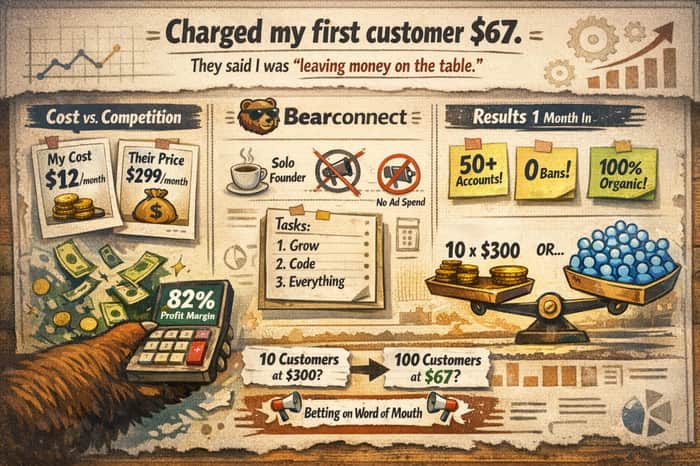
December 2024. Built Bearconnect to solve my own problem: LinkedIn kept banning my automation.
Launched quietly. No waitlist. No Product Hunt. Just posted in a Facebook group.
First customer signed up within 2 hours.
Then they emailed me:
"Why are you only charging $67/month? Your competitors charge $300. You're undervaluing yourself."
My gut reaction: raise prices immediately.
But here's what I realized:
I'm not competing with $300 tools. I'm competing with founders doing everything manually.
The math that changed my pricing strategy:
My cost to run: ~$12/user/month
Competitor pricing: $299/month
My pricing: $67/month per LinkedIn account
Profit margin: Still 82%. I'm profitable from customer #1.
What I learned:
- High prices only work when you have:
- VC funding to burn on ads
- A sales team to justify the cost
- Enterprise customers who don't care about budgets
I have none of those.
What I do have: Bootstrapped founders who need LinkedIn automation that doesn't get them banned, but can't justify $3,600/year.
Current traction (1 month in):
- 50+ accounts managed
- Zero LinkedIn bans (the whole point)
- Profitable without a single paid ad
Bearconnect → https://bearconnect.io
Would you rather have 10 customers at $300/month or 100 customers at $67/month?
(Because I'm betting on volume + word-of-mouth over premium positioning.)

Local Python scripts have a structural advantage in the current market: they're immune to the SaaS subscription backlash. No recurring costs, no vendor risk, no data concerns.
The positioning challenge is that 'script' sounds less polished than 'platform.' Worth double-down on the positioning: 'the tool you own, not the subscription you rent.'
Really valuable insight — keeping pricing tied to the actual decision context of your users (manual founders vs enterprise buyers) often makes a huge difference in early traction.
One thing I’ve seen work well is testing small pricing bumps with early users — not to chase higher revenue immediately, but to learn at what point the perceived value stops increasing demand. That can help you understand whether you should stay volume-focused or gradually move toward higher tiers.
Curious — have you experimented with any tiered add-ons (e.g., per-feature, per-seat) yet, or has the focus been just on keeping that baseline price simple?
Do you think the person you signed up for $67 and told you that you are leaving money on the table was not representative of your target segment?
Because if they are, you are leaving money on the table. To paraphrase your math, I'd rather have 100 customers at $300/month than 100 customers at $67/month. In reality, there will of course be elasticity of demand, but that first signal tells you it may be worth probing around a bit.