Churn Is Inevitable: How I Stopped Stressing About Losing Customers
Understanding Why Customers Leave
Before I could stop worrying about churn, I needed to understand why it was happening. Here are the most common reasons I found:
Not the right fit: Some customers sign up, realize the product isn’t what they need, and leave. That’s okay. They weren’t your ideal customers to begin with.
Pricing concerns: If customers feel your SaaS is too expensive for the value they’re getting, they’ll eventually leave.
Lack of engagement: If people sign up but don’t use the product regularly, they’re more likely to cancel.
Better alternatives: Competition is fierce. If a competitor offers a better deal or better features, customers might switch.
Business changes: Some customers cancel simply because their business needs change. It has nothing to do with your product.
Recognizing that churn isn’t always a direct reflection of my SaaS’s quality helped me take things less personally.

What I Did to Reduce Churn (Without Losing My Sanity)
Instead of stressing about every customer who left, I focused on improving retention for the right customers—the ones who were a great fit and saw real value in my product.
1. Improved Onboarding
A lot of churn happens in the first few weeks because users don’t see value fast enough. I simplified the onboarding process and focused on getting new users to an ‘aha’ moment quickly.
I added an onboarding email sequence with step-by-step guidance.
I included tooltips and in-app prompts to highlight key features.
I reached out personally to high-value customers to ensure they were set up correctly.
2. Segmented My Users
Not all customers are equal. Some are power users who love the product, while others barely log in. I started segmenting my users based on engagement levels and sent targeted emails:
- Active users: Encouraged them to explore advanced features.
- Inactive users: Sent reminders, tutorials, and personalized check-ins.
- High-risk users: Offered discounts or personal support to keep them engaged.
3. Focused on Value, Not Just Features
I used to think adding more features would keep customers from leaving. But the reality is, customers care more about results than bells and whistles. So I shifted my messaging from "Look at this cool new feature!" to "Here’s how this will help you save time/make money."
4. Asked Customers Why They Were Leaving
Instead of guessing, I started collecting exit survey responses from every customer who canceled. Some key insights:
- Many left because they only needed the product for a short time.
- Some needed better integrations (which helped me prioritize new features).
- A few had pricing concerns, which led me to introduce a more flexible plan.
This data-driven approach helped me make meaningful improvements instead of just guessing.
5. Stopped Offering Discounts to Save Customers
At first, I’d panic when customers said they were leaving and immediately offer them a discount. But I realized this only delayed the inevitable. If a customer doesn’t see value in the product, a lower price won’t fix that. Now, I focus on delivering value instead of offering last-minute discounts.
The Mindset Shift That Helped Me Let Go
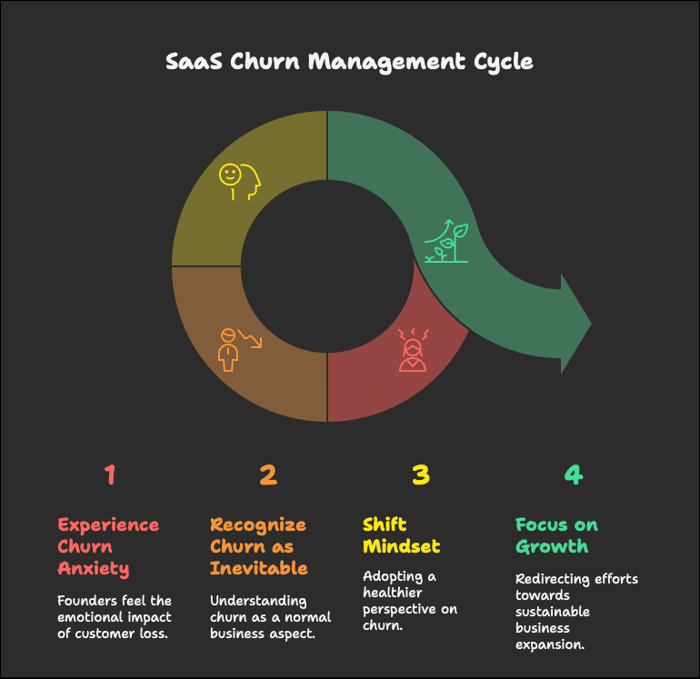
One of the biggest breakthroughs for me was accepting that some churn is healthy. If you try to hold onto every single customer, you’ll end up with a bloated user base full of people who aren’t truly benefiting from your product. Instead, I focus on:
- Retaining the right customers – the ones who find real value and are willing to pay.
- Continuously improving the product to keep my best customers happy.
- Bringing in new customers who are a better fit rather than clinging to bad-fit users.
Key Takeaways
- Churn is inevitable. Not every customer is the right fit, and that’s okay.
- Early churn is often an onboarding issue. Fix it by helping new users see value fast.
- Retention is about engagement. If people aren’t using the product, they’ll leave.
- Focus on the right customers. Don’t try to save everyone—double down on your best users.
- Collect feedback from churned users. Their insights can help you improve your product and retention strategy.
Once I stopped obsessing over churn and started focusing on building a strong SaaS for the right audience, I felt way less stressed. And ironically, that’s when my churn rate actually started improving.
If you’re struggling with churn, take a deep breath. It’s not the end of the world. Focus on retention strategies, but don’t let it consume you. Growth isn’t about never losing customers—it’s about keeping the right ones.
Have you found ways to reduce churn in your SaaS? I’d love to hear what worked for you!

The point about focusing on the right customers resonates — not all churn is equal. Losing a bad-fit customer is actually healthy. What I've found most useful is tracking the 30-day pre-churn signals: login drop-off, support sentiment turning negative, emails going unopened. By the time someone cancels, those signals were there weeks ago. The problem is connecting them fast enough to act. Curious what signals you found most predictive before you made the mindset shift
You're right that onboarding is the moment,but most founders miss the real timing. About 70% of churn in week 1 isn't because the product is bad; it's because new users never hit an "aha" moment. Build one specific, measurable value moment into your onboarding (not a feature tour). Then track cohort retention by signup month to see if product changes actually stick. That's how you spot whether your fix worked or you're just throwing things at the wall.
I've had the same thing with early churn, if users dont hit the aha moment in week one the retention chart is already lying to you. The useful bit in your post is asking why they leave, founders usually start with Typeform or Retently for that, I ended up building ScoresPulse because I wanted the bare-bones NPS and CSAT loop without the heavier setup. Curious what patterns kept showing up in those exit survey replies?
How is your approach when contacting your customers? I am currently struggling with views to conversions
Most churn signals are hiding in support conversations weeks before the cancellation happens. Phrases like "I'm evaluating other options" or "this has been frustrating" buried in a chat thread. By the time you see the churn in your metrics, that customer already made their decision 3 weeks ago. The real question is whether you have a system to flag those signals early.
That’s a spot-on breakdown of healthy vs. unhealthy churn. Moving from a feature-focus to a value-focus is a big-picture play.
The real issue isn’t just the percentage of users leaving, it’s the six-figure yearly loss tied directly to onboarding copy that doesn’t push the revenue-driving action.
We scrapped those passive onboarding emails (“Here’s how to use Feature X”) and built a sequence that turns every feature into a clear, personalized Revenue Per Subscriber (RPS) boost. That shift alone lifted activation for a similar SaaS product by 46.5%, because it reframed the user’s view from “just a tool” to “financial certainty.”
Your retention system hinges on pinpointing that Critical Conversion Failure Point in the first 7 days. If you’re not clear on the RPS impact of your onboarding emails, you’re stuck with the leak. How are you measuring that RPS loss right now?