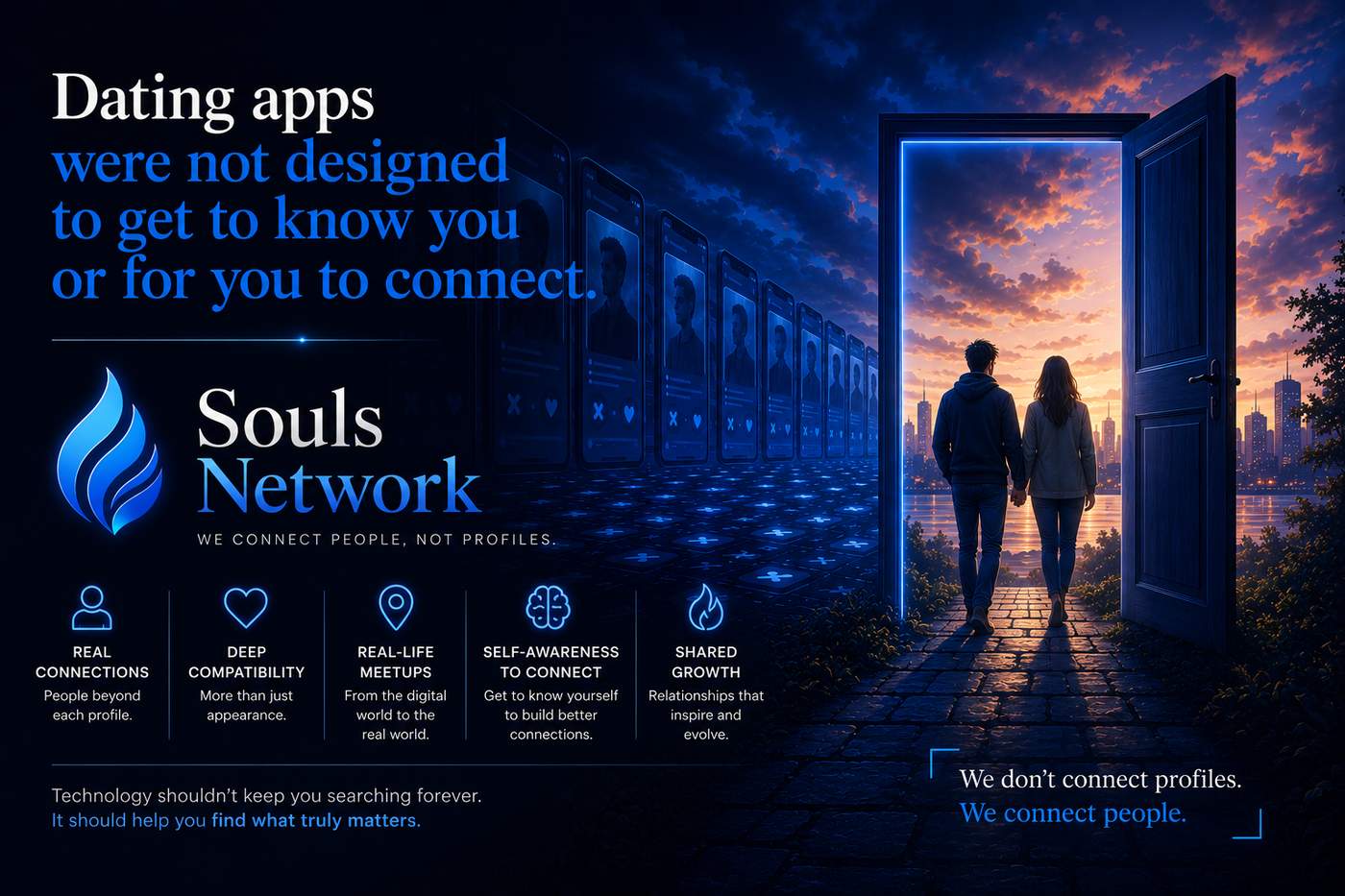
Dating Apps Were Never Designed to Know You—Or to Help You Connect
For years, we've taken it for granted that the purpose of a dating app is to help people find someone. The premise seems so obvious that it's rarely questioned. After all, that's exactly what their marketing campaigns, success stories, and public narratives promise: to reduce the distance between two strangers so they can build a relationship. Yet the moment you stop listening to the marketing and start paying attention to how these platforms actually work, a far more uncomfortable question emerges: if their goal was to help you meet someone, why do almost all of them seem designed to keep you searching indefinitely?
The answer isn't hidden in a conspiracy or some secret malicious intent. It's in the design. Every digital product, consciously or not, reveals what it truly values. Some applications reward creativity, others productivity, and others learning. Dating apps, however, have gradually come to reward something else: constant interaction. It doesn't matter how many people you've genuinely gotten to know; what matters is how many profiles you've viewed, how many times you've swiped, how many messages you've sent, and how often you came back the next day. Human connection, paradoxically, became nothing more than a possible byproduct of a system optimized for something entirely different.
There's a profound difference between knowing information about someone and actually knowing a person. Traditional dating apps collect enormous amounts of data: your age, your location, which photos generate the most engagement, how long you spend looking at a profile, who you swipe right on, which conversations you abandon, and what hours of the day you're most active. From a technological perspective, they know an extraordinary amount about your behavior. But knowing how you use an application is not the same as knowing who you are. No activity log can explain what moves you, what wounds you carry, which values you refuse to compromise on, how you navigate conflict, or what kind of relationship you're hoping to build. Confusing data with understanding has become one of the technology industry's most persistent mistakes, and dating apps are no exception.
The problem becomes even more obvious when we look at how people discover one another on these platforms. First impressions are usually reduced to a photograph, an age, a distance, and a few lines of text. Within seconds, people make a decision that, in every other area of life, would require time, conversation, and genuine curiosity. The interface doesn't encourage discovery; it encourages judgment. It doesn't cultivate sustained attention; it rewards immediate decisions. Little by little, often without users even realizing it, this logic begins to shape the way they perceive other people. Human beings stop being complex individuals and become interchangeable options in what feels like an endless stream.
That endless stream isn't accidental either. When there's always someone else just one swipe away, the mind gradually learns that no opportunity deserves too much patience. If a conversation loses momentum, you simply return to the catalog. If getting to know someone requires effort, there's always the promise that the next person will be easier. This permanent abundance creates the illusion that everyone is replaceable, making genuine commitment increasingly difficult to develop. Not because people suddenly changed, but because the digital environment repeatedly teaches them that there's always another option waiting behind the next card.
This dynamic gives rise to something even more profound: the transformation of human relationships into a consumer experience. In a store, you compare products. On an entertainment platform, you compare content. On many dating apps, you compare people. Profiles are evaluated with the same speed used to browse TV recommendations or online shopping listings. The design turns the search for a relationship into an uninterrupted sequence of instant decisions, where the next potential match always seems to be just one gesture away. Without explicitly intending to, technology ends up teaching us that people can be consumed too.
The result is a paradox that's difficult to ignore. Never before have we had access to so many potentially compatible people, and yet feelings of exhaustion, frustration, and disconnection have become an ordinary part of the experience. Many users don't leave these apps because they've found what they were looking for—they leave because they become tired of a process that eventually feels repetitive. What creates fatigue isn't meeting people. It's spending months or even years inside a system that turns the possibility of connection into an endless sequence of shallow decisions.
Perhaps the industry's greatest mistake has been assuming that human relationships could be optimized like any other technological problem. If a transportation app wants to reduce waiting times, it improves its algorithm. If a navigation app wants to suggest better routes, it processes more real-time information. But human relationships don't work that way. They aren't born from a perfect equation or an ideal combination of variables. They emerge when two people have the space to discover one another, understand one another, and build something that no algorithm can manufacture on their behalf. Technology can make that encounter easier, but it cannot replace what gives a relationship meaning.
For far too long, we've confused interaction with connection. We celebrate matches as though they were relationships, messages as though they were meaningful conversations, and constant activity as though it were emotional closeness. But interacting is not the same as connecting. Two people can exchange hundreds of messages without ever truly knowing one another, just as they can meet once and discover a level of understanding that no algorithm could ever have predicted. The difference isn't measured by the amount of activity generated, but by the quality of the encounter that activity makes possible.
That's why the real debate surrounding dating apps has never been technological. It's philosophical. Before a single line of code is written, every platform answers—whether it admits it or not—a fundamental question: what does it actually mean to connect two people? If the answer is maximizing clicks, swipes, session time, and activity, the product will inevitably resemble everything we've already seen. If the answer is helping someone be understood as more than a photograph, then the design must inevitably be different.
That is precisely the conversation we need to begin today. Not because technology has failed, but because for far too long we've accepted an impoverished definition of what it means to bring two human beings together. That's why Souls Network is being built: not to keep people inside an application for longer, but to build technology whose greatest success is knowing when to step aside—returning people to the real world, where genuine human connections can finally begin.