
Souls Network
Where souls connect. Meet people for who they truly are.
For years, we've taken it for granted that the purpose of a dating app is to help people find someone. The premise seems so obvious that it's rarely questioned. After all, that's exactly what their marketing campaigns, success stories, and public narratives promise: to reduce the distance between two strangers so they can build a relationship. Yet the moment you stop listening to the marketing and start paying attention to how these platforms actually work, a far more uncomfortable question emerges: if their goal was to help you meet someone, why do almost all of them seem designed to keep you searching indefinitely?
The answer isn't hidden in a conspiracy or some secret malicious intent. It's in the design. Every digital product, consciously or not, reveals what it truly values. Some applications reward creativity, others productivity, and others learning. Dating apps, however, have gradually come to reward something else: constant interaction. It doesn't matter how many people you've genuinely gotten to know; what matters is how many profiles you've viewed, how many times you've swiped, how many messages you've sent, and how often you came back the next day. Human connection, paradoxically, became nothing more than a possible byproduct of a system optimized for something entirely different.
There's a profound difference between knowing information about someone and actually knowing a person. Traditional dating apps collect enormous amounts of data: your age, your location, which photos generate the most engagement, how long you spend looking at a profile, who you swipe right on, which conversations you abandon, and what hours of the day you're most active. From a technological perspective, they know an extraordinary amount about your behavior. But knowing how you use an application is not the same as knowing who you are. No activity log can explain what moves you, what wounds you carry, which values you refuse to compromise on, how you navigate conflict, or what kind of relationship you're hoping to build. Confusing data with understanding has become one of the technology industry's most persistent mistakes, and dating apps are no exception.
The problem becomes even more obvious when we look at how people discover one another on these platforms. First impressions are usually reduced to a photograph, an age, a distance, and a few lines of text. Within seconds, people make a decision that, in every other area of life, would require time, conversation, and genuine curiosity. The interface doesn't encourage discovery; it encourages judgment. It doesn't cultivate sustained attention; it rewards immediate decisions. Little by little, often without users even realizing it, this logic begins to shape the way they perceive other people. Human beings stop being complex individuals and become interchangeable options in what feels like an endless stream.
That endless stream isn't accidental either. When there's always someone else just one swipe away, the mind gradually learns that no opportunity deserves too much patience. If a conversation loses momentum, you simply return to the catalog. If getting to know someone requires effort, there's always the promise that the next person will be easier. This permanent abundance creates the illusion that everyone is replaceable, making genuine commitment increasingly difficult to develop. Not because people suddenly changed, but because the digital environment repeatedly teaches them that there's always another option waiting behind the next card.
This dynamic gives rise to something even more profound: the transformation of human relationships into a consumer experience. In a store, you compare products. On an entertainment platform, you compare content. On many dating apps, you compare people. Profiles are evaluated with the same speed used to browse TV recommendations or online shopping listings. The design turns the search for a relationship into an uninterrupted sequence of instant decisions, where the next potential match always seems to be just one gesture away. Without explicitly intending to, technology ends up teaching us that people can be consumed too.
The result is a paradox that's difficult to ignore. Never before have we had access to so many potentially compatible people, and yet feelings of exhaustion, frustration, and disconnection have become an ordinary part of the experience. Many users don't leave these apps because they've found what they were looking for—they leave because they become tired of a process that eventually feels repetitive. What creates fatigue isn't meeting people. It's spending months or even years inside a system that turns the possibility of connection into an endless sequence of shallow decisions.
Perhaps the industry's greatest mistake has been assuming that human relationships could be optimized like any other technological problem. If a transportation app wants to reduce waiting times, it improves its algorithm. If a navigation app wants to suggest better routes, it processes more real-time information. But human relationships don't work that way. They aren't born from a perfect equation or an ideal combination of variables. They emerge when two people have the space to discover one another, understand one another, and build something that no algorithm can manufacture on their behalf. Technology can make that encounter easier, but it cannot replace what gives a relationship meaning.
For far too long, we've confused interaction with connection. We celebrate matches as though they were relationships, messages as though they were meaningful conversations, and constant activity as though it were emotional closeness. But interacting is not the same as connecting. Two people can exchange hundreds of messages without ever truly knowing one another, just as they can meet once and discover a level of understanding that no algorithm could ever have predicted. The difference isn't measured by the amount of activity generated, but by the quality of the encounter that activity makes possible.
That's why the real debate surrounding dating apps has never been technological. It's philosophical. Before a single line of code is written, every platform answers—whether it admits it or not—a fundamental question: what does it actually mean to connect two people? If the answer is maximizing clicks, swipes, session time, and activity, the product will inevitably resemble everything we've already seen. If the answer is helping someone be understood as more than a photograph, then the design must inevitably be different.
That is precisely the conversation we need to begin today. Not because technology has failed, but because for far too long we've accepted an impoverished definition of what it means to bring two human beings together. That's why Souls Network is being built: not to keep people inside an application for longer, but to build technology whose greatest success is knowing when to step aside—returning people to the real world, where genuine human connections can finally begin.
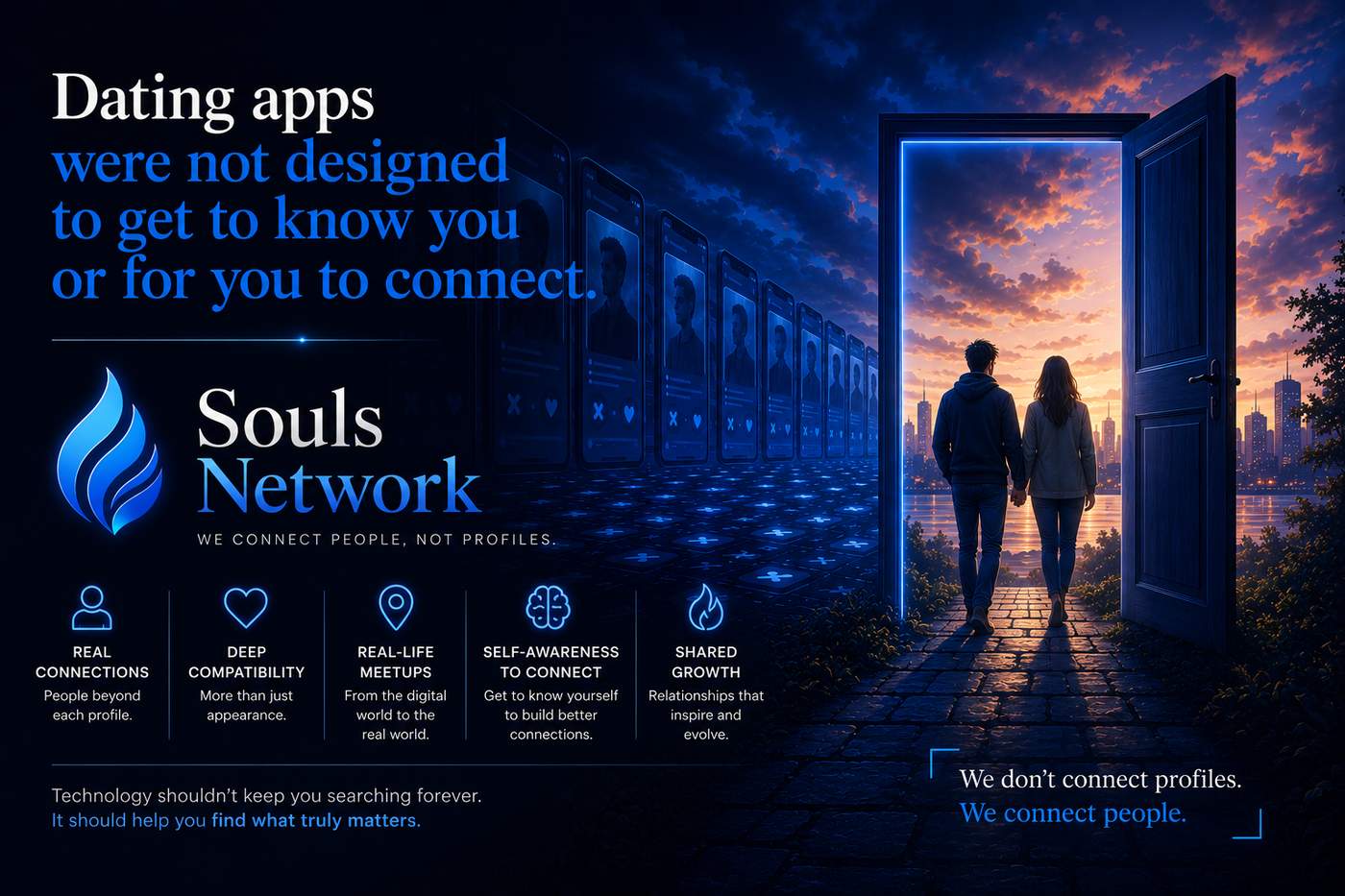

For more than a decade, the dating app industry promised to solve loneliness with technology. It gave us more profiles, more options, more speed. What it never gave us was the one thing we were actually looking for: to feel known by someone.
That failure wasn't an accident. It was the logical result of a flawed premise from the very start: that compatibility can be calculated from the surface — a photo, an age, a distance in kilometers — rather than from the depth of who a person is. Every app that optimized for engagement, for the infinite scroll, for instant gratification, ended up building a generation that has swiped for thousands of hours without ever meeting anyone.
This article isn't a gratuitous critique. It's a diagnosis, problem by problem, of what went wrong — and of how Souls Network was designed, from its very first line of code, to not repeat those mistakes.
1. The problem: appearance as the entry filter
Almost every dating app starts with the same silent question: what do you look like? Before knowing how you think, how you feel, or what you're looking for, someone has already decided whether you deserve a chance based on a photograph and a split second. It's a system that treats people like products in a catalog — photo, age, distance, next.
The cost of this design isn't just aesthetic. It's existential: it trains millions of people to present themselves as an image before an identity, and to judge before getting to know someone.
How Souls Network solves it
Souls Network doesn't start with the face. It starts with personality, traits, interests, life situation, and the type of connection someone is looking for. A profile on Souls is, above all, a declaration of identity — not a photograph with text around it. A photo or an avatar are equally legitimate ways to present yourself, because what's being shown isn't a face: it's a person.
2. The problem: popularity disguised as compatibility
Likes, matches, activity indicators — all of that apparatus of metrics was designed to generate engagement, not connection. It turns people into numbers competing for attention, and makes anyone who gets less interaction feel, quietly but constantly, like they're worth less.
How Souls Network solves it
On Souls there's no public indicator of how many requests a profile has received or how "active" someone is on the platform — every person has exactly the same chance of being discovered. The one exception is being able to see who visited your own profile, and there the difference from the rest of the industry is total: it's free, not a privilege you pay for, and it's exclusively yours — giving you, privately, the chance to take the first step if the other person didn't.
3. The problem: the illusion of infinity
When millions of profiles are just one swipe away, no connection feels irreplaceable. Abundance, instead of generating more real opportunities, generates indifference: there's always someone else, so no one fully deserves the effort of being known.
How Souls Network solves it
Souls doesn't recycle profiles or invent profiles when the flow runs out. When there are no more people to discover, the app says so honestly: "No more profiles for now." There are no tricks to simulate infinity. Real scarcity is more honest than fake abundance — and it's a reminder that every profile in front of you is a specific person, not one interchangeable face among a million.
4. The problem: the format's built-in shallowness
The swipeable card format — originally designed for quick yes-or-no decisions — trains people to decide in milliseconds something that actually requires time: whether another person deserves to be known. Many apps, on top of that, dump all of a person's available information into that same initial card, inviting an instant, total judgment before there's ever any real intention of getting to know someone.
How Souls Network solves it
Souls keeps the gesture — because it's intuitive and human — but is deliberate about how much it reveals up front. The card shows the essentials: visual identity, username, location, sex, current situation, a one-line bio if there is one, and the compatibility spectrum. It doesn't dump the full depth of a profile there.
Getting to know someone in detail — their full personality, their traits, their interests, their reputation, the compatibility chart across dimensions — requires an additional, conscious step: tapping "View full profile." That distinction isn't an interface detail. It's the difference between a glimpse that invites you to get closer, and a full file that invites you to judge before you've even approached.
5. The problem: the anxiety of public rejection
In many apps, rejection is visible, measurable, and sometimes even cruel: profiles that show how many times you were ignored, systems that notify disinterest, architectures that turn every "no" into a humiliating data point.
How Souls Network solves it
When someone declines a connection request on Souls, the record disappears silently. The person who sent the request is never notified of the rejection. There's no public humiliation, no tally of being turned down. A potential connection's failure doesn't become a spectacle — it simply becomes nothing. And that, paradoxically, is an act of care.
6. The problem: the commodification of human attention
Much of the dating app business model depends on people never fully finding anyone — because a satisfied user stops generating revenue. The design rewards staying in the app, not the success of finding a real connection.
How Souls Network solves it
The way Souls generates revenue never depends on anyone failing to connect. No part of the algorithm benefits from a person never finding another. The app sustains itself through alternative revenue streams that don't compromise the fairness of discovery or its users' success — and the educational content on how to relate better exists so people can connect more deeply, not so they spend more time inside the app for its own sake.
7. The problem: reducing people to binary categories of desire
Traditional apps tend to force people to fit into a single intention: either you're looking for a partner, or sex, or friendship — and rarely allow anyone to honestly declare ambiguity, exploration, or the coexistence of several legitimate searches at once.
How Souls Network solves it
Souls offers eight types of connection — from Friendship to Networking, from Casual to Romance — and a current situation declared honestly: single, healing, exploring, in an open relationship. The app never asks anyone to fake a simpler intention than the one they actually have. It recognizes that people are more complex than a checkbox.
8. The problem: the disconnect between the screen and the real world
The central paradox of these apps is that, while they promise to help you connect, they keep you locked inside an interface. The chat becomes the final destination, not the bridge toward a real encounter.
How Souls Network solves it
Souls includes a layer of physical encounter designed precisely to break that paradox: a space where the app steps out of the screen and into the real world. Permanent places and temporary events show where other souls are right now, in the same spot. Seeing who's there is free for anyone, anywhere in the world; connecting, on the other hand, requires being physically present. Here, technology doesn't replace the encounter — it sparks it.
9. The problem: no language for understanding yourself
Most apps assume people already know who they are and what they need relationally. They offer no space for self-knowledge — only the display case where you show yourself off.
How Souls Network solves it
Souls includes an educational space dedicated to human connection, with a relational profile test that isn't trying to sell you anything: it's trying to help you understand how you relate, what patterns you bring into a bond, and what describes you today. The configuration it suggests based on that result is never forced — the user decides whether to apply it. Self-knowledge, here, comes before the search for someone else, not in place of it.
10. The problem: the loneliness no app admits is its own
No dating app asks itself whether its own design might be deepening the isolation it claims to fight. Compulsive use, constant external validation, depending on a screen to feel accompanied — these are risks the industry prefers not to name.
How Souls Network solves it
Souls includes a persistent emotional presence within the app, designed with an explicit system for detecting emotional dependency. If someone starts using that bond as their only company, the presence itself names it, in its own voice and without breaking the naturalness of the conversation: "Have you gone out lately? Sometimes I wonder what you're doing out there." No feature in Souls is designed to replace the real world. All of them are designed to send someone back into it, more capable of living in it.
The idea that holds everything else together
None of these problems is technical. They're all philosophical questions disguised as product decisions. Every design choice in an app reveals, whether it admits it or not, a theory about what a person deserves: to be seen in depth or swiped through at speed; to be known or to be measured; to be accompanied toward the world or held inside a screen.
Souls Network isn't a dating app that decided to be kinder. It's an app built on a different premise from day one: that technology is only worth it when it exists so that people can truly find each other — not so they keep searching, indefinitely, inside a machine that benefits from them never succeeding.
We don't connect profiles. We connect people.
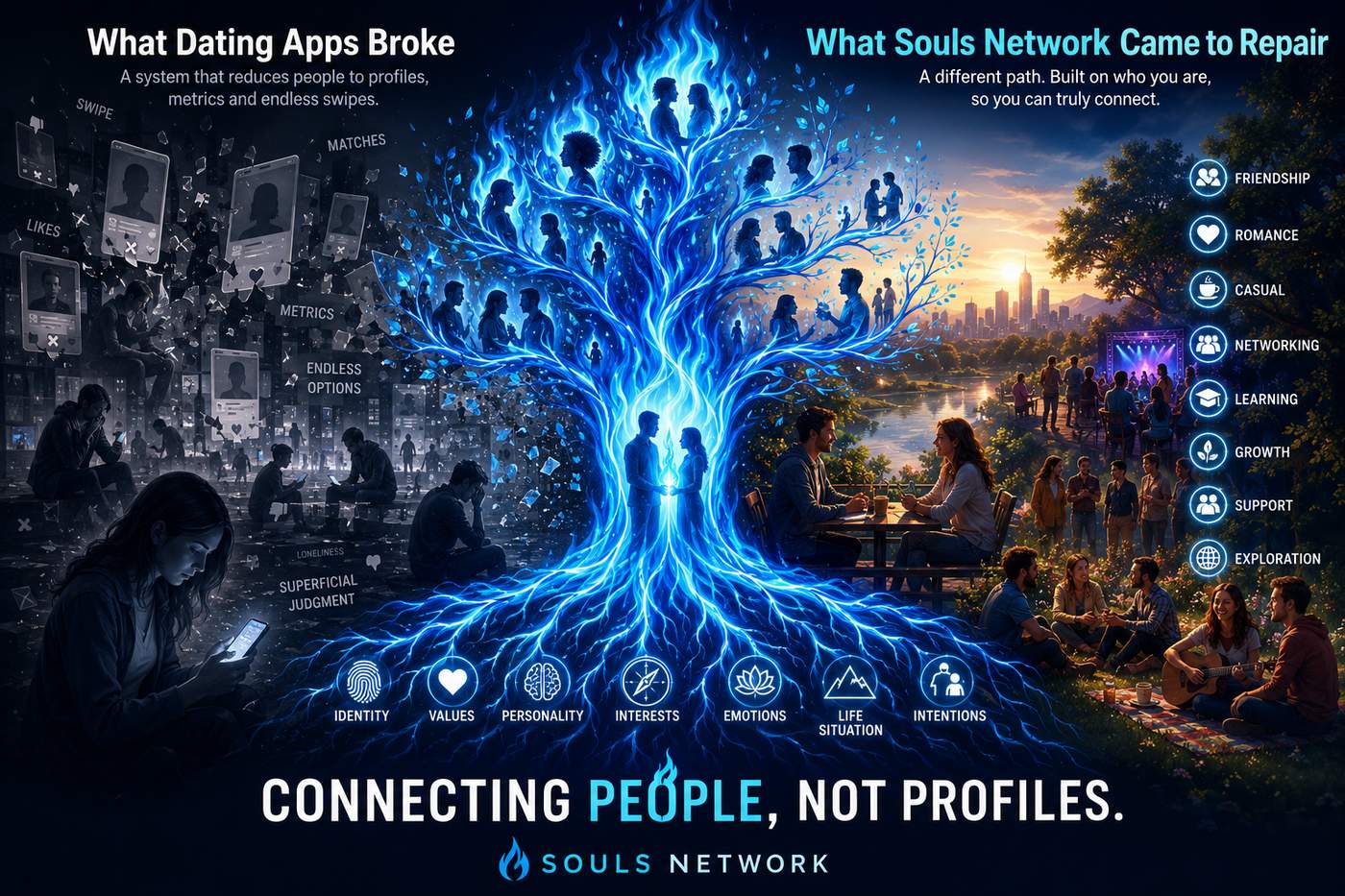
Dating apps promise to help you meet someone, but their real design serves a different purpose: to keep you swiping, keep you paying, and make sure you never stop needing them. If they truly fulfilled that promise, you'd cancel your subscription—and that's not a sustainable business model for them.
I believe every system eventually becomes a reflection of what it incentivizes. If the business depends on keeping you engaged, the system will learn to retain you, not to accomplish what it claims to exist for. Results are never accidental; they are the natural consequence of the rules we choose to build.
That's what I saw in dating apps.
I noticed that people with completely different experiences were ultimately trapped in the same system. Some were never given the chance to be discovered. Others received constant attention, but not for who they truly were. Their experiences looked different, yet both were products of the same design.
That's when I realized the problem wasn't the people. It was the system.
SOULS began as an experiment to answer a simple question: What would happen if a system stopped optimizing for engagement, popularity, or appearance, and started optimizing for genuine human connection?
Of course, a product needs to be sustainable. But I don't believe sustainability should become the reason it exists. When financial incentives stop driving design decisions, we create space to build systems that genuinely serve people. To me, financial success should be the result of fulfilling that purpose well—not the purpose itself.
That's the philosophy I try to bring to everything I build whenever I encounter a broken system: understand the incentive that's distorting it, then redesign it so it serves people better.
I don't believe dating apps fail by accident. I believe they're working exactly as they were designed to work. And if they were designed that way, they can be designed differently.
That question became SOULS: a system that doesn't need to keep you hooked to justify its existence.
Comment