Finally Found M3U IPTV 2026: What It Is & How to Use It Safely
M3U IPTV explained: what the format does, legal players, safe setup, and pricing — a concise 2026 guide for safe, legal use.
🚀 Start Streaming the Smart Way
🚀 Start Streaming the Smart Way
Most "M3U IPTV" content online falls into two camps: dry technical explainers, or setup guides that quietly point you toward unauthorized playlist links. This guide takes a third path — a genuinely practical walkthrough of how M3U playlists work, how to load them into legitimate player apps, and how to troubleshoot common issues, all while sticking strictly to legally licensed content sources.
It's written for learners who want to understand the technology properly, freelancers setting up a personal media dashboard, and startups or small business owners configuring a shared screen. If you already know what M3U is conceptually and just want to understand how to actually use it correctly and safely in 2026, this is the guide.

What Is M3U IPTV?
M3U IPTV is a plain-text playlist file format that lists stream URLs rather than storing video itself — similar to how a Spotify playlist points to songs rather than containing the audio files directly.
The Technical Basics
An M3U file contains a series of entries, each pointing to a stream URL, often with metadata like a channel name, logo, and category.
M3U8 is the UTF-8 encoded version used by HLS (HTTP Live Streaming), the adaptive-bitrate standard behind most modern legal streaming platforms.
The player app you load the file into — not the file itself — determines how the content is displayed, organized, and navigated.
🚀 Start Streaming the Smart Way
Where Legal M3U Playlists Actually Come From
Licensed IPTV subscriptions that issue an official M3U or Xtream Codes link as part of your paid account.
Personal media servers like Plex, Jellyfin, or Emby, which can generate playlists from content you own or are authorized to access.
ISP or telecom-provided IPTV bundles that deliver a playlist link as part of a legal home or business internet package.
Public, royalty-free, or educational broadcast feeds distributed legally by some government or public broadcasters.
This guide does not cover, recommend, or link to unauthorized "IPTV USA.io" sources, since these typically distribute pirated content and carry real legal and security risk.
Why Setting Up M3U IPTV Correctly Matters in 2026

HLS/M3U8 remains the dominant streaming standard, so understanding how to configure it properly is genuinely useful, transferable technical knowledge.
Self-hosted media adoption keeps growing among freelancers For IPTV USA and small businesses who want more control over their content library than a single subscription service offers.
App store policies have tightened around apps that facilitate access to unauthorized playlists, making correct setup with licensed sources more important than ever.
Malware risks tied to unauthorized IPTV Player apps have increased, making it worth understanding exactly what a safe, legitimate setup actually looks like.
Businesses using M3U-based displays need to understand licensing terms to avoid inadvertently violating a content agreement on a customer-facing screen.
🚀 Start Streaming the Smart Way
Key Benefits of a Properly Configured M3U IPTV Setup
One interface, multiple legal sources — organize a licensed IPTV subscription, personal media library, and public broadcast feeds together in a single, browsable guide.
No proprietary hardware lock-in — most M3U-compatible players run on hardware you likely already own, from a smart TV to a laptop web browser.
Custom organization — group channels by category, mark favorites, and build a genuinely personalized viewing experience rather than accepting a provider's default layout.
Cost control — many capable M3U player apps are free, with the subscription cost tied only to your chosen legal content source rather than the player itself.
Transferable skills — understanding playlist-based streaming is valuable, practical knowledge for freelancers working in media, IT, or digital signage fields.
Top Legal Player Apps for M3U Setup

1. Plex
A full personal media server that can import M3U playlists alongside your owned or licensed content library, plus its own built-in free channels.
2. Jellyfin
A free, open-source alternative to Plex with solid M3U playlist support, popular for privacy-focused, self-hosted setups.
3. Emby
Similar to Plex and Jellyfin, with M3U/IPTV tuner integration well-suited to small business media management.
🚀 Start Streaming the Smart Way
4. TiviMate
A dedicated Android/Android TV/Fire TV player known for a clean, cable-style guide interface when paired with a licensed provider's playlist.
5. IPTV Smarters Player
A widely available cross-platform player (iOS, Android, Windows, Smart TVs) that loads M3U and Xtream Codes playlists from any licensed source.
Comparison: M3U-Compatible Player Apps for Setup
Plex
Setup Difficulty: Moderate (server + client)
Platforms: Smart TV, mobile, web
EPG Support: Yes, integrated
Best For: Combining owned media with live channels
Jellyfin
Setup Difficulty: Moderate (self-hosted)
Platforms: Smart TV, mobile, web
EPG Support: Yes, via XMLTV
Best For: Privacy-focused self-hosting
Emby
Setup Difficulty: Moderate (server + client)
Platforms: Smart TV, mobile, web
EPG Support: Yes, integrated
Best For: Small business media libraries
TiviMate
Setup Difficulty: Easy (direct playlist import)
Platforms: Android, Android TV, Fire TV
EPG Support: Yes, grid-style guide
Best For: Straightforward live-TV viewing
IPTV Smarters Player
Setup Difficulty: Easy (direct playlist import)
Platforms: iOS, Android, Windows, Smart TVs
EPG Support: Yes
Best For: Cross-platform simplicity
Note: All apps listed are neutral players. Legality of use depends entirely on the licensing status of your playlist source.
Step-by-Step: How to Set Up an M3U Playlist (General Process)
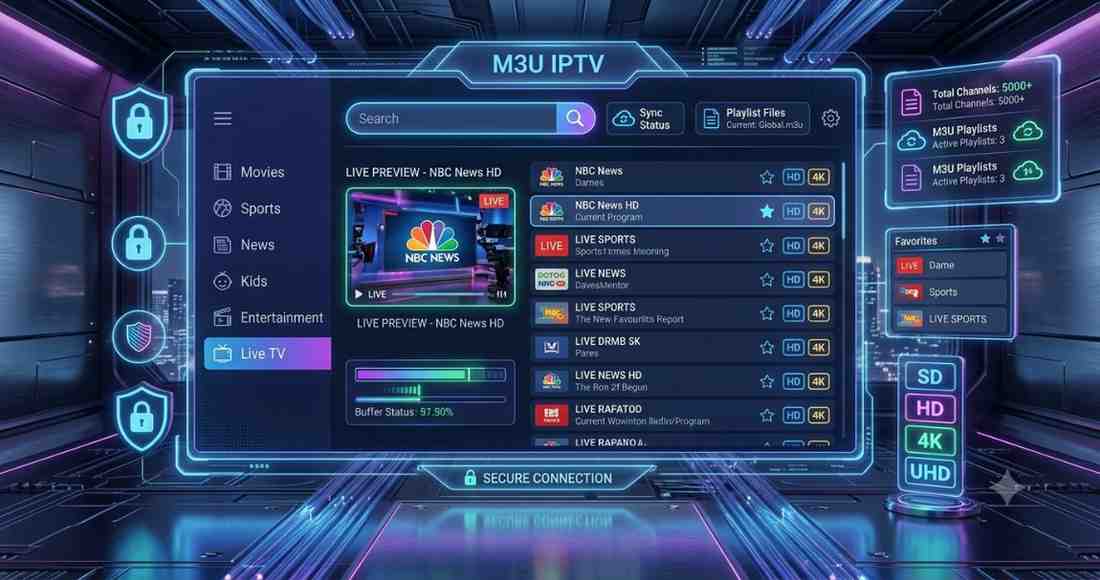
Step 1: Confirm Your Playlist Source Is Legal
Before doing anything technical, verify your M3U link comes from a licensed IPTV subscription, your own media server, or another authorized source. This single step prevents nearly every common problem associated with M3U IPTV.
Step 2: Choose the Right Player for Your Setup
Pick a media server (Plex, Jellyfin, Emby) if you're combining personal content with live channels, or a dedicated player (TiviMate, IPTV Smarters) if you just need a straightforward live-TV guide.
Step 3: Install the App From an Official Source
Download only from official app stores (Apple App Store, Google Play, Amazon Appstore, or your smart TV's built-in store) rather than sideloading from unfamiliar websites.
Step 4: Add Your M3U URL or Xtream Codes Login
Most players have a straightforward "add playlist" or "add source" option where you paste your official M3U link or enter your Xtream Codes credentials provided by your licensed subscription.
Step 5: Allow the EPG to Sync
If your provider supplies program guide (EPG) data, most apps will automatically populate a schedule once the playlist loads — this can take a few minutes on first setup.
Step 6: Organize Categories and Favorites
Use built-in category and favorites tools to organize a large channel list into something genuinely usable, rather than scrolling through an unsorted list every time.
🚀 Start Streaming the Smart Way
Step 7: Test Across All Intended Devices
If you plan to use the same setup on a smart TV, phone, and web browser, test the playlist on each device individually. Some players sync favorites and settings automatically across devices tied to one account, while others require manual configuration on each device separately.
Step 8: Set a Reminder to Check for Playlist Updates
Some licensed providers periodically refresh or rotate M3U URLs for security reasons. Bookmark your provider's account page so you can quickly retrieve an updated link if your playlist ever stops working unexpectedly.
Core Features to Configure Correctly
Buffering and Performance Settings
Most players let you adjust buffer size, which can reduce stuttering on slower connections at the cost of a slightly longer initial load time.
Multi-Playlist Management
Advanced players support loading multiple playlists simultaneously, useful for combining a personal media server with a separate licensed live-TV subscription.
Some setups benefit from keeping playlists in clearly labeled categories (e.g., "Home Media," "News Subscription," "Sports Add-on") to avoid confusion when troubleshooting later.
Parental Controls
PIN-protected restrictions are available on most players, worth configuring immediately on any shared household or office device.
EPG Source Configuration
Some players allow manually specifying an XMLTV guide URL separately from your playlist, useful if your provider supplies EPG data through a different link.
If your provider doesn't supply EPG data at all, some players support third-party, legally sourced XMLTV guide data as a supplement, though availability and accuracy vary by region.
Pricing: M3U Player Apps and Setup Costs

Plex
App Cost: Free core features
Premium: Plex Pass, roughly $5–7/mo or lifetime option
Content Cost: Separate, paid to your licensed provider
Jellyfin
App Cost: Fully free, open-source
Premium: None (donation-supported)
Content Cost: Separate, paid to your licensed provider
🚀 Start Streaming the Smart Way
Emby
App Cost: Free tier
Premium: Emby Premiere, roughly $5/mo or lifetime option
Content Cost: Separate, paid to your licensed provider
TiviMate
App Cost: Free basic tier
Premium: Roughly $6–8 one-time or annual, pricing varies
Content Cost: Separate, paid to your licensed provider
IPTV Smarters Player
App Cost: Free app
Premium: None for the app itself
Content Cost: Separate, paid to your licensed provider
Pricing changes over time — always confirm current rates on each app's official listing before purchasing.
Common Use Cases
Learners: Practicing real-world setup of HLS/M3U8 playlists as part of media technology or IT coursework.
Freelancers: Building a personal, organized media dashboard combining owned content and a licensed live-TV subscription.
Startups: Configuring a simple, low-cost office media setup using a self-hosted server or a licensed provider's playlist.
Small businesses: Setting up customer-facing displays correctly, ensuring the underlying content license permits commercial use.
IT-comfortable households: Consolidating multiple legal sources into a single, well-organized interface.
Best For: Choosing the Right Setup Path
Best for combining personal media with live TV: Plex
Best for privacy-focused, fully self-hosted setups: Jellyfin
Best for small business media management: Emby
Best for a simple, dedicated live-TV guide: TiviMate
Best for easy cross-platform access: IPTV Smarters Player
🚀 Start Streaming the Smart Way
Pros and Cons of Setting Up M3U IPTV Yourself
Pros
Full control over how your legal content sources are organized and displayed.
No dependency on a single provider's proprietary app or interface.
Works across a wide range of devices you likely already own.
Many capable player apps are free or low-cost to set up.
Builds genuinely useful technical knowledge about modern streaming infrastructure.
Cons
Initial setup requires more effort than simply opening a provider's dedicated app.
The player itself doesn't verify whether your playlist source is legally licensed.
Troubleshooting buffering or EPG issues sometimes requires basic technical comfort.
Unauthorized playlist sources are heavily marketed alongside legitimate setup guides, creating real confusion for new users.
Multi-playlist setups can become cluttered without deliberate organization.
Troubleshooting Common M3U IPTV Setup Issues
Channels Won't Load or Buffer Constantly
Confirm your internet connection meets the recommended 15–25 Mbps for HD streaming.
Adjust the buffer size setting in your player app to reduce stuttering on slower connections.
EPG Data Isn't Showing
Check whether your provider supplies a separate XMLTV guide URL that needs to be added manually.
Allow extra time on first setup, as some players take several minutes to fully sync a large program guide.
Playlist Won't Import
Double-check that the M3U URL was copied correctly and hasn't expired, which can happen with some licensed provider links after a set period.
Confirm the player app supports the specific playlist format (M3U vs. M3U8) your provider issued.
Streams Play but Audio or Video Is Out of Sync
This is often caused by network congestion rather than a playlist problem. Try switching to a wired connection or moving closer to your router if using Wi-Fi.
Restarting the player app after a long viewing session can also resolve minor sync drift on some devices.
🚀 Start Streaming the Smart Way
Favorites or Settings Don't Sync Across Devices
Confirm you're logged into the same account on each device, since some players tie sync functionality to account login rather than the playlist itself.
If your player doesn't support cross-device sync at all, consider a media server option like Plex or Jellyfin, which handle this more reliably.
Best Alternatives to a Self-Configured M3U Setup
Direct provider apps — many licensed IPTV and streaming services offer their own dedicated app, removing the need for manual M3U configuration entirely.
Free ad-supported streaming (FAST) platforms — Pluto TV, Tubi, and Samsung TV Plus require no playlist setup at all.
Telecom-provided IPTV boxes — a preconfigured, provider-managed alternative to a self-built M3U setup.
Traditional cable or satellite — still relevant where broadband reliability makes IPTV setup impractical.
Future Trends for M3U IPTV Setup in 2026 and Beyond
Simplified onboarding flows as more licensed providers move toward one-tap Xtream Codes login instead of manual playlist URL entry.
Continued dominance of M3U8/HLS as the standard underlying most legal streaming platforms.
Tighter app store scrutiny on apps facilitating unauthorized playlist sources, pushing users toward more clearly licensed setups.
Growth of self-hosted ecosystems as more freelancers and small businesses build their own Plex, Jellyfin, or Emby-based setups.
AI-assisted playlist organization, making large, multi-source channel libraries easier to browse and search automatically.
Conclusion
Setting up M3U IPTV correctly isn't complicated once you understand the fundamentals: verify your playlist source is legally licensed, choose a player app that matches your actual needs, install it from an official app store, and take a few minutes to organize your channels and EPG data properly. Whether you're building a personal media dashboard with Plex or Jellyfin, or connecting a dedicated player like TiviMate to a licensed IPTV subscription, the technology itself is straightforward and safe — as long as the content behind it is legitimate.
🚀 Start Streaming the Smart Way
Skip any setup guide that quietly points you toward "free M3U link" sites. The players covered here are genuinely capable tools, and pairing them with licensed content gives you a stable, legal, and fully functional IPTV setup in 2026.
Frequently Asked Questions (FAQ's)
Do I need coding knowledge to set up M3U IPTV?
No. Most modern player apps have a simple "add playlist" interface where you paste a URL or enter login credentials — no coding or technical scripting is required.
Why won't my M3U playlist load correctly?
Common causes include an expired or incorrectly copied URL, a mismatch between M3U and M3U8 format support, or a slow internet connection. Double-check the link with your provider and confirm your player app supports the specific format issued.
Can I use the same M3U setup on multiple devices?
Yes, as long as your licensed provider's terms allow multi-device access. Media servers like Plex and Jellyfin generally support this more flexibly than some dedicated player apps.
🚀 Start Streaming the Smart Way
Is it safe to download IPTV player apps outside official app stores?
It's best to avoid this. Sideloaded apps from unfamiliar websites are more likely to bundle malware or facilitate access to unauthorized content sources. Stick to official app stores whenever possible.
How do I know if my M3U playlist source is legal?
Legitimate sources come from a licensed IPTV subscription with transparent pricing and business information, a personal media server built from content you own, or an ISP-provided bundle. Be wary of any source that can't clearly explain its licensing.
What internet speed do I need for a smooth M3U IPTV setup?
A stable connection of at least 15–25 Mbps is generally recommended for HD streaming, with higher speeds needed for 4K content or multiple simultaneous streams.
Can businesses use an M3U setup for customer-facing displays?
Yes, provided the underlying content subscription's terms of service permit commercial or public display use. Always confirm this with your provider before deploying a customer-facing screen.
What's the easiest player app for a beginner to set up?
IPTV Smarters Player and TiviMate are generally the simplest for beginners, since they focus specifically on straightforward playlist import and a clean live-TV guide, without the additional server configuration that Plex, Jellyfin, or Emby require.
Should I use a media server or a dedicated player app for my first setup?
If you only need to watch live channels from a single licensed IPTV subscription, a dedicated player like TiviMate or IPTV Smarters Player is the faster, simpler starting point. If you also want to organize personal media, photos, or a growing licensed content library over time, a media server like Plex or Jellyfin is worth the slightly steeper initial setup.
Can I switch between player apps without losing my subscription?
Yes. Your M3U URL or Xtream Codes login belongs to your licensed provider, not to any specific player app, so you can generally re-enter the same credentials into a different compatible player if you decide to switch.

