Gojek Clone Malaysia: What Happens When Multiple Services Meet One Platform?
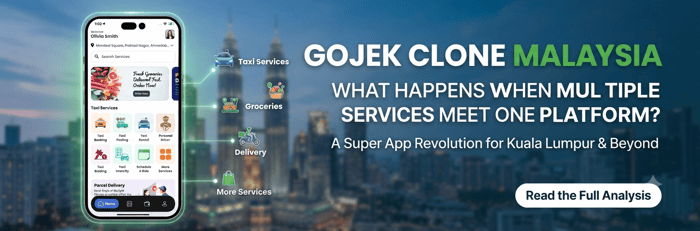
What happens when ride booking, food delivery, grocery shopping, courier services, and everyday local services are brought together under one digital platform? The answer is a business model built around convenience, repeat usage, and multiple revenue opportunities.
This is the idea behind a Gojek Clone Malaysia - a customizable multi-service platform designed for businesses that want to bring different on-demand services into a single branded ecosystem.
Malaysia provides an interesting environment for this model. The country's digital economy continues to expand, with ICT and e-commerce contributing 23.4% of the economy in 2024, according to the Department of Statistics Malaysia (DOSM). E-commerce transaction income also reached RM1.288 trillion in 2024.
But the bigger question is not simply whether people use digital services. It is how businesses can connect those services in a way that makes sense for local customers and merchants.
Why Multiple Services Change the Platform Model
A single-purpose application generally solves one problem. A multi-service platform attempts to solve several related problems from the same digital environment.
Consider a customer who needs to:
- Book a ride to work
- Order lunch
- Purchase groceries
- Send a parcel
- Schedule a home service
Instead of interacting with several unrelated platforms, a multi-service application can bring these activities together.
For a business owner, this creates another advantage: every service can become another customer touchpoint.
Someone might initially download the platform because they need a taxi. Later, the same customer may use food delivery or courier services. This creates opportunities to increase engagement without requiring a completely new customer acquisition journey for every service.
What Could a Gojek Clone Malaysia Include?
A Malaysian multi-service platform can be customized around the services a business actually wants to operate.
1. Ride-Hailing
Transportation can serve as the foundation of the platform. Customers can book rides, view driver locations, estimate fares, select payment methods, and receive trip updates.
Businesses can configure different vehicle categories depending on their operating model.
2. Food Delivery
Restaurants can list menus, receive orders, manage preparation status, and coordinate deliveries through the platform.
For customers, the experience can include restaurant discovery, digital ordering, delivery tracking, ratings, and promotional offers.
3. Grocery Delivery
Grocery delivery adds another recurring-use category. Customers can browse products, create carts, select delivery schedules, and track orders.
For merchants, the platform can provide tools for product management, inventory updates, order processing, and delivery coordination.
4. Courier and Parcel Delivery
A courier module can connect customers and businesses with delivery partners for documents, packages, and local shipments.
Features such as pickup scheduling, GPS tracking, delivery status updates, and digital proof of delivery can make the workflow easier to manage.
5. Local On-Demand Services
The platform can also be expanded into services such as home cleaning, beauty appointments, handyman services, laundry, pharmacy delivery, or other categories relevant to the target market.
The important point is that businesses do not necessarily need to launch every service on day one. They can start with a focused combination and expand as operations develop.
Why Malaysia Makes the Multi-Service Idea Interesting
Malaysia's digital ecosystem provides a strong foundation for businesses exploring online service platforms.
DOSM reported that 95.3% of establishments had internet access in 2024, while 74.4% had a web presence. E-commerce transaction income increased 8.8% to RM1.2881 trillion during the year.
Google, Temasek, and Bain & Company also reported that Malaysia's digital economy was projected to reach US$39 billion in GMV in 2025, with e-commerce, online travel, and digital financial services among the areas contributing to growth.
These figures do not guarantee that a particular multi-service startup will succeed. Instead, they show why digital platforms continue to attract attention from businesses looking for new ways to serve customers.
The Real Opportunity May Be Integration
The interesting part of a multi-service platform isn't simply having many icons on a home screen.
The real opportunity is connecting the services.
For example, a customer could order food while tracking a scheduled ride. A merchant could use delivery services for orders received through the same ecosystem. A driver could potentially receive different types of service requests depending on the platform's operational model.
This interconnected structure can create a more unified experience.
From the business side, shared technology infrastructure can also support user accounts, notifications, payments, promotions, analytics, and administrative controls across multiple service categories.
Revenue Opportunities Beyond Service Commissions
A multi-service platform can support several monetization methods.
Service commissions: The platform can charge merchants, drivers, or service providers a percentage or fixed fee depending on the business model.
Delivery fees: Customers can pay delivery or convenience fees for food, grocery, courier, or other services.
Subscription plans: Frequent users could receive benefits such as reduced delivery fees, promotional offers, or membership-based advantages.
Business promotions: Restaurants, retailers, and service providers can pay for promotional visibility within the platform.
Surge or dynamic pricing: For selected services, pricing can be adjusted according to demand, availability, distance, time, or other business rules.
The exact combination depends on the service categories, target customers, operating costs, and local requirements.
Building the Technology Around the Business
A ready-made Gojek Clone can provide the technological foundation while allowing businesses to customize the platform around their own brand and operations.
A typical ecosystem can include:
- Customer application
- Driver or delivery partner application
- Merchant/service-provider application
- Admin dashboard
- Booking and order management
- GPS and real-time tracking
- Payment integration
- Push notifications
- Ratings and reviews
- Promotions and coupons
- Earnings and commission management
- Analytics and reporting
The objective is not to reproduce another company's identity. It is to use a proven multi-service concept as a starting point and develop a platform with its own branding, services, pricing structure, and operational rules.
Localization Matters More Than Simply Adding Malaysia to the Name
Launching a platform in Malaysia requires more than changing the country setting.
Businesses need to think about local customer expectations, payment preferences, language requirements, service availability, merchant onboarding, driver operations, and applicable regulations.
Malaysia's Competition Commission published a 2026 review of the digital economy ecosystem covering areas including payment systems, e-commerce, digital advertising, online travel agencies, and data privacy. The review identified 34 issues and proposed 18 recommendations for consideration.
This highlights an important lesson for entrepreneurs: technology is only one part of building a digital marketplace. Operational processes, transparency, privacy, competition considerations, and regulatory requirements also need attention.
Start Focused, Then Expand
One common mistake with multi-service platforms is trying to launch everything simultaneously.
A more structured approach can begin with two or three services that share a customer base or operational infrastructure.
For example, a business could start with:
Ride-hailing + food delivery + courier services
Once those operations become established, grocery delivery, home services, or additional categories can be introduced.
This approach allows the company to test demand, improve operations, onboard partners, understand customer behavior, and gradually expand the ecosystem.
So, What Happens When Multiple Services Meet One Platform?
The result is more than a collection of services.
A well-designed multi-service platform can become a digital marketplace connecting customers, merchants, drivers, delivery partners, and service providers through one ecosystem.
For Malaysian entrepreneurs, a Gojek Clone Malaysia can provide the foundation for exploring this model without requiring every component to be developed from the ground up.
The bigger opportunity lies in deciding which services belong together, who the platform is built for, and how each service can create value for the wider ecosystem.
In the end, the strongest concept may not be the platform with the longest list of services. It may be the one that connects the right services, solves genuine everyday problems, and creates a smooth experience from discovery to payment and delivery.
FAQs
1. What is a Gojek Clone Malaysia?
A Gojek Clone Malaysia is a customizable multi-service platform that can combine services such as ride-hailing, food delivery, grocery delivery, courier services, and other on-demand solutions under a business's own brand.
2. Can businesses choose which services to launch?
Yes. A business can select the service categories that fit its target audience and operating model and introduce additional services as the platform grows.
3. Can the platform support multiple user types?
Yes. A typical solution can include separate experiences for customers, drivers or delivery partners, merchants, service providers, and administrators.
4. How can a multi-service platform generate revenue?
Possible models include commissions, delivery charges, subscriptions, promotional placements, service fees, and other business-specific monetization methods.
5. Is localization important for Malaysia?
Yes. Payment methods, language options, service availability, merchant operations, customer expectations, privacy, and applicable regulatory requirements should all be considered during localization.
6. Should every service be launched at once?
Not necessarily. Starting with a focused group of services can make it easier to test the business model, establish operations, and expand gradually.
7. What makes a multi-service platform different from a single-service app?
A single-service application focuses primarily on one category, while a multi-service platform connects several categories through a shared ecosystem, potentially increasing the number of ways customers and businesses can interact with the platform.
