Gojek Clone Script vs Custom Super App in Malaysia: Which Is Better for Your Business?
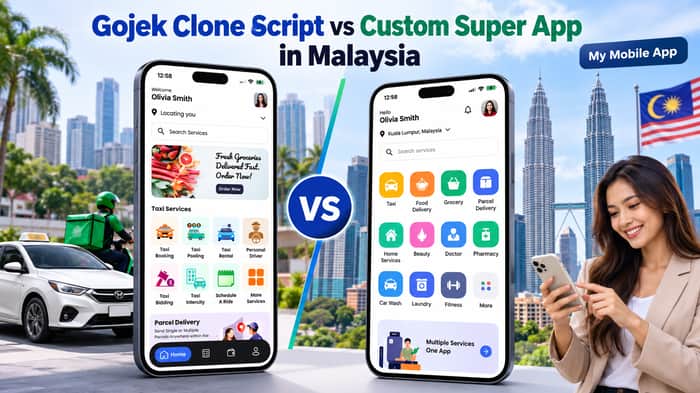
Malaysia’s digital economy is creating new opportunities for entrepreneurs who want to build on-demand platforms. From ride-hailing and food delivery to grocery shopping, courier services, home services, and digital payments, consumers increasingly expect multiple everyday services to be available through convenient mobile platforms.
This has increased interest in super app development in Malaysia. Entrepreneurs generally have two choices: launch a Gojek clone script with ready-made features or develop a completely custom super app from scratch.
Both approaches have advantages. A Gojek clone can help businesses launch faster with a proven feature structure, while custom development provides greater control over functionality, branding, integrations, and long-term product evolution.
So, which option is better for a Malaysian business?
The answer depends on your budget, launch timeline, target audience, required features, scalability plans, and level of customization.
What Is a Gojek Clone Script?
A Gojek clone script is a ready-made or customizable software solution inspired by the multi-service business model of platforms such as Gojek. Instead of developing every component from the ground up, entrepreneurs can start with an existing technology framework and customize it according to their business requirements.
A typical Gojek-style platform may include several applications and panels, such as:
- Customer mobile app
- Service provider or driver app
- Delivery partner app
- Admin dashboard
- Vendor or merchant panel
- Website or landing page
- Payment and transaction management
- Service management system
Depending on the solution, businesses can offer services such as taxi booking, food delivery, grocery delivery, courier services, home maintenance, beauty services, and other on-demand offerings.
For Malaysian entrepreneurs, the model can be adapted to local customer preferences, payment methods, service categories, languages, and operational requirements.
What Is a Custom Super App?
A custom super app is developed specifically for a particular company and its business model. Unlike a ready-made solution, the application is designed from the initial planning stage around the company's exact requirements.
A custom super app can include selected services rather than copying an existing multi-service structure.
For example, a Malaysian startup could initially build a platform combining:
- Ride booking
- Food delivery
- Grocery delivery
- Parcel delivery
- Home services
- Digital payments
- Loyalty programs
The company can then add additional services as its customer base grows.
Custom development also allows businesses to create unique workflows, user experiences, algorithms, dashboards, APIs, and third-party integrations.
Gojek Clone Script vs Custom Super App: Key Difference
The main difference is the starting point.
A Gojek clone script starts with an existing technology foundation that can be customized.
A custom super app starts with requirements and develops the technology around those requirements.
Factor
Development approach
Launch speed
Initial investment
Customization
UI/UX flexibility
Feature selection
Scalability
Maintenance
Market testing
Suitable for
Gojek Clone Script
Pre-built foundation
Faster
Generally lower
Moderate to high, depending on solution
Customizable
Existing + customizable
Depends on architecture
Usually easier initially
Faster
Startups and fast launches
Custom Super App
Built from scratch
Usually slower
Generally higher
Very high
Fully customizable
Fully controlled
Designed according to requirements
Requires dedicated development resources
Takes longer
Businesses needing unique technology
Why Malaysia Is Attractive for a Super App Business
Malaysia offers an increasingly digital environment for businesses offering mobile-first services. Consumers are familiar with mobile ordering, online payments, delivery platforms, and app-based transportation.
This creates opportunities for entrepreneurs to combine complementary services within one platform.
For example, a company could allow customers to book a ride and order food from the same application. Later, the business could add grocery delivery, courier services, or household services.
The important point is that entrepreneurs do not necessarily need to launch every possible service on day one.
A better approach can be to start with a small number of high-demand services, validate the business model, and expand gradually.
Benefits of Using a Gojek Clone Script in Malaysia
1. Faster Market Entry
One of the biggest advantages of a Gojek clone script is the ability to reduce the time required to launch.
Instead of creating every module from zero, businesses can begin with an existing application structure and customize it.
This can be particularly useful for startups that want to test their business idea before making a larger technology investment.
2. Lower Initial Development Complexity
Developing a large super app from scratch requires planning, UI/UX design, backend architecture, APIs, databases, testing, security, and multiple application interfaces.
A ready-made foundation can simplify the initial development process.
Entrepreneurs can focus more attention on branding, service operations, partnerships, customer acquisition, and market expansion.
3. Multiple Services Under One Platform
A Gojek-style solution can support multiple on-demand services from a single ecosystem.
Depending on the business model, services may include:
- Taxi booking
- Food delivery
- Grocery delivery
- Parcel delivery
- Courier services
- Home cleaning
- Plumbing
- Electrical services
- Beauty services
- Handyman services
The exact service mix should be selected according to the Malaysian market and the company's operational capabilities.
4. Easier Business Model Testing
Launching a large technology platform without testing customer demand can create unnecessary risk.
A customizable clone solution can provide a practical starting point for testing:
- Customer demand
- Service categories
- Pricing
- Provider acquisition
- Customer retention
- Commission structures
- Promotional campaigns
Once the model proves successful, additional investment can be made in advanced customization.
5. Established Feature Structure
A mature Gojek-style application generally contains important features needed for an on-demand marketplace.
These can include:
- User registration
- Social login
- Location detection
- Service search
- Booking management
- Real-time tracking
- Ratings and reviews
- Push notifications
- Wallet functionality
- Promo codes
- Order history
- Provider management
- Admin analytics
This gives entrepreneurs a structured starting point.
Benefits of Building a Custom Super App in Malaysia
1. Complete Product Control
Custom development provides greater control over the product.
Businesses can decide exactly how users, providers, merchants, administrators, and partners interact with the platform.
This is useful when the company has a business model that does not fit a standard marketplace structure.
2. Unique User Experience
A custom super app can be designed around a company's brand identity.
Every component—from onboarding and navigation to booking flows and checkout—can be designed specifically for the target audience.
This can help businesses differentiate themselves in a competitive market.
3. Advanced Integrations
A custom platform can be designed to integrate with specific third-party services.
Depending on the business requirements, integrations might include:
- Payment gateways
- Maps and location services
- SMS services
- Email platforms
- Analytics systems
- Customer support tools
- Accounting software
- CRM systems
- Loyalty platforms
For Malaysia, businesses should evaluate payment and regulatory requirements carefully before selecting integrations.
4. Greater Feature Flexibility
Suppose a company wants a unique subscription system where customers pay a monthly membership fee and receive discounted rides, delivery fees, and food orders.
A custom super app can be designed around that model from the beginning.
Similarly, businesses can build specialized loyalty programs, dynamic pricing systems, corporate accounts, referral programs, or B2B service workflows.
5. Long-Term Product Strategy
A custom application can be developed around a company's long-term roadmap.
For example:
Phase 1: Ride booking
Phase 2: Food delivery
Phase 3: Grocery delivery
Phase 4: Courier services
Phase 5: Home services
Phase 6: Loyalty and subscription features
This approach allows the technology architecture to evolve with the business.
Which Features Should a Malaysian Gojek Clone Include?
Whether you choose a clone script or custom development, the platform should provide a strong core feature set.
Customer App
The customer application may include:
- Registration and login
- Profile management
- Location selection
- Service discovery
- Booking and ordering
- Multiple payment options
- Order tracking
- Ride tracking
- Ratings and reviews
- Coupons and promotions
- Notifications
- Order history
- Customer support
Driver or Service Provider App
Providers may need:
- Registration
- Document submission
- Profile management
- Availability status
- Booking requests
- Navigation
- Earnings dashboard
- Booking history
- Ratings
- Notifications
- Support
Merchant Panel
For restaurants, grocery stores, and other vendors, useful features include:
- Product/service management
- Pricing management
- Order management
- Availability control
- Sales reports
- Promotions
- Customer information
- Payout information
Admin Dashboard
The admin panel should provide centralized control over the ecosystem.
Important functions can include:
- User management
- Provider management
- Vendor management
- Service management
- Booking management
- Commission management
- Payment monitoring
- Promotional management
- Reports and analytics
- Dispute management
- Content management
Monetization Models for a Malaysian Super App
A super app can generate revenue through several channels.
Commission
The platform can charge service providers or merchants a percentage of each completed transaction.
Delivery Fees
Customers can pay delivery charges for food, groceries, parcels, or other services.
Booking Fees
A small platform or convenience fee can be applied to selected bookings.
Surge or Dynamic Pricing
Certain services may use demand-based pricing, provided the model is transparent and compliant with applicable requirements.
Subscription Plans
Businesses can introduce membership packages that offer benefits such as reduced delivery charges or promotional discounts.
Advertising
Restaurants, merchants, and service providers can pay for promoted listings or advertising placements.
Corporate Accounts
Companies can receive specialized services for employee transportation, deliveries, or business orders.
Using multiple revenue streams can reduce dependence on a single source of income.
Gojek Clone Script vs Custom Super App: Cost Considerations
Cost is one of the biggest differences between the two approaches.
A clone script generally requires a lower initial investment because the core software already exists. Expenses may then include customization, branding, integrations, deployment, testing, hosting, and ongoing maintenance.
Custom development typically requires a larger investment because the entire product must be designed and engineered according to the company's specifications.
However, the cheapest solution is not necessarily the best solution.
Entrepreneurs should evaluate the total cost of ownership, including:
- Development
- Customization
- Infrastructure
- Security
- Maintenance
- Updates
- Third-party services
- Marketing
- Customer support
- Future feature development
The right choice is the one that provides the best balance between investment, functionality, scalability, and business goals.
Security and Compliance Considerations
Security should be considered from the beginning of any Malaysian super app project.
The platform may process personal information, location information, transaction data, and other sensitive business information.
Important areas to consider include:
- Secure authentication
- Data encryption
- Role-based access control
- Secure APIs
- Payment security
- Data backups
- Fraud monitoring
- Secure cloud infrastructure
- Privacy controls
- Regular security testing
Businesses should also assess Malaysia's applicable personal-data protection requirements and other relevant regulations based on the services they offer.
For payment processing, using established payment providers and following their security and compliance requirements can reduce unnecessary risks.
How to Choose Between a Gojek Clone and Custom Development
Before making a decision, ask these questions:
What Is Your Budget?
If you want to validate the business model with a controlled initial investment, a customizable clone solution may be more suitable.
If you have significant funding and require a unique platform, custom development may make more sense.
How Quickly Do You Need to Launch?
If speed is a priority, a ready-made foundation generally offers an advantage.
If you can spend more time on research, design, and engineering, custom development provides more flexibility.
Do You Need Unique Features?
If your business requires highly specialized workflows, custom development may be preferable.
If standard on-demand features meet most requirements, a clone solution can provide a practical starting point.
What Is Your Long-Term Strategy?
Startups entering a new market may prefer to validate demand first.
Established businesses with a clear technology roadmap may benefit from a fully customized platform.
Can You Combine Both Approaches?
Yes. A hybrid strategy can be a practical option.
A business can start with a customizable Gojek clone platform, launch its initial services, collect customer feedback, and then progressively develop proprietary features.
For example:
Stage 1: Launch with a customizable platform.
Stage 2: Add Malaysian market-specific services and integrations.
Stage 3: Analyze customer and provider behavior.
Stage 4: Develop proprietary features.
Stage 5: Expand to additional cities.
Stage 6: Introduce advanced automation, loyalty, subscriptions, or other differentiating features.
This approach can help balance speed, investment, and long-term innovation.
Final Verdict: Which Is Better for Malaysia?
There is no universal winner between a Gojek clone script and custom super app development in Malaysia.
A Gojek clone script can be a strong choice for entrepreneurs who want to launch quickly, control initial development complexity, and test a multi-service business model.
Custom super app development is better suited to businesses that need complete control, unique workflows, specialized integrations, and a long-term proprietary technology platform.
For many startups, a customizable Gojek clone can provide a practical starting point, while custom development can become part of the longer-term product strategy as the business grows.
The most important step is to define your target customers, initial services, monetization model, technology requirements, and expansion plan before selecting the development approach.
With the right strategy, a Malaysian super app can start with a focused service offering and gradually expand into a broader digital ecosystem.
Frequently Asked Questions
1. What is a Gojek clone script?
A Gojek clone script is a ready-made or customizable software solution designed around a multi-service on-demand business model. It can be adapted with different branding, services, workflows, and integrations.
2. Is a Gojek clone suitable for the Malaysian market?
Yes. A customizable Gojek-style platform can be adapted for Malaysian customers by configuring services, payment options, languages, locations, pricing, and business workflows according to the target market.
3. What is the difference between a Gojek clone and a custom super app?
A Gojek clone starts with an existing technology foundation that can be customized, while a custom super app is designed and developed specifically around a company's requirements.
4. Which option is faster to launch in Malaysia?
A Gojek clone script is generally faster to launch because the core application structure and features are already available. The actual timeline depends on customization, integrations, testing, and deployment requirements.
5. Can I add multiple services to a Gojek clone?
Yes. Depending on the platform's architecture, businesses can add services such as ride booking, food delivery, grocery delivery, courier services, home services, and other on-demand offerings.
6. Can a Gojek clone be customized with my brand?
Yes. A properly customizable solution can be adapted with your brand name, logo, colors, user interface, service categories, pricing structure, and business rules.
7. Which is more scalable: a clone script or custom app?
Both can be scalable when built on a suitable architecture. Custom development offers greater control over the architecture, while a high-quality clone solution can provide scalability through a well-designed and extensible technology foundation.
8. What monetization options can a Malaysian super app use?
Common options include commissions, delivery fees, booking fees, subscriptions, promoted listings, advertising, and corporate accounts.
9. Do I need a separate app for customers and service providers?
For many on-demand business models, separate customer and provider interfaces are useful because each user type requires different features and workflows. The exact architecture depends on the business model.
10. Should a startup choose a Gojek clone or custom super app?
A startup should evaluate its budget, launch timeline, required customization, target services, and long-term roadmap. A customizable clone can be a practical choice for faster market validation, while custom development may be better for a highly differentiated product.
