Gojek Like Multi Service App in Indonesia: A Complete Business Guide
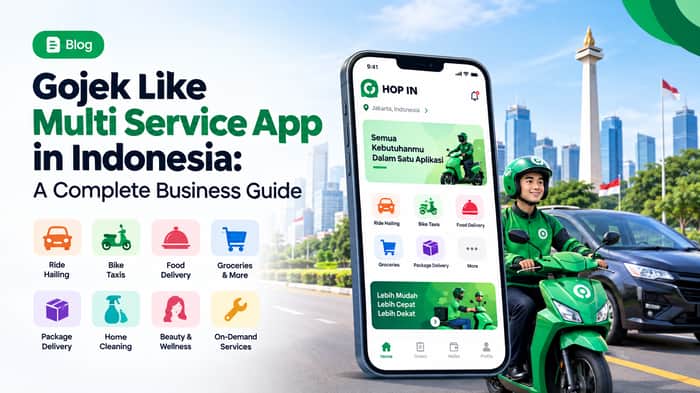
Indonesia has a rapidly growing digital economy, and consumers increasingly prefer using mobile applications to access everyday services from a single platform. Instead of downloading separate apps for transportation, food delivery, grocery shopping, courier services, and home services, users can access multiple services through one convenient application.
This growing demand has created opportunities for entrepreneurs to launch a Gojek Like Multi Service App in Indonesia. A multi-service platform can bring customers, drivers, delivery partners, merchants, and service providers together while creating multiple revenue opportunities for a business.
In this guide, we explore how a Gojek-like app works, which services it can offer, essential features, its business model, development process, and important factors to consider before launching in Indonesia.
What Is a Gojek Like Multi Service App?
A Gojek Like Multi Service App is an all-in-one mobile platform that allows users to access multiple on-demand services from a single application.
Rather than focusing on only taxi booking or food delivery, a multi-service app can combine different categories such as:
- Ride-hailing and taxi booking
- Food delivery
- Grocery delivery
- Courier and parcel delivery
- Medicine delivery
- Home services
- Beauty and wellness services
- Handyman services
- Laundry services
- Store and product delivery
- Professional services
The platform generally includes separate interfaces for customers, drivers, delivery agents, merchants, service providers, and administrators.
For Indonesian entrepreneurs, this model can provide an opportunity to build a localized digital ecosystem around the services customers use regularly.
Why Launch a Multi Service App in Indonesia?
Indonesia is a large and diverse market with strong demand for digital services. Consumers in major cities are accustomed to ordering transportation, food, products, and other services through smartphones.
A multi-service platform can address this behavior by bringing several services together.
1. Growing Demand for On-Demand Services
Customers increasingly value convenience. They want to book transportation, order meals, purchase groceries, and request services without switching between multiple applications.
A single application can simplify this experience.
2. Multiple Revenue Opportunities
A multi-service platform can generate revenue from different services instead of depending on one category.
Possible revenue streams include:
- Commission from service providers
- Delivery charges
- Booking fees
- Surge or dynamic pricing
- Merchant commissions
- Subscription plans
- Advertising
- Featured listings
- Convenience fees
The exact model depends on the services offered and the business strategy.
3. Localized Business Opportunities
Indonesia contains multiple cities, regions, customer segments, and service requirements. Entrepreneurs can build a platform specifically around local market conditions.
For example, a startup could initially focus on transportation and food delivery before expanding into grocery, courier, and home services.
4. One App, Multiple Services
The biggest advantage of a super-app-style model is convenience.
A customer could use the same account to:
- Book a ride.
- Order food.
- Send a package.
- Buy groceries.
- Request a home service.
This creates more opportunities for customers to interact with the platform.
Services You Can Include in a Gojek Like App
A Gojek-style platform does not need to launch every service from day one. Businesses can start with a selected group of services and expand gradually.
Taxi and Ride-Hailing
Users can enter pickup and destination locations, select a vehicle category, view estimated fares, book a ride, track the driver, and make payments through the application.
The platform can support different categories such as cars, motorcycles, or other locally relevant transportation options.
Food Delivery
Customers can discover restaurants, browse menus, place orders, select payment methods, and track deliveries.
Restaurants can receive and manage orders through a dedicated merchant application or dashboard.
Grocery Delivery
Users can purchase groceries and household products from participating stores.
Features can include product catalogs, search, categories, cart management, delivery scheduling, and real-time order tracking.
Courier and Parcel Delivery
Customers can request pickup and delivery services for documents, parcels, packages, and other eligible items.
The platform can calculate delivery charges based on distance, vehicle type, package details, and other business rules.
Home Services
A multi-service application can connect customers with professionals such as:
- Electricians
- Plumbers
- Cleaners
- Car washers
- Technicians
- Handymen
- Appliance repair professionals
Customers can select a service, choose a provider, schedule an appointment, and make payments through the application.
Beauty and Wellness
Businesses can also offer services such as salon appointments, massage, spa services, makeup, and other wellness-related bookings, depending on local requirements.
Essential Features of a Gojek Like Multi Service App
A successful platform requires more than a simple customer application. A complete ecosystem generally includes customer, provider, driver, merchant, and admin functionality.
Customer App Features
Important customer features include:
- Easy registration and login
- User profile
- Multiple service categories
- Location detection
- Service search
- Booking management
- Real-time tracking
- Fare or price estimation
- Multiple payment options
- Order history
- Ratings and reviews
- Push notifications
- Offers and promotional codes
- Customer support
- Digital receipts
Driver and Delivery Partner App
Drivers and delivery partners need tools to manage bookings and earnings.
Common features include:
- Driver registration
- Document verification
- Online/offline status
- Booking notifications
- Navigation
- Trip management
- Earnings dashboard
- Order history
- Ratings
- Wallet
- Withdrawal requests
- Support
Merchant App
Restaurants, stores, and other businesses can manage their operations through a dedicated interface.
Merchant functionality can include:
- Business profile
- Product or menu management
- Order management
- Availability controls
- Pricing management
- Promotions
- Earnings reports
- Order notifications
- Customer reviews
Service Provider App
For home and professional services, providers need tools to receive and manage bookings.
They can view available requests, accept or reject jobs, manage schedules, update service status, communicate with customers, and monitor earnings.
Admin Panel
The admin panel acts as the central control system.
Administrators can manage:
- Customers
- Drivers
- Delivery partners
- Merchants
- Service providers
- Services
- Bookings
- Orders
- Payments
- Commissions
- Promotions
- Reviews
- Disputes
- Reports
- Notifications
AI Features for a Gojek Like Multi Service App
Artificial intelligence can help businesses improve automation and customer experience.
Depending on the platform, AI-powered functionality can include:
Intelligent Route Optimization
The system can analyze routes and help drivers select efficient paths.
Demand Prediction
Historical booking data can be analyzed to identify demand patterns and help businesses plan driver or provider availability.
Fraud Detection
Automated systems can identify unusual transactions, suspicious account activity, or abnormal booking patterns for further review.
Personalized Recommendations
The platform can recommend restaurants, services, products, or offers based on customer activity and preferences.
AI Customer Support
AI-powered assistants can answer common questions, provide order updates, and route complex issues to support teams.
Automated Promotions
Businesses can use customer and booking data to create targeted offers and promotional campaigns.
AI should complement business operations rather than replace human oversight, particularly for payments, disputes, safety, and account decisions.
How Does a Gojek Like Multi Service App Work?
The basic workflow is relatively straightforward.
Step 1: Customer Selects a Service
The customer opens the application and selects a service such as taxi booking, food delivery, grocery delivery, or courier delivery.
Step 2: Customer Enters Requirements
Depending on the service, the customer provides pickup and destination locations, selects products, chooses a service category, or schedules an appointment.
Step 3: Provider Receives the Request
The platform identifies suitable drivers, delivery partners, merchants, or service providers.
Step 4: Booking or Order Confirmation
The selected provider accepts the request and begins processing the booking or order.
Step 5: Real-Time Tracking
Customers can monitor the status of their booking or delivery through the application.
Step 6: Payment
After completing the service, the customer pays using an available payment method.
Step 7: Rating and Review
Customers can rate their experience and provide feedback.
This feedback can help businesses monitor service quality.
Business Model of a Gojek Like App
Before development, entrepreneurs should define how the platform will generate revenue.
Commission
The platform can charge merchants, drivers, or service providers a percentage of each completed transaction.
Delivery Fees
Customers can pay delivery charges depending on distance, order type, or other pricing rules.
Booking Fees
A fixed or variable service fee can be added to selected bookings.
Subscription Plans
Businesses can introduce membership plans that provide benefits such as discounted deliveries, exclusive offers, or priority services.
Advertising
Merchants and service providers can pay to promote their businesses or products within the platform.
Featured Listings
Businesses can purchase premium placement within relevant service categories.
A platform can combine several revenue models rather than relying on one source.
How to Build a Gojek Like Multi Service App in Indonesia
There are generally two approaches: developing the platform from scratch or using a ready-made multi-service solution.
Custom Development
Custom development provides greater flexibility because the application can be designed according to specific business requirements.
However, it may require more time, development resources, testing, and maintenance.
Ready-Made Multi Service Solution
A ready-made solution can provide pre-built modules for customers, drivers, merchants, service providers, and administrators.
Entrepreneurs can customize branding, services, payment integrations, pricing rules, and other components before launching.
The right approach depends on the business model, budget, timeline, technical requirements, and expected scale.
Development Process
A structured development process can help reduce launch risks.
1. Market Research
Identify customer requirements, competitors, service gaps, pricing models, and target cities.
2. Define Services
Select the services that will be available at launch.
Starting with a focused set of services can make operational management easier.
3. UI/UX Design
Create simple interfaces for customers, drivers, merchants, and administrators.
4. Development
Develop the required applications, backend infrastructure, APIs, database, admin panel, and integrations.
5. Payment and Map Integration
Integrate suitable payment gateways, maps, location services, notifications, and communication tools.
6. Testing
Test the platform for usability, security, performance, payment processing, location accuracy, and different booking scenarios.
7. Launch
Deploy the applications to the relevant app stores and begin operations in the selected market.
8. Marketing and Expansion
After launch, monitor customer feedback and operational data before expanding into additional cities and service categories.
Cost of Developing a Gojek Like Multi Service App
The cost depends on multiple factors, including:
- Number of services
- Number of applications
- Customization requirements
- UI/UX complexity
- Technology stack
- Payment integrations
- Map and location features
- AI functionality
- Admin requirements
- Third-party integrations
- Development team
- Testing requirements
- Post-launch support
A basic multi-service solution can require significantly less investment than a fully customized platform with numerous services and advanced automation.
Instead of focusing only on the initial development cost, entrepreneurs should calculate the total technology and operational cost required to launch and scale the business.
Key Factors to Consider Before Launching in Indonesia
Launching a multi-service platform requires more than technology.
Understand Local Customer Needs
Research the specific services customers need in your target city.
Choose the Right Launch Area
Starting in a limited geographic area can make driver recruitment, merchant onboarding, delivery operations, and customer support easier to manage.
Build a Reliable Provider Network
The customer experience depends heavily on the availability and quality of drivers, merchants, and service providers.
Support Local Payment Preferences
Choose payment methods that are convenient for your target customers and comply with applicable local requirements.
Focus on Safety and Data Protection
Customer information, payment data, location information, and provider data should be handled securely.
Businesses should also review Indonesian laws and regulations applicable to transportation, payments, consumer protection, data protection, and the specific services they offer.
Final Thoughts
A Gojek Like Multi Service App in Indonesia can bring transportation, delivery, shopping, and on-demand services together within one digital platform. The model provides businesses with the flexibility to launch selected services first and expand their offerings as customer demand grows.
For entrepreneurs, the key is not simply copying an existing application. A successful multi-service platform should be adapted to its target customers, local market conditions, service-provider network, pricing strategy, payment ecosystem, and operational requirements.
With a clear business model, scalable technology, localized services, strong provider management, and a customer-focused experience, entrepreneurs can build a multi-service platform designed for the Indonesian market.
FAQs
1. What is a Gojek Like Multi Service App?
It is an all-in-one application that combines services such as ride-hailing, food delivery, grocery delivery, courier services, and on-demand services within one platform.
2. How can I build a Gojek Like App in Indonesia?
You can develop a custom application or use a ready-made multi-service solution. The choice depends on your required features, budget, customization needs, and launch timeline.
3. What services can be included in a Gojek Like App?
Common services include taxi booking, motorcycle rides, food delivery, grocery delivery, courier services, medicine delivery, home services, beauty services, and other on-demand services.
4. How does a multi-service app make money?
Revenue can come from commissions, delivery fees, booking charges, subscriptions, advertising, featured listings, and other service-related fees.
5. How much does a Gojek Like Multi Service App cost?
There is no single fixed price. Development cost depends on the number of services, customization, integrations, technology, AI features, and platform requirements.
6. Can I launch a Gojek Like App in one Indonesian city first?
Yes. Starting with one city or a limited service area can allow a business to test its concept, build a provider network, collect customer feedback, and optimize operations before expanding.
7. Does a Gojek Like App need separate apps?
A complete ecosystem may include a customer app, driver or delivery partner app, merchant app, service provider app, and an admin panel.
8. Can AI be added to a multi-service app?
Yes. AI can be used for features such as recommendations, demand forecasting, route optimization, fraud monitoring, customer support, and automated promotions.
9. What payment methods should an Indonesian multi-service app support?
The available payment methods should be selected according to the target customers, business model, and applicable Indonesian payment requirements. Local payment integrations can make transactions more convenient.
10. Is a Gojek Like Multi Service App suitable for startups?
It can be suitable for startups that have a clearly defined target market and operational strategy. Starting with a focused set of services can help a startup validate its business model before expanding.
