Great idea, zero customers — another project on the heap?
There is a brutal moment in every side project where the excitement wears off and the numbers start telling the truth.
The landing page is live.
The login works.
The pricing page exists.
The feature list sounds convincing.
The product solves a real problem.
And yet…
Nobody is using it.
That is the uncomfortable stage I am currently facing with SERPTool: a tool designed to help people find keywords they can actually rank for, rather than blindly trusting generic keyword difficulty scores.
The idea is good. I genuinely believe that.
But good ideas do not pay invoices. Customers do.
What SERPTool is supposed to solve
Most keyword research tools give you a number. Keyword difficulty. Domain authority. Domain rating. Domain score. Different names, same general idea.
The problem is that these scores can be misleading.
A keyword might have a low difficulty score, but the actual search results may be full of strong, well-optimised pages. Another keyword might look competitive on paper, but when you inspect the top 10 results, you find weak domains, thin content, missing meta descriptions, stale articles, poor titles, Reddit threads, Quora pages, or low-effort blog posts.
That is the opportunity.
SERPTool analyses live search results and looks for weakness signals in the current SERP. The site describes it as a keyword research and SERP analysis tool with domain scoring, SERP weakness detection, traffic estimates, bulk analysis of up to 1,000 keywords, CSV export, and an opportunity score.
In plain English: it tries to answer the question that actually matters:
“Can I realistically rank for this keyword?”
Not theoretically.
Not based on a vague aggregate score.
But based on what is currently ranking.
The product makes sense
On paper, SERPTool has a clear use case.
It is for:
SEO consultants
content marketers
affiliate site builders
niche site owners
small agencies
SaaS founders doing their own SEO
ecommerce businesses looking for long-tail content ideas
The core idea is not “find keywords”.
Everyone does that.
The core idea is:
Find weak SERPs before your competitors do.
That is a much more useful promise.
SERPTool’s documentation explains that it uses live SERP data, weakness detection, opportunity scoring, and result-level authority signals to help prioritise keywords. It also leans into the argument that keyword difficulty on its own is often not enough, because it hides the actual composition of the search results.
That is the bit I still think is strong.
There is a genuine insight here: people do not just need more keyword data. They need better decisions.
So why are there zero customers?
Because building the tool is not the same as building the business.
This is the trap.
As developers, makers and side-project addicts, we love the build phase. It feels productive. It gives us visible progress. Every feature added feels like proof that the idea is becoming more real.
But the market does not care how clever the implementation is.
The market cares about pain, urgency, trust and distribution.
And that is where most side projects die.
Not because the idea is bad.
Not because the product is useless.
Not because the founder is stupid.
They die because nobody knows they exist, nobody trusts them yet, and nobody has been persuaded that this is painful enough to pay for.
That is the hard truth with SERPTool.
The product has features.
The site has pricing.
The documentation exists.
The positioning is getting clearer.
But the customer acquisition engine is not there yet.
The dangerous comfort of “almost ready”
There is a phrase that kills projects:
“I just need to add one more thing.”
One more feature.
One more dashboard.
One more report.
One more integration.
One more pricing tweak.
One more landing page rewrite.
One more comparison page.
It feels responsible, but often it is avoidance dressed up as progress.
For SERPTool, it would be very easy to keep building:
rank tracking
site audits
backlink monitoring
AI content briefs
WordPress exports
agency dashboards
white-label reports
competitor alerts
API access
All of those sound useful.
But none of them answer the most important question:
Will someone pay for the thing that already exists?
Until that question is answered, more features may just mean a more impressive failure.
The real product might be the workflow
The more I think about SERPTool, the more I think the product is not really the dashboard.
The product is the workflow.
A user does not wake up thinking:
“I need a SERP weakness detection platform.”
They think:
“I need to find content ideas that can bring traffic.”
“I need to prove to a client which keywords are worth targeting.”
“I need to stop wasting time writing articles that never rank.”
“I need to find SEO opportunities my competitors have missed.”
That means SERPTool cannot just be positioned as another SEO tool.
It needs to be positioned as a decision-making tool.
Something like:
“Upload 500 keywords. Find the 20 you should actually write.”
That is sharper.
That is easier to understand.
That is closer to a buying trigger.
Zero customers is not failure yet
This is the part I have to remind myself of.
Zero customers does not automatically mean the idea is dead.
It means the project has not yet passed the market test.
There is a difference.
At this stage, the worst thing I could do is quietly throw SERPTool on the heap with every other half-launched project and tell myself I will come back to it later.
That heap is where good ideas go to become guilt.
Instead, the next step has to be uncomfortable:
speak to SEO consultants
email small agencies
post real keyword case studies
show examples of weak SERPs
offer free credits in exchange for feedback
watch where people get confused
find out whether anyone would actually use it in their workflow
find the smallest painful use case worth paying for
The job now is not to build more.
The job now is to sell, learn, and tighten the positioning.
The honest conclusion
SERPTool might become a useful product.
It might also become another project on the heap.
Both are possible.
The difference will not be the quality of the code. It will not be whether the dashboard has one more chart. It will not be whether the pricing page is perfect.
The difference will be whether I can get it in front of the right people and prove that the problem matters enough.
Because a great idea with zero customers is not a business.
It is potential.
And potential is dangerous, because it feels valuable before the market has agreed.
So that is where SERPTool is right now.
A good idea.
A working product.
A clear problem.
Zero customers.
The next phase is not development.
It is proof.

This usually isn’t a product problem so much as a messaging and distribution problem. Before building more, I’d test a few very specific value props and partner angles with the exact buyers you want, I use TractionWay.com for that because it gets real human responses with written reasoning in a few hours, and it’s helped me figure out what people actually care about before burning weeks on outreach.
The gap between 'technically works' and 'people care' is where most side projects die. It's also the part nobody wants to sit with, because it requires accepting that the interesting problem was the build, not the market.
What I've found helps is to change the definition of 'done.' A feature is done when someone uses it and gets value — not when it compiles. That framing forces distribution to be part of the build cycle rather than a phase that follows it.
What does your distribution experiment look like right now? The specific action, not the category.
That is a good way to frame it.
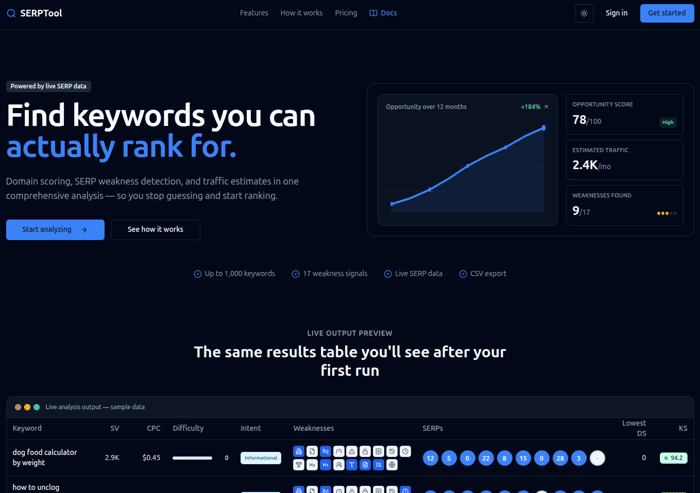
Right now the specific distribution experiment is the live example table.
Rather than explaining the product as “an SEO tool”, I’m trying to let the examples do the work. The table shows real keyword opportunities with search volume, CPC, weakness in the current SERP, and why the keyword may be worth targeting.
So the test is:
Can someone look at those examples and immediately understand the value?
More specifically, can they make the leap from “that is an interesting keyword” to “I want this for my niche”?
If the live table creates that reaction, then distribution and product are starting to overlap. If it does not, then the problem may not be the build — it may be that the value is not obvious enough yet.
Hi Robert, your honest reflection on the "Developer Trap" with SERPTool really hit home—many founders struggle with that shift from building to distribution. Since you've built a solid product and are now focused on the uncomfortable but necessary task of finding your first customers, would you be interested in a system that helps you scale distribution by connecting with multiple partners who can get SERPTool in front of the right audience?
Hi WenWang,
I am interested in investigating what that would look like. As you can imagine I am a poor developer looking to break into being financially secure in my life. I am happy to hear what you have to say.
Hi Robert, appreciate the openness — and I completely get where you're coming from. The "good product, no customers" stage is the hardest, but you've already done the heavy lifting by making it work.
We’ve built a system that lets you turn distribution into an automated engine. Essentially, you can have others to sell SERPTool for you. They can even build their own sub-teams to expand your reach organically. You simply define the revenue split, and our system handles everything else — from tracking and logic to global payouts.
There is no risk to build a sales force that only gets paid when you do. Are you open to a DM on X or LinkedIn to dive into the details?
OK shoot me a DM on X @6502Kebab - many thanks for reaching out.
Hi Robert, I have posted a reply to your post in X. Can we connect there to discuss further?