How I Validated a Developer Tool Without Talking to Users
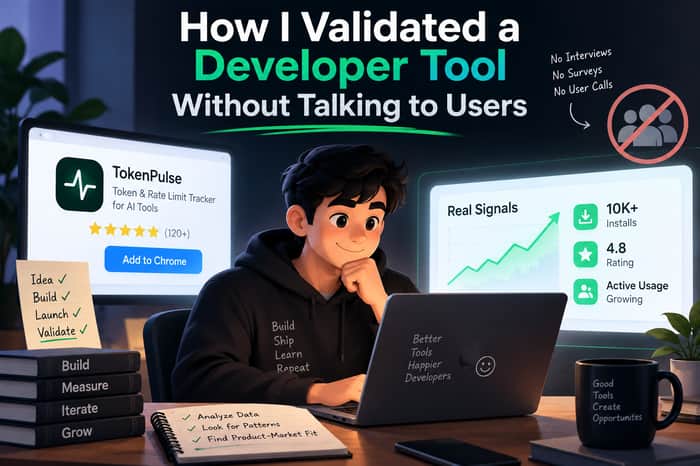
Every startup advice article tells you to talk to users before building. Interview potential customers. Validate the problem. Do not build until you have confirmed demand.
I did none of this. I had 100 active users in six weeks. Here is why the conventional advice does not always apply and what I did instead.
The problem with "talk to users" for developer tools
The standard validation advice assumes you do not know if the problem exists. You have a hypothesis about a pain point and you need to confirm it before investing time.
I did not have a hypothesis. I had the problem. I was the user. I got cut off by Claude mid-debugging session because I had no visibility into how close I was to the rate limit. The problem was not hypothetical — it happened to me that day.
When you are building for a problem you experience yourself, validation looks different. You are not trying to confirm the problem exists — you are trying to confirm that other people have it too.
How I validated without interviews
Signal 1: Reddit search
Before writing a line of code, I spent 30 minutes searching Reddit for posts about Claude rate limits and context windows. I found dozens of posts across r/ClaudeAI, r/ChatGPT, and r/webdev with people complaining about exactly the problem I had.
Comments like "Claude cut me off mid-session with no warning," "I had no idea I was so close to the limit," and "is there any way to see how much context I have left?" were not hard to find. They were everywhere.
This is passive validation — the problem has been articulated by many people who are not my friends, were not prompted to complain, and have no reason to exaggerate.
Signal 2: Chrome Web Store search
I searched "Claude rate limit" and "ChatGPT token counter" in the Chrome Web Store before building. I found a few extensions, but they either required API keys, only worked on one platform, or had not been updated in months.
The gap between what people were searching for and what was available was the validation. If good solutions existed, I would have found them and used them. I did not find them.
Signal 3: The "would I use this" test
The simplest validation for developer tools: would I actually use this product every day? Not "would this be nice to have" — would I genuinely reach for it in my workflow?
The answer for TokenPulse was yes, immediately. I had been annoyed by this problem for months. A tool that solved it would be on my list of daily utilities.
If you are building for yourself, this test is meaningful. If you are building for someone else's problem, it tells you nothing.
What validated demand actually looked like
The real validation happened after I shipped, not before.
Week 1 validation: First 15 installs from one Reddit comment. These are people who saw the extension, understood what it did from one sentence, and installed it immediately. That is real demand.
Week 2 validation: DMs asking "does it work on ChatGPT?" Multiple people asking the same question is a product roadmap. It means the core value was understood and the obvious next question was platform coverage.
Week 3 validation: A user emailed to say they had been recommending it to their team. Organic recommendation within 3 weeks of launch is strong signal.
Week 4 validation: Someone opened a GitHub issue with a feature request for cost tracking. They had looked at the code, understood the architecture, and thought about how to extend it. That level of engagement from a stranger is hard to fake.
None of this validation happened before I built. It happened because I built.
When pre-build validation is necessary
The "build first, validate second" approach works when:
- You have the problem yourself
- The build time is short (weeks, not months)
- You can reach your target user directly and quickly
- The cost of being wrong is low
It does not work when:
- You are building for a customer segment you are not part of
- The build takes six months or more
- The product requires significant infrastructure investment before it can be used
- You are in a regulated industry where building without validation wastes compliance costs
TokenPulse met all four conditions for skipping pre-build validation. Three weeks to a working product. I am the target user. I can reach developers on Reddit. Being wrong cost me three weekends.
The actual risk of skipping user interviews
The risk is not "nobody wants this." If you have the problem yourself and you see evidence of others with the same problem, demand exists.
The real risk is building the wrong solution to the right problem. My first instinct — the web dashboard — was the wrong solution. I caught it in three days before building much.
The fastest way to find the wrong solution is to build a small version of it and see how you use it. No interview would have told me "the web dashboard is wrong" as clearly as spending two days on it and realizing I would never open it mid-session.
Build small, use it yourself, adjust. That is validation enough for a developer tool with a clear, observable problem.
TokenPulse — free Chrome extension for Claude, ChatGPT, Gemini, DeepSeek, Grok.

The three-week build and the 15 installs from one Reddit comment make the approach credible, but the repeated ChatGPT requests are the stronger product signal. I would separate retention by platform and track how often users open the extension during a real debugging session, not just whether it remains installed. Have you seen a difference between people who install after a rate-limit failure and those who install from general curiosity?
The reframe is right - when you have the problem yourself, the question shifts from 'does it exist' to 'does anyone else have it.' I had the same advantage building my WordPress directory plugin: I knew the workflow pain from running one myself. The part I got wrong was assuming the buyer thinks like me. People who want to run a business directory don't feel the build pain, they feel the maintenance and monetization pain, so 'I was the user' covered maybe half the validation. How are you measuring the 'others have it too' part beyond the 100 signups - usage depth, or people hitting the same wall you hit?
Signal 2 is the one I would push harder. Searching a store tells you what exists; pulling its catalogue tells you what actually sells.
I did this on Apify recently. Their store has a public API, so instead of eyeballing search results I pulled all 13,214 listed actors with their usage stats and looked at demand vs competition numerically. Two things fell out that browsing would never have shown me:
The median actor gets 4 users a month, and the top 100 hold 64% of all demand in the store. So "only a few competitors here" means nothing on its own - the category itself can simply be dead.
The inverse trap is worse. I found several niches with zero competitors and got briefly excited, then realised zero competitors and zero demand almost always show up together. Every French-language data source I checked had no tooling AND no users. "Nobody built it" and "nobody wants it" look identical from the outside.
What ended up being the useful signal was your Signal 2 inverted: high usage on a badly-rated incumbent. That is real money plus provably unhappy users. One tool in the niche I picked had 859,000 runs at 1.93 stars. That pair of numbers told me more than an interview would have.
Your core point still does the heavy lifting though - being the user yourself is what gives you the hypothesis. The store data only tells you whether anyone else will pay for it.
This matches my experience closely. I built a tool site without doing formal user interviews either — I validated by searching where developers already hang out (dev communities, tool directories) and seeing what gaps existed in existing solutions, similar to your Chrome Web Store search.
The part that stood out to me: "the real risk is building the wrong solution to the right problem." I think that's underrated advice. It's easier to assume you know the right format (dashboard, extension, whatever) than to actually test it fast and see how you use it yourself.
Curious how you're thinking about retention now that you're past week 4 — are people coming back daily, or was it mostly a one-time install spike?
You're right to separate proving the problem from proving that other people have it. I'd also separate "people complain about it" from "they'll change their workflow to fix it." A small working prototype shared with people who wrote those posts will tell you more than another survey. With DictaFlow, the best conversations usually focus on the exact moment typing breaks down, not on whether faster text sounds useful in general.
Ran the same play for our analytics tool, but the search that mattered was not the feature name - it was the sentence people type when the thing breaks ("why is my event missing from the report"). Feature-name searches mostly surfaced competitors; the complaint-sentence search surfaced people worth building for. The part I got wrong: I read "many people complain" as "many people will switch", and most of them had already settled on a workaround that was good enough. Curious whether TokenPulse's first installs came from people who had abandoned another extension, or from first-timers who had never looked for one.
That’s a really good distinction. In my case, it was a mix, but the early users were mostly people who had already experienced the problem rather than people completely new to the category.
The interesting part was that I wasn’t really trying to convince them that rate-limit visibility was a problem. The Reddit discussions had already established that. The product just gave them a concrete solution they could try immediately.
I think your “complaint sentence” approach is actually stronger than searching for the feature name. “Why did Claude stop responding?” tells you much more about the underlying job than “Claude rate limit tracker” does.
There's an underappreciated connection between your Signal 1 and your Week 1: the Reddit threads where you did passive validation are the same threads that produced your first 15 installs. When validation happens where demand is already expressed, it doubles as distribution — you were building your launch list at the same time as your confidence. That only works because condition #3 held.
One blind spot worth naming: passive validation systematically understates demand in the places you didn't look. You searched r/ClaudeAI, r/ChatGPT, r/webdev — your own communities. The "does it work on ChatGPT?" DMs suggest the same demand pattern existed in communities you'd never searched. For a developer tool with a clear, observable problem that's a cheap fix: run your 30-minute Reddit search in the adjacent communities of every platform the problem touches, before you ship. You'll often find the roadmap before you write the code.
Exactly. That overlap between validation and distribution was probably the biggest advantage of the approach.
I was initially thinking of Reddit research purely as a way to validate the problem, but once the extension existed, those same conversations became the most natural places to introduce it.
And I agree about adjacent communities. The ChatGPT requests were a good reminder that the underlying problem wasn't really “Claude users need this” — it was “AI users don't have enough visibility into usage limits.” The platform-specific requests basically exposed the broader problem space and influenced what I built next.
The four conditions for skipping pre-build validation are useful, and #3 ("you can reach your target user directly and quickly") is the one that decides it. I hit the opposite case: I wasn't the user of my product, my buyers are strangers, and building first left me with no way to reach them.
You mention 15 installs from one Reddit comment. Do you remember what that comment did well? Answering a specific question, mentioning the extension without pitching, something else? The first strangers who tried my product also came from being useful somewhere the exact question was already being asked, so I'm curious what the pattern looked like for you.
I don't remember the exact wording, but the important part was that I wasn't dropping a promotional post. I was responding to someone who was already asking about the problem and mentioned the extension as something I had built to solve it.
That seems to be the pattern: answer the actual question first, then mention the product only if it genuinely solves the problem being discussed.
The first installs weren't really the result of “marketing” in the traditional sense. They came from putting the solution directly in front of people who were already experiencing the problem.
The store search step is the one I would keep and make harsher. When I counted one extension category the same way, 36 of them were splitting 74 monthly users between them. The complaints were all over Reddit for that problem too, they just never added up to a seat anyone paid for. On my side 875 free installs across marketplaces turned into zero payments, so an install reads as interest and not much more. You have 100 active users now, has anyone asked to pay for anything yet?
This is probably the most important challenge to my argument.
I agree that installs alone are weak evidence. They show interest and utility, but they don't automatically demonstrate willingness to pay.
I haven't treated the 100 active users as proof of a viable business. For me, the current validation question has shifted from “does anyone want this?” to “what part of this is valuable enough that developers would actually pay for it?”
That is a much harder question, and I'm still testing it. The free extension validates the problem better than it validates the business model.
Yeah the dashboard thing is the interesting part, not skipping interviews. You already knew the rate limit cut you off. What you did not know was that a separate tab would never get opened while you were mid debug. I have done that exact waste, built a page I thought was the product and then never clicked it when the problem actually happened. Two days is cheap for that lesson. Did the ChatGPT DMs change what the extension shows, or just which sites it runs on?
Mostly both, but the platform requests were the bigger signal.
The original extension was built around the problem rather than around supporting every platform. Once people repeatedly asked “does it work on ChatGPT?”, it became obvious that platform coverage was part of the value proposition.
That also reinforced the dashboard lesson: the important question isn't “what features can I build?” but “where and when will the user actually need this information?”
If the answer is “while they're actively using ChatGPT,” then putting the information inside the workflow makes much more sense than asking them to open another dashboard.
This is the most underrated validation method for developer tools. Your own pain + actual usage data = way better signal than any survey. 10K installs and 4.8 rating says everything. Love seeing devs build tools they actually needed themselves and then watching others pile in.
I agree with the broader point, although I’d separate “validation” from “usage data.”
Your own pain tells you the problem is real for at least one person. Actual usage from strangers tells you the problem extends beyond you. That combination is what made me comfortable continuing with TokenPulse.
The interesting next step for me is figuring out whether that usage translates into retention and eventually willingness to pay. Installs and ratings are useful signals, but they don't answer that question by themselves.
100 active users plus repeated requests is real signal. What behavior are you seeing that tells you which job TokenPulse should expand into next?
The strongest signal so far has actually been repeated requests around broader AI usage visibility rather than one specific feature.
People asking for ChatGPT support, cost tracking, and visibility across different AI platforms suggest that the underlying job is bigger than simply “show me my Claude limit.”
So I'm watching repeated requests and actual usage rather than trying to decide the roadmap based on which feature sounds most interesting to build.
The next question I'm trying to answer is whether TokenPulse should remain primarily a lightweight developer utility or expand into a broader AI usage management tool.