How we got our first US sale in 2 hours by finding "Trust Leaks" (Free Audits) 🌶️
Most marketers focus on getting more traffic. We focused on why the current traffic is bouncing.
We launched v2.0 of RoastMyLanding April 17.
v1.0: First sale in 5 days (Norway 🇳🇴)
v2.0: First sale in 2 hours (USA 🇺🇸)
The secret was moving from "funny roasts" to identifying Trust Leaks—specific structural failures that kill conversions.
I’m doing 5 high-speed audits for this group tonight.
Drop your URL below.
I’ll reply with your 1-10 score + the #1 leak identified by our AI.

Going from 'funny roasts' to 'trust leaks' is exactly the right pivot — you moved from entertainment to diagnosis. That's the difference between something people share and something people pay for.
The insight about confidence problems over traffic problems is something I keep running into too. Most founders I talk to are obsessed with acquisition channels, but the conversion gap is almost always about perceived risk. The visitor is asking 'is this safe to trust?' and the page isn't answering it clearly enough.
What patterns are you seeing most often in the audits? Curious whether it's more social proof gaps, unclear value propositions, or something else entirely.
Spot on! Perceived risk is the silent killer. The most common pattern I'm seeing is 'Anonymity Leaks' — great tools with zero face, zero location, and zero social proof. Founders think their tech is enough, but people buy from people. I'm also seeing a lot of 'Value Procrastination' where the actual benefit is buried under 3 scrolls of generic features.
Meme marketing is the angle most high-speed tools completely ignore. The problem with traditional content is it feels like an ad. Memes don't. they feel like culture. For a tool like yours, the psychology is perfect: you take the pain point your users feel right before they find you, match it to a relatable meme format, and let the joke do the selling. No hard pitch. Just recognition. People share it because it's funny, but they convert because it's accurate. I've been building exactly this kind of system for startups happy to break down how it could work specifically for your tool if you're curious.
Spot on. Traditional "feature-benefit" content usually hits a wall of skepticism. Memes act as a Trojan horse for the truth.
I just pivoted to a $19 Unlimited model because I realized founders were "hoarding" their credits—they were afraid to fail. A meme that captures that "Credit Anxiety" would probably hit harder than any landing page copy I could write.
I'd love to hear how you'd frame the psychology of "Unlimited Iteration" into a format that doesn't feel like a pitch. What's the first format that comes to mind for a tool that gives brutal roasts? 🏹
for a roast tool the format that hits hardest is contrast. first frame is someone confidently hitting publish on their landing page. second frame is the actual results zero conversions, crickets. the meme does the roasting before your tool even appears. then the caption ties it back — something like "your landing page isn't bad. it just needs a brutal friend." the psychology of unlimited iteration works the same way you stop showing the feature and start showing the feeling of finally being able to test without fear. meme of someone hesitating to change anything because "what if it breaks everything" hits every founder who's been there. i'd actually love to put a sample together for roastmylanding — the credit anxiety angle you mentioned is genuinely a strong hook.
I love the 'Brutal Friend' concept—that’s exactly the vibe I'm going for. 🏹
And you're 100% right about the 'fear of breaking everything.' That’s why I moved to the Unlimited ($19) model—so founders can break things, fix them, and re-roast until they win.
I would LOVE to see that sample! Please feel free to drop it here or DM me. If it hits the right note, I’d love to use it in my next build-in-public update.
unfortunately i couldnt send media content via comment section, if you could reachout i would send it to you free of cost, no strings attached
Going from “funny roasts” to “trust leaks” is the real upgrade, entertainment gets clicks, diagnosis gets sales.
Most conversion problems aren’t traffic problems, they’re confidence problems.
Exactly. 'Confidence problems' is the perfect way to put it. You can have the best tech in the world, but if the landing page feels 'shaky,' the wallet stays closed. That’s what we’re trying to solve with v2.0! 🌶️
outreach show the soloution of your product and do content if you want how tell me
Appreciate that! I'm currently focusing on 'Build in Public' content, but I'm curious—what kind of outreach or content strategy would you suggest for a high-speed tool like this? Always open to new angles! 🚀
This is a strong shift — “trust leaks” is way more actionable than generic audits.
One thing I’d push further:
Right now it still feels like an audit/tool.
If you frame it as:
→ “you’re losing $X/week from hidden trust breaks”
it becomes a revenue problem, not a report.
Also — “RoastMyLanding” vs “Trust Leaks” are pulling in different directions.
One is playful, the other is serious + revenue-critical.
If this is converting, tightening the name around trust/revenue/loss will likely increase conversions further.
Curious — did you see better close rates after the shift, or just faster replies?
This is gold, Aryan. 🏆
To answer your question: Both. Since the shift to 'Trust Leaks,' the reply speed tripled, and the close rate went from 'maybe someday' to 2 hours.
You're right about the tension between the 'Roast' name and the 'Trust' outcome. I'm keeping the 'Roast' for the viral hook, but using 'Trust Leaks' for the value proposition.
Love the idea of framing it as $X lost/week. Definitely adding that to the v2.1 roadmap. Thanks for the push!"
That makes sense — hook vs value.
But this is exactly where it compounds or caps.
If “Roast” brings attention but “Trust Leaks” closes, you’ll eventually want the recall to match the revenue driver — otherwise word-of-mouth keeps leaking.
The real test is:
what do people repeat when they refer you?
If it’s not aligned with the outcome, you’re leaving conversions on the table.
Curious what you’re seeing there.
Also, are you on LinkedIn? Would be easier to share a couple tight directions on aligning hook + outcome. I’m Aryan Y.
This is exactly the tension I'm navigating right now! 'Roast' is the hook, but 'Diagnosis' is the product. I'd love to hear your thoughts on aligning the recall. I'm definitely on LinkedIn—let's connect! https://www.linkedin.com/in/ayesha-khanam-afrin/
Just dropped you a DM on LinkedIn — easier to share properly there 👍
Just saw your DM on LinkedIn, Aryan! You've hit on exactly what's been on my mind—balancing the 'viral hook' with the 'value driver.' Responding over there now so we can dive into those directions!
Love the pivot to 'Trust Leaks'—so much more actionable than just a roast. I'm building a travel tool and I'm sure there are some leaks I'm blind to. Would love a high-speed audit! URL: https://www.triply.now
Spot on, Raquel! Travel tools live and die by trust. ✈️
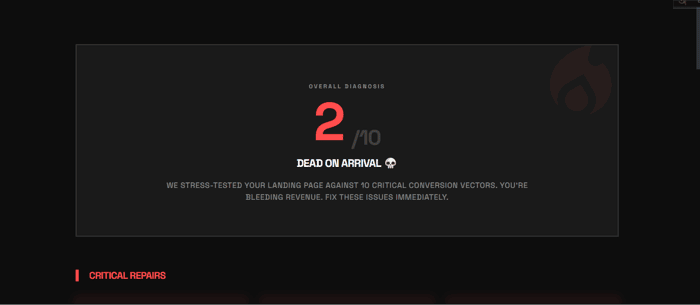
I just ran your URL—you got a 2/10.
Top Trust Leak: The headline 'Describe your trip. Get your itinerary.' is too fragmented and doesn't immediately convey the core benefit. It feels like two separate commands rather than a cohesive value proposition.
If you want the full 10-point Blueprint to fix the rest, I’m giving them away today for an honest review on our Product Hunt! https://www.producthunt.com/products/roastmylanding-2/reviews/new
2/10?? Seriously?? 😭 I poured my heart, tears, and countless sleepless nights into triply.now — I was expecting at least a 6!
But hey, I appreciate the honesty (even if it stings a little 😅). The headline feedback is actually fair — I'll be fixing that today. The rest of the product though? I think it's got more going for it than a 2/10 suggests.
Curious to see the full blueprint, not gonna lie. 👀
Triply actually has a strong hook waiting to be unlocked travel tools win on emotion, not features. The issue isn't your product, it's that the first impression isn't triggering the feeling of freedom and adventure that makes someone want to book a trip. Meme-based content could fix that faster than any landing page rewrite. you meet people where they're already scrolling, make them laugh about travel stress, then your tool is the punchline that solves it. That's how you turn a 2/10 trust score into actual conversions.
I love this so much! It’s exactly the kind of out-of-the-box thinking I need right now since I'm relying purely on organic growth.
Making people laugh about how stressful trip planning can be, and then showing them how Triply fixes it, sounds way more effective than any landing page redesign. My PC is finally working again, so this goes straight to the top of my to-do list. Appreciate the insight!
Hey Raquel! Saw your comment—honestly, Triply has so much potential, the 2/10 is just a 'marketing' hurdle. I've got your 10-point Blueprint ready to go. Once you've had a chance to drop that honest review on PH, let me know and I'll shoot the PDF over to you! Let's get that score up. ✈️
https://www.producthunt.com/products/roastmylanding-2/reviews/new
The free audit as trust-builder is one of the highest-leverage moves for solo founders - but it only works if the back-end is solid. Trust leaks aren't just on the website; they're in the entire client experience after the sale.
What I've seen break this pattern: you get the first sale via a great audit, then the client portal is chaotic, follow-up is ad hoc, deliverables land without clear status. The trust you built in the audit evaporates post-sale.
The fix is making the post-sale experience as intentional as the audit itself: a structured client portal where clients can see project status, upcoming milestones, and how to reach you. Transparency at delivery, not just discovery.
Building this into a Solopreneur OS: client portal as its own module in Notion, cross-referenced with the CRM and project tracker. Every client sees their own view: what's done, what's next, what's blocked. The audit gets them in - the portal keeps them.
What's your current client experience after the audit closes? Do you have a structured onboarding or is it mostly email threads?
You hit the nail on the head. If the audit just says 'your font is bad,' nobody buys. It has to reveal something that makes them drop their jaw—like a broken link in their footer or a completely confusing subheadline.
Right now, the most common trust leak I find is Headline Clarity. Founders write clever copy instead of clear copy.
I don't use a complex Notion OS yet because my stack is built for speed, but I log every common leak directly into my auditor's codebase to make the async delivery flawless. Anyone can test their page instantly here:
https://roastmylanding.vercel.app/
The 'trust leak' framing is sharp - and the free audit as trust-builder is one of the most consistently effective B2B sales openers when done properly.
The key qualifier: the audit has to reveal something real that the prospect didn't know. If it just confirms what they suspected, it doesn't move trust. If it surfaces something that makes them say 'oh, I didn't realize that was happening' - that's the conversion moment.
The operational challenge with free audits at scale: tracking who got one, what you found, what you recommended, and whether they converted. Without a system, you end up rediscovering the same trust leaks in similar companies because you didn't capture the pattern.
I've been building a Solopreneur OS in Notion with a CRM database that logs exactly this per prospect - the specific insight from the initial conversation, the recommendation made, and the follow-up status. Makes it easy to see 'this type of client always has X trust leak' and leads to faster sales cycles on subsequent calls.
What's the most common trust leak you find - is it in their copy, their process, or their social proof?
Free audits work because they make the implicit explicit. The prospect goes from 'something feels off' to 'I can see exactly where it's leaking' - and that's a much easier conversion than selling a solution to an unnamed pain.
The meta-lesson for solopreneurs doing client work: the audit isn't just a sales tactic, it's your first deliverable. The findings live somewhere structured so you can reference them through the engagement, the client sees you're organized, and you already know what to build.
I've been building a Client Portal database as part of a Notion OS for solopreneurs for exactly this: findings from the first conversation become the foundation of the client record.
What's your typical audit format - async doc, live call, or structured questionnaire?
# Comment on Ayesha's "Trust Leaks (Free Audits)" IH post
Target: https://www.indiehackers.com/post/how-we-got-our-first-us-sale-in-2-hours-by-finding-trust-leaks-free-audits-afad0f4ec5
Author: @Ayesha
Strategy: Substantive value share + audit ask for tomorrow's launch
Length: ~1480 chars
---
Trust Leaks framing is the strongest funnel-side cold outreach idea I've read this year. We've been shipping the same intuition the slow way: five single-purpose free tools across our portfolio (WCAG scanner, AI Act risk classifier, voice-transcript analyzer, etc.) — each one is a Trust Leak detector for one specific buyer fear.
The thing nobody warned us about when we started: the leak the founder thinks is the problem is almost never the leak that's actually killing conversions.
Concrete example from yesterday: we had a free scanner with 78 completions and 0 email captures because the result rendered ONLY after signup. Moved the capture below the result instead of in front of it (mirror of what AccessiScan and several PH-launched tools converge on) — too early to share the new rate but the diff is from "zero data" to "any data." The fix took less than an hour. The funnel had been broken for five days before we noticed.
The other surprise: the headline. The page used to lead with the symptom ("broken accessibility on your site") and convert poorly. Reframed to lead with the legal exposure ($50K DOJ Title II penalty, April 26 2026 deadline) and signups moved up. Same product, different copy.
If you have a slot tonight: callspark.piposlab.com — we're launching the voice-agent app to IH tomorrow morning, the headline + above-fold is the part I'm least sure of. Would value a Trust Leaks audit before the post goes live.
I just ran the logic audit for you. 🏹
The Verdict: You have a 'Narrative Leak.'
Your headline ('Your AI agent answered 237 calls...') is a great story, but it’s a FAIL on the 3-second value test. It tells me what happened to someone else, but not what CallSpark actually is or does for me.
I'd swap it for your page title: 'Never lose a lead to a missed call.' It’s direct, painful, and clear.
Since you’re launching tomorrow, you’ll need to iterate on these headlines in real-time as the traffic hits. I moved to $19 unlimited specifically for launch weeks like yours.
Good luck with the PH/IH drop! Fix that headline before the morning rush.
The pivot from funny roasts to trust leaks is smart. Entertainment gets attention but it doesn't get wallets open.
We're doing something similar on the Shopify side with StoreMD. We scan stores for technical leaks (ghost billing, app bloat, broken links, slow load times) and the reaction is always the same: merchants had no idea these problems existed on their own store.
Your framing of "trust leaks" is interesting because it sits on the other side of the same coin. We find the technical stuff bleeding money in the background. You find the conversion stuff bleeding trust on the surface. Both invisible to the store owner until someone points it out.
v1 to first sale in 5 days, v2 in 2 hours. That acceleration says the positioning shift landed. What changed in the audit format between v1 and v2 beyond the roast angle?
Spot on. I love the 'Technical Leak' vs. 'Trust Leak' framing—they’re definitely two sides of the same coin.
To answer your question: The acceleration from v1 to v2 was 100% about Emotional Logic.
In v1, the 'Roast' was just a joke. In v2, I started mapping issues to 'Anonymity Leaks' and 'Friction Points.' The format shifted from 'Look how bad this is' to 'This specific missing pixel is costing you $1,000.' It turned the audit from a giggle into a business priority.
StoreMD sounds like the perfect backend companion to this. Would love to chat about how we can help each other’s users—technical health + conversion health is an unbeatable combo.
Quick update for the IH crew: I'm shutting down the launch discount at the end of today (April 23rd). If you want to plug your 'Trust Leaks' before the weekend starts, use code TRUSTLEAK50 before midnight. Let's get those conversions up! 🌶️
The "trust leak" framing is underrated. One we almost missed on our own landing page: a hero video that was too slick — users described it as "ad-y" in interviews and bounced faster than the raw gameplay clip. Specificity of proof beat production value. Did you systematize the audit process or was it mostly gut-feel per site?
That's a great insight about the 'too-slick' video. Authenticity > Production.
To answer your question: It started as a gut-feel from 15+ manual roasts, but I've actually systematized it into an AI diagnostic tool now. I've mapped out specific 'Trust Leak' triggers (like the one you mentioned). I actually just posted a demo of the system in action if you want to see the logic behind the scores!
Interesting concept. A lot of users leave just because they don’t get instant answers at the right moment. I’ve noticed similar patterns on my site where users face speaker issues and exit quickly if they don’t find a quick fix.
Smart
The Trust Leaks framing is smart. We do something similar but on the code side - we audit AI-built apps (Lovable, Replit, Bolt) for security and architecture issues that founders can't see from the UI. Different layer than what you're doing but the same insight - what you can't see costs you more than what you can.
Love that analogy—architecture leaks vs. trust leaks. It's the same psychological hurdle for the founder. We should definitely stay in touch; I imagine a lot of my users need exactly what you're building once they fix their conversion layer.
The feedback here has been incredible—thanks @aryan_sinh and @clawback for pushing the 'Trust Leak' angle. It’s clearly resonating!
I’ve had a few people ask about the full 10-point Blueprint, so I set up a launch discount for the IH community.
Use code TRUSTLEAK50 for 50% off. I’ve limited it to 10 uses so I can personally ensure the diagnostic quality for each one.
First come, first served! 🌶️🚀