Hyperliquid Complete Guide for 2026

Hyperliquid has grown from a crypto derivatives platform into a broader on-chain trading ecosystem with its own Layer 1, HyperCore, HyperEVM and builder-deployed markets. In 2026, the key question is how these components perform together as competition, regulation and market structure change.
What Is Hyperliquid and Why Its Architecture Matters
Hyperliquid is a Layer 1 built around on-chain trading. Its HyperCore environment runs perpetual futures and spot markets through a central limit order book, with bids, asks and executed trades processed on the network.
The model gives traders direct control over execution and makes market activity visible on-chain. Its core elements include:
● Limit orders: traders set the price at which they want to trade.
● Market orders: trades execute against available liquidity.
● Maker/taker model: participants either add liquidity or consume it.
● On-chain data: open interest, funding, liquidations and order-book activity can be analyzed alongside price and volume.
This differs from AMM-based perpetual DEXs, where trades interact with liquidity pools and their pricing mechanisms. Hyperliquid's order-book structure has also supported automated trading and order-flow analysis.
HYPE becomes relevant when users move beyond basic market access and interact with the wider network. Those researching where to buy Hyperliquid may consider ChangeNOW as a non-custodial option for acquiring HYPE without keeping funds on a centralized exchange. The token also has staking, governance and network functions discussed below.
How Trading on Hyperliquid Actually Works
A perpetual position depends on entry price, position size, collateral and maintenance margin. Funding creates a recurring payment between traders while the position remains open, while liquidation rules determine when a position must be closed.
Orders, Margin and Funding
Hyperliquid supports market, limit, reduce-only and TWAP orders.
Cross margin allows eligible positions to share account equity. Isolated margin assigns collateral to one position, limiting the funds allocated to that trade. Leverage limits vary by asset and position size.
Funding settles hourly. When a perpetual trades above its underlying index, longs generally pay shorts. When it trades below the index, the direction reverses.
Liquidation occurs when equity falls below the required maintenance margin. Hyperliquid seeks to close the position through the market, with HLP serving as a backstop when ordinary liquidation cannot complete the process.
Reading Market Positioning
Three metrics provide a practical view of positioning:
● Open interest: outstanding perpetual exposure.
● Funding: which side is paying to maintain positions.
● Liquidations: leveraged positions being forcibly closed.
Rising open interest alongside increasingly positive funding can indicate growing long exposure. If price then falls while liquidations rise and open interest declines, leveraged longs are being removed. CVD and order-book imbalance add execution data by showing whether aggressive buying or selling is driving the move.
From HyperCore to HyperEVM: The Ecosystem
Hyperliquid extends beyond its trading environment through HyperEVM, an EVM-compatible environment connected to the network's broader infrastructure. This gives developers a way to build applications around assets and activity already present in the ecosystem.
HyperEVM as an Application Layer
Lending protocols can use on-chain collateral, trading applications can add custom execution logic and portfolio products can combine balances with market data. Assets can move between HyperCore and HyperEVM while remaining separate within each environment.
The architecture also makes trading activity observable on-chain. This provides a useful comparison with networks that prioritize transaction privacy. Bitcoin and Monero take different approaches to transaction privacy, reflecting different protocol choices around transparency and fungibility. Hyperliquid similarly makes observable market activity available to applications and analytics tools.
HLP and Liquidity
HLP provides a separate liquidity function. The vault can take trading exposure generated by activity on Hyperliquid, with its performance determined by market conditions and trading results.
HIP-3: Builder-Deployed Markets
HIP-3 introduced a way for outside teams to create perpetual markets on Hyperliquid. Since its launch in October 2025, builders have been able to launch their own perp markets by staking 500,000 HYPE. They choose the assets and key market parameters while trading runs through HyperCore.
How HIP-3 Works
Builders are responsible for market-specific elements such as the price oracle, leverage limits and open-interest caps. Each builder also operates its own frontend, so HIP-3 markets are separate from the standard Hyperliquid interface.
This gives builders room to create markets around assets outside the core crypto market. It also makes the builder part of the risk assessment. Traders should check the operator, oracle methodology and available liquidity before opening a position.
From Crypto to Traditional Assets
HIP-3 has extended Hyperliquid into stocks, indices, commodities, forex and pre-IPO assets. As of August 25, 2026, 144 live HIP-3 markets across 10 builder venues had about $3.27 billion in 24-hour volume and $3.78 billion in open interest.
Stock-linked perpetuals show why this model attracts attention. They can trade around the clock even when the underlying exchange is closed, giving traders continuous access to assets that normally follow fixed market hours.
That structure creates an additional oracle issue. Stocks and commodities can have periods without underlying market activity, so builders need a clear method for updating reference prices during overnight sessions and weekends.
Traditional-asset markets also bring regulatory considerations. Derivatives rules vary by jurisdiction and can affect which products users can access.
HYPE Tokenomics and Utility
HYPE is used for staking and governance, serves as the native gas token for HyperEVM and can provide stakers with trading-fee discounts. Its maximum supply is 1 billion, while circulating supply changes as emissions add tokens and protocol mechanisms remove them.
Where HYPE Demand Comes From
Delegators assign HYPE to validators and receive staking rewards. Staked balances can also qualify for lower trading fees, although staking limits immediate liquidity. Governance gives holders a role in protocol decisions.
HyperEVM creates routine utility because HYPE is used for transaction fees. Base and priority fees are burned at the network level, linking application activity to the token.
Supply, Emissions and the Assistance Fund
The initial allocation included 38.89% for future emissions and community rewards. These emissions can add HYPE to circulation through staking rewards.
The Assistance Fund provides an offsetting mechanism. Protocol fees are used to buy HYPE on the open market, with acquired tokens permanently removed from supply. As of August 23, 2026, about 46.7 million HYPE had been removed through this mechanism, roughly 4.7% of the original supply.
For tokenomics, the useful indicators are fee generation, staking emissions and HYPE removed through the Assistance Fund. Looking at the burn figure alone gives an incomplete view of supply dynamics.
Getting Started with Hyperliquid
Using Hyperliquid requires a compatible wallet, a supported asset and a transfer into the appropriate Hyperliquid account. The self-custodial setup means users remain responsible for transaction checks and wallet security.
Deposits and Wallet Setup
A typical setup looks like this:
● Connect a compatible wallet to Hyperliquid.
● Fund the wallet with a supported asset.
● Transfer the funds to the appropriate Hyperliquid account.
● Check the balance and market before trading.
● Withdraw funds to a user-controlled wallet when needed.
The transfer stage deserves particular care. Before sending funds, verify the destination address, asset and network. A small test transfer can confirm the route before larger amounts are moved.
Managing Funds After a Trade
After a position is closed, funds remain available until they are withdrawn or allocated elsewhere. A withdrawal sends the assets back to a wallet controlled by the user.
Private-key protection and address verification therefore remain part of routine use. The platform gives users direct control over funds, while the same setup makes transaction errors and wallet compromises the user's responsibility.
Hyperliquid vs. Other Perp DEXs
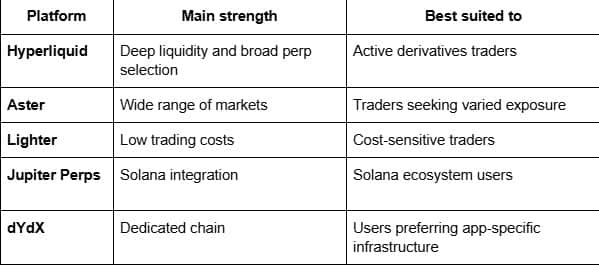
Hyperliquid entered 2026 with a substantial lead in on-chain perpetuals. CoinGecko's April 2026 data put its share of open interest across major perp DEXs at 59.1%, compared with 14.8% for Aster, 5.3% for Lighter and 2% for Jupiter.
What Gives Hyperliquid an Edge
Hyperliquid's large trader and capital base supports liquidity across major markets. Its established user base also gives new markets access to an existing pool of traders.
Competitors approach the market from different directions. Jupiter Perps benefits from Solana integration, Lighter emphasizes trading costs, Aster offers broad market coverage and dYdX operates its own derivatives-focused chain.
What Traders Should Compare
A practical comparison comes down to four factors:
Factor What to check
Liquidity Market depth and spread for the intended position size
Open interest Active capital in the market
Fees Trading cost at the expected frequency
Market selection Available assets and contract types
Hyperliquid currently leads in market activity, while competitors can remain attractive for specific cost, ecosystem or market-selection requirements.
Hyperliquid in 2026: Three Scenarios
The rest of 2026 will depend on the performance of Hyperliquid's core perpetual markets as well as HIP-3 and HyperEVM. These scenarios describe possible paths for the protocol rather than HYPE price targets.
Base: Leadership Holds
Hyperliquid retains its lead in perpetuals while competitors capture some activity. HIP-3 remains a meaningful trading venue and HyperEVM continues to attract applications without becoming the network's primary source of activity.
Stable perp open interest, market share and fee generation would support this scenario, with HIP-3 and HyperEVM adding activity around the core business.
Optimistic: A Broader Trading Venue
The stronger scenario requires sustained activity beyond crypto perpetuals. HIP-3 would maintain meaningful volume in stocks, indices and commodities while HyperEVM attracts applications with recurring users and capital.
Trading activity would become more diversified, reducing dependence on core perp markets. Institutional participation could support this path if regulatory conditions permit broader access to on-chain derivatives.
Stress: Activity Fragments
The stress scenario combines stronger competition with tighter restrictions on leveraged or traditional-asset products. Rival perp DEXs could take market share through lower costs or specialized markets, while regulatory limits could reduce HIP-3 activity.
The clearest warning signs would be sustained declines in perp open interest, market share and fee generation alongside weaker HIP-3 and HyperEVM activity.
Through the end of 2026, the most useful indicators are perp open interest, market share, HIP-3 volume and open interest, HyperEVM activity and protocol fees. Together, they show whether newer products are generating durable activity across the ecosystem.
The Road Ahead for Hyperliquid
Hyperliquid's position in 2026 rests on the depth of its core derivatives market, while HIP-3 and HyperEVM will determine how far the ecosystem can extend. For users, the relevant test is whether its markets, products and risk profile fit the intended use.
FAQ
What is Hyperliquid?
Hyperliquid is a Layer 1 blockchain focused on on-chain trading. Its HyperCore environment supports spot and perpetual markets through an on-chain order book, while HyperEVM provides an EVM-compatible environment for decentralized applications.
What is HYPE used for?
HYPE is Hyperliquid’s native token. It is used for staking, governance and HyperEVM transaction fees. Staking HYPE can also provide trading-fee discounts, while protocol mechanisms can remove HYPE from circulation.
How does trading on Hyperliquid work?
Users can trade spot and perpetual markets using market, limit, reduce-only and TWAP orders. Perpetual trading involves collateral, leverage, funding and maintenance-margin requirements, with liquidation occurring when an account no longer meets the required margin.
What are HIP-3 markets?
HIP-3 allows external builders to create perpetual markets on Hyperliquid. Builders can introduce markets linked to crypto assets, stocks, indices, commodities, forex and other assets while setting parameters such as oracle configuration, leverage and open-interest limits.
Is Hyperliquid suitable for beginners?
Hyperliquid is primarily suited to users who understand on-chain trading and the risks of leverage. Beginners should first understand wallet management, margin, funding, liquidation and the specific risks of each market before trading with significant funds.
Disclaimer: This article is for informational purposes only and does not constitute financial, investment, legal or tax advice. Cryptocurrency trading, perpetuals and leveraged products involve significant risk, including the possible loss of your entire position. Hyperliquid’s features, fees, markets and availability may change over time and can vary by jurisdiction. Always verify current information and assess the risks before using the platform or any related product.

