
alexblog
blogs0407@gmail.com

Hyperliquid has grown from a crypto derivatives platform into a broader on-chain trading ecosystem with its own Layer 1, HyperCore, HyperEVM and builder-deployed markets. In 2026, the key question is how these components perform together as competition, regulation and market structure change.
What Is Hyperliquid and Why Its Architecture Matters
Hyperliquid is a Layer 1 built around on-chain trading. Its HyperCore environment runs perpetual futures and spot markets through a central limit order book, with bids, asks and executed trades processed on the network.
The model gives traders direct control over execution and makes market activity visible on-chain. Its core elements include:
● Limit orders: traders set the price at which they want to trade.
● Market orders: trades execute against available liquidity.
● Maker/taker model: participants either add liquidity or consume it.
● On-chain data: open interest, funding, liquidations and order-book activity can be analyzed alongside price and volume.
This differs from AMM-based perpetual DEXs, where trades interact with liquidity pools and their pricing mechanisms. Hyperliquid's order-book structure has also supported automated trading and order-flow analysis.
HYPE becomes relevant when users move beyond basic market access and interact with the wider network. Those researching where to buy Hyperliquid may consider ChangeNOW as a non-custodial option for acquiring HYPE without keeping funds on a centralized exchange. The token also has staking, governance and network functions discussed below.
How Trading on Hyperliquid Actually Works
A perpetual position depends on entry price, position size, collateral and maintenance margin. Funding creates a recurring payment between traders while the position remains open, while liquidation rules determine when a position must be closed.
Orders, Margin and Funding
Hyperliquid supports market, limit, reduce-only and TWAP orders.
Cross margin allows eligible positions to share account equity. Isolated margin assigns collateral to one position, limiting the funds allocated to that trade. Leverage limits vary by asset and position size.
Funding settles hourly. When a perpetual trades above its underlying index, longs generally pay shorts. When it trades below the index, the direction reverses.
Liquidation occurs when equity falls below the required maintenance margin. Hyperliquid seeks to close the position through the market, with HLP serving as a backstop when ordinary liquidation cannot complete the process.
Reading Market Positioning
Three metrics provide a practical view of positioning:
● Open interest: outstanding perpetual exposure.
● Funding: which side is paying to maintain positions.
● Liquidations: leveraged positions being forcibly closed.
Rising open interest alongside increasingly positive funding can indicate growing long exposure. If price then falls while liquidations rise and open interest declines, leveraged longs are being removed. CVD and order-book imbalance add execution data by showing whether aggressive buying or selling is driving the move.
From HyperCore to HyperEVM: The Ecosystem
Hyperliquid extends beyond its trading environment through HyperEVM, an EVM-compatible environment connected to the network's broader infrastructure. This gives developers a way to build applications around assets and activity already present in the ecosystem.
HyperEVM as an Application Layer
Lending protocols can use on-chain collateral, trading applications can add custom execution logic and portfolio products can combine balances with market data. Assets can move between HyperCore and HyperEVM while remaining separate within each environment.
The architecture also makes trading activity observable on-chain. This provides a useful comparison with networks that prioritize transaction privacy. Bitcoin and Monero take different approaches to transaction privacy, reflecting different protocol choices around transparency and fungibility. Hyperliquid similarly makes observable market activity available to applications and analytics tools.
HLP and Liquidity
HLP provides a separate liquidity function. The vault can take trading exposure generated by activity on Hyperliquid, with its performance determined by market conditions and trading results.
HIP-3: Builder-Deployed Markets
HIP-3 introduced a way for outside teams to create perpetual markets on Hyperliquid. Since its launch in October 2025, builders have been able to launch their own perp markets by staking 500,000 HYPE. They choose the assets and key market parameters while trading runs through HyperCore.
How HIP-3 Works
Builders are responsible for market-specific elements such as the price oracle, leverage limits and open-interest caps. Each builder also operates its own frontend, so HIP-3 markets are separate from the standard Hyperliquid interface.
This gives builders room to create markets around assets outside the core crypto market. It also makes the builder part of the risk assessment. Traders should check the operator, oracle methodology and available liquidity before opening a position.
From Crypto to Traditional Assets
HIP-3 has extended Hyperliquid into stocks, indices, commodities, forex and pre-IPO assets. As of August 25, 2026, 144 live HIP-3 markets across 10 builder venues had about $3.27 billion in 24-hour volume and $3.78 billion in open interest.
Stock-linked perpetuals show why this model attracts attention. They can trade around the clock even when the underlying exchange is closed, giving traders continuous access to assets that normally follow fixed market hours.
That structure creates an additional oracle issue. Stocks and commodities can have periods without underlying market activity, so builders need a clear method for updating reference prices during overnight sessions and weekends.
Traditional-asset markets also bring regulatory considerations. Derivatives rules vary by jurisdiction and can affect which products users can access.
HYPE Tokenomics and Utility
HYPE is used for staking and governance, serves as the native gas token for HyperEVM and can provide stakers with trading-fee discounts. Its maximum supply is 1 billion, while circulating supply changes as emissions add tokens and protocol mechanisms remove them.
Where HYPE Demand Comes From
Delegators assign HYPE to validators and receive staking rewards. Staked balances can also qualify for lower trading fees, although staking limits immediate liquidity. Governance gives holders a role in protocol decisions.
HyperEVM creates routine utility because HYPE is used for transaction fees. Base and priority fees are burned at the network level, linking application activity to the token.
Supply, Emissions and the Assistance Fund
The initial allocation included 38.89% for future emissions and community rewards. These emissions can add HYPE to circulation through staking rewards.
The Assistance Fund provides an offsetting mechanism. Protocol fees are used to buy HYPE on the open market, with acquired tokens permanently removed from supply. As of August 23, 2026, about 46.7 million HYPE had been removed through this mechanism, roughly 4.7% of the original supply.
For tokenomics, the useful indicators are fee generation, staking emissions and HYPE removed through the Assistance Fund. Looking at the burn figure alone gives an incomplete view of supply dynamics.
Getting Started with Hyperliquid
Using Hyperliquid requires a compatible wallet, a supported asset and a transfer into the appropriate Hyperliquid account. The self-custodial setup means users remain responsible for transaction checks and wallet security.
Deposits and Wallet Setup
A typical setup looks like this:
● Connect a compatible wallet to Hyperliquid.
● Fund the wallet with a supported asset.
● Transfer the funds to the appropriate Hyperliquid account.
● Check the balance and market before trading.
● Withdraw funds to a user-controlled wallet when needed.
The transfer stage deserves particular care. Before sending funds, verify the destination address, asset and network. A small test transfer can confirm the route before larger amounts are moved.
Managing Funds After a Trade
After a position is closed, funds remain available until they are withdrawn or allocated elsewhere. A withdrawal sends the assets back to a wallet controlled by the user.
Private-key protection and address verification therefore remain part of routine use. The platform gives users direct control over funds, while the same setup makes transaction errors and wallet compromises the user's responsibility.
Hyperliquid vs. Other Perp DEXs
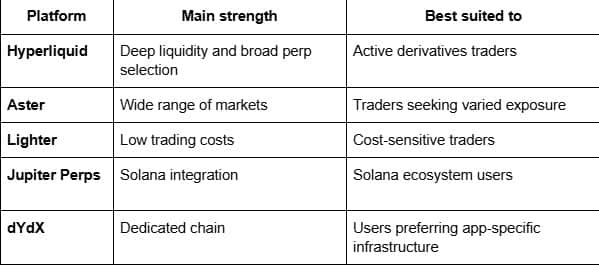
Hyperliquid entered 2026 with a substantial lead in on-chain perpetuals. CoinGecko's April 2026 data put its share of open interest across major perp DEXs at 59.1%, compared with 14.8% for Aster, 5.3% for Lighter and 2% for Jupiter.
What Gives Hyperliquid an Edge
Hyperliquid's large trader and capital base supports liquidity across major markets. Its established user base also gives new markets access to an existing pool of traders.
Competitors approach the market from different directions. Jupiter Perps benefits from Solana integration, Lighter emphasizes trading costs, Aster offers broad market coverage and dYdX operates its own derivatives-focused chain.
What Traders Should Compare
A practical comparison comes down to four factors:
Factor What to check
Liquidity Market depth and spread for the intended position size
Open interest Active capital in the market
Fees Trading cost at the expected frequency
Market selection Available assets and contract types
Hyperliquid currently leads in market activity, while competitors can remain attractive for specific cost, ecosystem or market-selection requirements.
Hyperliquid in 2026: Three Scenarios
The rest of 2026 will depend on the performance of Hyperliquid's core perpetual markets as well as HIP-3 and HyperEVM. These scenarios describe possible paths for the protocol rather than HYPE price targets.
Base: Leadership Holds
Hyperliquid retains its lead in perpetuals while competitors capture some activity. HIP-3 remains a meaningful trading venue and HyperEVM continues to attract applications without becoming the network's primary source of activity.
Stable perp open interest, market share and fee generation would support this scenario, with HIP-3 and HyperEVM adding activity around the core business.
Optimistic: A Broader Trading Venue
The stronger scenario requires sustained activity beyond crypto perpetuals. HIP-3 would maintain meaningful volume in stocks, indices and commodities while HyperEVM attracts applications with recurring users and capital.
Trading activity would become more diversified, reducing dependence on core perp markets. Institutional participation could support this path if regulatory conditions permit broader access to on-chain derivatives.
Stress: Activity Fragments
The stress scenario combines stronger competition with tighter restrictions on leveraged or traditional-asset products. Rival perp DEXs could take market share through lower costs or specialized markets, while regulatory limits could reduce HIP-3 activity.
The clearest warning signs would be sustained declines in perp open interest, market share and fee generation alongside weaker HIP-3 and HyperEVM activity.
Through the end of 2026, the most useful indicators are perp open interest, market share, HIP-3 volume and open interest, HyperEVM activity and protocol fees. Together, they show whether newer products are generating durable activity across the ecosystem.
The Road Ahead for Hyperliquid
Hyperliquid's position in 2026 rests on the depth of its core derivatives market, while HIP-3 and HyperEVM will determine how far the ecosystem can extend. For users, the relevant test is whether its markets, products and risk profile fit the intended use.
FAQ
What is Hyperliquid?
Hyperliquid is a Layer 1 blockchain focused on on-chain trading. Its HyperCore environment supports spot and perpetual markets through an on-chain order book, while HyperEVM provides an EVM-compatible environment for decentralized applications.
What is HYPE used for?
HYPE is Hyperliquid’s native token. It is used for staking, governance and HyperEVM transaction fees. Staking HYPE can also provide trading-fee discounts, while protocol mechanisms can remove HYPE from circulation.
How does trading on Hyperliquid work?
Users can trade spot and perpetual markets using market, limit, reduce-only and TWAP orders. Perpetual trading involves collateral, leverage, funding and maintenance-margin requirements, with liquidation occurring when an account no longer meets the required margin.
What are HIP-3 markets?
HIP-3 allows external builders to create perpetual markets on Hyperliquid. Builders can introduce markets linked to crypto assets, stocks, indices, commodities, forex and other assets while setting parameters such as oracle configuration, leverage and open-interest limits.
Is Hyperliquid suitable for beginners?
Hyperliquid is primarily suited to users who understand on-chain trading and the risks of leverage. Beginners should first understand wallet management, margin, funding, liquidation and the specific risks of each market before trading with significant funds.
Disclaimer: This article is for informational purposes only and does not constitute financial, investment, legal or tax advice. Cryptocurrency trading, perpetuals and leveraged products involve significant risk, including the possible loss of your entire position. Hyperliquid’s features, fees, markets and availability may change over time and can vary by jurisdiction. Always verify current information and assess the risks before using the platform or any related product.


Four months ago, the app I was working on had essentially zero visibility across the AI platforms I was tracking.
Ask ChatGPT about the category. We weren’t there.
Perplexity? Nothing.
Gemini? Nothing.
Google AI Mode? Nothing.
Grok? Nothing.
Then I started treating AI visibility as a distribution problem rather than a traditional backlink problem.
Within roughly four months, my tracking showed 800+ citations and mentions across ChatGPT, Perplexity, Gemini, Google AI Mode, and Grok.
This post is the exact process I followed, what appeared to move the needle, what underperformed, and what I’d change if I were launching another product from scratch.
One caveat before we start: I can measure the correlation between this campaign and growing AI visibility, but I can’t prove that one specific Medium post caused one specific ChatGPT answer. AI retrieval systems change constantly. So I treat this as a repeatable experiment, not a magic formula.
TL;Dr
My distribution over the first four months looked roughly like this
• 10–15 strong research-led articles on the main website
• 50 unique Medium articles
• 100 LinkedIn posts
• 40 Facebook/community posts
• Relevant Reddit/community participation and mentions
• Consistent category and competitor positioning
• AI visibility tracking from the beginning
The strongest-performing content types were specific FAQs and comparison/listicle content.
The weakest? Generic promotional posts
The Mental Model: AI Visibility Is a Distribution Problem
I started with the wrong mental model.
Like most founders who have done SEO, I was thinking:
Create pages → build links → improve rankings → wait for traffic.
But the question I actually needed to answer was:
“If someone asks an AI assistant, ‘What’s a good product for X?’, does the web contain enough credible context for that AI system to know my product belongs in the answer?”
That changed the strategy.
Instead of focusing only on my own site, I wanted the product to appear naturally in the places where a person researching the category would expect to find it:
• Reviews
• Comparisons
• Alternatives
• Listicles
• FAQs
• Founder content
• Community discussions
• Third-party mentions
The goal wasn’t to repeat the brand name everywhere.
The goal was to create consistent context.
If multiple independent-looking sources describe a product as “an invoicing tool for freelancers,” compare it with other invoicing tools, and answer questions about when it is useful, the product becomes easier to understand in relation to the category.
What I Actually Published
1. Specific FAQ Content
This was the most interesting format in my experiment.
Instead of chasing broad terms such as:
“best CRM”
I created content around narrower questions:
“What’s the best CRM for a three-person recruiting agency?”
“What’s the easiest invoicing app for a freelancer?”
“What’s a good alternative to [competitor] for small teams?”
“What software is best for [specific workflow]?”
Why did this appear to work?
My theory is that the structure closely matches how people use AI assistants: question in, answer out
A focused FAQ gives an answer engine a clear problem, a clear category, a set of options, and a useful conclusion.
2. Listicles and Comparison Posts
The next-best format was the classic:
“Top 10 [tools] for [use case]”
But I didn’t write these as disguised ads.
I included established competitors that genuinely belonged in the article, then positioned the newer product where it made sense.
For example:
1. Established tool
2. Established tool
3. Newer product
4. Established alternative
5. Specialist option
I deliberately avoided putting an unknown product at #1 with no justification.
Humans can smell that instantly, and it makes the whole page feel like affiliate spam.
A better article explains where each tool fits.
3. Category Roundups
Roundups such as:
“Best [category] apps in 2026”
also worked, especially when the article ended with a real verdict by use case.
For example
Best for freelancers: Product A
Best for larger teams: Product B
Best for beginners: Product C
Best for a specific niche: Product D
That’s more useful than pretending one product is universally “the best.”
The Distribution Numbers
This is the part that turned the strategy from content marketing into a production system.
In under four months, I pushed roughly:
50 Medium articles
Every article was unique. Different topic, angle, wording, and structure.
100 LinkedIn posts
This was the highest-volume channel in the campaign. I mixed list-style posts, founder observations, category education, and problem/solution content.
40 Facebook and community posts
These produced less obvious citation impact than LinkedIn in my tracking, but they added distribution diversity.
Reddit and community mentions
I looked for real discussions already happening around the problem and category.
The important part: don’t manufacture fake conversations, coordinate fake comments, or pretend unrelated accounts “discovered” your product.
Participate where you actually have something useful to add. Reddit communities are especially good at detecting marketing behavior.
10–15 foundation articles on the product website
I consider these essential.
Distributed content works much better when it points back to a site that clearly explains:
• What the product does
• Who it’s for
• How it works
• What it costs
• How it compares
• Which problems it solves
A weak website gives all of your third-party distribution nowhere credible to lead.
What I Learned From Each Channel
If I were doing this again, LinkedIn would remain a major part of the strategy.
But I’d lean even harder into founder-led posts rather than generic company content.
For example:
“I analyzed 50 prompts buyers use when researching [category]. Here are the five questions that kept appearing.”
That creates something people may actually want to read while still establishing category context.
Medium
Medium worked well as a place to publish longer, focused articles quickly.
The mistake would be posting the same article 50 times with minor rewrites.
I wanted topic diversity, not duplicate pages.
Instead of producing 10 versions of “Best Accounting Software,” I’d use angles like:
• Best accounting software for freelancers
• QuickBooks alternatives for consultants
• How solo founders should track expenses
• Best bookkeeping tools for contractors
• Product A vs Product B
• What should accounting software cost?
Same market. Different intent.
Reddit is not a content syndication platform.
It is a community.
The best approach is to find relevant questions and contribute useful experience.
If your own product genuinely solves the problem, say so transparently where the subreddit rules allow it.
A sentence like:
“I built X after running into this exact problem, so take my recommendation with that bias…”
is more credible than trying to manufacture social proof.
What Didn’t Work
Generic promotion performed poorly.
Posts whose entire message was basically:
“Here’s our product. It’s great. Check it out.”
had almost no measurable citation impact compared with FAQs and comparisons.
I also wouldn’t repeat exact-match messaging across dozens of sites.
The product/category relationship should stay consistent, but the language should vary naturally.
And I would never pay for fake discussion or fake endorsements.
The objective is to make the product easier to discover and understand, not to fabricate consensus.
How I Outsourced the Work
There was no realistic way I was going to personally write nearly 200 pieces of content while also building the product.
So I turned it into a briefing and production system.
The brief I gave writers was intentionally small:
1. One specific title
2. The product URL
3. At least three legitimate competitors or alternatives to consider
4. A target length, usually around 800–1,200 words for articles
That was usually enough.
I wanted different writers to sound like different writers.
Over-templating everything would defeat the point.
One brief. One angle. One unique piece.
If You’d Rather Buy the Distribution Than Coordinate It Yourself
Once you understand the strategy, execution becomes a production problem: research topics, source writers, publish unique pieces, place community mentions, coordinate Medium and LinkedIn distribution, and track what happens afterward.
For founders who don’t want to build that operation themselves, LLMentioned packages this kind of AI-visibility distribution, including Reddit/community mentions plus LinkedIn and Medium content.
LLMentioned AI Visibility: https://www.1stpage.agency/llmentioned-ai-visibility/
I’d still keep strategy close to the founder
No external service knows your customer, positioning, competitive advantages, and product truth as well as you do.
Outsource production if it makes sense. Don’t outsource the thinking.
Disclosure note before publishing: if you own, work with, receive commission from, or otherwise have a commercial relationship with LLMentioned / 1stPage.agency, state that relationship clearly in this section. Indie Hackers readers are generally much more receptive to transparent promotion than hidden promotion.
How I Tracked the Results
I tracked AI visibility rather than relying only on referral traffic.
The questions I cared about were:
• Are AI platforms mentioning the product?
• Which prompts trigger mentions?
• Which sources are being cited?
• Which competitors appear more often?
• Is visibility trending up over several weeks?
• Are AI referrals turning into signups or revenue?
I also learned not to obsess over daily fluctuations.
At one point, ChatGPT visibility climbed much higher and then settled lower.
That didn’t automatically mean the strategy had stopped working.
AI search results change. Retrieval changes. Sources rotate. Prompts vary.
The multi-week trend is more useful than yesterday’s number.
What Appeared to Drive the Most Citations
Based on my own tracking, the rough order was:
1. Specific FAQs
2. Comparison/listicle content
3. Category roundups with a clear conclusion
4. Useful founder/category posts
5. Plain promotional posts
The common denominator was usefulness plus context.
The better the piece answered a real question, the more valuable it seemed to be.
If I Were Launching a New SaaS Tomorrow
I’d repeat the strategy in five phases.
Phase 1: Build the foundation
Publish 10–15 genuinely useful pages on the product site.
Cover the main problem, use cases, comparisons, alternatives, FAQs, pricing questions, and terminology buyers actually use.
Phase 2: Publish 30–50 third-party articles
Start with Medium and other relevant publishing opportunities.
Mix FAQs, comparisons, alternatives, roundups, and how-to content.
Every piece should target a different useful angle.
Phase 3: Build LinkedIn distribution
Publish consistently for six to eight weeks.
Mix founder lessons, research, problem breakdowns, product-category insights, and comparisons.
Don’t make every post a pitch.
Phase 4: Participate in communities
Find where people are already discussing the problem.
Reddit, Indie Hackers, niche forums, Facebook groups, Slack communities, and other relevant spaces can all matter depending on the market.
Contribute first. Promote only when relevant and permitted.
Phase 5: Measure from day one
Establish a baseline before you start.
Then track AI mentions, citations, prompts, competitors, referral traffic, signups, and—ultimately—revenue.
A Smaller Version for Indie Hackers Who Don’t Have a 190-Post Budget
You do not need to start with 190 pieces.
If I were a solo founder testing this with limited time and budget, my first 30 days would look like:
Week 1:
Publish three strong FAQ/comparison pages on the main site.
Week 2:
Publish five unique Medium articles targeting narrow customer questions.
Week 3:
Publish three to five genuinely useful LinkedIn posts and participate in five relevant community discussions.
Week 4:
Check which prompts and pages are showing signs of visibility, then double down on the angles that are working.
The point is to prove the model before scaling the production.
Final Takeaway
The biggest change for me was stopping thinking about AI visibility as “SEO, but for ChatGPT.”
It’s closer to building a web-wide body of evidence around your product:
What is it?
Who is it for?
What problem does it solve?
Which category does it belong to?
How does it compare with known alternatives?
When should somebody choose it?
Your own website should answer those questions.
Then useful third-party content and genuine community participation should reinforce them.
That’s the system I used to go from essentially zero tracked AI visibility to 800+ citations and mentions in roughly four months.
I wouldn’t copy the exact numbers blindly.
I’d copy the process:
Build a strong source of truth.
Create useful category context.
Distribute it widely.
Keep the content genuinely unique.
Participate in communities transparently.
Track what the AI platforms actually surface.
Then scale the formats that work.
That’s what I’d do again.

A niche content site sounds like an excellent strategy until you choose a subject where getting the facts wrong matters.
Online poker is a prime example. Search terms for poker topics include intense affiliate competition, state laws, offshore operators, and constantly evolving rules. A page that ranks well is not useful if its legal information is outdated or if readers are given an inaccurate picture of what is available in their state.
For founders building content-driven businesses, poker presents an interesting SEO case study. You have to do more than find keywords and produce more content than your competitors. You must also demonstrate why readers and search engines should trust what you've published.
SEO Gets Harder When Accuracy Matters
One common mistake poker and gambling SEO managers make is using the same approach that works for most other verticals. While the fundamentals of SEO still matter, regulated topics add a layer some don’t fully consider.
Since gambling leans heavily into YMYL, SEO managers can’t afford to treat all gambling-themed sites like a traditional informational site. This approach may work well for general information sites on how to play poker games. However, once you start moving into legal areas, things change.
If someone is searching for “online poker laws in Texas”, that search has a potential influence on a person's finances and may even carry legal implications. To meet Google's E-E-A-T requirements, accuracy is crucial if you want to rank highly and retain those rankings.
The LegalUsPokerSites.com Approach
LegalUsPokerSites.com is a useful case study because its content reflects the subject's complexity rather than simplifying US poker into a handful of generalized landing pages.
Its core content includes state-specific poker law pages alongside poker room reviews, industry news, and educational resources. The site was launched in 2011 and describes its mission as helping US players understand poker legislation and evaluate online poker rooms.
The state-level content is key to its success. There isn't one answer to "Is online poker legal in the United States?" Nine states have legalized online poker, but only six have launched regulated poker rooms. The legal situation in the other states varies considerably.
Let’s look at how different laws can be between two states. Washington explicitly criminalizes unauthorized online gambling, while Rhode Island has legalized online poker but does not yet have a state-regulated poker platform available to players.
You have to approach each site individually, both from an SEO and editorial perspective. Creating content focusing exclusively on a keyword is not enough. You have to provide accurate information that meets what players in each state are looking for.
Programmatic SEO Isn't Enough
Another mistake some gambling SEO managers make is creating too much repetition. They stick to a repeatable structure and scale it across the entire site. While this creates content quickly, it often falls short on usefulness.
A better approach is to customize pages based on each state’s laws. This includes citing specific state statutes, discussing previous legislative attempts, identifying the appropriate state regulator, and explaining the difference between regulated and offshore markets in each state.
This approach makes your pages less repetitive and genuinely useful to users.
Freshness Is Part of the Product
The more evergreen content is, the better for a company financially. Content ranks for an extended period without needing to pay for constant updates.
Regulated niches rarely work that cleanly. Gambling laws are constantly evolving, regulators change policies, and operators regularly enter and leave markets.
For example, if you look at LegalUsPokerSites.com's current California page, you’ll see recent information about the state’s sweepstakes gambling ban that went into effect in January 2026. Other pages have updated information regarding changes in gaming laws and current bills that are being considered by state legislatures.
Updating existing content is not just housekeeping. It is part of the product. Google's own guidance recommends regularly assessing whether content remains helpful rather than making changes because your ranking slipped.
For founders, this creates a recurring cost to consider before entering a regulated niche. Every evergreen page you create may be accompanied by a hefty maintenance obligation.
Lessons for Indie Hackers Entering Difficult Niches
This poker example provides useful insight for anyone considering a content business in a regulated or high-competition vertical.
First, determine whether geography or regulation affects search intent. If it does, focus your content around those differences to bring genuine value to visitors.
Next, factor content maintenance into your budget. Pages containing laws, regulations, product availability, or other changing information will require future updates to stay relevant.
Finally, don't mistake a high ranking with credibility. You can optimize a page well enough to reach the first page of Google, but staying there in a competitive niche requires giving readers a reason to prefer your answer once they arrive.
The Bigger SEO Lesson
Online poker is an extreme example of a problem many sites are experiencing across the web. Publishing content has become cheap, especially with the advent of AI. Creating content people trust requires a significant investment of time and money.
Google's guidance emphasizes helpful and reliable content over pages that are created to attract search traffic. For founders, this creates an opportunity.
Gaining an advantage in a competitive content niche boils down to understanding the subject better, updating content with the most relevant information, and building content around nuances that most competitors miss.
LegalUsPokerSites.com illustrates what that looks like in online poker, where every state can create a different search problem and yesterday's accurate legal guide can become tomorrow's outdated content.
The lesson applies beyond gambling. If you're entering a competitive niche, don't focus exclusively on whether you can rank for its keywords. Instead, ask whether you're prepared to become a reliable resource on the subject behind those keywords.
That's a considerably harder business to build, but it's also much more difficult for the next publisher to copy.

While the fact that we enjoy online gambling differently is almost a truism, it’s important to note that these divergences depend on various factors. Most of them have something to do with expenditures and frequency of play, and that tells how we perceive priority.
In this article, we will discuss this reality by assessing several slot player archetypes. We’ll focus on this game category mostly because it’s mostly uniform as an experience. As a constant that unifies gaming of this sort, it can help to look at where the differences actually lie.
As for the way we’ve found the data that informs these categories, we have relied on expenditure logs sourced from SlotsCalendar, using information based both on free and real money play.
If you find yourself in any category, you may want to know if there are any pitfalls to your respective situation, which should allow you to reconsider your attitude if there is some necessary balance.
Why is there differentiation among slot players?
The main reason why there are noticeable variations in the style of slot play stems from the willingness to spend. Some look for the upside that it brings in staking money for winning, while others just enjoy the ability to make such an effort.
Naturally, each one’s capability influences their expenditures. What indicates the true type of gambler that they are depends on what they do when they do, indeed, have the money. Response to impulses tells a lot about us.
You also have the matter of priority. Given that the main split is between chasing cash or feeling the thrill, some gaming patterns differ because of what certain types represent. We will discuss this.
Casual players looking to have fun are the majority
Based on Mordor Intelligence’s 2026 global gambling market report, the majority of players are in the 25-44 age group, which means that this is where much of the user base falls. This is a starting point to consider when discussing those who play casually.
As for the activity itself, it mostly revolves around low values in all aspects. We’re talking about small stakes played per hand and during a session. Speaking of which, they don’t play too long at a time, and slot gaming tends to be a side activity to delve into during moments of respite, in transition, or in other periods when there is a clear opening.
Their emotional connection to the game is purely recreational, which means that losing is not too upsetting, while winning is not a life-changing feeling. They are in the best position to have a sustainable experience.
Bonus hunters are always searching for a comeuppance
Casino bonuses provide additional value to what you’d actually have with only your money. Some are freebies, while others are on-deposit ones. Usage within a casino varies by available category, which means that not all of them are available simultaneously.
This is why the bonus hunter archetype is a pure nomad. They do not settle at one or a few casinos because the promotional upside comes from a different brand. This category generally relishes redeeming as many freebies as possible because they stack up opportunities to win as much real money as possible.
It’s an understandable concept in terms of value, but it can degenerate into an obsessive type of attitude. Moreover, casino networks (multi-brand operating companies) can identify such behavior based on personal data and IP, which can lead to account restrictions and closures.
Jackpot chasers shoot for the moon
Statistically speaking, the chances of winning a jackpot are incredibly slim, as proven by a 2023-published study on jackpot statistics from a physicist’s perspective. Does that stop jackpot chasers from playing only the slots that can provide a life-changing pot at any given moment? Not at all!
We can also encounter some variation from this point of view. Some prefer to hedge their bets in these slots because, if they decide to gamble, they prefer to do so in a game that can lead to such a huge win. These are the pragmatic ones.
There’s also the sub-category that simply believes that they will be due for a jackpot win at some point, so they keep spending, sometimes to a toxic degree, in hopes of landing it.
If you’re this latter type, you may want to scale back a bit and remember that luck is completely random. Going overboard is very dangerous for your money and mental health.
Thrill-seekers are those banking on high volatility
The emotional impact of getting a massive win leads to a dopamine rush that stands at the physiological root of gambling. The thrill-seekers are those who exemplify this principle best, and some slots are of particular interest to them.
Game design with high volatility shapes the distribution of wins in a way that makes the wait feel longer because of the lack of consistency in prize value. That’s why many of the rewards appear very generous.
Landing such wins is the main desire for the thrill seekers. They understand that the emotional upside of this setting, not to mention the anticipation that they feel, is the true driver of their relationship with gambling.
As for how to consider things, you want to remember that this type of mental back-and-forth can be taking on your psyche. Variation can help if you’d also like to delve into some more light-hearted, low-volatility slots. Longer breaks and, especially, small stakes are truly helpful.
Low-stakes grinders engage in steady-process gambling
What is the purpose of numerous low-value bets over a long time? The logic of the RTP (Return To Players) would tell you that there’s not much value in this, given that slots are programmed to only return about 96% of this sum on average.
There are two major reasons why some rely on this attitude: wagering requirements and occasional upside.
When talking about wagering, a.k.a. the rollover, the steady process helps and allows you to keep money. For example, if you win $50 due to free spins, but have to bet $1,750 because of 35x turnover demands, grinding through it (within the terms of the bonus) is the safest choice.
If you keep playing over and over, at some point, you may get a significant win that will be far above what you bet up to that point in total value.
As for the downsides, they revolve around one simple thing: prolonged exposure. Even if the impact of so much gambling is not as harsh as in other, more expensive cases, you still have to contend with the fact that the entertainment factor dries up quickly, and that’s against the point of gambling in the first place.
High-rollers are the uppermost category in terms of spending
We can say that, along with the casuals that we’ve started with, these ones are just as simple. If you have money and you like spending it, why not do so? The thrill is there, the potential for returns is there, and doing so both online and physically is proof of financial capability.
Now, if you like to do it with limited resources, you clearly have a problem. Risk-taking in vulnerable situations is not the best way to go about any form of entertainment. Even if you have the bands to go toe-to-toe with the slot, it’s still a dangerous attitude that can lead to addiction, and money dries up quicker than anyone would like to admit.
As such, these high rollers are mostly the stuff of romanticizing gambling. They’re an image of excess, which is why, if you’re a casual, you shouldn’t aspire to be this way.
Conclusion
Our article keenly showcases that the most easygoing types of slot players are those who are exposed to the lowest possible level of risk. It speaks volumes about the nature of this activity, which can turn sour quite quickly. For this reason, remember that the best way to gamble is to do it responsibly!

The modern business world is experiencing a fundamental transformation. Companies are no longer operating through isolated systems, disconnected teams, or traditional workflows. Instead, organizations are becoming connected enterprises, businesses that use technology, data, and digital collaboration tools to create more efficient, intelligent, and adaptable operations.
A connected enterprise is not defined only by the number of digital tools it uses. It is defined by how effectively technology connects people, processes, customers, and business decisions. From cloud platforms and artificial intelligence to cybersecurity frameworks and automation, technology has become the foundation for creating more responsive organizations.
As markets become increasingly competitive, businesses must rethink how they approach technology. The goal is no longer simply to maintain systems but to build an environment where technology actively supports innovation, productivity, and long-term growth.
Understanding the Connected Enterprise Model
A connected enterprise brings together multiple areas of business operations through integrated technology solutions. Instead of different departments working separately, information flows seamlessly across the organization.
For example, a traditional business may have separate systems for:
Customer management
Accounting
Employee communication
Data storage
Inventory management
Security monitoring
In a connected enterprise, these systems can work together, allowing businesses to make faster and more informed decisions.
This approach creates several advantages:
Improved operational efficiency
Better customer experiences
Faster decision-making
Reduced manual processes
Stronger collaboration between teams
The connected enterprise model is becoming essential because customers, employees, and business partners now expect speed, accessibility, and reliability.
Why Digital Connectivity Matters for Modern Businesses
Technology has changed how companies communicate, operate, and compete. Businesses that successfully embrace digital connectivity are often better prepared to handle market changes.
1. Improved Business Agility
Markets can change quickly due to economic shifts, customer preferences, or emerging technologies. Connected businesses can adapt faster because their systems provide real-time information.
For example, a retail company using connected inventory and customer analytics platforms can quickly identify changing buying patterns and adjust its strategy accordingly.
Without connected systems, businesses often rely on outdated reports and delayed information, making it harder to respond effectively.
2. Better Collaboration Across Teams
Modern workplaces often include remote employees, hybrid teams, and global partnerships. Digital connectivity allows employees to collaborate regardless of location.
Cloud-based collaboration platforms enable teams to:
Share documents instantly
Communicate securely
Manage projects efficiently
Access important resources remotely
This flexibility helps businesses maintain productivity while supporting modern work environments.
3. Data-Driven Decision Making
Data is one of the most valuable resources for businesses today. However, collecting data alone is not enough. Organizations need connected systems that transform information into meaningful insights.
Businesses can use data analytics to:
Understand customer behavior
Identify operational challenges
Forecast market trends
Improve financial planning
For example, a service company can analyze customer interaction data to identify common issues and improve its support process.
The Role of Technology Infrastructure in Business Growth
Behind every connected enterprise is a strong technology infrastructure. Businesses require reliable networks, secure systems, and scalable platforms to support their operations.
Technology infrastructure includes:
Hardware and networking systems
Cloud computing environments
Software applications
Cybersecurity solutions
Data management platforms
A weak technology foundation can limit business growth, create security risks, and reduce productivity.
This is why many organizations work with experienced technology providers to evaluate their systems, improve performance, and develop long-term strategies. Companies exploring technology support options often consider Business IT Services Miami providers as part of their broader digital transformation planning, especially when they need expertise in areas such as infrastructure management, cybersecurity, and cloud adoption.
The purpose of these partnerships is not simply fixing technical problems. The larger objective is creating technology environments that support business goals and future expansion.
Cybersecurity: Protecting the Connected Enterprise
As businesses become more connected, cybersecurity becomes increasingly important. Every connected device, application, and network creates potential security challenges.
Cyber threats can affect businesses through:
Data breaches
Ransomware attacks
Unauthorized access
Phishing attempts
System disruptions
A connected enterprise must prioritize security from the beginning rather than treating it as an afterthought.
Building a Strong Security Framework
Modern cybersecurity strategies often include:
Multi-Factor Authentication
Multi-factor authentication adds an additional layer of protection by requiring users to verify their identity through multiple methods.
Regular Security Updates
Keeping software and systems updated helps reduce vulnerabilities that attackers may exploit.
Employee Awareness Training
Employees play an important role in cybersecurity. Training helps teams recognize suspicious activities and avoid common security mistakes.
Data Backup Strategies
Reliable backups help businesses recover important information during unexpected events such as cyberattacks or system failures.
Artificial Intelligence and Automation in Connected Businesses
Artificial intelligence and automation are becoming important components of modern enterprise technology.
AI allows businesses to analyze large amounts of information, recognize patterns, and support decision-making.
Automation helps companies reduce repetitive manual work and improve efficiency.
Examples include:
Customer Service Automation
Businesses can use AI-powered chat systems to answer common customer questions and provide faster support.
Automated Workflows
Companies can automate processes such as invoice management, employee onboarding, and reporting.
Predictive Analytics
Organizations can use AI models to forecast demand, identify trends, and improve planning.
The goal of automation is not replacing human creativity but allowing employees to focus on higher-value activities.
Cloud Technology: The Foundation of Modern Connectivity
Cloud computing has become one of the most important technologies supporting connected enterprises.
Instead of relying only on physical servers, businesses can use cloud platforms to access computing resources, applications, and storage.
Benefits of cloud technology include:
Scalability
Cost efficiency
Remote accessibility
Improved collaboration
Business continuity
For example, a growing company can expand its digital operations without making large investments in physical infrastructure.
Cloud solutions also support remote work by allowing employees to securely access business resources from different locations.
Real-World Examples of Connected Enterprise Transformation
Example 1: Healthcare Organizations
Healthcare providers use connected technology to improve patient experiences and operational efficiency.
Digital systems can help with:
Electronic records management
Appointment scheduling
Secure communication
Data analysis
Connected platforms allow healthcare teams to provide faster and more coordinated services.
Example 2: Manufacturing Companies
Manufacturers use connected technologies to improve production processes.
Examples include:
Smart equipment monitoring
Automated quality checks
Supply chain tracking
Predictive maintenance
These technologies help reduce downtime and improve productivity.
Example 3: Professional Service Businesses
Law firms, financial companies, and consulting organizations use connected systems to manage information securely and collaborate efficiently.
Technology helps these businesses:
Protect sensitive data
Improve client communication
Automate administrative tasks
Analyze performance
Challenges Businesses Face During Digital Transformation
Although becoming a connected enterprise offers many benefits, businesses may face challenges during implementation.
Managing Technology Costs
Technology investments require careful planning. Businesses need to identify solutions that provide measurable value rather than adopting tools without clear objectives.
Employee Adaptation
New technologies often require employees to learn new processes. Proper training and communication are essential for successful adoption.
Maintaining Security
As businesses add more digital systems, they must continuously review security practices and update protection strategies.
Integrating Existing Systems
Many organizations already have multiple platforms. Connecting older systems with newer technologies requires careful planning.
Preparing for the Future of Connected Business
The future business environment will continue moving toward greater connectivity, automation, and intelligence.
Organizations preparing for the future should focus on:
Creating a Clear Technology Strategy
Businesses should understand their goals before investing in technology. Every digital initiative should support measurable business outcomes.
Building Flexible Systems
Technology should be capable of adapting as business needs change.
Prioritizing Security
Security should be integrated into every stage of technology planning.
Encouraging Continuous Innovation
Businesses should regularly evaluate new technologies and identify opportunities for improvement.
Final Words
The connected enterprise represents the future of modern business. Organizations that successfully integrate technology, data, and security can create more efficient operations and stronger competitive advantages.
Becoming a connected business is not about using the latest technology simply because it exists. It is about making strategic decisions that improve performance, strengthen relationships, and prepare the organization for future challenges.
As digital transformation continues, businesses that invest in connectivity, security, and innovation will be better positioned to succeed in an increasingly technology-driven world. The companies that thrive tomorrow will be those that understand technology is not just supporting their business, it is helping shape it.

When looking for the best IPTV subscription service, it is essential to make comparisons. The best IPTV 2026 ideal provider should have dependable streaming, helpful channels, be compatible with various devices, and offer competitive rates. The most important step users should take is to understand that the total number of channels is not the only parameter they need to consider in their product.
What Is an IPTV Subscription Service?
IPTV subscription provides television facilities via the internet channel, not through cable or satellite television facilities. Live broadcasting, sports, movies, entertainment, and on-demand delivery are possible via devices and IPTV applications.These features are commonly considered when comparing the best IPTV and best IPTV 2026 services.
Review Zyminex.com
Zyminex.com is one of the websites that can be evaluated with other websites that are related to IPTV. Please review the offer, as well as options, manufacturer-supported devices, subscription duration, service definition, and the prevailing tariffs before deciding to buy.It can also be reviewed while searching for the best IPTV and best IPTV 2026.
Review Ipvario.com
Another Ipvario.com website that must be taken into account while researching IPTV is ipvario.com. Comparing its subscription details, customer service, capabilities, etc., and pricing with others will make your decision that much easier.This comparison can also help when looking for the best IPTV and best IPTV 2026.
Review Televixy.com
One of the factors to consider as an add-on to the available IPTV services is televixy.com. When choosing a plan, it is important for Users to carefully read the supported_devices, currently available packages, Content availability, and Conditions/tamers.These details matter when selecting the best IPTV and best IPTV 2026.
Why Streaming Quality Matters
Quality of streaming is one of the most crucial factors to consider when looking at which IPTV provider you are able to use. If the streams keep freezing, buffering, or quitting just because they are listed in a big list, a large channel list will not be helpful. With Stable HD and Full HD streaming, consumers get better viewing quality.Streaming quality is also important for the best IPTV and best IPTV 2026
Check Channel Selection
All the IPTV customers have different preferences for watching IPTV. Most people watch sports, but for others, it might be a movie, news, international language channels, documentaries, or entertainment. The ideal IPTV subscription ought to offer channels that are really pertinent.Channel variety also helps users compare the best IPTV and best IPTV 2026.
Consider VOD Content
Numerous IPTV services additionally exist with video-on-demand data libraries. These may contain films, TV series, and other sorts of entertainment. A neatly functioning VOD or video-on-demand area can enhance ease of use and enable the user to view content that they have chosen and on their own timeline.VOD content can be an important feature of the best IPTV and best IPTV 2026.
Device Compatibility
Inquire about whether the service is supported for the device you want to subscribe to prior to purchasing a subscription. ViP isn't restricted to any type of device, as it can, on some providers, be used on Smart TVs, Android devices, smartphones, tablets, computers, streaming boxes, and other compatible devices.Device support should also be checked when searching for the best IPTV and best IPTV 2026.
Compare IPTV Pricing
IVPT typically changes according to the variety of features, number of connections, IPTV content, and time period of the subscription. The monthly, quarterly, 6-month, or annual plan is available from providers. The higher the subscription, the lower the monthly rate, on average.Pricing is also an important part of comparing the best IPTV and best IPTV 2026.
Start With a Short Plan
It may be necessary for new users to opt for a less expensive, shorter subscription initially. This gives you the opportunity to test streaming performance, channels, compatibility, and customer assistance prior to signing up for a much longer IPTV package.
Compare Different Providers
Users can use IPTV provider comparisons to choose a provider that suits them financially and their tastes and preferences. For more information on the IPTV providers around the globe, their web pages like 'Zyminex.com', 'Ipvario.com', and 'Televixy.com' may come into the picture.
Customer Support
Customer support that is available when users are having trouble logging in, setting up, buffering, or having problems with the application can be helpful. The IPTV provider ought to have straightforward systems of help and well-defined instructions connected to easily compatible gadgets.
Internet Connection
An internet connection is crucial to IPTV streaming. Higher bandwidth is typically needed for high-definition (HD) and other resolutions than it is for standard quality. Playback issues may also be caused by the quality of the Wi-Fi connection and number of connected devices.
Security and Payments
People must be cautious whenever they visit a web page that they don't know or did from a different source. Consider the payment and renewal details, what amount can be refunded, and who to contact regarding any purchase of IPTV subscriptions.
How to Choose the Right Provider
Key elements to consider include stream quality, channel selection, platform compatibility, cost, customer support, and subscription options. Don't just choose the cheapest or best channel provider because of the lowest prices or number of channels offered.
FAQs
What Is the Best IPTV Subscription Service?
Services are contingent upon your viewing pattern, channel choices, devices, and budget. Good support, reliable streaming, and appropriate content should be the primary factors in consideration.
How Much Does IPTV Cost?
The pricing of TV via the internet differs from one business to another. Ontop plans might be higher monthly, but longer time frames could yield greater value depending on the project, based on the average value of the plan.
Can IPTV Work on a Smart TV?
Absolutely! Numerous IPTV providers make use of Smart TVs via their applications. Depending on the type of television system and subscription package offered, support may be available.
What Internet Speed Is Needed for IPTV?
Depending on the video quality and connected devices, certain speeds will be required. For optimal use of HD capabilities and better streaming quality, a reliable internet connection is crucial.
Should I Buy a Yearly IPTV Plan?
Testing an abbreviated plan is typically more feasible. It works by allowing the user to try out the product before they subscribe for the long run, assess the quality, reliability, support, and compatibility.
Conclusion
When deciding on the best IPTV subscription service, you are going to be taking into account the price or how many channels it includes, but you will also be comparing more than that. Another thing about streaming: It's important for it to be stable, compatible with the devices recently released by customers, filled with useful content, have a customer support system to manage problems, and be flexible with customers' use of plans. Zyminex.com, Ipvario.com, and Televixy.com are some of the websites you will be able to visit during your research. Assess current subscriptions thoroughly; if applicable, compare the shorter ones and select the provider to meet your budgetary, device, and viewing requirements.
-
1I've been down that rabbit hole 😂 and much of the “best IPTV' is just noise. All seems great until you use it for a week. It's not the first days that matter, but peak hours. When many services buffer or drop quality, that's the time. One mentioned here is Zyminex, which is hit or miss depending on setup and location. The only way to be sure: try a month, watch during congestion, and forget about it—if you're not constantly switching, you'll find something good.
-
1I've been down that same rabbit hole 😂 and yes, much of the “best IPTV” crap out there is just noise. The make-up of all things is great until you actually use it for a week. What I found was that it's not the first few days that matters, it's what happens during peak hours. When you see a lot of services buffering or falling in quality, then this is the time. One I have seen mention here and there is Zyminex. It's one IPTV which is hit or miss depending on set up and location, like any IPTV. Actually, the only guaranteed way is: Try it for a month Watch at times of congestion Try to forget about it (good indicator!) If you're not constantly switching or refreshing, you're likely to discover something nice 👍


Contractors are under pressure to price work more quickly without sacrificing accuracy. Bid windows are tighter, material prices keep moving, labor assumptions need careful review, and customers expect clear proposals without long delays. At the same time, project documents are rarely perfect. Plans change, scope notes get buried, supplier quotes arrive late, and one missed assumption can turn a winning bid into a margin problem.
AI construction estimating software is becoming increasingly useful because it helps contractors bring more structure to the estimating process. It can support takeoff, organize project information, flag unclear scope, keep pricing inputs easier to review, and help teams create cleaner proposals. It should not replace contractor judgment. The strongest results occur when AI handles repetitive work while estimators maintain control of the final number.
For contractors comparing tools, the goal should be simple: build faster bids that are easier to review, explain, and hand off after the work is won.
Why Traditional Estimating Processes Start To Slow Contractors Down
Many contractors start with a familiar mix of spreadsheets, PDFs, email threads, shared folders, old proposal templates, and manual takeoff tools. That setup can work when bid volume is low, and one person knows where everything lives. As the business grows, the same process starts to create friction. The team may still get estimates out the door, but each bid takes more effort than it should.
The biggest problem is rarely a lack of effort. Contractors work hard to keep bids moving. The issue is that the workflow relies too heavily on memory, copying, and last-minute checks. One person may know where the latest supplier quote is. Another may know which exclusions were updated. Someone else may be tracking revisions in email. That creates risk because the final estimate is only as reliable as the process behind it.
Traditional estimating can create problems like these:
Project files are scattered across folders, inboxes, and desktops.
Takeoff quantities are copied between tools.
Pricing assumptions are buried in spreadsheets.
Scope notes get lost before the proposal is created.
Revisions become hard to track.
Customers wait too long for clear pricing.
Handoffs to operations lack context.
As more people touch the estimate, those gaps become harder to manage. A better workflow gives the team one cleaner path from project documents to final proposal.
What AI Construction Estimating Software Actually Does
AI construction estimating software helps contractors organize and support the work around the estimate. It can read project documents, assist with quantities, structure scope reviews, make assumptions easier to find, and help keep proposal details connected to the estimate. It is not an instant pricing machine, and contractors should be cautious with any tool that presents itself that way.
A practical AI-supported estimating workflow can help with:
Reading and organizing project documents.
Identifying quantities from drawings.
Flagging possible missing or unclear scope.
Connecting notes, assumptions, and exclusions.
Keeping estimate details easier to review.
Supporting proposal creation.
Tracking revisions and ownership.
The estimator still validates the work. They confirm quantities, review pricing, check scope, adjust labor assumptions, define exclusions, and decide how the proposal should be presented. AI can reduce repetitive setup, but it cannot replace field experience, supplier knowledge, trade judgment, or customer context.
Good software should make the estimate easier to understand. It should not hide the details behind a polished number.
AI Takeoff Creates A Stronger First Pass
Takeoff is one of the clearest areas where AI can reduce manual work. Contractors often spend hours measuring areas, counting items, reviewing sheets, and organizing quantities before pricing can even begin. On busy bid days, that repetitive work can leave too little time for deeper review.
AI-supported takeoff can create a stronger first pass. It can identify likely quantities, organize measurements, and provide outputs that are easier for the estimator to review. That first pass is not the final estimate. It is a cleaner starting point.
A better takeoff workflow can help contractors:
Measure and count faster.
Organize quantities more clearly.
Compare plan sheets more easily.
Reduce repetitive setup work.
Spend more time on scope and pricing judgment.
Move from takeoff to estimate with less manual rework.
The contractor still needs to check the output. Site conditions, unusual details, trade-specific requirements, and drawing quality can all affect the final number. AI is most useful when it speeds up the first layer of work and gives the estimator more time to focus on decisions that protect margin.
A contractor evaluating construction takeoff software should look for tools that improve review, not just speed.
Better Scope Review Reduces Expensive Surprises
An estimate can be mathematically clean and still be wrong if the scope is incomplete. A missed requirement, an unclear exclusion, an outdated detail, or a misunderstood customer expectation can lead to disputes, rework, change-order pressure, or margin loss after award.
AI can help estimators review scope by surfacing items that may be missing, conflicting, or unclear across plans, specs, notes, and addenda. This gives the team a better chance to address risk before pricing is locked in. The estimator still decides what belongs in the bid, what needs clarification, and what should be excluded.
A stronger scope review should help answer:
What work is included?
What is excluded?
What is unclear?
What changed from the previous document version?
Which assumptions need review?
Which customer choices could affect price?
Which items need clarification before submission?
Clear scope protects both profit and trust. Customers may not need every internal estimating detail, but they do need a proposal that explains what they are buying. Contractors also need internal clarity so operations understands the basis of the bid once the job is won.
Pricing Inputs Need To Stay Visible And Easy To Review
Clean quantities are only part of a strong estimate. Pricing still depends on labor rates, productivity assumptions, material pricing, supplier quotes, subcontractor scope, equipment, disposal, permits, markup, overhead, allowances, alternates, and contingencies. If those inputs are scattered, the final number becomes harder to explain.
AI-supported workflows can help organize pricing inputs so estimators can see what is driving the number. That makes the estimate easier to review internally and easier to defend with customers. It also helps the team catch outdated quotes, unclear exclusions, inconsistent markup, or missing allowances before the proposal goes out.
A stronger pricing review should ask:
Are labor rates current?
Are supplier quotes still valid?
Are subcontractor inclusions and exclusions clear?
Are allowances defined?
Are markup and overhead applied consistently?
Are alternates and contingencies documented?
Are pricing assumptions easy to explain?
Software should not decide the right price on its own. It should give estimators a clearer view of the assumptions, enabling them to make better decisions with confidence. A clean pricing trail also strengthens the handoff because the project team can see where the estimate originated.
Workflow Automation Keeps The Estimate Moving
Estimating is a workflow, not one calculation. Even a small contractor may have several people involved in a bid. The owner may gather customer details. An estimator may review drawings. A project manager may check site conditions. A supplier may provide pricing. A salesperson may prepare the proposal. Someone still has to follow up with the customer.
When those tasks live in texts, emails, notebooks, and memory, estimates stall. A bid may be waiting on one missing quote, but no one owns the follow-up. A revision may be requested, but the team may not know which version is current. A proposal may look ready, but scope review may still be incomplete.
A strong workflow should show:
Which estimates need project details.
Which takeoffs need review.
Which supplier or trade quotes are missing.
Which revisions need ownership.
Which proposals are ready to send.
Which customers need follow-up.
Which tasks are blocking the bid.
Task visibility reduces status chasing. It also helps small teams act bigger by making it clear what needs attention. Instead of asking where the estimate stands, the team can work from a shared view of the bid.
Professional Proposals Help Contractors Build Trust
The proposal is where the estimate becomes customer-facing. A contractor can have a fair number and still lose trust if the proposal is vague, inconsistent, or difficult to understand. Customers want to know what is included, what is excluded, what is assumed, and what could change.
AI-supported estimating workflows can help carry estimate details into cleaner proposal language. That reduces copy-paste mistakes and keeps inclusions, exclusions, assumptions, allowances, and pricing details connected. It also helps teams create more consistent proposals across similar job types.
A better proposal workflow should support:
Consistent line item organization.
Clear inclusions and exclusions.
Easier explanation of assumptions.
Cleaner revision tracking.
Faster customer-ready output.
More polished presentation.
Better handoff after award.
Speed helps contractors respond faster, but clarity helps customers trust the bid. A fast proposal that creates confusion can still lead to disputes later. The best estimating process keeps proposal quality tied to estimate accuracy.
AI Improves Accuracy Through Better Review, Not Blind Automation
One common misunderstanding is that AI estimating accuracy comes from the software producing a perfect number. Construction does not work that way. Every project carries real-world variables, including labor productivity, site access, material movement, subcontractor availability, customer expectations, and project risk.
AI improves accuracy by improving the review conditions around the estimate. It can help organize documents, compare details, flag issues, track revisions, and keep assumptions easier to review. The final decision still belongs to the estimator.
Better accuracy comes from:
Cleaner document review.
More consistent quantity capture.
Earlier scope gap identification.
More visible pricing assumptions.
Clearer revision history.
Human review before submission.
The healthiest workflow is AI-supported and human-led. Software helps organize the work, but the contractor owns the bid. Estimators still need to apply experience, adjust for project conditions, and decide whether the number makes sense.
How Contractors Should Evaluate AI Estimating Software
Contractors should compare AI estimating software based on workflow fit, not demo visuals. A polished demo can look impressive, but real estimating involves messy documents, customer revisions, supplier delays, addenda, unclear scope, and deadline pressure. The tool needs to work inside that reality.
Good evaluation questions include:
Can it handle real project documents?
Does it support takeoff without removing human review?
Can it help surface unclear or missing scope?
Can pricing assumptions stay visible?
Does it support revisions?
Can tasks and ownership be tracked?
Does it create clear proposals?
Is it easy enough for the team to use under bid pressure?
Can the estimate be handed off cleanly after award?
Contractors should test software with real project files, real revisions, and the people who will use it every day. The strongest platform is not always the one with the most features. It is the one that helps the team repeat good estimating habits with less friction.
The Best AI Estimating Workflows Keep Contractors In Control
AI construction estimating software is most useful when it improves the full estimating lifecycle. Faster takeoffs help, but contractors also need cleaner scope review, better pricing visibility, stronger task ownership, clearer proposals, better revision tracking, and a final review process they can trust.
The goal is not automation that hides details. The goal is a workflow that makes the details easier to review. Contractors need to know where the quantities came from, which pricing inputs were used, what scope was included, which exclusions were intentional, and how the proposal should be explained.
For contractors comparing systems and planning their next move, the right estimating workflow can create a more connected path from project documents to a bid the team can stand behind.

Shopping on AliExpress opens the door to products from sellers around the world, but international shipping can sometimes feel uncertain. Once an order is placed, the most common question is simple: where is my package now? Learning how AliExpress tracking works helps buyers follow their parcel, understand status updates, and know when action may be needed.
After a seller dispatches an order, AliExpress normally provides a tracking number in the order details. Buyers can sign in, open “My Orders,” select the relevant purchase, and choose the tracking option. For a quick way to check progress, a dedicated AliExpress tracking tool can help you enter the shipment number and view its latest delivery status.
What Do AliExpress Tracking Updates Mean?
Tracking messages describe different stages of a parcel’s journey. Although wording can vary by courier and destination, several updates are especially common.
“Shipment information received” or “label created” usually means the seller has prepared the package for shipping, but the carrier may not have collected it yet. It can take a few days before the first physical scan appears.
“Accepted by carrier” means the parcel has entered the delivery network. From there, updates may show that it has departed the origin country, arrived at a sorting centre, cleared customs, or reached the destination country.
When the package arrives locally, the final-mile delivery company may take responsibility. At this stage, tracking may show messages such as “out for delivery,” “arrived at local facility,” or “available for pickup.” Checking updates regularly is helpful, especially if a courier needs additional address details or attempts delivery while you are away.
Why Is My AliExpress Tracking Not Updating?
A gap between tracking events does not always mean there is a problem. International parcels often travel long distances between scans, and updates may pause while a shipment is in transit, waiting for a flight, or being processed by customs.
Here are a few practical steps to take when tracking has not changed:
- Confirm that the tracking number was copied correctly.
- Allow several business days after dispatch for the first carrier scan.
- Compare the latest event with the estimated delivery date in your AliExpress order details.
- Check whether the parcel has been handed to a local postal service or courier.
- Contact the seller through AliExpress if the package remains inactive for an extended period.
It is also wise to keep an eye on the buyer-protection period shown in the order. If the expected delivery date passes and the item has not arrived, use the options available in your AliExpress account to contact support or request assistance.
Tips for a Smoother Delivery Experience
Before ordering, review the seller’s ratings, shipping method, and estimated delivery window. Choose tracked shipping for higher-value purchases whenever possible, since it gives you more visibility throughout the journey. Make sure your delivery address, phone number, and postal code are complete and accurate before placing an order.
Remember that customs inspections, public holidays, weather disruptions, and local delivery volume can all affect international shipping times. Tracking information is most useful when viewed as a timeline rather than an exact delivery guarantee.
Conclusion
AliExpresstracking.net gives buyers greater confidence throughout the shipping process. By checking the tracking number, understanding common status messages, and responding promptly to delivery updates, you can make international online shopping much easier and less stressful.
Comment