I Built an AI-Powered Bilingual Newsroom. Writing the Articles Was the Easy Part.
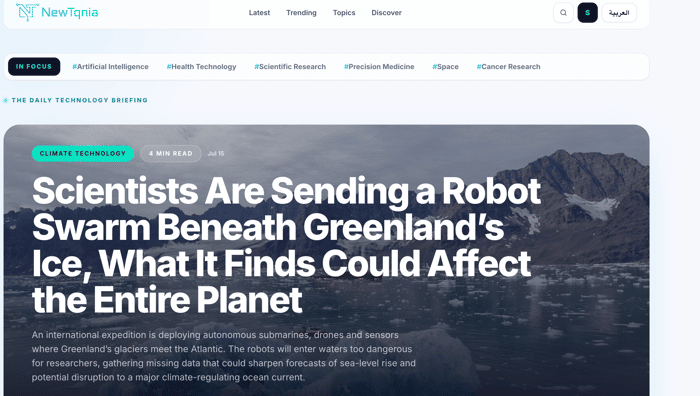
I recently launched NewTqnia, a bilingual technology news website publishing in English and Arabic.
The original idea sounded simple:
- Find important technology stories.
- Research them.
- Write each article in English and Arabic.
- Add an image and sources.
- Publish consistently.
AI could handle most of that, right?
Technically, yes.
But I quickly discovered that generating text was the least interesting part of building an AI-assisted newsroom.
The real challenge was building a system I could trust.
The problem I wanted to solve
There is no shortage of technology news online, but Arabic readers often face one of two extremes:
- Literal translations of English articles that feel unnatural
- Short summaries that remove the context, limitations, and uncertainty
I wanted NewTqnia to cover stories that make people stop and say, “Wait, technology can do that?”
Examples include:
AI reading a Roman scroll sealed for nearly 2,000 years
A brain implant helping a man with ALS communicate and work independently
Robots diving beneath Greenland’s ice
The goal was not to become another feed of routine product announcements.
I wanted a focused publication about breakthroughs, surprising applications, and technological developments with real human or scientific significance.
My first mistake: treating AI like a writer
My earliest workflow focused heavily on the writing prompt.
I specified the tone, article length, HTML structure, Arabic translation style, and SEO requirements. The output looked polished, but several problems appeared quickly.
An article could be beautifully written and still be:
- Based on an old event republished as new
- Semantically identical to an existing story
- Built around an exaggerated press release
- Missing an important limitation
- Paired with a completely irrelevant image
- Written in Arabic that was grammatically correct but editorially unnatural
That changed how I approached the system.
AI was not going to be the writer.
It needed to behave more like an editorial workflow.
The workflow I ended up building
NewTqnia now uses a twice-daily research and drafting process.
Before selecting anything, the system retrieves recent articles from the website and checks candidates for semantic duplication.
A potential story must then pass several filters:
- Was the event genuinely published or materially updated recently?
- Is there a primary source?
- Can the central claim be confirmed by multiple reliable sources?
- Is the story important or naturally interesting?
- Does its appeal depend on facts, or only on sensational wording?
- Can its limitations be explained honestly?
- Is there a relevant, story-specific image?
- Does it fit an existing category, or justify creating a reusable new one?
Only then does the system create a draft.
Every article includes:
- A complete English version
- A separately edited Arabic version
- Clean HTML structure
- A clear explanation of why the story matters
- Meaningful limitations and uncertainty
- Four to six bilingual tags
- At least three direct citations
- A verified image
- A bilingual category object
The system submits the result through a private MCP integration and keeps it as a draft. Publishing still requires review.
Arabic cannot be treated as a translation field
One of the most important lessons was that Arabic content cannot simply be generated by translating English paragraphs sentence by sentence.
A literal translation often preserves English sentence structure, overuses nouns and passive constructions, and introduces technical terms without enough context.
I changed the workflow to treat the Arabic version as a second editorial product.
The facts remain the same, but the Arabic article can:
- Reorganize sentences naturally
- Use established Arabic technical terminology
- Explain unfamiliar English acronyms
- Adjust examples and transitions
- Avoid awkward transliteration where a clear Arabic term exists
This takes more work, but it is the difference between translated content and an actual Arabic publication.
Images became an unexpected problem
The first batch taught me another lesson: an image can technically match a topic while still damaging the article.
A generic laboratory photo is not necessarily appropriate for a specific cancer study. A random rocket launch does not represent a particular propulsion technology. A stock image of a brain does not explain a real brain-computer interface.
I had to tighten the image rules:
- The image must represent the actual study, organization, experiment or subject.
- The URL must be publicly accessible through HTTPS.
- The server must successfully download and store it.
- Generic stock images are a last resort.
- Images are manually checked before publication.
This was one of the clearest cases where a technically valid result was not necessarily an editorially acceptable one.
Categories also needed to become dynamic
I started with broad categories such as AI, Health, Science, Space and Energy.
That worked until stories appeared that did not fit cleanly.
Forcing a Greenland robot expedition into “Science” would work, but it would lose an opportunity to build a more meaningful content cluster.
The system can now create narrow bilingual categories when needed. Recent additions include:
Climate Technology / تقنيات المناخ
Biomanufacturing / التصنيع الحيوي
Technology Policy / سياسات التقنية
The rule is that a new category must be reusable. I do not want hundreds of categories created for individual stories.
What remains human?
Quite a lot.
AI helps with discovery, comparison, research, drafting, translation and structured submission. But human judgment still matters for:
- Whether a story is worth publishing
- Whether the headline is accurate
- Whether the Arabic sounds natural
- Whether an image feels misleading
- Whether uncertainty is presented fairly
- Whether the article adds something useful
The objective is not to remove the editor.
It is to let one editor operate with the research capacity of a much larger team.
The next challenge is distribution
The publishing system is now working, but consistent content does not automatically create an audience.
My next focus is building distribution around:
- Google Search and Google Discover
- Facebook and WhatsApp sharing
- Telegram and browser notifications
- Stronger semantic internal linking
- Topic-based newsletters
- Reader reactions and lightweight engagement
- Short social versions of the most visual stories
This is probably the most important lesson so far:
Building the content engine and building the audience engine are two completely different products.
I have built the first version of the content engine.
Now I need to earn the audience.
What I would love feedback on
You can see the project at NewTqnia.com.
I would especially appreciate feedback from other founders on three questions:
- Would you trust a publication that transparently uses AI inside a human-reviewed editorial workflow?
- Which distribution channel would you prioritize first for bilingual technology content?
- Should the workflow remain focused on five strong stories per day, or publish more frequently to accelerate SEO coverage?
I am also happy to share more technical details about the MCP integration, bilingual content model, duplicate detection and automated draft workflow if anyone is interested.

Five strong stories per day is already enough to learn; more volume would mostly test your pipeline. I'd take one highly visual Arabic story each day, package it for WhatsApp and Telegram, and measure direct forwards plus return visits to a related article. That tests whether the second editorial product creates a distribution advantage before you spend months widening SEO coverage.
Answering your first question as a reader: yes, and the trust would come from a specific place. You require every article to carry its limitations and uncertainty. Most human newsrooms skip that part. When I can see what a story doesn't prove, who drafted it matters a lot less. Worth surfacing that rule on the site itself, readers will never see this post.
The editorial workflow is the real product, not the AI writing. I'd keep validating whether readers are buying AI-assisted news or confidence that every published story has already survived a disciplined editorial process. That's a much stronger trust signal than simply saying "human reviewed."
The point about Arabic not being a translation field but a second editorial product really stood out that's the kind of detail most people building multilingual AI content miss entirely. They treat translation as a mechanical step instead of a separate editorial pass with its own rules. Curious about your duplicate-detection layer: when you check semantic similarity against existing articles, are you comparing embeddings of the full draft or just the core claim/headline? Asking because in image-heavy or fast-moving news cycles, two stories can share a claim but differ enough in framing/timing to both be worth publishing wondering how you draw that line without either missing real duplicates or blocking legitimate follow-ups.
Thank you, @wikihacker5144. The approach for detecting duplicates is a combination of headline, category, and publishing date . All these signals are then fed into the AI detection path to decide and exclude similar topics.