I Spent Years Helping Students Enter Universities. It Unexpectedly Taught Me How to Build Startups
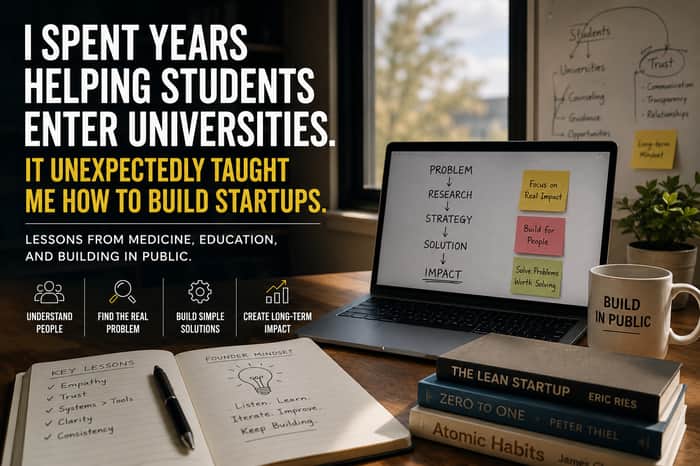
When people ask about my background, they usually expect a straightforward answer.
The problem is that my career has never followed a straight line.
I trained in medicine.
I later worked in international education.
Today, I'm building technology ventures and AI-focused initiatives.
At first glance, those worlds don't seem connected.
But over time, I've realized that helping students navigate international education taught me some of the most important lessons I've applied as a founder.
I Thought Growth Came From Marketing
When I first started working with students and universities, I assumed growth was mostly about visibility.
Better marketing.
More leads.
More traffic.
More exposure.
That assumption lasted until I started paying attention to where opportunities were actually being won and lost.
Students rarely chose a university because of a flashy advertisement.
They chose based on trust.
Parents chose based on trust.
Partners chose based on trust.
Universities chose partners based on trust.
The biggest bottleneck wasn't awareness.
It was confidence.
That lesson completely changed how I think about startups.
Many founders focus heavily on acquisition while underestimating credibility.
But credibility compounds.
Trust compounds.
Reputation compounds.
Most Problems Aren't Technical
One of the biggest surprises in both education and startups is how often people blame technology for problems that are actually organizational.
I've sat in meetings where people wanted new software, new systems, or new platforms.
After enough conversations, a pattern emerged.
The software usually wasn't the problem.
Communication was.
Ownership was.
Decision-making was.
Technology often gets blamed because it's easier to replace software than it is to fix a process.
As I started working on technology projects myself, I found the same pattern.
A product can be technically impressive and still fail if it solves the wrong problem.
The AI Lesson
Recently, I proposed an initiative to help medical students better understand artificial intelligence and its future role in healthcare.
The idea seemed obvious to me.
Future doctors will work alongside AI systems.
Preparing them early felt valuable.
The response was interesting.
Support was strong, but one of the first questions wasn't about educational impact.
It was about revenue.
How much could it make?
That wasn't a bad question.
Businesses need sustainable economics.
But it reminded me how easy it is to focus on short-term metrics while missing larger opportunities.
The long-term value wasn't immediate monetization.
It was preparing future professionals for a rapidly changing world.
Startups face the same challenge every day.
The metric that's easiest to measure isn't always the one that matters most.
What Building Across Industries Taught Me
The biggest lesson I've learned isn't about medicine, education, or technology.
It's about systems.
Whether you're helping a student choose a university, building an AI platform, or launching a startup, the same principle applies:
Understand the system before trying to optimize it.
Most founders are looking for hacks.
Most breakthroughs come from understanding.
The founders I admire most aren't necessarily the smartest people in the room.
They're the people who spend enough time understanding the real problem before rushing toward a solution.
That's a lesson I learned long before I started building technology companies.
I just didn't realize it at the time.
Looking back, every chapter of my career was preparing me for entrepreneurship.
Not because the industries were similar.
Because the underlying problems were.
